
mohd izzuan/iStock via Getty Images
The Mountain
Following our strong Q2 results, the Value Fund declined 0.9% in Q3, bringing our year-to-date return to 1.0%.(1)
While headline equity indices appear to be treading water, the broader market is showing signs of meaningful strain. Bond yields have climbed sharply under the twin pressures of sticky inflation and an onslaught of debt issuance—much of it underwriting fiscal deficits and a booming AI data center buildout.
We address the difficult choices this environment creates for disciplined capital allocators in The Mountain on page 4. First, an update on our portfolio holdings.
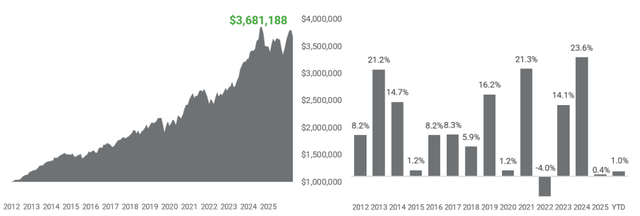
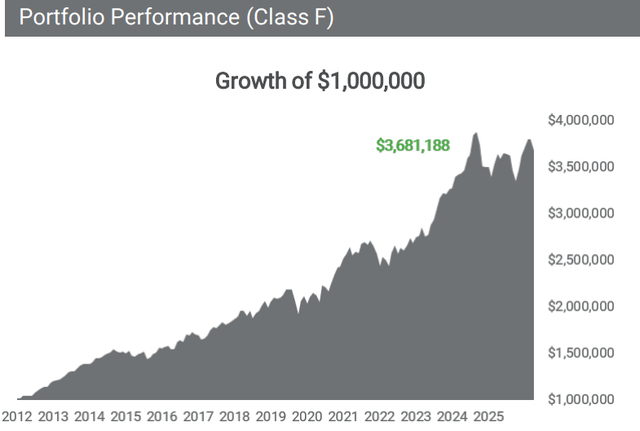
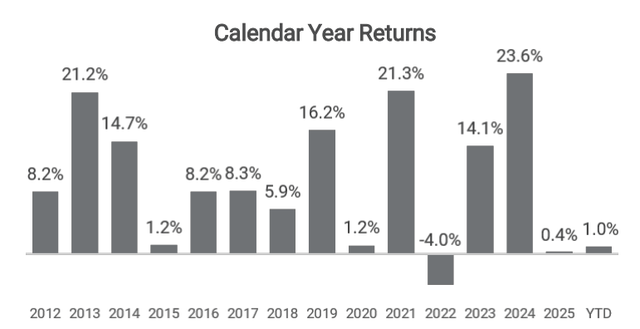
The left panel shows a silhouette chart of revenue from 2012 to 2025, ending at $3,681,188. The right panel is a bar chart showing the annual percentage change from 2012 to 2025 YTD.
Portfolio Update
Our top performer in the third quarter was TVA Group (TVA.B), which gained 46.7%. TVA’s first-half earnings reached levels not seen in over a decade. While results benefited from the Montreal Canadiens’ playoff run—driving a 65% year-over-year increase in revenue at TVA Sports—we see encouraging signs that the core broadcasting division is returning to sustainable profitability. The higher carriage fees negotiated with Bell late last year will provide a lasting benefit, while operating expenses declined 17% as TVA’s restructuring efforts gain traction.
Importantly, management directed this recent cash windfall toward debt reduction, leaving TVA entirely debt-free. Beyond the core operating turnaround, we believe substantial hidden asset value remains to be unlocked. The company has begun redeveloping surplus real estate accumulated over decades, and its pension surplus represents another underappreciated asset. Ultimately, it would be logical for parent company Quebecor (QBR.B) to take TVA private by acquiring the minority public float. While a privatization remains beyond our control, we believe the shares remain undervalued even after their sharp year-to-date advance.
(1) All returns and Fund details are: (a) based on Class F units; (b) net of all fees; and (c) as of September 30, 2026.
Intercontinental Exchange (ICE) advanced 23.5% in Q3, validating our view in Scorecard 54 that the regulatory panic surrounding perpetual futures was overdone. The CFTC has since affirmed that any approvals for perpetuals tied to traditional commodities will proceed on a case-by-case basis under rigorous oversight, removing fears of sudden market disruption. Proactively, ICE licensed its benchmark Brent and WTI crude pricing to OKX, a major cryptocurrency exchange, securing ICE’s participation should perpetual futures demand grow without compromising its core institutional base.
Operational results confirmed ICE’s resilience. Total average daily volume (ADV) surged 31% in Q3, underscoring that legacy trading activity was unaffected. This momentum should support healthy earnings growth for the remainder of the year.
During the quarter, ICE also announced its planned $6 billion acquisition of MarketAxess Holdings Inc. (MKTX), accelerating its expansion into electronic fixed-income trading. MarketAxess possesses the hallmark traits we admire—network effects, structural tailwinds from the ongoing digitization of bond markets, and attractive returns on invested capital. Beyond execution capabilities, the strategic fit is compelling: MarketAxess’ proprietary data will integrate directly into ICE’s pricing, reference data, and index franchise. In an opaque, illiquid asset class like fixed income, high-fidelity transaction data commands premium pricing power and deepens ICE’s recurring-revenue moat.
Portfolio stalwart Visa Inc. (V) was our third-best contributor in Q3, advancing 4.7% as payment volumes and revenues sustained their double-digit growth. During the quarter, the company unveiled the Visa Stablecoin Platform, building on the newly formed Open USD stablecoin ecosystem where Visa serves as a founding consortium partner.
The growing adoption of stablecoins has been one of the most widely discussed potential threats to Visa. By enabling frictionless, low-cost cross-border settlement, disintermediation could theoretically challenge one of Visa’s highest-margin revenue pools if flows bypass its network entirely.
Visa’s established playbook for technological disruptors is its “network of networks” strategy: co-opting emerging payment rails rather than fighting them. By securing board-level governance and co-authoring technical interoperability standards, Visa ensures these alternative protocols plug directly into its existing infrastructure. In return, Visa provides the crucial missing ingredients these nascent technologies lack: institutional trust, global merchant acceptance, dispute resolution, and proprietary fraud-mitigation architecture.
Visa’s global network and brand equity, built over six decades, cannot be easily replicated. By integrating emerging payment innovations early, Visa neutralizes disintermediation risk and reinforces its position as the indispensable tollbooth of global commerce.
Our biggest laggard in the quarter was Automatic Bank Services Limited (SHVA), which declined 13.9%. Underlying transaction volumes remained resilient, and the company’s entrenched position at the center of Israel’s national payment infrastructure remains entirely intact.
In May, SHVA announced price increases following several years of heavy capital expenditures directed toward network resiliency and cybersecurity—mandates stemming from its designation as critical national infrastructure. While these essential investments have compressed operating margins in recent quarters, price adjustments originally slated for July 1 encountered pushback from major domestic card issuers, prompting a phased implementation. Half of the planned tariff increase took effect on October 1, with the remainder scheduled for January 1, 2027. The market reacted negatively to this delayed implementation.
We view this delay as temporary friction. Given SHVA’s near-monopoly status, pricing revisions naturally attract scrutiny and require delicate execution. Because these capital investments were both necessary and government-mandated, we believe meaningful regulatory intervention remains unlikely. Once the two-stage tariff increase is fully absorbed, operating leverage should kick in, driving significant margin recovery and expanding SHVA’s normalized earnings power.
Our second-worst performer in the quarter was Compagnie Financière Richemont (CFRUY), declining 7.8%. The luxury sector continues to navigate a complex macroeconomic landscape marked by geopolitical conflict in Eastern Europe and the Middle East, high inflation, and soft consumer sentiment across key markets such as Greater China.
Yet within luxury, branded jewellery continues to demonstrate superior pricing power and structural demand. Richemont’s flagship maisons, Cartier and Van Cleef & Arpels, anchor the global branded jewellery market. Built on generations of heritage and elite craftsmanship, their appeal to the world’s most affluent consumers provides enduring insulation against cyclical swings. We view the current weakness as cyclical rather than structural, leaving Richemont exceptionally well placed to capture share and compound value as conditions normalize.
Following its second-quarter earnings release, we exited our position in Lululemon Athletica (LULU). While we anticipated top-line softness in North America, an abrupt and significant deceleration in Greater China—the company’s primary remaining growth engine—altered our investment thesis. We remain of the view that Lululemon’s core brand equity remains intact, but repeated merchandising and execution missteps cannot be ignored.
Newly appointed CEO Heidi O’Neill faces structural lead times: retail product cycles typically average 18 months, meaning tangible improvements remain several quarters away. Rather than waiting through an uncertain turnaround, we liquidated our smallest position and redeployed the proceeds, harvesting the realized capital loss to offset fund-level taxable gains.
Following its recent Capital Markets Day, we fully exited our position in Novo Nordisk (NVO). We initially underwrote the investment believing explosive GLP-1 category demand would shield both Novo and Eli Lilly (LLY) from margin pressure. In practice, volume gains have failed to fully offset sharp net price compression driven by negotiations with the Trump administration.
Furthermore, management signalled plans at its investor presentation to diversify its clinical pipeline. Large pharmaceutical companies pivoting into unproven therapeutic adjacencies inevitably introduce substantial capital allocation risk, a variable we are unwilling to underwrite. When weighed against the looming patent cliff for semaglutide in 2031, we concluded that the risk-reward had deteriorated and that our capital is better deployed elsewhere.
Shortly after quarter-end, we sold our small position in Mobility Global Inc. (MBGL), which we received following its spin-off from S&P Global (SPGI). SPGI remains a core Value Fund holding, and we support management’s decision to separate this non-core automotive data unit from the business.
The crown jewels of S&P Global’s franchise remain its Credit Ratings and Indices divisions, which possess unmatched economic moats and pricing power. The spin-off allows management to sharpen its focus and capital deployment on these high-margin, compounding businesses, while simplifying the story for the market.
While Mobility Global is a solid enterprise anchored by assets like CARFAX, we preferred to liquidate this stub holding at current market valuations.
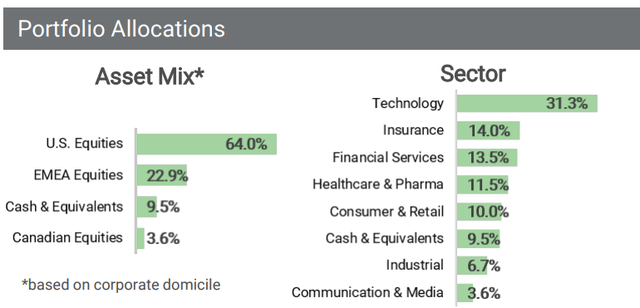
Our top ten holdings as of September 30 are listed below.
GreensKeeper Value Fund
* As of September 30, 2026. The Value Fund’s holdings are subject to change and are not recommendations to buy or sell any security.
Rampant fiscal deficits. Rioting in France. The Canada-US trade war. A “Casino” stock market.
What do these seemingly disconnected events have in common? Stick with me, and all will become clear.
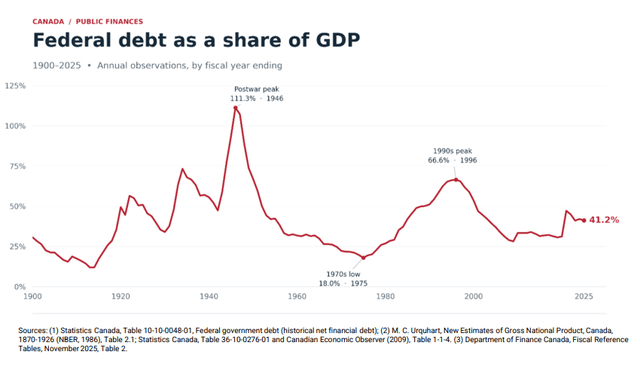
During my graduate studies in the early 1990s, Canada’s mounting debt burden dominated the headlines. Canada’s credit ratings were downgraded, more than one-third of federal revenue was consumed simply servicing interest on the national debt, and The Wall Street Journal famously labelled Canada “an honorary member of the Third World in the unmanageability of its debt problem.”
Ultimately, the bond market forced our politicians to act. Painful spending cuts and tax increases produced a decade of federal budget surpluses, staging an impressive fiscal turnaround. Decades later, that hard-won discipline has steadily eroded, initially catalyzed by pandemic-era emergency spending and now perpetuated by widening structural deficits.
The current fiscal trajectory of our American neighbours to the south bears an unsettling resemblance to Canada in the mid-1990s. U.S. federal debt recently crossed 100% of GDP—a threshold unseen since the immediate aftermath of World War II. Yet unlike wartime mobilization or a deep recession, this expansion comes during an economic expansion with low unemployment, while the federal deficit runs at an irresponsible 6% of GDP.
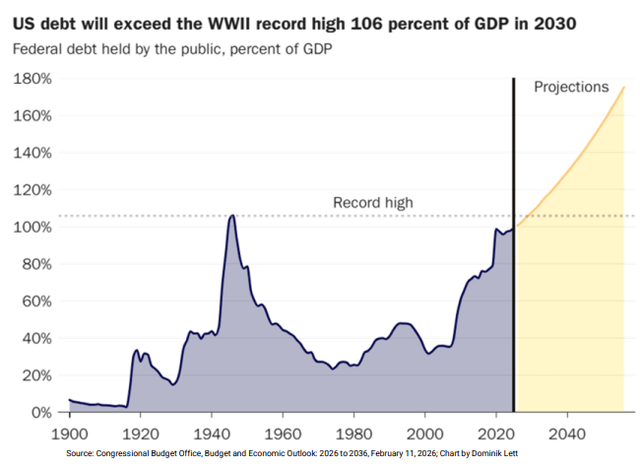
Meanwhile, the primary trust funds supporting U.S. Social Security are projected to be depleted by the early 2030s. As Herbert Stein famously observed: “If something cannot go on forever, it will stop.”
Much like Canada’s experience thirty years ago, meaningful course correction will likely arrive only when the market forces it. Long-term sovereign yields have begun to rise rapidly, sounding an early warning. Paraphrasing Hemingway, how does a society go broke? Gradually, then suddenly.
Across the Atlantic, France faces a similar reckoning. Rising bond yields reflect deep political gridlock, expanding budget deficits, and a public unwilling to accept inevitable pension and fiscal reforms. Street protests and civil unrest underscore widespread anger over living costs, yet neither the electorate nor the political class exhibits an appetite for an honest conversation about the austerity required to restore balance.
These disparate headlines reveal a universal human tendency: few people are willing to make hard choices. Society increasingly demands rewards while refusing to endure the short-term pain required to secure them.
Consider trade relations between Canada and the United States. While most premiers broadly endorse the Prime Minister’s countermeasures against punitive US tariffs, individual provinces frequently resist sharing the burden when proposed actions affect their dominant local exports (energy, agriculture). Everyone has resolve in the abstract; no one wants to bear the direct cost.
Politicians simply follow incentives. Deficit spending and tax cuts buy near-term popularity; fiscal discipline invites electoral defeat. As Charlie Munger reminded us, show me the incentive, and I will show you the outcome. Our collective refusal to accept short-term discomfort ensures we keep living beyond our means.(2)
This dilemma brings to mind a powerful reflection written by Shane Parrish:
Short-term easy is long-term hard. Short-term hard is long-term easy…
We’d rather do the easy thing than the hard thing. That’s natural and normal. I call this the mountain. You can climb it, or you can avoid it, but it’s not going away. There is always a mountain. There is always something in front of us that we know we should do, but it just seems so … hard.
On any given day, we can avoid the climb. We can stand at the bottom, look up, and say, “I’ll wait. Hopefully, the mountain isn’t here tomorrow.” But we all know the mountain is still there tomorrow. And instead of looking smaller, it’s even larger.
The choice is yours, but the mountain isn’t going away. The longer you put off the hard thing you know you need to do, the harder it becomes to get started.
The climb is the fun part.
– Shane Parrish – Brain Food (Farnam Street)
(2) Charlie Munger’s long-time business partner, Warren Buffett, once offered a succinct, tongue-in-cheek fix for chronic government deficits: “I could end the deficit in five minutes. You just pass a law that says that anytime there’s a deficit of more than three percent of GDP, all sitting members of Congress are ineligible for re-election.” Unsurprisingly, the rule-makers have little appetite to impose such discipline on themselves..
This instinct to bypass the climb goes a long way towards explaining the speculative behaviour infecting financial markets. A gambling culture has taken root across broad segments of the market: round-the-clock crypto trading, event-driven prediction platforms, single-stock leveraged ETFs, and zero-day-to-expiry (0DTE) equity options.
We want to get rich, but quickly. As a result, many are tempted by the lure of these speculative assets, often adding additional risk via financial leverage. Whenever the investing public seeks immediate gratification, Wall Street eagerly manufactures the instruments to deliver it.
We are currently living in the era of a “Casino” stock market. Perhaps this is to be expected. A significant cohort of market participants has never navigated a sustained bear market or capital-starved environment like 2000–2002 (dot-com bubble) or 2008 (Great Financial Crisis). Some lessons cannot be taught; they must be experienced firsthand.
Runaway sovereign debt, civil discord in Europe, and market speculation all share a single root cause: our human wiring. Our DNA and psychology are programmed to seek pleasure and avoid pain. We crave wealth without the waiting, immediate investment returns without the discipline of managing risk.
*****
We are value investors navigating an aging, top-heavy momentum market that is ripe for a pullback.
While headline equity indices have inched higher, market breadth continues to deteriorate. A small cadre of mega-cap technology and artificial intelligence (AI) firms are propping up the index. A closer look reveals that not all is well.
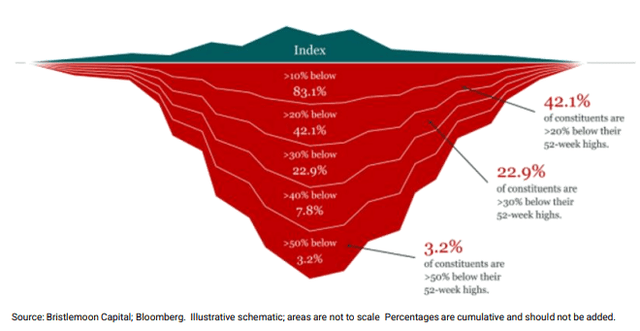
Beneath the surface, stress is building, with most equities trading well below their all-time highs. In the bond market, yield spikes in speculative corporate debt—such as high-profile AI infrastructure operators like CoreWeave (CRWV)—offer reminders that debt capital is neither infinite nor free.
Over the past few months, our portfolios have exhibited a noticeable negative correlation with the broader market on many trading days. When momentum rallies and speculative enthusiasm take over, our holdings often lag. Conversely, when market exuberance cools, our portfolio shines. This trend has continued into October.
This day-to-day divergence is reassuring given our view of the broader market environment. It is the natural byproduct of holding cash-generative, reasonably priced assets in a market increasingly dominated by speculation. We don’t construct our portfolio to mirror the benchmark’s daily mood swings; we build it to protect our capital and compound intrinsic value over time.
The dilemma facing equity investors today is clear: do you chase speculative AI names simply to match headline benchmarks, or do you avoid investing in dangerous neighbourhoods?
Artificial intelligence will unquestionably reshape the economy and society at large. Yet history offers a sobering guide: from the railroads of the 19th century, the automakers and aviation of the early 20th century, and the fiber-optic boom of the early 1990s, transformative technologies routinely generate vast consumer surplus while delivering net-negative returns to early equity investors.
Many of today’s high-flying AI pioneers continue to incinerate billions in cash, have yet to demonstrate a viable business model, and trade at ridiculous valuations. Most critically, their operational survival depends on debt and equity markets’ continued willingness to fund their ballooning spending. Investors should remember that markets are notoriously fickle.
The parallels to the late-1990s dot-com era are obvious. Investors in the AI trade operate under the dual illusion that they have uniquely identified tomorrow’s ultimate survivors, or that they possess the agility to exit before liquidity dries up. In our view, they are playing with fire.
We choose to embrace the discipline of avoiding what looks like an AI bubble, even if it means watching others profit in the interim. As Jim Rohn neatly summarized:
“We must all suffer from one of two pains: the pain of discipline or the pain of regret…”— Jim Rohn
Our investment mandate is capital preservation and the pursuit of attractive absolute returns. While we maintain a core holding in Alphabet (GOOG)—which combines impressive AI assets with a durable moat and an undemanding valuation—we see little elsewhere in the pure-play AI complex that meets our criteria.
*****
Deficits gradually add to a growing debt pile until bond markets force a crisis (the Minsky moment). Speculative market momentum builds until liquidity tightens and the cycle turns. These inflections develop gradually, then, all at once:
Trying to predict and successfully time when the next storm will arrive is not a substitute for sturdy construction. Financial storms tend to arrive with little warning. The key to resilience is to know that they will inevitably come and to prepare in advance.
GreensKeeper – Scorecard # 34 (Q2 2021)
Our team’s personal capital, alongside that of our families, remains invested right beside yours. We are willing to absorb the short-term pain of trailing a speculative rally to protect against an eventual unwinding. This is a time to be disciplined, patient, and cautious.
As mentioned earlier, over the past few months we exited several positions, trimmed others, and allowed our cash reserves to build. We remain eager to deploy capital when compelling opportunities present themselves, but we refuse to lower our standards. On the contrary, given the market environment, we have raised the bar.
If market momentum continues higher, we may look conservative or out of step for a period. We can live with that. We will bide our time and stay disciplined. And as lovers of learning and knowledge, we will enjoy the climb.
Thank you for your continued trust and for the privilege of growing your wealth alongside our own.
Michael P. McCloskey
President, Founder & Chief Investment Officer
Michael Van Loon
Associate Portfolio Manager
Fund Overview
The fund invests in a concentrated portfolio (15-20 stocks), primarily in equities from any sector and market capitalization.
Fund Details
Fund Distributions ($/Unit Class A)
Service Providers
Annualized Compound Returns
Testimonials
Don’t just take our word for it. See what our clients are saying:
“My wife and I began investing in GreensKeeper in 2023 after decades in mediocre mutual funds. After hearing Michael on a podcast, we were intrigued by his Value Investing strategy, and we like that our investments are in the same ones he puts his own family investments in. Michael and his team are very customer-focused and communicative. We are very glad to be a part of the GreensKeeper family and its growth and success.”
Doug S.
Vice President
“My family has known Michael for over 20 years, and we have invested in the Value Fund. He has a track record of success, and we sleep soundly at night knowing that he is growing our investments safely.”
Dr. Erin R.*
Anesthesiologist
“We began investing with GreensKeeper in 2013. A large portion of our three grandchildren’s education money is guided by Michael McCloskey and his patient advice. We have a long-term view towards investing and trust in the fund’s risk aversion strategy for preservation of capital. I recommend GreensKeeper to my friends and family.”
Timothy B.
President & CEO
The preceding testimonials are from current GreensKeeper client households with no compensation provided and may not be representative of the views of all people or investors. Certain testimonials were provided unsolicited, and others were provided by request. * Client household includes a GreensKeeper shareholder.
The GreensKeeper Team
Michael McCloskey
Founder & CIO
Michael Van Loon
Analyst & Assoc. Advising Rep.
James McCloskey
Private Client Sales
Michelle Tait
Executive Assistant
What Makes Us Different
Disciplined
Value Investing is simple, but not easy. At GreensKeeper, we put in the work and have the proper temperament to succeed in the stock market.
Alignment of Interests
Our founder is among our largest investors and has most of his family’s net worth invested alongside our clients. Does your IA have their own money invested alongside yours?
Owner Managed
Our clients deal directly with the people making the investment decisions. Do you know who is managing your money?
Original Post
Editor’s Note: The summary bullets for this article were chosen by Seeking Alpha editors.
Credit: Source link