



















Biohub, the U.S. Department of Energy, the National Institutes of Health, and new funding partners on October 7, 2026 announced a major expansion of an international effort to generate and make accessible the data enabling predictive AI models of biology. Together, the organizations are investing $1.8 billion in funding, data, computation, and new measurement technology, according to a press release issued by Biohub. Biohub described the combined investment as the largest coordinated commitment to generating AI-ready biological data to date. The result, the organizations said, will be an open resource for the research community that provides the foundation for greater understanding and ultimately treatment of human diseases.
Biohub Head of Science Alex Rives said an accurate predictive model of biology could accelerate scientific discovery by enabling scientists to perform experiments digitally, with insights that could unlock a far greater understanding of disease and open new paths for cures. He called the creation of a virtual cell “one of the most important challenges for the next era of science,” said it will require coordinated data generation at national and international scale, and invited the worldwide scientific community to join the project.
DOE and NIH Commitments Through the Genesis Mission
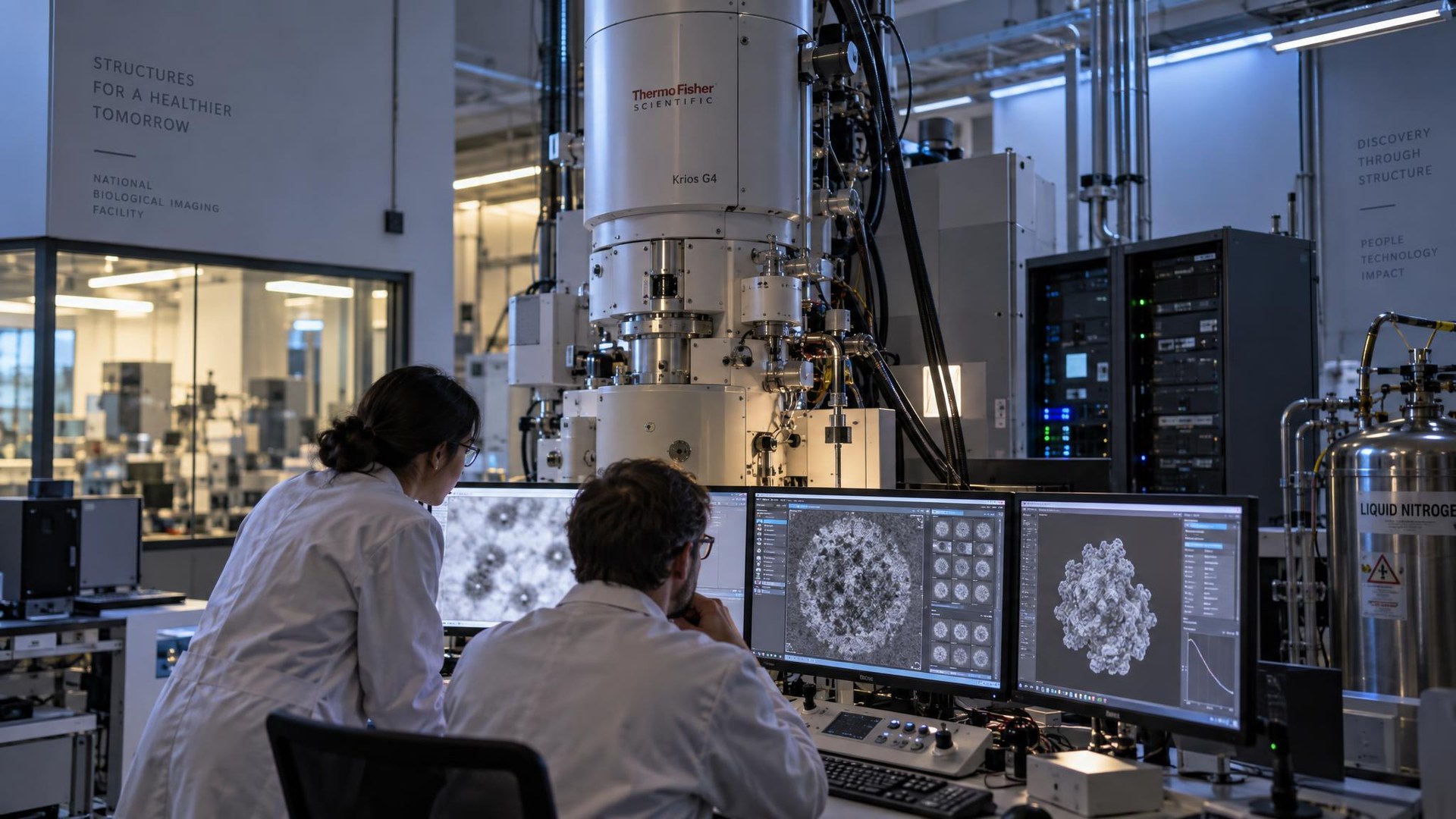
The Department of Energy will invest more than $500 million over five years in lab measurement, modeling, and computation toward the international effort to build an AI-ready open data resource. DOE’s contribution runs through the Genesis Mission, a national initiative led by the department that unites its National Laboratories, industry, and academia to harness AI for scientific discovery. The work spans data collection, AI analytics, measurement and imaging, modeling, and computation, drawing on exascale supercomputing, X-ray and neutron scattering, cryo-electron microscopy and tomography, and autonomous laboratories across the National Laboratory system.
Darío Gil, DOE’s Under Secretary for Science and the department’s director for the Genesis Mission, said the partnership combines DOE’s exascale computing, experimental measurement, and modeling assets — including user facilities at the Joint Genome Institute, the Environmental Molecular Sciences Laboratory, and advanced structural beamlines — with Biohub’s AI models, tool development, and biological data capabilities. He said the collaboration sets a new standard for open science that will accelerate discoveries in medicine and biotechnology.
NIH will coordinate the contribution of relevant datasets, repositories, and knowledge bases developed through more than $500 million in prior federal investment aligned to the initiative, and Biohub will work with NIH to standardize these datasets for AI model training. NIH’s role runs through its Bio Genesis Mission, the agency’s contribution to the national Genesis Mission, a federal effort under Executive Order 14363 to harness artificial intelligence and advanced computing to accelerate American science. The Bio Genesis Mission states a goal of doubling the pace of biomedical innovation, from discovery to health impact, within the next five to 10 years, and is advancing six National Science and Technology Challenges that include predicting living systems, accelerating drug discovery and clinical translation, and understanding the root causes of chronic disease. NIH said it is also working with the White House Office of Science and Technology Policy and other Genesis Mission agencies to advance the American Science and Security Platform, which integrates advanced computing, scientific facilities, data resources, and AI capabilities across the federal research enterprise. Resources involved in the NIH contribution include national biomedical repositories catalogued by its National Library of Medicine and the National Center for Biotechnology Information, as well as NIH Common Fund programs already developing coordinated biological atlases, shared data standards, and AI-ready biomedical datasets.
Nicole Kleinstreuer, NIH Deputy Director for Program Coordination, Planning, and Strategic Initiatives, said: “By combining resources and expertise, we can accelerate the development of universal cell models with sufficient biological complexity to predict how any cell responds to an intervention.” She added that the return from these models could be broad and profound, with substantially faster timelines for medical breakthroughs than laboratory experiments alone could achieve.
Industry Funders Join the Virtual Biology Initiative
Google DeepMind, Isomorphic Labs, and Meta are collectively investing $300 million in the Virtual Biology Initiative to create the technologies and multi-modal datasets needed to build predictive models of life. Max Jaderberg, President of Isomorphic Labs, said the company is joining the initiative as a founding member and that generating the data to solve predictive systems biology requires scaling past the limits of what any single organization can produce today. Pushmeet Kohli, VP of AI for Science at Google DeepMind and Google Cloud’s Chief Scientist, said the investment in biological data generation will help create an open, standardized data commons for researchers.
The Virtual Biology Initiative was announced on April 29, 2026 as a five-year effort to coordinate data generation across institutions and disciplines and to build AI-ready open datasets enabling predictive models of life. Biohub’s founding $500 million commitment anchors that work: $400 million supports new measurement technologies, including cryo-electron tomography that resolves near-atomic detail inside the cell, microscopy that can image millions to billions of cells in living tissue, and engineering tools to build and perturb biology at molecular, cellular, tissue, and whole-organism levels. A further $100 million funds research outside Biohub. At the April launch, Biohub said achieving a high-accuracy predictive model of the cell would require orders of magnitude more data than is currently available. Partners named at launch included the Allen Institute, Arc Institute, Broad Institute, and Wellcome Sanger Institute, along with the Human Cell Atlas and Human Protein Atlas consortia, NVIDIA, and Renaissance Philanthropy.
Participating Institutions and Shared Data Infrastructure
Scientific institutions and consortia joining to help organize the scientific community around virtual biology include the Allen Institute, Broad Institute, Gladstone Institutes, the Human Cell Atlas, the Human Protein Atlas, and the Wellcome Sanger Institute. The release describes these groups as having experience organizing international collaborations dating to the Human Genome Project, and states they are committed to working together as part of the initiative as well as through independent efforts. NVIDIA will support the initiative with accelerated computing infrastructure, domain-specific software, and technical expertise, and Renaissance Philanthropy is helping expand funding for data generation.
As the initiative takes shape, Biohub said it is building the layer that lets partner datasets work in a unified fashion: shared standards, common identifiers, and a single point of access. It is also convening researchers across institutions and disciplines to connect complementary expertise and create opportunities to define and pursue joint scientific questions.
Over the past decade, Biohub has led open data projects including Tabula Sapiens, OpenCell, and Zebrahub, and has built and maintained community data infrastructure including CELLxGENE and the CryoET Data Portal. The organization said the Virtual Biology Initiative builds on these experiences to enable coordinated efforts at a scale that no single institution could achieve alone.
Credit: Source link