















Sentante has begun commercial deployment of its CE-marked endovascular robotic platform, the medical robotics company announced on August 20, 2026, with vascular surgery and interventional radiology as its first clinical markets. The move takes the Kaunas-based company from regulatory clearance into revenue-generating clinical use three months after its CE mark, granted in May 2026.
The announcement frames the commercial rollout as the start of the company’s physical AI strategy: every procedure performed on the platform is recorded as multi-modal training data, and the company intends to progressively introduce AI-driven assistance into endovascular procedures as that dataset matures.
What the Robot Does in the Cath Lab
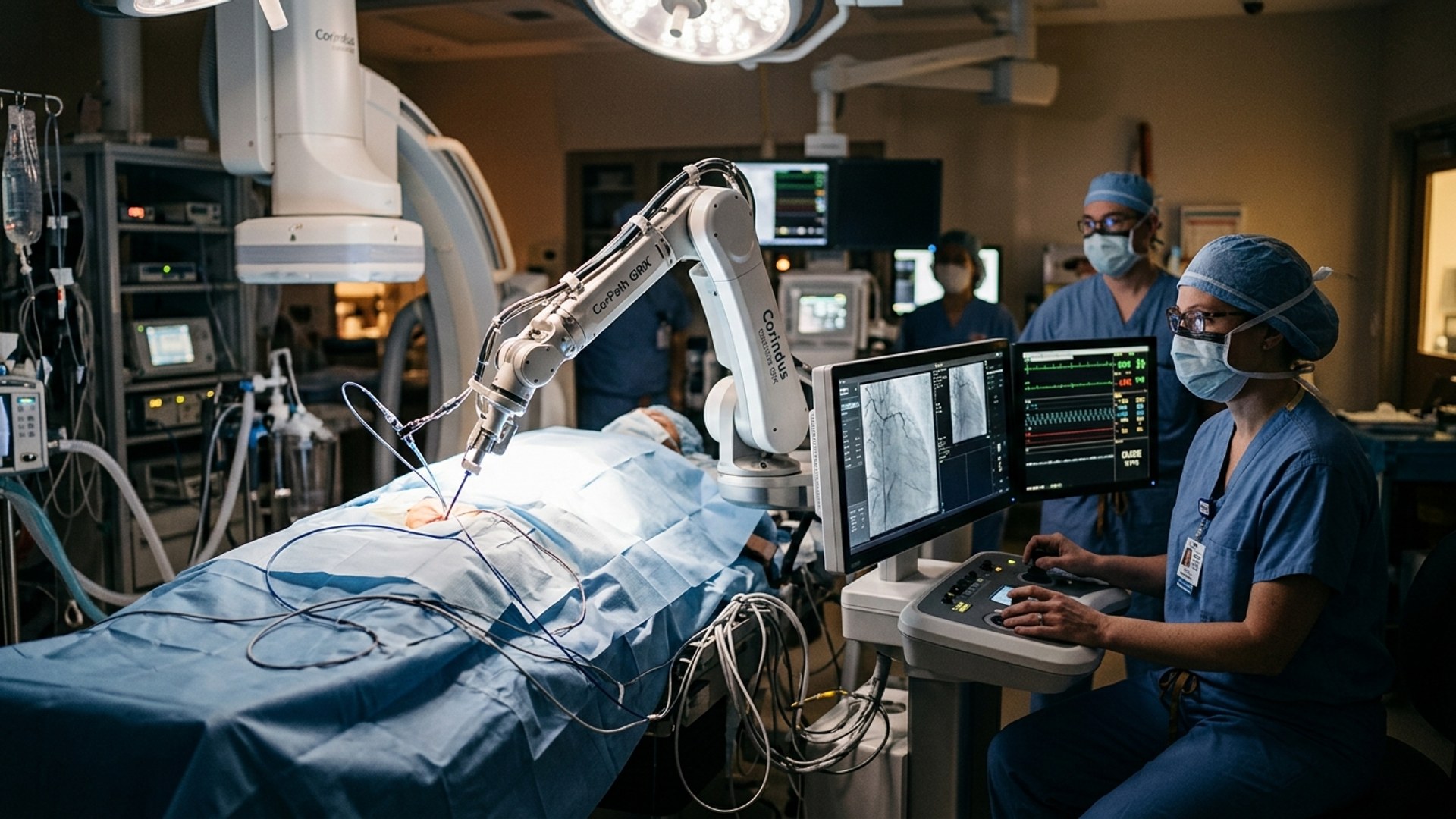
Sentante’s system is built for catheter-and-guidewire intervention through vascular anatomy, which covers the daily caseload of vascular surgeons and interventional radiologists: peripheral arterial intervention, embolisation, and interventional oncology procedures. The bedside unit manipulates standard, off-the-shelf catheters and guidewires rather than proprietary disposables, and the operator works from a control workstation outside the X-ray field.
Three design choices define the platform. Force and torque sensing at the catheter drive gives the operator tactile feedback during navigation. A 1:1 motion-mimicking interface reproduces the hand movements an interventionalist already trains on, which the company says lets existing clinicians operate without retraining. And device-agnostic actuation means the robot works across the catheter and guidewire portfolios hospitals already stock, integrating with existing cath-lab infrastructure rather than requiring a rebuilt suite.
“Vascular surgery and interventional radiology are the specialties Sentante was built to serve first,” said Edvardas Satkauskas, CEO and co-founder of Sentante, in the announcement. “The platform earns its place on daily clinical volume, supports the interventionalists who treat these patients every day, and the data substrate that endovascular physical AI requires accumulates in real clinical use only.”
Every Procedure Doubles as a Training Record
The physical AI angle is the part worth watching. The platform records drive-side force and torque, device kinematics, and time-aligned fluoroscopy together on every procedure. Because the robot mediates every movement the operator makes, each case produces a complete mechanical record of expert technique rather than a filtered approximation of it, and that record accumulates from the first commercial case onward.
The company’s argument is that the mechanical signatures of safe versus unsafe catheter-vessel contact are continuous across vascular indications, so data captured in peripheral procedures trains capabilities that later apply elsewhere on its AI roadmap. The loop compounds: more procedures produce a richer dataset, the dataset improves the AI, and better AI makes the platform more capable. The data acquisition is embedded in routine clinical workflow, with no synthetic data or separate capture campaign.
“These are the specialties where my colleagues treat the highest volume of patients with catheter-based intervention,” said Dr. Tomas Baltrūnas, co-founder and Chief Medical Officer of Sentante. “The platform supports their work with consistent, force-aware execution, and the team learns from what they teach us.”
The Clinical Record Behind the Clearance
The rollout follows a year of clinical validation. The company’s ESSENTIAL first-in-human trial, conducted in the Baltic region, reported 100% technical success with zero device-related complications and zero radiation exposure to staff. Its clinical validation included a world-first transatlantic remote thrombectomy on perfused human cadaver models. A GLP animal study covered 24 remote procedures conducted across three continents.
On the regulatory side, the platform received CE mark approval in May 2026, clearing it for sale across European markets. The company’s remote stroke programme runs on a separate track in the United States under an FDA Breakthrough Device Designation granted in September 2025.
On the compute side, Sentante has integrated NVIDIA’s Jetson AGX platform into its latest-generation robot and was among the first companies developing on NVIDIA Isaac for Healthcare, the robotics platform NVIDIA has been extending into surgical applications — including a surgical world model that now runs live on a single GPU. Sentante is a member of the NVIDIA Inception programme.
What Comes Next for Sentante
The company says the peripheral vascular indication is also the route into neurovascular intervention: the over-the-wire device setup, cath-lab infrastructure, and safety logic, including the force-sensing decisions and bail-out manoeuvres learned in peripheral practice, carry over to the neurovascular territory. Founded in 2017, Sentante plans to continue its European commercial rollout and introduce AI-driven assistance features progressively as the procedural dataset matures. Other surgical robotics players are moving through regulators in parallel — Momentis gained FDA clearance for its Anovo multiport system in July 2026 — but endovascular intervention, where the robot manipulates wires inside vessels rather than instruments inside a body cavity, remains a distinct engineering problem, and Sentante is now the company testing it at commercial scale in Europe.
Credit: Source link