














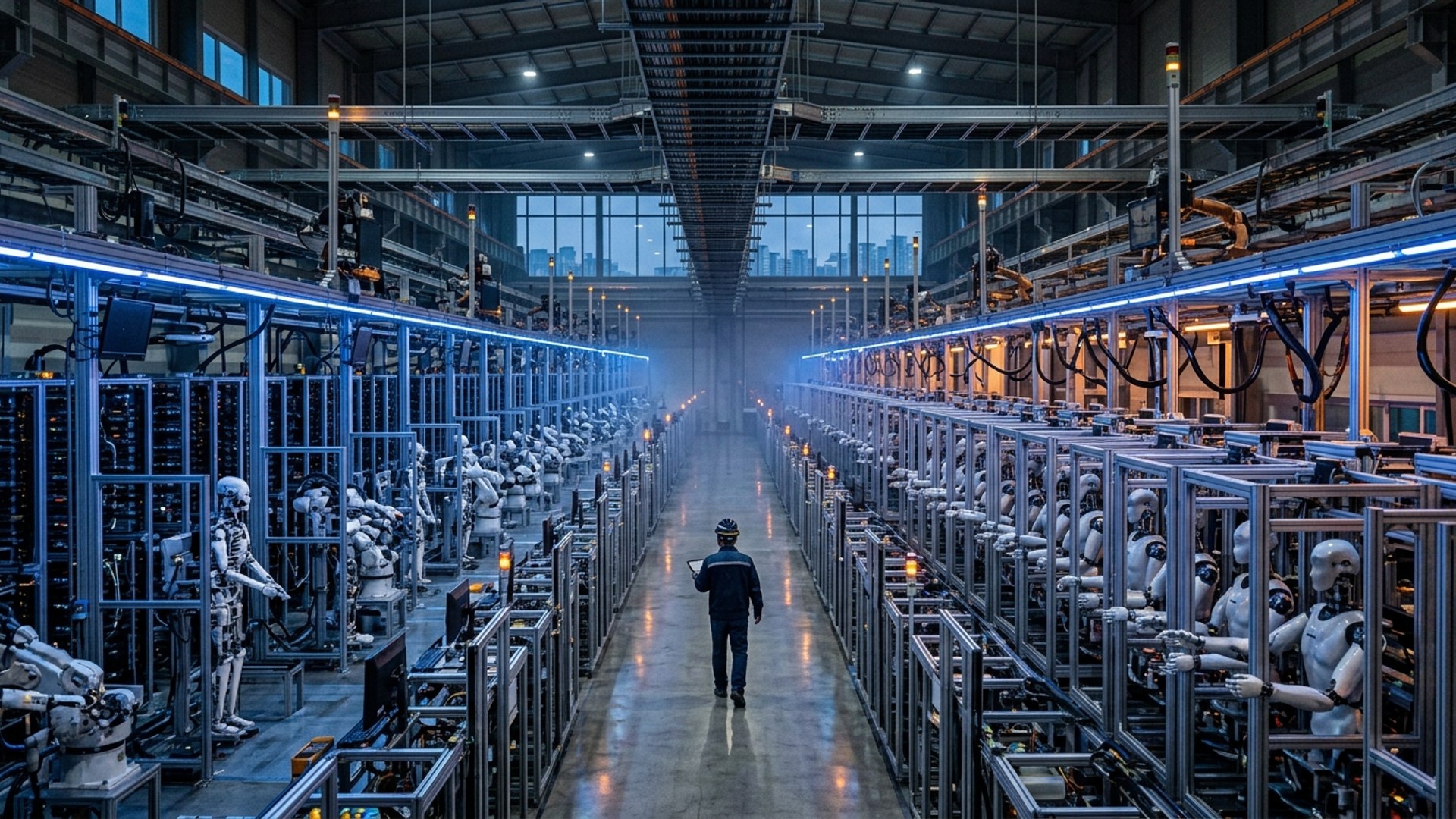

LG Electronics hosted senior NVIDIA officials at its new robot Data Factory in Seoul on August 18, 2026, announcing an accelerated robotics collaboration built around a target of 100,000 hours of robot training data by year’s end.
The meeting came four days after LG Group and NVIDIA signed a memorandum of understanding on strategic cooperation at NVIDIA’s Santa Clara headquarters on August 13, 2026. The speed of the follow-up is the point: the two companies are moving from a signed document to a working facility review in under a week, and LG is framing 2026 as the starting year of a companywide robotics push that runs from industrial machines to a home humanoid.
The Data Factory itself, still under construction at LG’s Yangjae R&D Campus, is where that push becomes physical. The facility spans four floors with 10,000 square meters of total floor area, and LG expects it to house several hundred robots by the end of 2026.
Inside the Yangjae Data Factory
The setup is best understood as a gymnasium for robots, with separate rooms for separate skills. LG has deployed its self-developed CLOiD home robots at scale across training spaces built to repeat tasks until the data is clean enough to learn from.
One room replicates a home environment, where CLOiD units practice cleaning tasks on a loop. Another is a simulated manufacturing space modeled on LG’s washing machine plant in Tennessee, where the robots move, stack, and assemble parts. LG CNS is running logistics automation work in the same building, and LG Innotek has a dedicated area for training robotic hands. Data from all of these environments feeds into NVIDIA’s robotics stack, where it gets augmented and synthesized into higher-quality training material.
That pipeline is the actual product here. LG is combining decades of manufacturing and logistics data from its own operations with NVIDIA’s physical AI tools — Omniverse libraries, Cosmos world models, and the Isaac development platform — to build what it calls a data flywheel: robots generate data, the data trains better models, better models make the robots more useful, and the loop repeats.
The 100,000-Hour Target and What It Trains
By the end of 2026, LG expects data collected directly at the facility, plus synthetic data generated and augmented with NVIDIA Cosmos, to total 100,000 hours, roughly 12 years of experience compressed into a few months of operation.
The destination for that data is LG’s Robot Foundation Model, the general-purpose model the company is building to underpin its humanoid robots. A foundation model for a robot is what a large language model is for text: a single system trained on broad experience that can then be adapted to specific tasks. Feeding one requires exactly the kind of large, varied, physically grounded dataset the Yangjae facility is designed to produce.
The collaboration goes further than data tooling. NVIDIA’s own account of the partnership describes LG exploring the Isaac GR00T foundation model for its home robots and modular platforms, with the two companies planning to jointly develop reference robots. We reported earlier this month that LG is developing a bipedal humanoid built on GR00T, targeting a public unveiling in the first quarter of 2027.
LG has also restructured itself around this bet. In July 2026, the company established a Robotics Business Center reporting directly to the CEO, tasked with overseeing robotics work across the entire group. The company has proven expertise in manufacturing and developing core robotic components, including actuators, giving it a hardware base alongside its data effort.
What LG Is Actually Building Toward
The strategic picture is a company converting an appliance manufacturing empire into a robotics business. LG’s plan, as stated, is to expand from its established industrial and commercial robot lines into home robots, backed by the Data Factory’s training capacity and NVIDIA’s compute and simulation stack.
“Through the synergy built on ‘One LG’ – bringing together core capabilities across the Group – and strategic collaboration with global partners, we will secure our competitiveness in physical AI and become a comprehensive robotics solutions provider,” said Lyu Jae-cheol, CEO of LG Electronics.
The nearer-term test is concrete. The Data Factory is scheduled to be fully operational by the end of 2026, and the 100,000-hour data target lands on the same timeline. For a company whose CLOiD robot is only now headed for production-line validation in Tennessee, the Yangjae facility is the first hard infrastructure behind the ambition — a building full of robots doing laundry-factory repetitions so that something more capable can eventually walk out of it.
Credit: Source link