


For developers, the operating assumption has been one engineer, one agent — the model Claude Code and similar tools. At VB Transform 2026, James Zou, associate professor of biomedical data science at Stanford University, argued that assumption is about to break: the next frontier isn’t a single, more capable agent, it’s tens of thousands of them collaborating.
For developers and product builders, the most critical takeaway from Zou’s presentation is how these massive systems are orchestrated. His team’s research offers a practical blueprint for connecting legacy databases to AI orchestration layers and designing environments that enable thousands of agents to collaborate.
Emulating the organization — the virtual biotech
Zou’s project began as a “Virtual Lab” consisting of five to eight agents structured to mirror his physical Stanford lab. The setup included an AI professor acting as the principal investigator and AI students with distinct specialties holding regular group meetings.
“We also created for the agents a replica of Stanford, an agent school, where the agents can actually go to the school and do supervised fine-tuning to improve their expertise in their specific domains,” Zou noted.
The virtual lab successfully designed new nanobody proteins for recent COVID variants.
“What is really exciting to us is that these AI-designed nanobody proteins actually worked much better than the previous human-designed nanobodies in terms of binding to the recent different viruses,” Zou said.
Following this wet-lab validation, the team expanded their ambition. They transitioned from emulating a single research team to modeling a massive corporate structure.
The resulting system, dubbed the Virtual Biotech, comprises tens of thousands of specialized AI agents overseen by a Chief Scientific Officer (CSO) agent. It operates through distinct corporate divisions, such as target discovery, molecule design, and clinical trials.
“Working with the CSO agent are different divisions that mirror the divisions found in a human biotech or pharma company,” Zou explained — one focused on identifying drug targets, another on designing molecules, a third on safety and clinical trials. Individual agents specialize further within a division, he said. “Under the target discovery division, we’ll have one agent that specializes in looking at all the genetics data, another agent that looks at all the genomics data and single-cell data, and so on.”
The multi-agent advantage
As foundation models grow more capable, developers face a core architectural dilemma: Why distribute workloads across tens of thousands of specialized agents instead of channeling all computing resources into a single, omniscient model?
Zou’s team ran a head-to-head comparison of a multi-agent team against a single agent tasked with the same scientific challenge. The multi-agent ecosystem created friction and interaction that produced better solutions that were more resilient against compounding errors.
“In these scientific virtual labs, the agents actually get into debates and disagreements. They have to convince the other AI scientists [of] their ideas, and all of that elicits much more creative and robust reasoning compared to if you have a single model trying to do the problem by itself from scratch,” Zou said.
The orchestration bottleneck
When scaling to tens of thousands of agents, orchestration becomes the primary bottleneck. The system requires a unified context layer that allows agents to synthesize knowledge from various tools, datasets, and historical records.
Many enterprise teams attempt to solve data integration by wrapping existing databases with an MCP. However, legacy systems are not very friendly to agents. For instance, dropping a PDF of a research paper into an agent’s context window is inefficient, and standard text models struggle to interpret complex figures and tables, leading to hallucinations.
“Even if you wrap an MCP around the existing databases and APIs, that doesn’t solve the underlying problem: the interface and APIs are not suitable for agents,” Zou said. He added that existing databases are designed to be consumed by humans or pre-AI algorithms.
To resolve this, Zou’s team created Paperclip. The platform relies on a core strength of modern LLMs: their ability to write code and navigate file systems. Instead of forcing agents to query brittle, database-specific APIs, Paperclip digitizes unstructured data and maps disparate databases into a unified, AI-native virtual file system.
This structure allows agents to access knowledge from millions of papers using standard file-system operations.
“This basically shows that we can get much better accuracy if you use Paperclip, and we can reduce the time and the cost by over an order of magnitude compared to if you use agents without these AI-native scientific infrastructures,” Zou stated.
Real-world validation
To test the practical output of this architecture, Virtual Biotech spun up 37,000 “clinical trial agents” to synthesize fragmented trial data. These agents identified single-cell features that predict trial success — drug targets supported by these features were about 50% more likely to reach market than comparable drugs without them.
The system then autonomously designed an antibody-drug conjugate (ADC) targeting the CD276 protein for lung cancer. The agents completed this design autonomously, relying exclusively on data published prior to January 2025.
Several months later, Zou said, pharmaceutical company Merck independently developed and validated the same therapeutic design — which went on to receive breakthrough designation from the FDA. He characterized this as “a third-party external validation of the therapeutic design provided by the virtual biotech agents.”
Designing ecosystems, not workflows
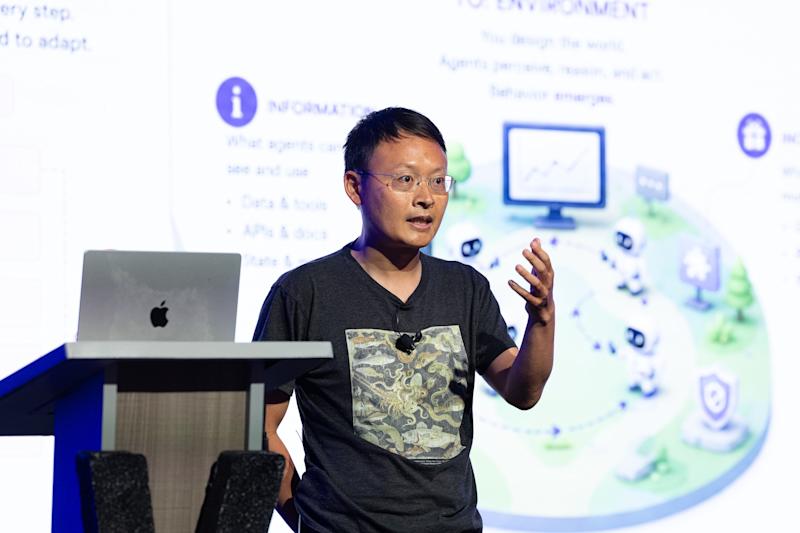
As multi-agent systems scale, leaders must rethink how they manage these digital workforces. Zou advocated for shifting from designing rigid workflows to creating open environments. Workflows dictate the exact steps an agent should take, similar to managing a junior employee. Environments provide the infrastructure, guardrails, and incentives for agents to collaborate on open-ended problems.
“In workflows, we’re trying to tell agents what to do and how to do their job. But in environments, we’re providing the infrastructures, the incentives, and the guardrails, but otherwise we leave it open to incentivize agents to collaborate,” Zou said.
Optimization at scale means engineering the environment rather than fine-tuning individual models. While single agents can improve via reinforcement learning or supervised fine-tuning in the agent school, the success of a massive multi-agent system relies on adjusting the parameters governing their collaboration.
“At the multi-agent [side], we’re not actually fine-tuning and changing the individual models anymore, but we’re optimizing the environment,” Zou explained. “The environment itself is the object that we optimize to improve the agents.”
Credit: Source link