
Enterprise teams building AI agents keep hitting the same wall: a chatbot that can answer a prompt but can’t remember what the last five people asked it, and can’t tell you whether last month’s version actually worked.
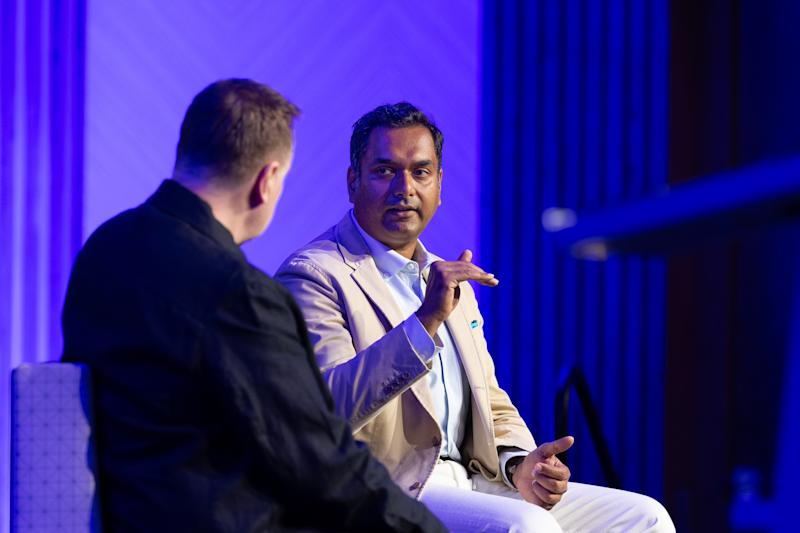
In a fireside chat with VentureBeat’s Sam Witteveen at VB Transform 2026, Asana’s chief product officer, Arnab Bose, unpacked how his team tackled this problem to build a new operating system: Agentic Work Management (AWM). The product treats AI agents as coachable teammates that operate alongside humans rather than as one-to-one assistants.
For product builders and developers trying to move beyond basic integrations, Bose provided a look under the hood. He detailed how Asana engineered AWM, offering a blueprint for solving real-world bottlenecks and building agentic systems at scale.
The Work Graph: 18 years of company data, repurposed
To build an operating system for human-agent teams, Asana needed a ready-made enterprise context graph. They built AWM on top of their 18-year-old architecture: the Work Graph.
This graph-based database organizes information through a structure the company calls the Pyramid of Clarity. The smallest unit of work is a task with an assignee and a due date. Tasks belong to projects, projects roll up into portfolios, and portfolios connect to company-wide goals. The graph can help trace for example how a delayed design task impacts a corporate revenue goal. The Work Graph provides a real-time ledger of who does what, by when, and why.
AWM leverages this architecture to create a multiplayer teammate. A standard AI copilot is stateless and tied to a single user’s prompt. Because AWM plugs into the Work Graph, the AI can view overarching company goals, update project statuses, and share memory with human colleagues.
“Because [the agent] is plugged into the Work Graph, it’s not just looking at a particular prompt that you’re sending it or looking at a particular individual’s markdown file system on their local file,” Bose said. “It’s working off of that shared ledger for the whole company.”
AWM is already in production. Bose said Asana has “several customers live and successful on it,” including FedEx, which published its own case study on the shift.
Building in guardrails for confidential work
Shipping AWM to enterprise customers required Asana to solve several technical hurdles. The first was data governance. If an AI teammate acts across a company, it builds a shared memory by learning from workflows and human feedback.
Bose highlighted a critical boundary problem: If an executive uses AWM to build workflows for a confidential project, the system must ensure the agent’s updated memory does not leak context to an unauthorized employee who interacts with the same agent later.
“[I] shouldn’t be able to leverage that shared memory when I run the AI teammate if you created that memory using that same teammate on a project that is, let’s say, a secret M&A project that I don’t have access to,” Bose said. Asana engineered a system of access controls to govern what triggers the creation of a memory versus the simple execution of a task.
Second, AWM handles dynamic model routing to abstract prompt engineering away from the user. When a user assigns a task to an AI teammate (i.e., drafting a job description for a general manager role), the AI cross-references public job postings, Asana’s internal style guide, and product requirement documents. For a complex task, the system automatically routes the prompt to a heavy frontier model — Bose pointed to Anthropic’s Opus and OpenAI’s models as examples — while lighter tasks get down-leveled to something faster and cheaper.
“We don’t want the knowledge worker to have to think through what the best possible prompt, context engineering, and attachments are that they should put into the task,” Bose said. “It should feel as if you were assigning the task to a human being.”
This dynamic routing introduces a third challenge: billing abstraction. Agentic tasks vary in computational complexity, making credit burn rates unpredictable.
“We don’t want to get into a state where our customers are having to reason about the fact that some of these tasks… are way more complex than others and they’ll be burning credits at different rates,” Bose said, adding that unpredictable pricing risked customers throttling their own employees by capping how often they could run an AI teammate.
To make AWM commercially viable, Asana designed its billing architecture to charge a static cost per task completion. The platform absorbs the complexity of model selection, token counts, and run limits to ensure predictable enterprise pricing.
The problem with stateless chatbots
AWM targets a specific problem with current enterprise AI deployments: statelessness. Developers can easily connect large language models to enterprise tools like Slack, Google Drive, or Databricks using Model Context Protocol (MCP) integrations. However, basic chat-based agents lack persistence.
Bose detailed a scenario where a user asks a chat agent to draft a marketing campaign based on historical performance and competitive research. The agent fetches data from external tools to answer the prompt, but the execution happens in a vacuum. It is a one-off task that benefits a single individual. It fails to create a reusable workflow for the next person building a similar campaign.
“The challenge with that is that those calls are stateless, and they are not leveraging a shared company brain that is this graph-based database or a context graph,” Bose said.
AWM solves this by creating a permanent state. When an AI teammate inside AWM completes a task, the system records the metadata. It registers whether the completion improved the project status and how it moved higher-level company goals.
Inside CoreWeave’s product launches
Cloud provider CoreWeave is an early adopter using AWM to overhaul complex new product launches.
“CoreWeave is using both our deterministic AI studio workflow rules as well as multiple AI teammates to do new product launches,” Bose shared.
In the past, CoreWeave product managers filled out complicated forms detailing infrastructure, parameters, and costs. Human reviewers manually evaluated these forms and broke them out into specific tasks for finance, marketing, and hardware teams.
Under the AWM workflow, a product manager writes a standard Google document pointing to their product requirement documents. A deterministic AI workflow reads the document, automatically creates the project structure, and assigns tasks. Specialized agents then take over the execution. One agent then watches overall project status and flags bottlenecks; another, working inside individual tasks, forecasts infrastructure costs and recommends approvals when the numbers align with historical budgets. The system automatically triages the busywork while human beings focus on evaluating the AI’s outputs.
The frenemy problem
The dynamic gets complicated by the fact that the same frontier-model providers powering AWM under the hood — Anthropic, OpenAI — are also shipping their own competing agent products, like Anthropic’s Claude in Slack (Tag). Pressed on the overlap, Bose didn’t dispute the tension.
“I think that’s the reality that we all have to live in,” he said.
His case for AWM’s staying power rests on Asana’s 18 years of user-experience and workflow data, and prebuilt standard operating procedures for specific industries — expertise he argues raw frontier models don’t have. A product like Tag can work well in Slack, he said, but it requires a highly curated channel and its own separate credentials for every downstream app it touches.
“There’s a big difference between the power of the model plus a lightweight way to demonstrate its value, and something that’s pre-built … for true end-to-end use,” Bose said.
Credit: Source link