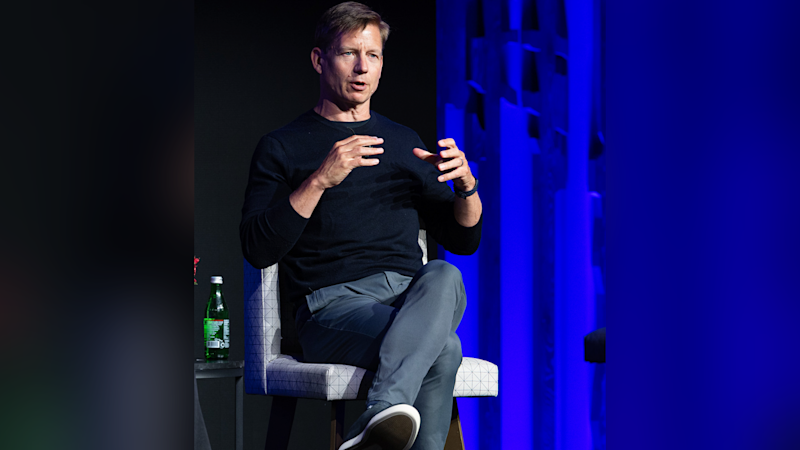

Every time a Mastercard gets tapped, the network has less than a tenth of a second to judge how likely the purchase is to be fraudulent. It made that call across 175 billion transactions last year. Now the buyer on the other side of that judgment is starting to change, and Greg Ulrich, the company’s chief AI and data officer, spelled out the consequence for the VB Transform 2026 audience in Menlo Park on July 14. “We’ve built a bunch of risk rules over time that were intended to stop a bot from transacting,” Ulrich said. “Now we need to enable the bot to transact, so that requires a change to our risk framework and our risk rules.”
Ulrich joined Mastercard eleven years ago when an analytics company he worked at was acquired, and said trust struck him from day one on the job. “It’s what enables a merchant that’s never met you to accept payment and ensure that they’re going to get paid. It’s what enables you as a consumer to transact and ensure that things are going to work out in a trusted, secure way. And if something goes wrong, there’s a safe and secure path for a dispute and to resolve this,” he said.
175 billion transactions, scored in under 100 milliseconds
He took the audience inside each of those calls. “When you tap your Mastercard to pay for a product or service, we’re providing a score to that transaction,” he said. “We have under 100 milliseconds to look at that and give a score from zero to 999 about how likely is that to be fraudulent or real. And we pass that on to the issuing bank.”
Generative AI widened what that score can see. “Because we have new technology, we can bring in more data, we can bring in more context, and now we’re finding that we can identify 300, 400% more fraudulent transactions at those high-risk bands,” Ulrich said, without adding friction or false positives for consumers. The company’s Safety Net system has stopped more than 70 billion fraudulent transactions, he told the audience, and Mastercard is building its own transformer model on its transaction data as a foundation for new safety, security, and personalization solutions. VentureBeat’s Beyond the Pilot podcast took that production fraud stack apart in detail earlier this year.
A third of the services business already runs on AI
The business stakes reach past fraud. About 40% of Mastercard’s company is now based on services, Ulrich said, including marketing services; fraud, safety and security; and business intelligence. “A third of those are predicated on AI, and those are growing at a much faster clip than everything else,” he said.
One line he returned to all session went further. “What’s going to enable AI to continue to scale is not the capabilities of the agents, it’s how much we trust those agents to do on our behalf as a consumer, as a business, as a financial institution, or otherwise,” he said.
Five layers stand between agents and the network
Agentic commerce changes the object being secured. “Instead of a single atomic transaction where I say go buy something, I’m effectively delegating authority, or a consumer’s delegating authority, a business is delegating authority,” Ulrich said. “And when that happens, it’s a much more complicated transaction.” Trust, in turn, has a precondition. “The only way it’s going to work with trust is if we can identify what was the intent, what are the behaviors, what are the constraints that were intended in that transaction.”
Ulrich walked through five layers Mastercard has built against that problem. Identity comes first. “I want to make sure I can understand not just who the consumer is, but who the agent is, that I combine them together and that I have KYA or know your agent, that I’m validating that it’s legitimate technology, that it’s a legitimate agent,” he said. “We can register it into our system.”
Verifiable intent settles the “wrong-Nikes” problem
Verifiable intent is second, a tamper-proof cryptographic record of the original instructions that travels with the transaction. “If you’ve asked for Nike black Nikes in size 12, but you got them on a final sale and they’re not returnable and that wasn’t in your instruction, there’s a way to look at that in an objective and clear way on the back end,” he explained.
Controls form the third layer, defining which merchants an agent can buy from, at what limit, and under what constraints. Execution runs through Mastercard Agent Pay, which carries “the tokenization, authentication, the acceptance framework embedded within it” and has launched with Microsoft, OpenAI, Google, and others, Ulrich said. Intelligence is the fifth layer, spanning risk rules, insight tokens that grant “consented or permissioned access to insights” for personalized recommendations, and monitoring through Recorded Future to identify threat actors in the system.
The bigger prize is a procurement agent with a budget
Consumer purchases are where agentic commerce started. Ulrich pointed the room past them, to business-to-business procurement as the larger opportunity. His example was a manufacturer that wants an always-on assembly line, with an agent that manages inventory levels, tracks when stock runs low, replenishes automatically, and understands the budget and the approved suppliers. “When you can start enabling that, you require those same five layers for that type of transaction,” he said.
Making it work across companies multiplies the parties that have to trust each other. “You need clear standards for identity, you need clear standards for intent, you need these to work across. You’re gonna have a procurement agent, a supplier agent, a banking agent. They’re all gonna need to communicate to enable this to happen in an autonomous way, and that’s gonna require really scaled trust infrastructure.”
Powerful new models, same security motion
Mastercard sat in the early wave of Project Glasswing with Anthropic’s Mythos model, and worked with OpenAI’s GPT-5.5-Cyber, he said. “What we’ve seen from both of those is incredibly powerful models finding new vulnerabilities in the ecosystem that were difficult to detect previously, but it’s really a new tool as opposed to a new motion,” Ulrich said.
Inside the company, the chief security officer leads that work. A dedicated team has prioritized the most critical assets, runs them through the models routinely, tracks findings by high, medium, and low severity, and uses the same technology to handle patches. Ulrich said the approach has already been extended out, and that Mastercard is working to make the same architecture and patching available to others as well.
What Mastercard would build differently after 14 months
“The guardrails, the security, all this stuff has to be embedded at the front end. These can’t be things that we’re adding on at the back end. That’s lesson one. Lesson two is you have to be operating for scale, and the other one is around observability and accountability matter as much as the intelligence,” Ulrich said, counting off what building inside Mastercard taught the team. The company built what he described as an agentic factory, an operating system with the compliance, the observability, and the guardrails built in rather than bolted on per agent. Model drift, once tracked manually by dedicated teams, is now automated into that factory.
Asked by an audience member about the gotchas, Ulrich did not soften the pilot-to-production trap. “If you’re trying to extend that and then add guardrails in as you’re extending it, once you’ve already built it, I think you’re doomed to fail,” he said.
Mastercard built a series of agents last year for its 4,000 consultants, covering deep research, text to SQL, Excel, and PowerPoint, tools that by his account did not exist at the level Mastercard needed. Were the company starting today, Ulrich said, it would build them fundamentally differently. “I don’t know that we anticipated when we built things fourteen months ago that we would be rethinking the fundamental architecture and the approach already.”
Agentic identity joins KYB and KYC
The identity layer is where Ulrich expects the market to move next. Inside Agent Pay, Mastercard authenticates the consumer the way it does in traditional e-commerce and binds the agent to that person. “Outside of that framework, I think there will be open standards to identify who an agent is and bind the agent with the consumer,” he said. “And then we can tie that with verifiable intent.”
VentureBeat’s June 2026 Pulse research points at the same gap. Only 32% of the 107 qualified enterprise respondents give every agent its own scoped, managed identity, and just 12% include an agent-identity product in their consideration set.
He called identity “one of the faster-growing ecosystems,” noting Mastercard has been expanding there organically and inorganically for about six or seven years, with the work now spanning “agentic identity as well as the traditional KYB and KYC identity.” The risk rules that keep bots off the network came out of more than two decades of applying AI to those transactions. The rewrite, for the agents Mastercard now wants to let in, is already underway on the same network that scored 175 billion of them last year.
Credit: Source link