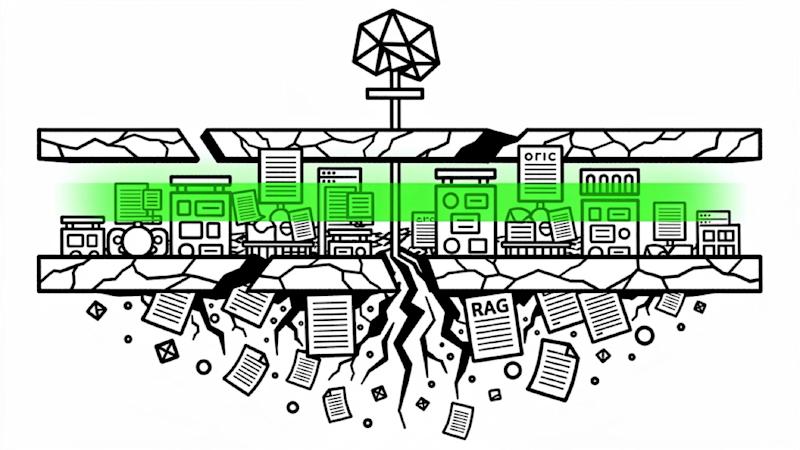

The vector database category is undergoing a shift in response to the needs of agentic AI.
The retrieval-augmented generation (RAG)-to-vector database pipeline doesn’t cut it anymore; agentic AI requires a different approach that incorporates context. VentureBeat’s Q1 2026 Pulse survey underscores this trend: Every standalone vector database is losing adoption share, while hybrid retrieval intent has tripled to 33.3%, the fastest-growing strategic position in the dataset.
Vector database pioneer Pinecone recognizes this and is pivoting to meet the specific needs of agentic AI.
The company today announced Nexus, which it positions as a knowledge engine rather than an improvement on retrieval. Nexus introduces a context compiler that converts raw enterprise data into persistent, task-specific knowledge artifacts before agents query them, and a composable retriever that serves those artifacts with field-level citations and deterministic conflict resolution.
Alongside Nexus, Pinecone is releasing KnowQL, a declarative query language that gives agents a vocabulary to specify output shape, confidence requirements, and latency budgets. In Pinecone’s own internal benchmark, one financial analysis task that previously consumed 2.8 million tokens was completed by Nexus with just 4,000. This represents a 98% reduction, although the company has not yet validated it in customer production deployments. Nexus is in early access starting today.
“RAG was built for human users,” Pinecone CEO Ash Ashutosh told VentureBeat. “Nexus was built for agentic users, because their language is very different. The responses they expect are very different. The task that an agent is assigned to do is very different from what a chatbot is supposed to do.”
Why RAG was never built for what agents actually do
RAG encompasses one query, one response, and a person in the loop to interpret the result. But agents work differently. They are assigned tasks, not questions — and completing these requires assembling context from multiple sources, resolving conflicts, tracking what has already been retrieved, and deciding what to query next.
The distinction matters. A RAG pipeline retrieves documents and hands them to a model at inference time. Each agent session starts cold, with no compiled understanding of the enterprise data estate — which tables relate to which, which sources are authoritative for which questions, and which formats an agent downstream will actually be able to consume. Every session re-discovers that from scratch.
“At the heart of all this stuff was a very simple problem,” Ashutosh said. “You’re asking agents — machines — to work on systems and data that was designed for humans.”
Pinecone estimates that 85% of agent compute effort goes to the re-discovery cycle rather than task completion. The downstream effects compound: unpredictable latency, runaway token costs, and non-deterministic results. Run the same task twice against the same data, and an agent may return different answers with no record of which sources drove either result. For enterprises where auditability is a compliance requirement, that is a structural disqualifier, not a tuning problem.
What Nexus is and how it works
Nexus moves reasoning work from inference time to compilation time. In a conventional RAG pipeline, the reasoning required to interpret, contextualize, and structure knowledge happens at the moment an agent queries — every session, every time, burning tokens on work that could have been done in advance. But Nexus reasons just once during a compilation stage that runs before any agent query, then stores the result as a reusable knowledge artifact. The agent receives structured, task-ready context rather than raw documents to interpret on the fly.
The architecture Pinecone is shipping has three distinct components, each addressing a different layer of the agent retrieval problem.
-
Context compiler. Nexus takes raw source data and a task specification and builds specialized knowledge artifacts — structured, task-optimized representations that agents consume directly without interpretation overhead. The same underlying data estate produces different artifacts for different agents: a sales agent gets deal context synthesized from CRM and call records, a finance agent gets revenue context linking contracts to billing schedules. Artifacts are persistent and reused across agent sessions, not regenerated at inference time.
-
Composable retriever. Compiled artifacts are served at query time with typed fields, per-field citations with confidence levels, and deterministic conflict resolution. Output is shaped to match the agent’s specified format rather than returned as raw text for the agent to re-parse.
-
KnowQL. Pinecone describes this as the first declarative query language designed for agents rather than humans. Six primitives — intent, filter, provenance, output shape, confidence, and budget — allow agents to specify structured responses and source grounding and latency envelopes in a single interface. Ashutosh compared the structural gap that KnowQL fills to what SQL did for relational databases: Before a standard interface existed, every application built its own data access layer from scratch.
The relationship between Nexus and Pinecone’s underlying vector database is additive. The context compiler produces knowledge artifacts that are indexed and stored in the vector database; the compilation layer shapes and serves knowledge; the vector layer handles storage, retrieval speed, and scale.
“The vectors are still stored and managed by the Pinecone vector database,” Ashutosh said.
What analysts make of the architectural claim
Moving reasoning upstream from inference to a compilation stage is not a novel concept — ontologies, data catalogs, and semantic layers have pursued versions of it for years. What has changed is the ability to do this at scale without dedicated engineering teams for every domain. That is the specific argument Nexus is making, and it is where analysts see the genuine advance.
Stephanie Walter, practice leader for AI stack at HyperFRAME Research, told VentureBeat that Nexus is directionally important because it shifts knowledge work from runtime chaos to pre-compiled structure. She stressed, however, that it is an evolution of RAG architecture, not a complete reinvention.
“The real innovation isn’t the idea itself, but the productization of knowledge compilation as a first-class infrastructure layer,” Walter said. “If Pinecone can operationalize that reliably, it becomes meaningful infrastructure, not just another RAG tuning trick.”
The technical mechanism behind that claim is what Gartner distinguished VP analyst Arun Chandrasekaran called the meaningful architectural distinction.
“Unlike traditional RAG, which relies on pure semantic search at runtime, architectural compilation embeds structural logic into the metadata layer, which can boost time to response and provide better reasoning,” Chandrasekaran told VentureBeat. “This is an important leap from simple retrieval to enhanced reasoning, allowing agents to navigate enterprise schemas and acquire better memory for contextualization.”
The competitive landscape
Multiple vendors acknowledge that a vector database and traditional RAG are not enough for agentic AI.
Microsoft has extended its FabricIQ technology to provide semantic context for agentic AI. Google recently announced its Agentic Data Cloud as an approach to help solve the same issues. There are also standalone contextual memory technologies, like hindsight, that provide yet another option for users.
But analysts are less focused on the feature comparison than on what buyers should actually be evaluating.
“The agentic AI stack is fragmenting into dozens of features, but enterprise buyers shouldn’t chase features,” Walter said. “They should chase control: cost control, governance control, and security control.”
Most enterprise failures in agentic AI, she argued, will not be technical. They will be operational — tied to cost overruns, governance gaps, and security discipline.
The capability bar goes beyond retrieval speed.
“The true differentiator is deterministic grounding,” Chandrasekaran said, pointing to techniques like knowledge graphs that ensure agents understand structural relationships within enterprise data rather than returning surface-level matches. Interoperability is a related consideration: Standards like model context protocol (MCP) matter for connecting agents to legacy data sources without creating new dependencies.
What this means for enterprises
RAG and standalone vector databases were built for a different era. Agentic workloads are exposing the limits of both.
The retrieval cost problem is architectural
Teams running complex agentic workloads on conventional RAG pipelines are burning tokens at inference time on work that could be done in advance — interpreting, contextualizing, and structuring knowledge, every session, from scratch. That is a design problem. Tuning the retrieval layer will not fix it. The question for data engineering teams is whether their current stack is structurally capable of pre-compiling knowledge for specific agent tasks, or whether it was built for a human user who never needed that capability.
Governance is what separates a pilot from a production deployment
The capabilities that determine whether agentic AI gets approved for enterprise use are not performance metrics.
“The real enterprise value proposition isn’t just faster retrieval, but governed knowledge pipelines,” Walter said. “Those are the capabilities that turn agentic AI from an experiment into something finance and risk teams will actually approve.”
The budget has shifted
VentureBeat’s Q1 Pulse data shows that retrieval optimization investment rose to 28.9% in March, overtaking evaluation spending for the first time in the quarter. Enterprises have finished measuring their retrieval problems. They are now spending to fix them.
“The future of agentic AI won’t be decided by who has the longest context window,” Walter said. “It will be decided by who can operationalize trusted knowledge at scale without blowing up cost or governance.”
Credit: Source link