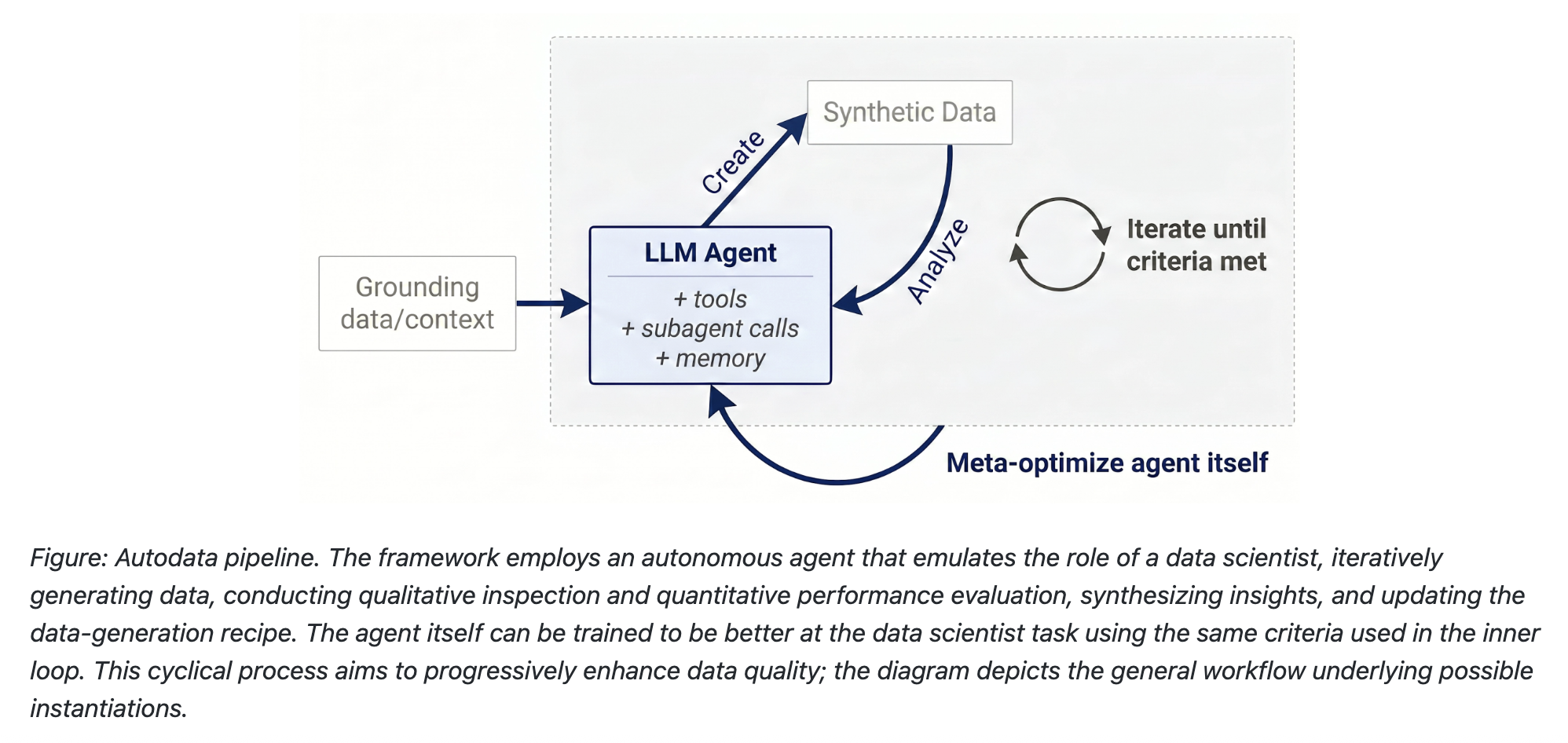

The bottleneck in building better AI models has never been compute alone — it has always been data quality. Meta AI’s RAM (Reasoning, Alignment, and Memory) team is now addressing that bottleneck directly. Meta researchers have introduced Autodata, a framework that deploys AI agents in the role of an autonomous data scientist, tasked with iteratively building, evaluating, and refining training and evaluation datasets — without relying on costly human annotation at every step.
And the results, tested on complex scientific reasoning problems, show that this approach doesn’t just match classical synthetic data generation methods — it significantly outperforms them.
Why Synthetic Data Creation Has Always Been Hard
To understand what Autodata is solving, you need to understand how AI training data is typically created today.
Most modern AI systems started with human-written data. As models improved, researchers began supplementing that with synthetic data — data generated by the model itself. Synthetic data is attractive because it can generate rare edge cases, reduce the cost of manual labeling, and produce more challenging examples than what naturally exists in public corpora.
The dominant approach for generating synthetic data has been Self-Instruct — prompting a large language model (LLM) using zero-shot or few-shot examples to create new training samples. Grounded Self-Instruct methods extended that by grounding generation on documents and other sources to reduce hallucination and increase diversity. CoT Self-Instruct (Chain-of-Thought Self-Instruct) pushed further by using chain-of-thought reasoning during generation to construct more complex tasks more accurately. Most recently, “Self-Challenging” methods allow a challenger agent to interact with tools before proposing a task and accompanying evaluation functions — the closest prior work to what Autodata does.
The problem? None of these methods gave researchers a feedback-driven way to actually control or iteratively improve data quality during generation itself. You could filter, evolve, or refine data after the fact — but the generation pipeline remained largely static and single-pass.
Autodata changes that.
What Autodata Actually Does
Autodata is a method that allows AI agents to act as data scientists who iteratively build high-quality training and evaluation data. Instead of generating data in a single pass, the agent runs a closed-loop pipeline modeled after how a human data scientist actually works:
- Data Creation — The agent grounds itself on provided source documents (research papers, code, legal text, etc.) and uses tools and learned skills to generate training or evaluation examples.
- Data Analysis — The agent then inspects what it created: Is this example correct? High quality? Challenging enough? It synthesizes learnings at the example level and, eventually, at the dataset level (Is it diverse? Does it improve a model when used as training data?).
- Iteration — Using those learnings, the agent updates its data-generation recipe and loops back to create better data. This continues until a stopping criterion is met.
Agentic data creation provides a way to convert increased inference compute into higher quality model training. The more inference-time compute you give the agent, the better the data it produces — a key insight for practitioners managing compute budgets.
The Specific Implementation: Agentic Self-Instruct
Meta’s initial instantiation of Autodata is called Agentic Self-Instruct, and its architecture is built around a main orchestrator LLM that coordinates four specialized subagents:
- Challenger LLM — generates a training example (input + response pair) based on a detailed prompt from the main agent
- Weak Solver — a smaller, less capable model expected to generally fail on the generated example
- Strong Solver — a more capable model expected to generally succeed
- Verifier/Judge — evaluates whether each solver’s output meets quality criteria, using rubrics generated by the Challenger LLM
An important design note: the Weak and Strong solver can actually be the same LLM operating in different modes. For example, the strong version can be allowed to use increased inference time compute including scaffolding or aggregation, as well as having access to privileged information — giving practitioners flexibility in how they define capability separation.
The acceptance criteria are precise and multi-condition. For an example to be accepted into the dataset, all four of the following must hold:
- The quality verifier (QV) must pass the example
weak_avg ≤ 65%andmax_weak ≤ 75%with no zero scoresstrong_avg ≥ 60%andstrong_avg < 95%— ensuring the question is neither too hard for everyone nor trivially easy for the strong solver- The gap
strong_avg − weak_avg ≥ 20%
If any of those thresholds aren’t met, the main agent sends targeted feedback to the Challenger and tries again — from a different reasoning angle. This loop typically runs several rounds per paper (median 3–5) before producing an accepted question or exhausting its step budget.
The Numbers That Matter
The quality gains over standard CoT Self-Instruct are measurable and significant.
Under CoT Self-Instruct, the two solvers score nearly identically — weak at 71.4% and strong at 73.3%, a gap of only 1.9 percentage points — showing that single-shot questions fail to find challenging enough tasks for either model. Agentic Self-Instruct drives the weak score down to 43.7% while lifting the strong score to 77.8%, widening the gap to 34 points. The agentic data creation loop produces questions that specifically reward stronger model capabilities, rather than questions both models can answer equally well.
The dataset itself was produced by processing over 10,000 CS papers from the S2ORC corpus (2022+), yielding 2,117 QA pairs that satisfy all quality constraints and performance gap requirements.
When Qwen-3.5-4B was then trained with GRPO for roughly one epoch (batch size 32, learning rate 1e-6) on Agentic Self-Instruct data versus CoT Self-Instruct data — using Kimi-K2.6 as the reward model to score responses against the generated rubrics — the model trained on agentic data demonstrated a clear advantage on both in-distribution and out-of-distribution test sets.
Meta-Optimization: Teaching the Agent to Be a Better Data Scientist
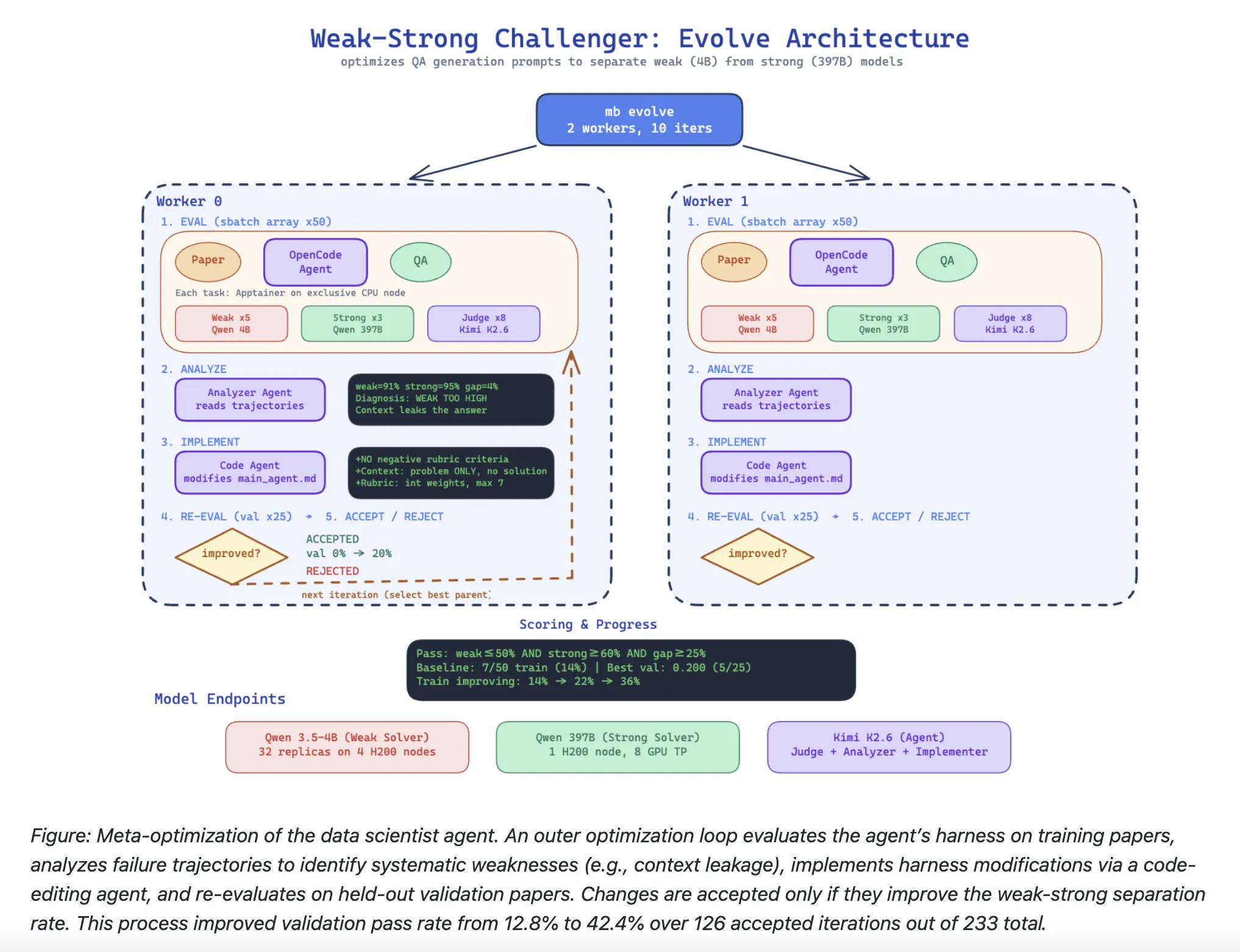
Autodata goes one level deeper. Beyond the inner data creation loop, the framework supports meta-optimization of the data scientist agent itself — using the same inner-loop quality criteria to optimize the outer-loop agent harness (the agent’s code scaffolding, prompts, and evaluation logic).
Using an evolution-based optimization framework, the meta-optimizer ran 233 total iterations, of which 126 were accepted (a mutant harness is only added to the population if its validation score strictly exceeds its parent’s). The meta-optimizer used Kimi-K2.6 as both the analyzer — reading full evaluation trajectories to diagnose systematic failure patterns — and the implementer, which modified the agent’s harness via a code-editing agent. The setup used 50 training papers and 25 validation papers.
Starting from a baseline harness that achieves 12.8% validation pass rate, the meta-optimizer progressively discovered four key harness improvements automatically:
- Paper-specific insight enforcement: Questions must test knowledge specific to the paper, not generic ML/CS knowledge. A self-test was introduced: “If a solver could answer correctly without reading this specific paper, the question is too easy.”
- Context leak prevention: Strict rules requiring the context to describe only the problem domain and setup, never the paper’s proposed solution.
- Positive-only rubric with weight capping: The optimizer eliminated negative-weight rubric criteria entirely, finding they historically misfired and destroyed strong model scores without improving discrimination. All criteria now use positive integer weights capped at 7.
- Structured rubric format: Strict JSON format for rubric criteria with integer weights, eliminating parsing errors that had caused evaluation failures in earlier iterations.
The progression from 12.8% to 42.4% validated pass rate demonstrates that meta-optimizing the data scientist agent’s instructions can substantially improve data quality without manual harness engineering.
Check out the Technical details here. Also, feel free to follow us on Twitter and don’t forget to join our 130k+ ML SubReddit and Subscribe to our Newsletter. Wait! are you on telegram? now you can join us on telegram as well.
Need to partner with us for promoting your GitHub Repo OR Hugging Face Page OR Product Release OR Webinar etc.? Connect with us
The post Meta Introduces Autodata: An Agentic Framework That Turns AI Models into Autonomous Data Scientists for High-Quality Training Data Creation appeared first on MarkTechPost.
Credit: Source link