
• bitcoinBitcoin(BTC)$84,136.000.28%
  • ethereumEthereum(ETH)$2,692.790.11%
  • tetherTether(USDT)$1.000.00%
  • binancecoinBNB(BNB)$774.03-0.01%
  • rippleXRP(XRP)$1.55-1.41%
  • usd-coinUSDC(USDC)$1.000.00%
  • solanaSolana(SOL)$121.590.07%
  • tronTRON(TRX)$0.3364040.09%
  • zcashZcash(ZEC)$1,563.480.82%
  • Figure HelocFigure Heloc(FIGR_HELOC)$1.02-0.41%
  • HyperliquidHyperliquid(HYPE)$92.611.24%
  • dogecoinDogecoin(DOGE)$0.0983830.37%
  • chainlinkChainlink(LINK)$14.333.21%
  • moneroMonero(XMR)$555.49-0.27%
  • whitebitWhiteBIT Coin(WBT)$83.980.19%
  • USDSUSDS(USDS)$1.000.01%
  • cardanoCardano(ADA)$0.2588431.10%
  • RainRain(RAIN)$0.0127067.25%
  • leo-tokenLEO Token(LEO)$8.981.62%
  • stellarStellar(XLM)$0.2206611.03%
  • bitcoin-cashBitcoin Cash(BCH)$337.810.08%
  • nearNEAR Protocol(NEAR)$4.83-5.69%
  • uniswapUniswap(UNI)$9.651.09%
  • litecoinLitecoin(LTC)$72.994.78%
  • CantonCanton(CC)$0.13986212.69%
  • Ethena USDeEthena USDe(USDE)$1.00-0.03%
  • avalanche-2Avalanche(AVAX)$11.035.82%
  • suiSui(SUI)$1.186.20%
  • daiDai(DAI)$1.00-0.01%
  • USD1USD1(USD1)$1.000.00%
  • the-open-networkGram (prev. Toncoin)(GRAM)$1.515.40%
  • hedera-hashgraphHedera(HBAR)$0.0952571.51%
  • BittensorBittensor(TAO)$334.049.46%
  • shiba-inuShiba Inu(SHIB)$0.0000063.08%
  • crypto-com-chainCronos(CRO)$0.0662020.36%
  • Global DollarGlobal Dollar(USDG)$1.000.00%
  • BitwayBitway(BTW)$1.07-13.36%
  • EthenaEthena(ENA)$0.2754884.99%
  • MemeCoreMemeCore(M)$1.223.66%
  • paypal-usdPayPal USD(PYUSD)$1.00-0.01%
  • tether-goldTether Gold(XAUT)$4,278.87-0.12%
  • OndoOndo(ONDO)$0.551.29%
  • okbOKB(OKB)$121.440.85%
  • Ripple USDRipple USD(RLUSD)$1.00-0.01%
  • Circle USYCCircle USYC(USYC)$1.140.00%
  • aaveAave(AAVE)$155.461.15%
  • mantleMantle(MNT)$0.705.39%
  • BlackRock USD Institutional Digital Liquidity FundBlackRock USD Institutional Digital Liquidity Fund(BUIDL)$1.000.00%
  • Ondo US Dollar YieldOndo US Dollar Yield(USDY)$1.150.13%
  • polkadotPolkadot(DOT)$1.288.43%
TradePoint.io
  • Main
  • AI & Technology
  • Stock Charts
  • Market & News
  • Business
  • Finance Tips
  • Trade Tube
  • Blog
  • Shop
No Result
View All Result
TradePoint.io
No Result
View All Result

AI Interview Series #4: Transformers vs Mixture of Experts (MoE)

December 4, 2025
in AI & Technology
Reading Time: 4 mins read
A A
AI Interview Series #4: Transformers vs Mixture of Experts (MoE)
ShareShareShareShareShare

Question:

MoE models contain far more parameters than Transformers, yet they can run faster at inference. How is that possible?

Difference between Transformers & Mixture of Experts (MoE)

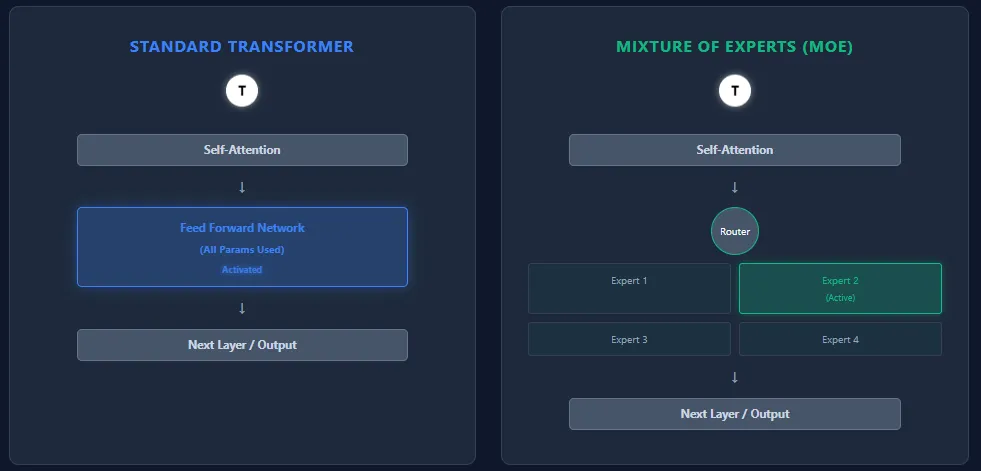
Transformers and Mixture of Experts (MoE) models share the same backbone architecture—self-attention layers followed by feed-forward layers—but they differ fundamentally in how they use parameters and compute.

YOU MAY ALSO LIKE

This App Lets You Use An Apple Watch With An Android Phone

These Xbox Players Got GTA 6 For Free The Hard Way

Feed-Forward Network vs Experts

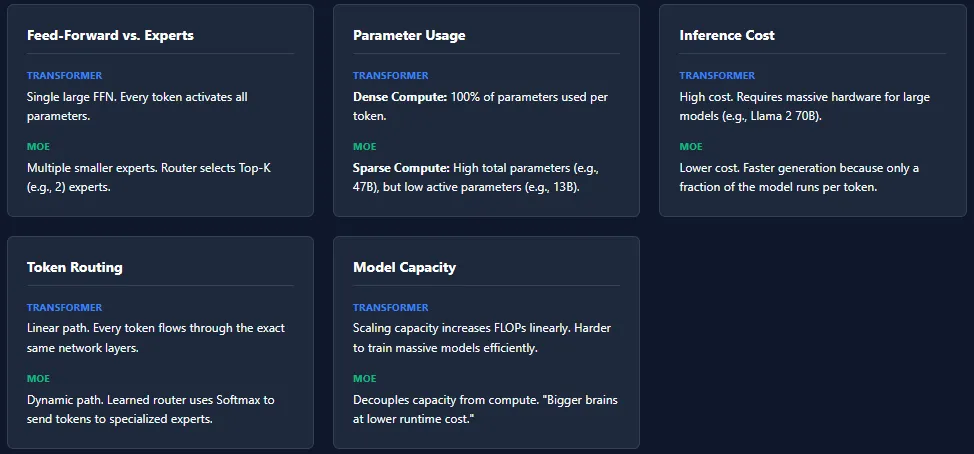
  • Transformer: Each block contains a single large feed-forward network (FFN). Every token passes through this FFN, activating all parameters during inference.
  • MoE: Replaces the FFN with multiple smaller feed-forward networks, called experts. A routing network selects only a few experts (Top-K) per token, so only a small fraction of total parameters is active.

Parameter Usage

  • Transformer: All parameters across all layers are used for every token → dense compute.
  • MoE: Has more total parameters, but activates only a small portion per token → sparse compute. Example: Mixtral 8×7B has 46.7B total parameters, but uses only ~13B per token.

Inference Cost

  • Transformer: High inference cost due to full parameter activation. Scaling to models like GPT-4 or Llama 2 70B requires powerful hardware.
  • MoE: Lower inference cost because only K experts per layer are active. This makes MoE models faster and cheaper to run, especially at large scales.

Token Routing

  • Transformer: No routing. Every token follows the exact same path through all layers.
  • MoE: A learned router assigns tokens to experts based on softmax scores. Different tokens select different experts. Different layers may activate different experts which  increases specialization and model capacity.

Model Capacity

  • Transformer: To scale capacity, the only option is adding more layers or widening the FFN—both increase FLOPs heavily.
  • MoE: Can scale total parameters massively without increasing per-token compute. This enables “bigger brains at lower runtime cost.”

While MoE architectures offer massive capacity with lower inference cost, they introduce several training challenges. The most common issue is expert collapse, where the router repeatedly selects the same experts, leaving others under-trained. 

Load imbalance is another challenge—some experts may receive far more tokens than others, leading to uneven learning. To address this, MoE models rely on techniques like noise injection in routing, Top-K masking, and expert capacity limits. 

These mechanisms ensure all experts stay active and balanced, but they also make MoE systems more complex to train compared to standard Transformers.

AI Interview Series #3: Explain Federated Learning

The post AI Interview Series #4: Transformers vs Mixture of Experts (MoE) appeared first on MarkTechPost.

Credit: Source link

ShareTweetSendSharePin

Related Posts

This App Lets You Use An Apple Watch With An Android Phone
AI & Technology

This App Lets You Use An Apple Watch With An Android Phone

September 26, 2026
These Xbox Players Got GTA 6 For Free The Hard Way
AI & Technology

These Xbox Players Got GTA 6 For Free The Hard Way

September 26, 2026
Exa Launches Agent Ultra: A Subagent Swarm Deep Research API Built for Exhaustive List Building
AI & Technology

Exa Launches Agent Ultra: A Subagent Swarm Deep Research API Built for Exhaustive List Building

September 26, 2026
End-to-End Multimodal Data Augmentation and Adversarial Robustness Benchmark with AugLy for Images, Text, Audio, and PyTorch
AI & Technology

End-to-End Multimodal Data Augmentation and Adversarial Robustness Benchmark with AugLy for Images, Text, Audio, and PyTorch

September 26, 2026
Next Post
Meet the Press Full Episode — Nov. 16

Meet the Press Full Episode — Nov. 16

Leave a Reply Cancel reply

Your email address will not be published. Required fields are marked *

Search

No Result
View All Result
The Pros And Cons Of Using A Password Manager Over An Authenticator App

The Pros And Cons Of Using A Password Manager Over An Authenticator App

September 23, 2026
I Borrowed 0,000 For Family And They Haven’t Paid Me Back

I Borrowed $300,000 For Family And They Haven’t Paid Me Back

September 22, 2026
Dallas Cowboys star CeeDee Lamb’s home burglarized

Dallas Cowboys star CeeDee Lamb’s home burglarized

September 25, 2026

About

Learn more

Our Services

Legal

Privacy Policy

Terms of Use

Bloggers

Learn more

Article Links

Contact

Advertise

Ask us anything

©2020- TradePoint.io - All rights reserved!

Tradepoint.io, being just a publishing and technology platform, is not a registered broker-dealer or investment adviser. So we do not provide investment advice. Rather, brokerage services are provided to clients of Tradepoint.io by independent SEC-registered broker-dealers and members of FINRA/SIPC. Every form of investing carries some risk and past performance is not a guarantee of future results. “Tradepoint.io“, “Instant Investing” and “My Trading Tools” are registered trademarks of Apperbuild, LLC.

This website is operated by Apperbuild, LLC. We have no link to any brokerage firm and we do not provide investment advice. Every information and resource we provide is solely for the education of our readers. © 2020 Apperbuild, LLC. All rights reserved.

No Result
View All Result
  • Main
  • AI & Technology
  • Stock Charts
  • Market & News
  • Business
  • Finance Tips
  • Trade Tube
  • Blog
  • Shop

© 2023 - TradePoint.io - All Rights Reserved!