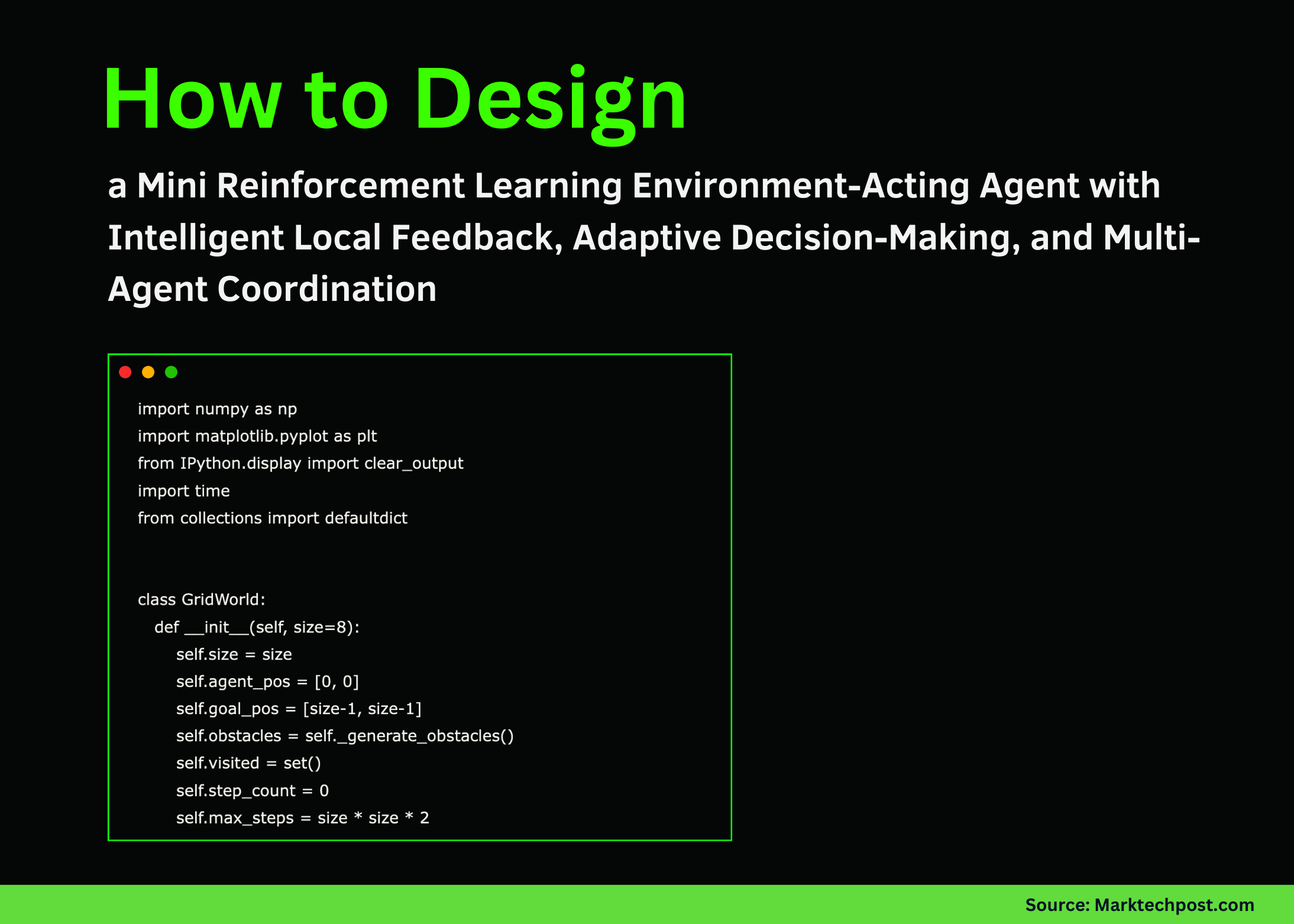

In this tutorial, we code a mini reinforcement learning setup in which a multi-agent system learns to navigate a grid world through interaction, feedback, and layered decision-making. We build everything from scratch and bring together three agent roles: an Action Agent, a Tool Agent, and a Supervisor, so we can observe how simple heuristics, analysis, and oversight combine to produce more intelligent behavior. Also, we observe how the agents collaborate, refine their strategies, and gradually learn to reach the goal while overcoming obstacles and uncertainty. Check out the FULL CODES here.
import numpy as np
import matplotlib.pyplot as plt
from IPython.display import clear_output
import time
from collections import defaultdict


class GridWorld:
   def __init__(self, size=8):
       self.size = size
       self.agent_pos = [0, 0]
       self.goal_pos = [size-1, size-1]
       self.obstacles = self._generate_obstacles()
       self.visited = set()
       self.step_count = 0
       self.max_steps = size * size * 2

   def _generate_obstacles(self):
       obstacles = set()
       n_obstacles = self.size
       while len(obstacles) < n_obstacles:
           pos = (np.random.randint(1, self.size-1),
                  np.random.randint(1, self.size-1))
           if pos != (0, 0) and pos != (self.size-1, self.size-1):
               obstacles.add(pos)
       return obstacles

   def reset(self):
       self.agent_pos = [0, 0]
       self.visited = {tuple(self.agent_pos)}
       self.step_count = 0
       return self._get_state()

   def _get_state(self):
       return {
           'position': tuple(self.agent_pos),
           'goal': self.goal_pos,
           'distance_to_goal': abs(self.agent_pos[0] - self.goal_pos[0]) +
                               abs(self.agent_pos[1] - self.goal_pos[1]),
           'visited_count': len(self.visited),
           'steps': self.step_count,
           'can_move': self._get_valid_actions()
       }

   def _get_valid_actions(self):
       valid = []
       moves = {'up': [-1, 0], 'down': [1, 0], 'left': [0, -1], 'right': [0, 1]}
       for action, delta in moves.items():
           new_pos = [self.agent_pos[0] + delta[0], self.agent_pos[1] + delta[1]]
           if (0 <= new_pos[0] < self.size and 0 <= new_pos[1] < self.size and
               tuple(new_pos) not in self.obstacles):
               valid.append(action)
       return valid
We set up the entire GridWorld environment and define how the agent, goal, and obstacles exist in it. We establish the structure for state representation and valid movements, and we prepare the environment so we can interact with it dynamically. As we run this part, we see the world taking shape and becoming ready for the agents to explore. Check out the FULL CODES here.
class GridWorld(GridWorld):
   def step(self, action):
       self.step_count += 1
       moves = {'up': [-1, 0], 'down': [1, 0], 'left': [0, -1], 'right': [0, 1]}

       if action not in moves:
           return self._get_state(), -1, False, "Invalid action"

       delta = moves[action]
       new_pos = [self.agent_pos[0] + delta[0], self.agent_pos[1] + delta[1]]

       if not (0 <= new_pos[0] < self.size and 0 <= new_pos[1] < self.size):
           return self._get_state(), -1, False, "Hit wall"

       if tuple(new_pos) in self.obstacles:
           return self._get_state(), -1, False, "Hit obstacle"

       self.agent_pos = new_pos
       pos_tuple = tuple(self.agent_pos)
       reward = -0.1
       if pos_tuple not in self.visited:
           reward += 0.5
           self.visited.add(pos_tuple)

       done = False
       info = "Moved"
       if self.agent_pos == self.goal_pos:
           reward += 10
           done = True
           info = "Goal reached!"
       elif self.step_count >= self.max_steps:
           done = True
           info = "Max steps reached"

       return self._get_state(), reward, done, info

   def render(self, agent_thoughts=None):
       grid = np.zeros((self.size, self.size, 3))
       for pos in self.visited:
           grid[pos[0], pos[1]] = [0.7, 0.9, 1.0]
       for obs in self.obstacles:
           grid[obs[0], obs[1]] = [0.2, 0.2, 0.2]
       grid[self.goal_pos[0], self.goal_pos[1]] = [0, 1, 0]
       grid[self.agent_pos[0], self.agent_pos[1]] = [1, 0, 0]

       plt.figure(figsize=(10, 8))
       plt.imshow(grid, interpolation='nearest')
       plt.title(f"Step: {self.step_count} | Visited: {len(self.visited)}/{self.size*self.size}")
       for i in range(self.size + 1):
           plt.axhline(i - 0.5, color="gray", linewidth=0.5)
           plt.axvline(i - 0.5, color="gray", linewidth=0.5)
       if agent_thoughts:
           plt.text(0.5, -1.5, agent_thoughts, ha="center", fontsize=9,
                    bbox=dict(boxstyle="round", facecolor="wheat", alpha=0.8),
                    wrap=True, transform=plt.gca().transData)
       plt.axis('off')
       plt.tight_layout()
       plt.show()
We define how each step in the environment works and how the world is visually rendered. We calculate rewards, detect collisions, track progress, and display everything through a clean grid visualization. As we execute this logic, we watch the agent’s journey unfold in real time with clear feedback. Check out the FULL CODES here.
class ActionAgent:
   def __init__(self):
       self.q_values = defaultdict(lambda: defaultdict(float))
       self.epsilon = 0.3
       self.learning_rate = 0.1
       self.discount = 0.95

   def choose_action(self, state):
       valid_actions = state['can_move']
       if not valid_actions:
           return None
       pos = state['position']
       if np.random.random() < self.epsilon:
           action = np.random.choice(valid_actions)
           reasoning = f"Exploring randomly: chose '{action}'"
       else:
           action_values = {a: self.q_values[pos][a] for a in valid_actions}
           action = max(action_values, key=action_values.get)
           reasoning = f"Exploiting: chose '{action}' (Q={self.q_values[pos][action]:.2f})"
       return action, reasoning

   def learn(self, state, action, reward, next_state):
       pos = state['position']
       next_pos = next_state['position']
       current_q = self.q_values[pos][action]
       next_max_q = max([self.q_values[next_pos][a] for a in next_state['can_move']], default=0)
       new_q = current_q + self.learning_rate * (
           reward + self.discount * next_max_q - current_q)
       self.q_values[pos][action] = new_q


class ToolAgent:
   def analyze(self, state, action_taken, reward, history):
       suggestions = []
       distance = state['distance_to_goal']
       if distance <= 3:
           suggestions.append("🎯 Very close to goal! Prioritize direct path.")
       exploration_rate = state['visited_count'] / (state['steps'] + 1)
       if exploration_rate < 0.5 and distance > 5:
           suggestions.append("🔍 Low exploration rate. Consider exploring more.")
       if len(history) >= 5:
           recent_rewards = [h[2] for h in history[-5:]]
           avg_reward = np.mean(recent_rewards)
           if avg_reward < -0.5:
               suggestions.append("⚠️ Negative reward trend. Try different strategy.")
           elif avg_reward > 0.3:
               suggestions.append("✅ Good progress! Current strategy working.")
       if len(state['can_move']) <= 2:
           suggestions.append("🚧 Limited movement options. Be careful.")
       return suggestions
We implement the Action Agent and Tool Agent, giving the system both learning capability and analytical feedback. We observe how the Action Agent chooses actions through a balance of exploration and exploitation, while the Tool Agent evaluates performance and suggests improvements. Together, they create a learning loop that evolves with experience. Check out the FULL CODES here.
class SupervisorAgent:
   def decide(self, state, proposed_action, tool_suggestions):
       if not proposed_action:
           return None, "No valid actions available"

       decision = proposed_action
       reasoning = f"Approved action '{proposed_action}'"

       for suggestion in tool_suggestions:
           if "goal" in suggestion.lower() and "close" in suggestion.lower():
               goal_direction = self._get_goal_direction(state)
               if goal_direction in state['can_move']:
                   decision = goal_direction
                   reasoning = f"Override: Moving '{goal_direction}' toward goal"
                   break

       return decision, reasoning

   def _get_goal_direction(self, state):
       pos = state['position']
       goal = state['goal']
       if goal[0] > pos[0]:
           return 'down'
       elif goal[0] < pos[0]:
           return 'up'
       elif goal[1] > pos[1]:
           return 'right'
       else:
           return 'left'
We introduce the Supervisor Agent, which acts as the final decision-maker in the system. We see how it interprets suggestions, overrides risky choices, and ensures that actions remain aligned with overall goals. As we use this component, we experience a coordinated multi-agent decision flow. Check out the FULL CODES here.
def train_multi_agent(episodes=5, visualize=True):
   env = GridWorld(size=8)
   action_agent = ActionAgent()
   tool_agent = ToolAgent()
   supervisor = SupervisorAgent()

   episode_rewards = []
   episode_steps = []

   for episode in range(episodes):
       state = env.reset()
       total_reward = 0
       done = False
       history = []

       print(f"\n{'='*60}")
       print(f"EPISODE {episode + 1}/{episodes}")
       print(f"{'='*60}")

       while not done:
           action_result = action_agent.choose_action(state)
           if action_result is None:
               break
           proposed_action, action_reasoning = action_result

           suggestions = tool_agent.analyze(state, proposed_action, total_reward, history)
           final_action, supervisor_reasoning = supervisor.decide(state, proposed_action, suggestions)

           if final_action is None:
               break

           next_state, reward, done, info = env.step(final_action)
           total_reward += reward
           action_agent.learn(state, final_action, reward, next_state)
           history.append((state, final_action, reward, next_state))

           if visualize:
               clear_output(wait=True)
               thoughts = (f"Action Agent: {action_reasoning}\n"
                          f"Supervisor: {supervisor_reasoning}\n"
                          f"Tool Agent: {', '.join(suggestions[:2]) if suggestions else 'No suggestions'}\n"
                          f"Reward: {reward:.2f} | Total: {total_reward:.2f}")
               env.render(thoughts)
               time.sleep(0.3)

           state = next_state

       episode_rewards.append(total_reward)
       episode_steps.append(env.step_count)

       print(f"\nEpisode {episode+1} Complete!")
       print(f"Total Reward: {total_reward:.2f}")
       print(f"Steps Taken: {env.step_count}")
       print(f"Cells Visited: {len(env.visited)}/{env.size**2}")

   plt.figure(figsize=(12, 4))
   plt.subplot(1, 2, 1)
   plt.plot(episode_rewards, marker="o")
   plt.title('Episode Rewards')
   plt.xlabel('Episode')
   plt.ylabel('Total Reward')
   plt.grid(True, alpha=0.3)

   plt.subplot(1, 2, 2)
   plt.plot(episode_steps, marker="s", color="orange")
   plt.title('Episode Steps')
   plt.xlabel('Episode')
   plt.ylabel('Steps to Complete')
   plt.grid(True, alpha=0.3)
   plt.tight_layout()
   plt.show()

   return action_agent, tool_agent, supervisor


if __name__ == "__main__":
   print("🤖 Multi-Agent RL System: Grid World Navigation")
   print("=" * 60)
   print("Components:")
   print("  • Action Agent: Proposes actions using Q-learning")
   print("  • Tool Agent: Analyzes performance and suggests improvements")
   print("  • Supervisor Agent: Makes final decisions")
   print("=" * 60)

   trained_agents = train_multi_agent(episodes=5, visualize=True)
We run the full training loop where all agents collaborate inside the environment across multiple episodes. We track rewards, observe movement patterns, and visualize learning progression with each trial. As we complete this loop, we see the multi-agent system improving and becoming more efficient at navigating the grid world.
In conclusion, we see how a multi-agent RL system emerges from clean components and how each layer contributes to smarter navigation: the Action Agent learns via Q-updates, the Tool Agent guides improvements, and the Supervisor ensures safe, goal-oriented action selection. We appreciate how this simple yet dynamic grid world helps us visualize learning, exploration, and decision-making in real time.
Check out the FULL CODES here. Feel free to check out our GitHub Page for Tutorials, Codes and Notebooks. Also, feel free to follow us on Twitter and don’t forget to join our 100k+ ML SubReddit and Subscribe to our Newsletter. Wait! are you on telegram? now you can join us on telegram as well.
Asif Razzaq is the CEO of Marktechpost Media Inc.. As a visionary entrepreneur and engineer, Asif is committed to harnessing the potential of Artificial Intelligence for social good. His most recent endeavor is the launch of an Artificial Intelligence Media Platform, Marktechpost, which stands out for its in-depth coverage of machine learning and deep learning news that is both technically sound and easily understandable by a wide audience. The platform boasts of over 2 million monthly views, illustrating its popularity among audiences.
Credit: Source link