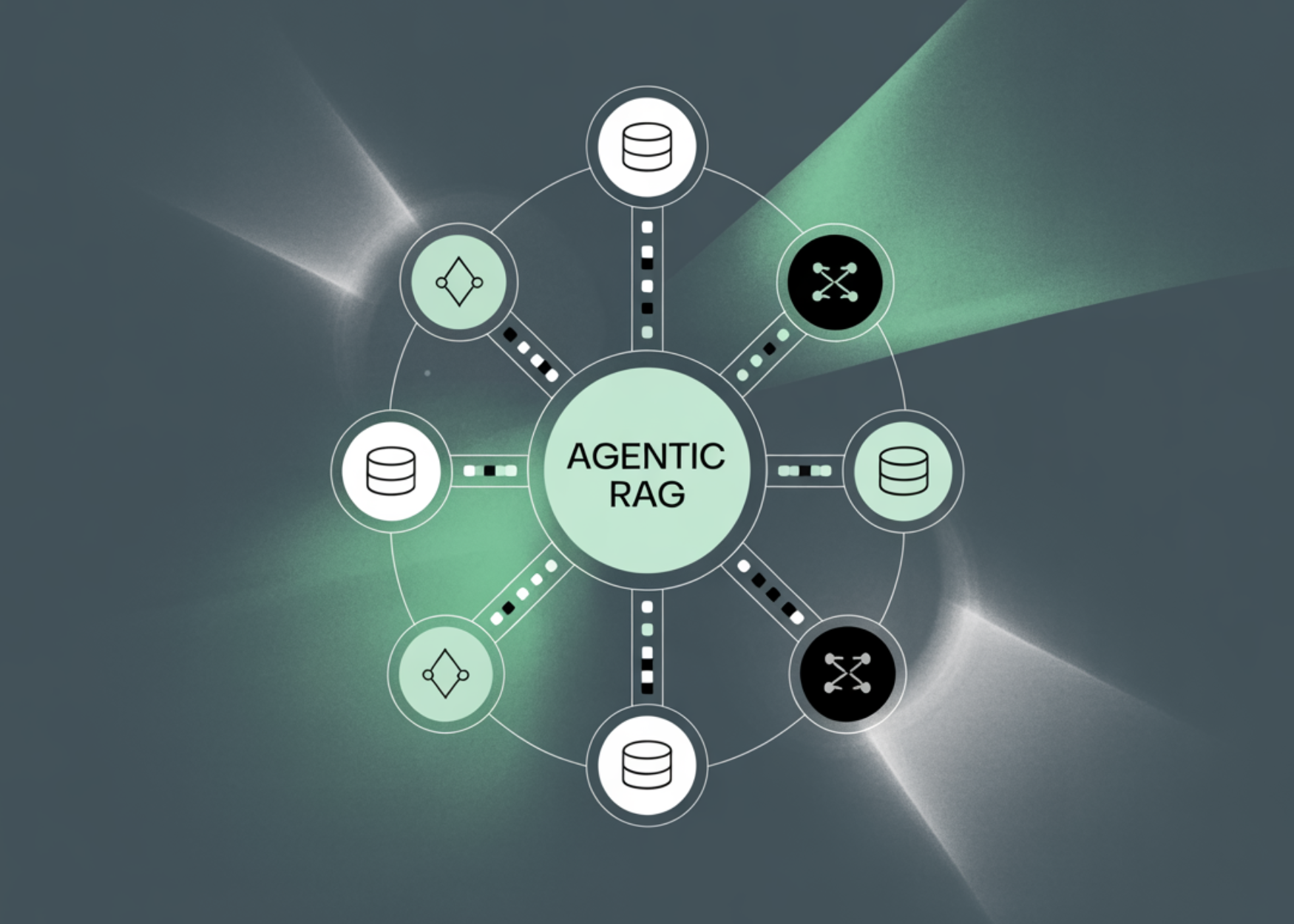

What is Agentic RAG?
Agentic RAG combines the strengths of traditional RAG—where large language models (LLMs) retrieve and ground outputs in external context—with agentic decision-making and tool use. Unlike static approaches, agentic RAG features AI agents that orchestrate retrieval, generation, query planning, and iterative reasoning. These agents autonomously choose data sources, refine queries, invoke APIs/tools, validate context, and self-correct in a loop until the best output is produced. The result is deeper, more accurate, and context-sensitive answers as the agent can dynamically adapt the workflow to each query.
Why not just vanilla RAG?
Vanilla RAG struggles with underspecified questions, multi-hop reasoning, and noisy corpora. Agentic patterns address this by adding:
- Planning / query decomposition (plan-then-retrieve).
- Conditional retrieval (decide if retrieval is needed, from which source).
- Self-reflection / corrective loops (detect bad retrieval and try alternatives).
- Graph-aware exploration (narrative/relational discovery instead of flat chunk search).
Use Cases and Applications
Agentic RAG is being deployed across many industries to solve complex problems that traditional RAG struggles to address.
- Customer Support: Empowers AI helpdesks to adapt responses to customer context and needs, resolving issues faster and learning from past tickets for continuous improvement.
- Healthcare: Assists clinicians with evidence-based recommendations by retrieving and synthesizing medical literature, patient records, and treatment guidelines, enhancing diagnostic precision and patient safety.
- Finance: Automates regulatory compliance analysis, risk management, and monitoring by reasoning over real-time regulatory updates and transactional data, significantly reducing manual effort.
- Education: Delivers personalized learning through adaptive content retrieval and individualized learning plans, improving student engagement and outcomes.
- Internal Knowledge Management: Finds, checks, and routes internal documents, streamlining access to crucial information for enterprise teams.
- Business Intelligence: Automates multi-step KPI analysis, trend detection, and report generation by leveraging external data and API integrations with intelligent query planning.
- Scientific Research: Helps researchers rapidly conduct literature reviews and extract insights, cutting down manual review time.
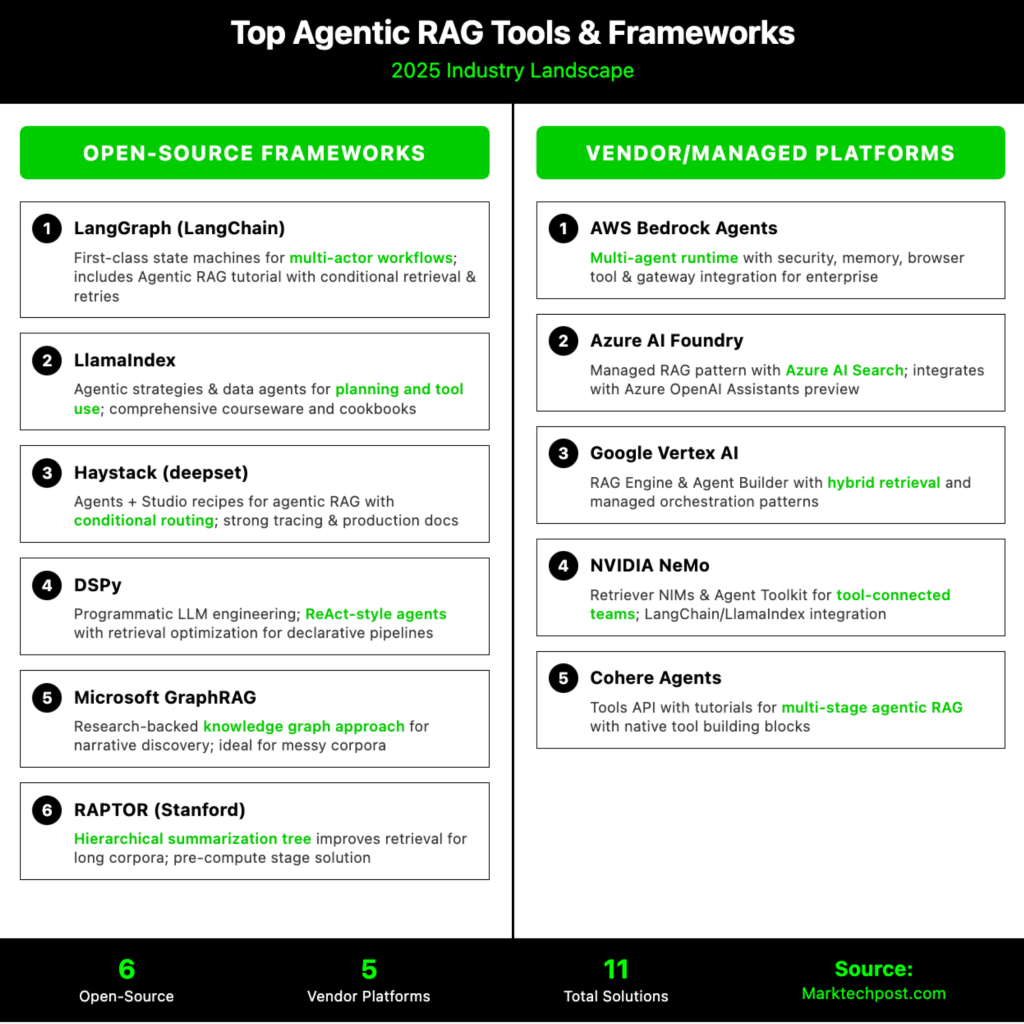
Open-source frameworks
- LangGraph (LangChain) – First-class state machines for multi-actor/agent workflows; includes Agentic RAG tutorial (conditional retrieval, retries). Strong for graph-style control over steps.
- LlamaIndex – “Agentic strategies / data agents” for planning and tool use atop existing query engines; courseware and cookbooks available.
- Haystack (deepset) – Agents + Studio recipes for agentic RAG, including conditional routing and web fallback. Good tracing, production docs.
- DSPy – Programmatic LLM engineering; ReAct-style agents with retrieval and optimization; fits teams who want declarative pipelines and tuning.
- Microsoft GraphRAG – Research-backed approach that builds a knowledge graph for narrative discovery; open materials and paper. Ideal for messy corpora.
- RAPTOR (Stanford) – Hierarchical summarization tree improves retrieval for long corpora; works as a pre-compute stage in agentic stacks.
Vendor/managed platforms
- AWS Bedrock Agents (AgentCore) – Multi-agent runtime with security, memory, browser tool, and gateway integration; designed for enterprise deployment.
- Azure AI Foundry + Azure AI Search – Managed RAG pattern, indexes, and agent templates; integrates with Azure OpenAI Assistants preview.
- Google Vertex AI: RAG Engine & Agent Builder – Managed orchestration and agent tooling; hybrid retrieval and agent patterns.
- NVIDIA NeMo – Retriever NIMs and Agent Toolkit for tool-connected teams of agents; integrates with LangChain/LlamaIndex.
- Cohere Agents / Tools API – Tutorials and building blocks for multi-stage agentic RAG with native tools.
Key Benefits of Agentic RAG
- Autonomous multi-step reasoning: Agents plan and execute the best sequence of tool use and retrieval to reach the correct answer.
- Goal-driven workflows: Systems adaptively pursue user goals, overcoming limitations of linear RAG pipelines.
- Self-verification and refinement: Agents verify the accuracy of retrieved context and generated outputs, reducing hallucinations.
- Multi-agent orchestration: Complex queries are broken down and solved collaboratively by specialized agents.
- Greater adaptability and contextual understanding: Systems learn from user interactions and adapt to diverse domains and requirements.
Example: Choosing a stack
- Research copilot over long PDFs & wikis → LlamaIndex or LangGraph + RAPTOR summaries; optional GraphRAG layer.
- Enterprise helpdesk → Haystack agent with conditional routing and web fallback; or AWS Bedrock Agents for managed runtime and governance.
- Data/BI assistant → DSPy (programmatic agents) with SQL tool adapters; Azure/Vertex for managed RAG and monitoring.
- High-security production → Managed agent services (Bedrock AgentCore, Azure AI Foundry) to standardize memory, identity, and tool gateways.
Agentic RAG is redefining what’s possible with generative AI, transforming traditional RAG into dynamic, adaptive, and deeply integrated systems for enterprise, research, and developer use.
FAQ 1: What makes Agentic RAG different from traditional RAG?
Agentic RAG adds autonomous reasoning, planning, and tool use to retrieval-augmented generation, allowing the AI to refine queries, synthesize information from multiple sources, and self-correct, instead of simply fetching and summarizing data.
FAQ 2: What are the main applications of Agentic RAG?
Agentic RAG is widely used in customer support, healthcare decision support, financial analysis, education, business intelligence, knowledge management, and research, excelling at complex tasks requiring multi-step reasoning and dynamic context integration.
FAQ 3: How do agentic RAG systems improve accuracy?
Agentic RAG agents can verify and cross-check retrieved context and responses by iteratively querying multiple data sources and refining their outputs, which helps reduce errors and hallucinations common in basic RAG pipelines.
FAQ 4: Can Agentic RAG be deployed on-premises or in the cloud?
Most frameworks offer both on-premises and cloud deployment options, supporting enterprise security needs and seamless integration with proprietary databases and external APIs for flexible architecture choices.

Michal Sutter is a data science professional with a Master of Science in Data Science from the University of Padova. With a solid foundation in statistical analysis, machine learning, and data engineering, Michal excels at transforming complex datasets into actionable insights.
Credit: Source link