• bitcoinBitcoin(BTC)$84,414.000.43%
  • ethereumEthereum(ETH)$2,688.250.06%
  • tetherTether(USDT)$1.00-0.01%
  • binancecoinBNB(BNB)$775.950.40%
  • rippleXRP(XRP)$1.52-1.06%
  • usd-coinUSDC(USDC)$1.00-0.01%
  • solanaSolana(SOL)$122.010.83%
  • tronTRON(TRX)$0.333830-0.74%
  • zcashZcash(ZEC)$1,584.921.55%
  • Figure HelocFigure Heloc(FIGR_HELOC)$1.063.15%
  • HyperliquidHyperliquid(HYPE)$91.46-1.01%
  • dogecoinDogecoin(DOGE)$0.096871-0.97%
  • chainlinkChainlink(LINK)$14.11-1.18%
  • moneroMonero(XMR)$544.52-1.76%
  • whitebitWhiteBIT Coin(WBT)$84.260.45%
  • USDSUSDS(USDS)$1.00-0.02%
  • cardanoCardano(ADA)$0.254329-0.67%
  • RainRain(RAIN)$0.012567-4.63%
  • leo-tokenLEO Token(LEO)$9.010.60%
  • stellarStellar(XLM)$0.215952-1.11%
  • nearNEAR Protocol(NEAR)$5.207.44%
  • bitcoin-cashBitcoin Cash(BCH)$334.63-0.45%
  • uniswapUniswap(UNI)$9.711.02%
  • litecoinLitecoin(LTC)$71.13-1.81%
  • CantonCanton(CC)$0.135344-1.42%
  • suiSui(SUI)$1.245.65%
  • Ethena USDeEthena USDe(USDE)$1.000.02%
  • avalanche-2Avalanche(AVAX)$10.940.54%
  • the-open-networkGram (prev. Toncoin)(GRAM)$1.6810.31%
  • daiDai(DAI)$1.00-0.01%
  • USD1USD1(USD1)$1.00-0.02%
  • hedera-hashgraphHedera(HBAR)$0.093622-0.54%
  • BittensorBittensor(TAO)$324.09-2.04%
  • shiba-inuShiba Inu(SHIB)$0.000006-1.31%
  • crypto-com-chainCronos(CRO)$0.0671002.13%
  • Global DollarGlobal Dollar(USDG)$1.00-0.02%
  • BitwayBitway(BTW)$1.1911.80%
  • EthenaEthena(ENA)$0.2796904.19%
  • paypal-usdPayPal USD(PYUSD)$1.00-0.01%
  • quant-networkQuant(QNT)$187.6951.93%
  • MemeCoreMemeCore(M)$1.18-2.95%
  • OndoOndo(ONDO)$0.551.94%
  • tether-goldTether Gold(XAUT)$4,279.390.02%
  • okbOKB(OKB)$121.00-0.27%
  • Ripple USDRipple USD(RLUSD)$1.000.00%
  • Circle USYCCircle USYC(USYC)$1.140.00%
  • aaveAave(AAVE)$154.720.17%
  • BlackRock USD Institutional Digital Liquidity FundBlackRock USD Institutional Digital Liquidity Fund(BUIDL)$1.000.00%
  • Ondo US Dollar YieldOndo US Dollar Yield(USDY)$1.15-0.08%
  • Pump.funPump.fun(PUMP)$0.00488410.36%
TradePoint.io
  • Main
  • AI & Technology
  • Stock Charts
  • Market & News
  • Business
  • Finance Tips
  • Trade Tube
  • Blog
  • Shop
No Result
View All Result
TradePoint.io
No Result
View All Result

Google AI’s New Regression Language Model (RLM) Framework Enables LLMs to Predict Industrial System Performance Directly from Raw Text Data

August 27, 2025
in AI & Technology
Reading Time: 6 mins read
A A
Google AI’s New Regression Language Model (RLM) Framework Enables LLMs to Predict Industrial System Performance Directly from Raw Text Data
ShareShareShareShareShare

Google’s new Regression Language Model (RLM) approach enables Large Language Models (LLMs) to predict industrial system performance directly from raw text data, without relying on complex feature engineering or rigid tabular formats.

The Challenge of Industrial System Prediction

Predicting performance for large-scale industrial systems—like Google’s Borg compute clusters—has traditionally required extensive domain-specific feature engineering and tabular data representations, making scalability and adaptation difficult. Logs, configuration files, variable hardware mixes, and nested job data cannot be easily flattened or normalized for classic regression models. As a result, optimization and simulation workflows often become brittle, costly, and slow, especially when new types of workloads or hardware are introduced.
YOU MAY ALSO LIKE

How To Improve Your Router’s Security In 10 Minutes

Humanoid Robots Are Getting Even Creepier (This One Can Cry On Command)

https://arxiv.org/abs/2506.21718

The Main Idea: Text-to-Text Regression

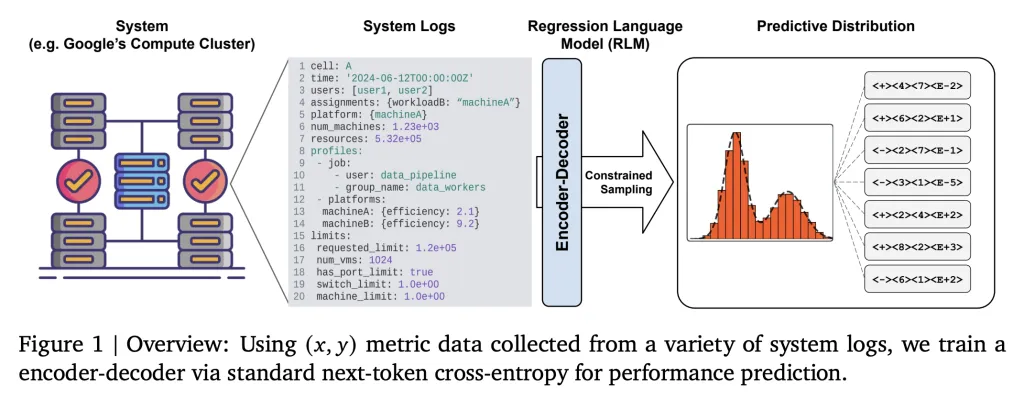
Google’s Regression Language Model (RLM) reformulates regression as a text generation task: all system state data (configuration, logs, workload profiles, hardware descriptions) are serialized into structured text formats like YAML or JSON and used as the input prompt xxx. The regression model then outputs the numerical target yyy—such as efficiency metrics (Millions of Instructions Per Second per Google Compute Unit, MIPS per GCU)—as a text string response.

  • No Tabular Features Required: This eliminates the need for predefined feature sets, normalization, and rigid encoding schemes.
  • Universal Applicability: Any system state can be represented as a string; heterogeneous, nested, or dynamically evolving features are natively supported.

Technical Details: Architecture and Training

The approach uses a relatively small encoder-decoder LLM (60M parameters) that trains via next-token cross-entropy loss on string representations of xxx and yyy. The model is not pretrained on general language modeling—training can start from random initialization, focusing directly on correlating system states with numeric outcomes.

  • Custom Numeric Tokenization: Outcomes are tokenized efficiently (e.g., P10 mantissa-sign-exponent encoding) to represent floating-point values within the model’s vocabulary.
  • Few-shot Adaptation: Pretrained RLMs are rapidly fine-tunable on new tasks with as few as 500 examples, adapting to new cluster configurations or months within hours, not weeks.
  • Sequence Length Scaling: Models can process very long input texts (thousands of tokens), ensuring complex states are fully observed.

Performance: Results on Google’s Borg Cluster

Testing on the Borg cluster, RLMs achieved up to a 0.99 Spearman rank correlation (0.9 average) between predicted and true MIPS per GCU, with 100x lower mean squared error than tabular baselines. The models natively quantify uncertainty by sampling multiple outputs for each input, supporting probabilistic system simulation and Bayesian optimization workflows.

  • Uncertainty Quantification: RLMs capture both aleatoric (inherent) and epistemic (unknowns due to limited observability) uncertainties, unlike most black-box regressors.
  • Universal Simulators: The density modeling capabilities of RLMs suggest their use in building universal digital twins for large-scale systems, accelerating infrastructure optimization, and real-time feedback.

Comparison: RLMs vs Traditional Regression

Approach Data Format Feature Engineering Adaptability Performance Uncertainty
Tabular Regression Flat tensors, numbers Manual required Low Limited by features Minimal
RLM (Text-to-Text) Structured, nested text None required High Near-perfect ranks Full-spectrum

Applications and Summary

  • Cloud and Compute Clusters: Direct performance prediction and optimization for large, dynamic infrastructure.
  • Manufacturing and IoT: Universal simulators for outcome prediction across diverse industrial pipelines.
  • Scientific Experiments: End-to-end modeling where input states are complex, textually described, and numerically diverse.

This new approach—treating regression as language modeling—removes longstanding barriers in system simulation, enables rapid adaptation to new environments, and supports robust uncertainty-aware prediction, all crucial for next-generation industrial AI.


Check out the Paper, Codes and Technical details. Feel free to check out our GitHub Page for Tutorials, Codes and Notebooks. Also, feel free to follow us on Twitter and don’t forget to join our 100k+ ML SubReddit and Subscribe to our Newsletter.


Michal Sutter is a data science professional with a Master of Science in Data Science from the University of Padova. With a solid foundation in statistical analysis, machine learning, and data engineering, Michal excels at transforming complex datasets into actionable insights.

Credit: Source link

ShareTweetSendSharePin

Related Posts

How To Improve Your Router’s Security In 10 Minutes
AI & Technology

How To Improve Your Router’s Security In 10 Minutes

September 27, 2026
Humanoid Robots Are Getting Even Creepier (This One Can Cry On Command)
AI & Technology

Humanoid Robots Are Getting Even Creepier (This One Can Cry On Command)

September 27, 2026
AI Coding Agents for Enterprise: IP Indemnity, Data Residency and 500-Seat Cost Compared
AI & Technology

AI Coding Agents for Enterprise: IP Indemnity, Data Residency and 500-Seat Cost Compared

September 27, 2026
A Coding Guide to Google Research’s MSEB: Writing Sound Encoders to the Benchmark Contract and Scoring Them Across Classification, Clustering, Retrieval and Segmentation
AI & Technology

A Coding Guide to Google Research’s MSEB: Writing Sound Encoders to the Benchmark Contract and Scoring Them Across Classification, Clustering, Retrieval and Segmentation

September 27, 2026
Next Post
20 killed in Israeli strikes on Gaza hospital

20 killed in Israeli strikes on Gaza hospital

Leave a Reply Cancel reply

Your email address will not be published. Required fields are marked *

Search

No Result
View All Result
Tony Romo gets 3 new citations for impaired driving arrest

Tony Romo gets 3 new citations for impaired driving arrest

September 21, 2026
Track where a potent nor’easter will bring heavy rain, winds and waves – The Washington Post

Track where a potent nor’easter will bring heavy rain, winds and waves – The Washington Post

September 24, 2026
Swing ride malfunctions at Tennessee fair

Swing ride malfunctions at Tennessee fair

September 26, 2026

About

Learn more

Our Services

Legal

Privacy Policy

Terms of Use

Bloggers

Learn more

Article Links

Contact

Advertise

Ask us anything

©2020- TradePoint.io - All rights reserved!

Tradepoint.io, being just a publishing and technology platform, is not a registered broker-dealer or investment adviser. So we do not provide investment advice. Rather, brokerage services are provided to clients of Tradepoint.io by independent SEC-registered broker-dealers and members of FINRA/SIPC. Every form of investing carries some risk and past performance is not a guarantee of future results. “Tradepoint.io“, “Instant Investing” and “My Trading Tools” are registered trademarks of Apperbuild, LLC.

This website is operated by Apperbuild, LLC. We have no link to any brokerage firm and we do not provide investment advice. Every information and resource we provide is solely for the education of our readers. © 2020 Apperbuild, LLC. All rights reserved.

No Result
View All Result
  • Main
  • AI & Technology
  • Stock Charts
  • Market & News
  • Business
  • Finance Tips
  • Trade Tube
  • Blog
  • Shop

© 2023 - TradePoint.io - All Rights Reserved!