
In this tutorial, we guide you through the development of an advanced Graph Agent framework, powered by the Google Gemini API. Our goal is to build intelligent, multi-step agents that execute tasks through a well-defined graph structure of interconnected nodes. Each node represents a specific function, ranging from taking input, performing logical processing, making decisions, and producing outputs. We use Python, NetworkX for graph modeling, and matplotlib for visualization. By the end, we implement and run two complete examples, a Research Assistant and a Problem Solver, to demonstrate how the framework can efficiently handle complex reasoning workflows.
!pip install -q google-generativeai networkx matplotlib


import google.generativeai as genai
import networkx as nx
import matplotlib.pyplot as plt
from typing import Dict, List, Any, Callable
import json
import asyncio
from dataclasses import dataclass
from enum import Enum


API_KEY = "use your API key here"
genai.configure(api_key=API_KEY)
We begin by installing the necessary libraries, google-generativeai, networkx, and matplotlib, to support our graph-based agent framework. After importing essential modules, we configure the Gemini API using our API key to enable powerful content generation capabilities within our agent system.
Check out the Codes.
class NodeType(Enum):
    INPUT = "input"
    PROCESS = "process"
    DECISION = "decision"
    OUTPUT = "output"


@dataclass
class AgentNode:
    id: str
    type: NodeType
    prompt: str
    function: Callable = None
    dependencies: List[str] = None
We define a NodeType enumeration to classify different kinds of agent nodes: input, process, decision, and output. Then, using a dataclass AgentNode, we structure each node with an ID, type, prompt, optional function, and a list of dependencies, allowing us to build a modular and flexible agent graph.
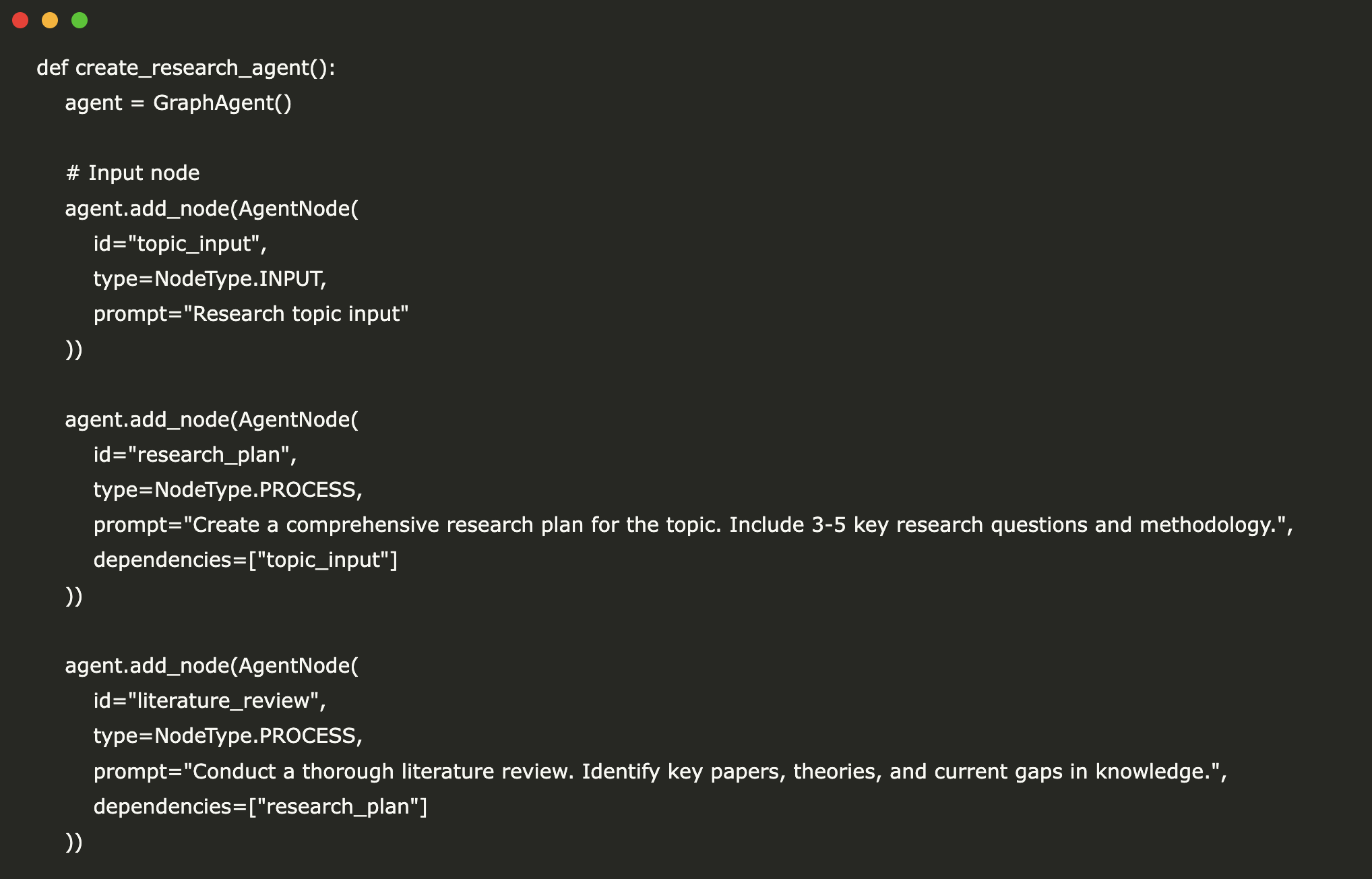
def create_research_agent():
    agent = GraphAgent()

    # Input node
    agent.add_node(AgentNode(
        id="topic_input",
        type=NodeType.INPUT,
        prompt="Research topic input"
    ))

    agent.add_node(AgentNode(
        id="research_plan",
        type=NodeType.PROCESS,
        prompt="Create a comprehensive research plan for the topic. Include 3-5 key research questions and methodology.",
        dependencies=["topic_input"]
    ))

    agent.add_node(AgentNode(
        id="literature_review",
        type=NodeType.PROCESS,
        prompt="Conduct a thorough literature review. Identify key papers, theories, and current gaps in knowledge.",
        dependencies=["research_plan"]
    ))

    agent.add_node(AgentNode(
        id="analysis",
        type=NodeType.PROCESS,
        prompt="Analyze the research findings. Identify patterns, contradictions, and novel insights.",
        dependencies=["literature_review"]
    ))

    agent.add_node(AgentNode(
        id="quality_check",
        type=NodeType.DECISION,
        prompt="Evaluate research quality. Is the analysis comprehensive? Are there missing perspectives? Return 'APPROVED' or 'NEEDS_REVISION' with reasons.",
        dependencies=["analysis"]
    ))

    agent.add_node(AgentNode(
        id="final_report",
        type=NodeType.OUTPUT,
        prompt="Generate a comprehensive research report with executive summary, key findings, and recommendations.",
        dependencies=["quality_check"]
    ))

    return agent
We create a research agent by sequentially adding specialized nodes to the graph. Starting with a topic input, we define a process flow that includes planning, literature review, and analysis. The agent then makes a quality decision based on the study and finally generates a comprehensive research report, capturing the full lifecycle of a structured research workflow.
Check out the Codes.
def create_problem_solver():
    agent = GraphAgent()

    agent.add_node(AgentNode(
        id="problem_input",
        type=NodeType.INPUT,
        prompt="Problem statement"
    ))

    agent.add_node(AgentNode(
        id="problem_analysis",
        type=NodeType.PROCESS,
        prompt="Break down the problem into components. Identify constraints and requirements.",
        dependencies=["problem_input"]
    ))

    agent.add_node(AgentNode(
        id="solution_generation",
        type=NodeType.PROCESS,
        prompt="Generate 3 different solution approaches. For each, explain the methodology and expected outcomes.",
        dependencies=["problem_analysis"]
    ))

    agent.add_node(AgentNode(
        id="solution_evaluation",
        type=NodeType.DECISION,
        prompt="Evaluate each solution for feasibility, cost, and effectiveness. Rank them and select the best approach.",
        dependencies=["solution_generation"]
    ))

    agent.add_node(AgentNode(
        id="implementation_plan",
        type=NodeType.OUTPUT,
        prompt="Create a detailed implementation plan with timeline, resources, and success metrics.",
        dependencies=["solution_evaluation"]
    ))

    return agent
We build a problem-solving agent by defining a logical sequence of nodes, starting from the reception of the problem statement. The agent analyzes the problem, generates multiple solution approaches, evaluates them based on feasibility and effectiveness, and concludes by producing a structured implementation plan, enabling automated, step-by-step resolution of the problem.
Check out the Codes.
def run_research_demo():
    """Run the research agent demo"""
    print("🚀 Advanced Graph Agent Framework Demo")
    print("=" * 50)

    research_agent = create_research_agent()
    print("\n📊 Research Agent Graph Structure:")
    research_agent.visualize()

    print("\n🔍 Executing Research Task...")

    research_agent.results["topic_input"] = "Artificial Intelligence in Healthcare"

    execution_order = list(nx.topological_sort(research_agent.graph))

    for node_id in execution_order:
        if node_id == "topic_input":
            continue

        context = {}
        node = research_agent.nodes[node_id]

        if node.dependencies:
            for dep in node.dependencies:
                context[dep] = research_agent.results.get(dep, "")

        prompt = node.prompt
        if context:
            context_str = "\n".join([f"{k}: {v}" for k, v in context.items()])
            prompt = f"Context:\n{context_str}\n\nTask: {prompt}"

        try:
            response = research_agent.model.generate_content(prompt)
            result = response.text.strip()
            research_agent.results[node_id] = result
            print(f"✓ {node_id}: {result[:100]}...")
        except Exception as e:
            research_agent.results[node_id] = f"Error: {str(e)}"
            print(f"✗ {node_id}: Error - {str(e)}")

    print("\n📋 Research Results:")
    for node_id, result in research_agent.results.items():
        print(f"\n{node_id.upper()}:")
        print("-" * 30)
        print(result)

    return research_agent.results


def run_problem_solver_demo():
    """Run the problem solver demo"""
    print("\n" + "=" * 50)
    problem_solver = create_problem_solver()
    print("\n🛠️ Problem Solver Graph Structure:")
    problem_solver.visualize()

    print("\n⚙️ Executing Problem Solving...")

    problem_solver.results["problem_input"] = "How to reduce carbon emissions in urban transportation"

    execution_order = list(nx.topological_sort(problem_solver.graph))

    for node_id in execution_order:
        if node_id == "problem_input":
            continue

        context = {}
        node = problem_solver.nodes[node_id]

        if node.dependencies:
            for dep in node.dependencies:
                context[dep] = problem_solver.results.get(dep, "")

        prompt = node.prompt
        if context:
            context_str = "\n".join([f"{k}: {v}" for k, v in context.items()])
            prompt = f"Context:\n{context_str}\n\nTask: {prompt}"

        try:
            response = problem_solver.model.generate_content(prompt)
            result = response.text.strip()
            problem_solver.results[node_id] = result
            print(f"✓ {node_id}: {result[:100]}...")
        except Exception as e:
            problem_solver.results[node_id] = f"Error: {str(e)}"
            print(f"✗ {node_id}: Error - {str(e)}")

    print("\n📋 Problem Solving Results:")
    for node_id, result in problem_solver.results.items():
        print(f"\n{node_id.upper()}:")
        print("-" * 30)
        print(result)

    return problem_solver.results


print("🎯 Running Research Agent Demo:")
research_results = run_research_demo()


print("\n🎯 Running Problem Solver Demo:")
problem_results = run_problem_solver_demo()


print("\n✅ All demos completed successfully!")
We conclude the tutorial by running two powerful demo agents, one for research and another for problem-solving. In each case, we visualize the graph structure, initialize the input, and execute the agent node-by-node using a topological order. With Gemini generating contextual responses at every step, we observe how each agent autonomously progresses through planning, analysis, decision-making, and output generation, ultimately showcasing the full potential of our graph-based framework.
In conclusion, we successfully developed and executed intelligent agents that break down and solve tasks step-by-step, utilizing a graph-driven architecture. We see how each node processes context-dependent prompts, leverages Gemini’s capabilities for content generation, and passes results to subsequent nodes. This modular design enhances flexibility and also allows us to visualize the logic flow clearly.
Check out the Codes. All credit for this research goes to the researchers of this project. SUBSCRIBE NOW to our AI Newsletter
Asif Razzaq is the CEO of Marktechpost Media Inc.. As a visionary entrepreneur and engineer, Asif is committed to harnessing the potential of Artificial Intelligence for social good. His most recent endeavor is the launch of an Artificial Intelligence Media Platform, Marktechpost, which stands out for its in-depth coverage of machine learning and deep learning news that is both technically sound and easily understandable by a wide audience. The platform boasts of over 2 million monthly views, illustrating its popularity among audiences.

Credit: Source link