
• bitcoinBitcoin(BTC)$81,726.001.03%
  • ethereumEthereum(ETH)$2,650.582.09%
  • tetherTether(USDT)$1.000.00%
  • binancecoinBNB(BNB)$767.791.27%
  • rippleXRP(XRP)$1.444.12%
  • usd-coinUSDC(USDC)$1.000.00%
  • solanaSolana(SOL)$112.160.17%
  • tronTRON(TRX)$0.3392950.21%
  • zcashZcash(ZEC)$1,493.813.26%
  • Figure HelocFigure Heloc(FIGR_HELOC)$1.030.45%
  • HyperliquidHyperliquid(HYPE)$93.142.19%
  • dogecoinDogecoin(DOGE)$0.0908473.70%
  • moneroMonero(XMR)$567.73-0.19%
  • RainRain(RAIN)$0.0139894.16%
  • whitebitWhiteBIT Coin(WBT)$83.390.49%
  • USDSUSDS(USDS)$1.00-0.03%
  • chainlinkChainlink(LINK)$12.623.99%
  • cardanoCardano(ADA)$0.2305035.37%
  • leo-tokenLEO Token(LEO)$8.930.72%
  • stellarStellar(XLM)$0.2000974.05%
  • uniswapUniswap(UNI)$8.81-0.15%
  • bitcoin-cashBitcoin Cash(BCH)$256.323.01%
  • Ethena USDeEthena USDe(USDE)$1.000.00%
  • nearNEAR Protocol(NEAR)$3.62-2.56%
  • daiDai(DAI)$1.00-0.01%
  • litecoinLitecoin(LTC)$57.953.40%
  • CantonCanton(CC)$0.1127303.43%
  • USD1USD1(USD1)$1.000.01%
  • avalanche-2Avalanche(AVAX)$9.7620.90%
  • the-open-networkGram (prev. Toncoin)(GRAM)$1.391.45%
  • hedera-hashgraphHedera(HBAR)$0.0820794.85%
  • suiSui(SUI)$0.878.26%
  • MemeCoreMemeCore(M)$1.4911.71%
  • shiba-inuShiba Inu(SHIB)$0.0000064.02%
  • Global DollarGlobal Dollar(USDG)$1.00-0.01%
  • BittensorBittensor(TAO)$268.708.20%
  • crypto-com-chainCronos(CRO)$0.0602612.10%
  • paypal-usdPayPal USD(PYUSD)$1.00-0.02%
  • tether-goldTether Gold(XAUT)$4,374.47-0.23%
  • Circle USYCCircle USYC(USYC)$1.140.00%
  • okbOKB(OKB)$119.433.45%
  • Ripple USDRipple USD(RLUSD)$1.00-0.01%
  • BlackRock USD Institutional Digital Liquidity FundBlackRock USD Institutional Digital Liquidity Fund(BUIDL)$1.000.00%
  • Ondo US Dollar YieldOndo US Dollar Yield(USDY)$1.150.03%
  • aaveAave(AAVE)$143.413.85%
  • OndoOndo(ONDO)$0.4371649.92%
  • mantleMantle(MNT)$0.634.41%
  • AsterAster(ASTER)$0.772.50%
  • EthenaEthena(ENA)$0.20356924.04%
  • Pump.funPump.fun(PUMP)$0.004188-2.09%
TradePoint.io
  • Main
  • AI & Technology
  • Stock Charts
  • Market & News
  • Business
  • Finance Tips
  • Trade Tube
  • Blog
  • Shop
No Result
View All Result
TradePoint.io
No Result
View All Result

EraRAG: A Scalable, Multi-Layered Graph-Based Retrieval System for Dynamic and Growing Corpora

July 26, 2025
in AI & Technology
Reading Time: 7 mins read
A A
EraRAG: A Scalable, Multi-Layered Graph-Based Retrieval System for Dynamic and Growing Corpora
ShareShareShareShareShare

Large Language Models (LLMs) have revolutionized many areas of natural language processing, but they still face critical limitations when dealing with up-to-date facts, domain-specific information, or complex multi-hop reasoning. Retrieval-Augmented Generation (RAG) approaches aim to address these gaps by allowing language models to retrieve and integrate information from external sources. However, most existing graph-based RAG systems are optimized for static corpora and struggle with efficiency, accuracy, and scalability when the data is continually growing—such as in news feeds, research repositories, or user-generated online content.

Introducing EraRAG: Efficient Updates for Evolving Data

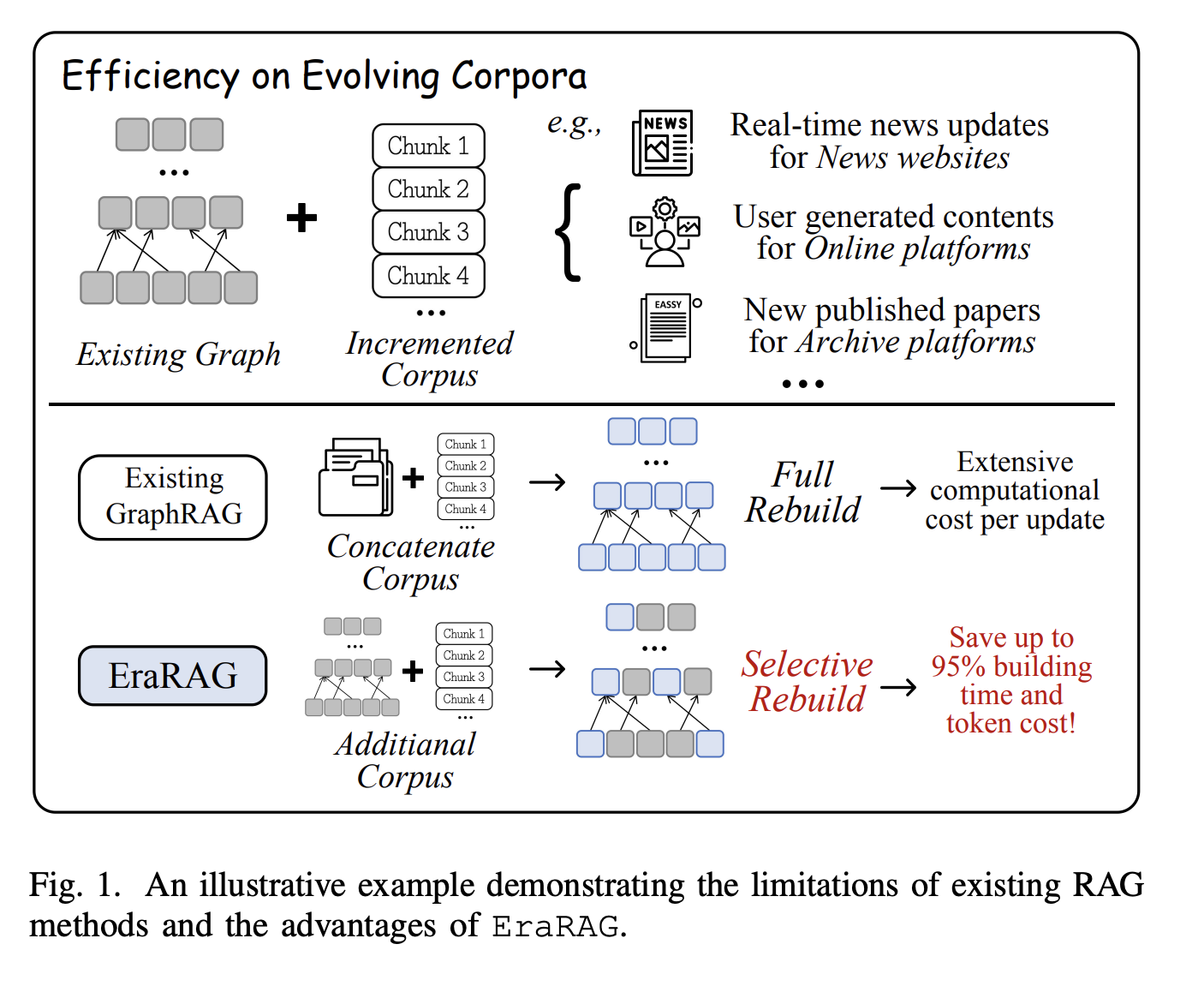
Recognizing these challenges, researchers from Huawei, The Hong Kong University of Science and Technology, and WeBank have developed EraRAG, a novel retrieval-augmented generation framework purpose-built for dynamic, ever-expanding corpora. Rather than rebuilding the entire retrieval structure whenever new data arrives, EraRAG relies on localized, selective updates that touch only those parts of the retrieval graph affected by the changes.
YOU MAY ALSO LIKE

How To Block And Unblock A Number On Your Android Phone

Google Gemini Also Escaped Its Testing Environment And Hacked Three Companies

Core Features:

  • Hyperplane-Based Locality-Sensitive Hashing (LSH):
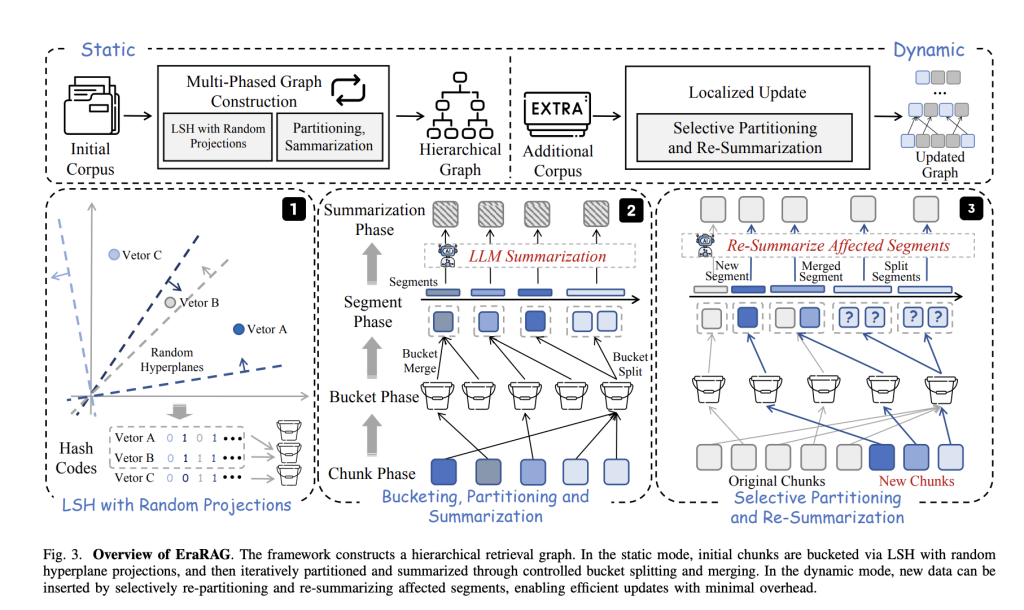
    Every corpus is chunked into small text passages which are embedded as vectors. EraRAG then uses randomly sampled hyperplanes to project these vectors into binary hash codes—a process that groups semantically similar chunks into the same “bucket.” This LSH-based approach maintains both semantic coherence and efficient grouping.
  • Hierarchical, Multi-Layered Graph Construction:
    The core retrieval structure in EraRAG is a multi-layered graph. At each layer, segments (or buckets) of similar text are summarized using a language model. Segments that are too large are split, while those too small are merged—ensuring both semantic consistency and balanced granularity. Summarized representations at higher layers enable efficient retrieval for both fine-grained and abstract queries.
  • Incremental, Localized Updates:
    When new data arrives, its embedding is hashed using the original hyperplanes—ensuring consistency with the initial graph construction. Only the buckets/segments directly impacted by new entries are updated, merged, split, or re-summarized, while the rest of the graph remains untouched. The update propagates up the graph hierarchy, but always remains localized to the affected region, saving significant computation and token costs.
  • Reproducibility and Determinism:
    Unlike standard LSH clustering, EraRAG preserves the set of hyperplanes used during initial hashing. This makes bucket assignment deterministic and reproducible, which is crucial for consistent, efficient updates over time.
Performance and Impact

Comprehensive experiments on a variety of question answering benchmarks demonstrate that EraRAG:

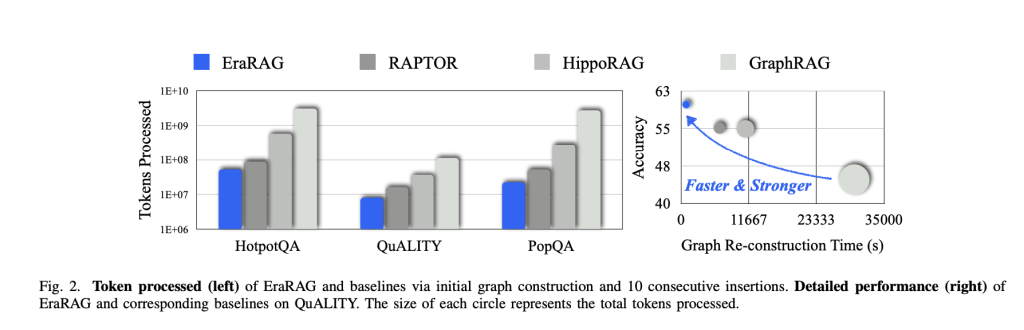
  • Reduces Update Costs: Achieves up to 95% reduction in graph reconstruction time and token usage compared to leading graph-based RAG methods (e.g., GraphRAG, RAPTOR, HippoRAG).
  • Maintains High Accuracy: EraRAG consistently outperforms other retrieval architectures in both accuracy and recall—across static, growing, and abstract question answering tasks—with minimal compromise in retrieval quality or multi-hop reasoning capabilities.
  • Supports Versatile Query Needs: The multi-layered graph design allows EraRAG to efficiently retrieve fine-grained factual details or high-level semantic summaries, tailoring its retrieval pattern to the nature of each query.

Practical Implications

EraRAG offers a scalable and robust retrieval framework ideal for real-world settings where data is continuously added—such as live news, scholarly archives, or user-driven platforms. It strikes a balance between retrieval efficiency and adaptability, making LLM-backed applications more factual, responsive, and trustworthy in fast-changing environments.


Check out the Paper and GitHub. All credit for this research goes to the researchers of this project | Meet the AI Dev Newsletter read by 40k+ Devs and Researchers from NVIDIA, OpenAI, DeepMind, Meta, Microsoft, JP Morgan Chase, Amgen, Aflac, Wells Fargo and 100s more [SUBSCRIBE NOW]


Nikhil is an intern consultant at Marktechpost. He is pursuing an integrated dual degree in Materials at the Indian Institute of Technology, Kharagpur. Nikhil is an AI/ML enthusiast who is always researching applications in fields like biomaterials and biomedical science. With a strong background in Material Science, he is exploring new advancements and creating opportunities to contribute.

Credit: Source link

ShareTweetSendSharePin

Related Posts

How To Block And Unblock A Number On Your Android Phone
AI & Technology

How To Block And Unblock A Number On Your Android Phone

September 19, 2026
Google Gemini Also Escaped Its Testing Environment And Hacked Three Companies
AI & Technology

Google Gemini Also Escaped Its Testing Environment And Hacked Three Companies

September 19, 2026
What Is AI Agent Memory? Short-Term, Long-Term, Episodic, and Semantic Memory Explained – Unite.AI
AI & Technology

What Is AI Agent Memory? Short-Term, Long-Term, Episodic, and Semantic Memory Explained – Unite.AI

September 19, 2026
Linkup Research Releases SPARSEUP: A 149M-Parameter Open-Source Sparse Embedding Model
AI & Technology

Linkup Research Releases SPARSEUP: A 149M-Parameter Open-Source Sparse Embedding Model

September 19, 2026
Next Post
Meta announces its Superintelligence Labs Chief Scientist: former OpenAI GPT-4 co-creator Shengjia Zhao

Meta announces its Superintelligence Labs Chief Scientist: former OpenAI GPT-4 co-creator Shengjia Zhao

Leave a Reply Cancel reply

Your email address will not be published. Required fields are marked *

Search

No Result
View All Result
‘Big Short’ trader Michael Burry slams OpenAI, Anthropic for ‘self-serving’ calls to slow AI

‘Big Short’ trader Michael Burry slams OpenAI, Anthropic for ‘self-serving’ calls to slow AI

September 14, 2026
Reddington says Trump has the ability to put pressure on DA Tim Cruz

Reddington says Trump has the ability to put pressure on DA Tim Cruz

September 15, 2026
Dante Moore struggles as Oregon loses to 24-point underdog Oklahoma State – NBC Sports

Dante Moore struggles as Oregon loses to 24-point underdog Oklahoma State – NBC Sports

September 12, 2026

About

Learn more

Our Services

Legal

Privacy Policy

Terms of Use

Bloggers

Learn more

Article Links

Contact

Advertise

Ask us anything

©2020- TradePoint.io - All rights reserved!

Tradepoint.io, being just a publishing and technology platform, is not a registered broker-dealer or investment adviser. So we do not provide investment advice. Rather, brokerage services are provided to clients of Tradepoint.io by independent SEC-registered broker-dealers and members of FINRA/SIPC. Every form of investing carries some risk and past performance is not a guarantee of future results. “Tradepoint.io“, “Instant Investing” and “My Trading Tools” are registered trademarks of Apperbuild, LLC.

This website is operated by Apperbuild, LLC. We have no link to any brokerage firm and we do not provide investment advice. Every information and resource we provide is solely for the education of our readers. © 2020 Apperbuild, LLC. All rights reserved.

No Result
View All Result
  • Main
  • AI & Technology
  • Stock Charts
  • Market & News
  • Business
  • Finance Tips
  • Trade Tube
  • Blog
  • Shop

© 2023 - TradePoint.io - All Rights Reserved!