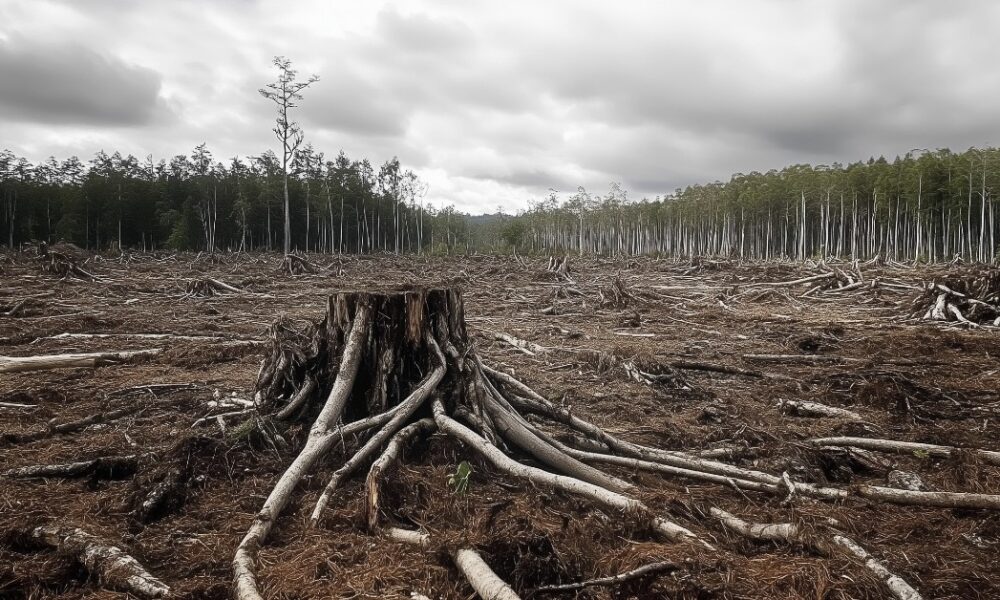

Deforestation has been an ongoing problem for decades. Even as technology has advanced, offenders have held the advantage because there’s simply too much land to cover — until now. Could artificial intelligence be the key to putting an end to illegal deforestation? Both its potential and real-world use cases show promise.
1. Identify Optimal Reforestation Areas
Although deforestation rates fluctuate, more trees are lost yearly. It increased by 4% from 2021 to 2022, amounting to over 6.6 million hectares of forest lost. Even if all illegal logging, mining and agriculture operations cease today, those critical environments will still be at a disadvantage.
If this trend continues unchecked, the world will see temperatures rise, wildlife flee and local ecosystems weaken. An unstoppable dieback process triggers at that point, meaning healthy trees’ conditions progressively deteriorate. This would lead to a domino effect where millions more hectares of forest are lost despite no human-led deforestation.
With AI, activists and local governments can accelerate reforestation, helping forests return to how they were before human intervention. The model can pinpoint areas where replanting would be most effective. It could also identify fast-growing, native tree species resistant to pests and drought. Once the saplings are planted, it can monitor growth in real time.
2. Analyze Satellite Imagery for Forest Loss
For decades, analyzing satellite imagery was one of the few ways to identify deforestation in action aside from the less efficient word-of-mouth or boots-on-the-ground strategies. However, since there are over 3 trillion trees on the planet, there’s a lot of ground to cover. While manually going through these images is impractical, traditional software misses critical details.
AI-powered image recognition technology can detect early indicators of forest loss, including new roads, smoke and new clearings. It can report any positive hit to a human in real time, enabling them to review and report to local law enforcement agencies. Teams can even use AI-powered drones for up-close aerial views.
3. Differentiate Between Legal and Illegal Operations
Sometimes, deforestation is legal. Local governments approve those operations so companies can continue doing business. However, what starts as a sanctioned action doesn’t always stay that way. There are many cases where individuals encroach into protected territory with the understanding that it is better to seek forgiveness than ask permission.
In fact, cropland expansion accounts for almost 50% of deforestation worldwide, closely followed by livestock grazing at 38.5%. With satellite imagery alone, differentiating between legal, semi-legal and illegal deforestation is complicated. AI fills in the gaps by analyzing the color, texture and extent of tree cover, eliminating the guesswork.
4. Analyze Sounds That Signal Deforestation
What does deforestation sound like? Revving chainsaws, falling logs, roaring excavators, distressed wildlife and burning brush. Unfortunately, the noise from heavy machinery, power tools, pickup trucks and conversations between workers is quickly dampened in densely forested areas, making pinpointing those operations difficult.
AI-enabled Internet of Things (IoT) surveillance systems powered by miniature solar panels for acoustic monitoring can be placed just about anywhere, so they can pick up those audio cues. Plus, since animals flee, entering areas they normally wouldn’t as the offenders burn or cut down trees, those cameras may identify potential human interference before logging begins.
5. Trace Illegal Operations to the Source
The Bureau of Investigative Journalism recently discovered beef from farmers was making its way into global supply chains — including those that supply two of the world’s largest meat companies — after they were accused of illegal deforestation and subsequently punished. Despite embargoes, business continued as usual. Some even seemingly continued deforesting.
Illegal deforestation is often driven by local sawmills, refineries and farms. Whether workers want to expand their cropland, sell more products or feed their herds for cheap, they contribute to significant forest loss. Unfortunately, tracing these activities back to their source is difficult. That is, unless people use AI.
AI can track heavy machinery as it moves from newly created clearings back to its base station, helping investigators narrow their search. Alternatively, it can employ facial recognition technology to uncover the identities of those involved. Doing so helps local law enforcement agencies identify repeat offenders, shrinking the gap between assigning and enforcing punishment.
6. Analyze Unarchived Legacy Data
Although data on deforestation stretches back decades, much remains inaccessible to this day. That’s because it is only accessible via unarchived, physical sources like field notes, cassette tapes, written correspondence and preserved biological specimens. This evidence exists in silos, hidden away from traditional tools that scrape online resources.
With AI image recognition, language detection and automatic transcription, researchers can finally secure these valuable insights. This enables them to identify forest loss drivers and reveal repeat offenders. Advanced models can consider context, maintaining accuracy even if offending entities change their names or localities’ borders shift.
7. Enable Proactive Intervention
Although satellite image clarity has been improving for decades — professionals can now pinpoint deforestation with unparalleled precision — this strategy is still reactive. Forest loss still happens even if they immediately intervene upon getting an alert. With AI, they can finally achieve proactive intervention, identifying at-risk areas before clearing begins.
AI can analyze factors like local topography, distance from roads and industrialization rates to determine which areas are most at risk. It can even consider complex elements like the geopolitical climate or the global timber market. Such a tool is no longer hypothetical — one joint research team has developed it.
Researchers at the World Wildlife Fund collaborated with computer scientists to develop an AI called Forest Foresight. It can predict forest loss up to six months in advance with upwards of 80% accuracy. When it recognizes potential illegal operations, it can alert local authorities, stopping deforestation before it starts.
8. Use Sensors to Identify Illegal Activity
Whether illegal deforestation operations use heavy machinery to cut down trees, move farm animals into protected territory or start wildfires to clear land, their actions produce some sort of emission. For instance, a single cow produces up to 264 pounds of methane annually — an entire herd’s gas would be noticeable.
AI-enabled IoT sensors strategically placed in high-risk forests can track methane, carbon monoxide and carbon dioxide emissions. If they suddenly spike, teams can investigate further. This approach could be uniquely effective because the model can consider context, enabling it to filter out false positives and make investigations easier.
9. Provide an Anonymous Tip Line
In the past, activists and law enforcement agencies largely relied on word of mouth to uncover illegal logging operations. While they moved away from that approach once satellite imagery became widely available, it is no less useful. If they were to leverage AI-powered chatbots in affected areas, they could receive insightful anonymous tips on potential forest loss.
Deploying AI for this use case is ideal because a single model can hold dozens — if not hundreds or thousands — of conversations at once. Those interacting with it don’t need to wait for business hours or be put on hold, incentivizing them to send a message. This technology can also analyze semantics, pull keywords and summarize reports for their human counterparts.
Could AI Put an End to Deforestation Once and for All?
Truth be told, AI isn’t a silver bullet. It may do all of the legwork, but many other moving parts exist. Ending deforestation requires buy-in from local politicians, collaboration between investigative groups and publicly available resources. That said, this technology could still be a game-changer, reducing forest loss rates to levels never before seen.

Credit: Source link