
ITkach/iStock via Getty Images
Paychex (NASDAQ:PAYX), a leader in the Human Capital Management software and payroll space in the United States, was founded in 1971 by Thomas Golisano, and went public in 1983. It has been a monster compounder over the years: since 1994 when Seeking Alpha’s data starts, it has delivered a total return of more than 13,700% compared to the S&P 500’s 1,100%.
It’s often a good idea to own leaders and a very good idea to own compounders, but of course, investing is about the future, not the present or the past, so in this article I will evaluate Paychex’s competitive positioning and prospects. I conclude from my analysis that while Paychex still holds some prodigious advantages over its competitors and over American businesses in general, there are areas of vulnerability. My valuation model suggests that market equalling returns are likely over the medium to long term, and as such, there is no margin of safety, which I would need to recommend a buy.
The Business
Paychex has quite a few offerings which help small and medium-sized businesses deal with their HR and payroll needs:
-
A SaaS HCM application (desktop and mobile) which “utilizes a single cloud-based platform, with single client and employee records. Clients can select the modules they need and easily customize solutions as they grow.”
-
A Payroll Service through which 1 in 12 US private sector employees are paid.
-
HR Outsourcing, consisting of Professional Employee Organization (PEO) whereby HR professionals known as Worksite Employees (WSEs) are co-employed by Paychex and the client to provide HR, and Administrative Service Offering (ASO), whereby HR functions are outsourced by the client to Paychex.
-
Retirement Accounts and Insurance: Paychex is the No. 1 401(k) recordkeeper in the US. They also act as an insurance broker for their clients to provide business cover as well as cover for employees. They do not underwrite the policies or take on any of the risk but work with a variety of insurance partners.
-
Support, the nature of which depends on the client. Smaller clients may use only self-serve tools, some may use a call center, larger clients may have a relationship manager.
There is plenty to like about the business model, though it is a little complicated. Firstly, the payroll space is a great one to be in. There are high switching costs because of the inconvenience and risk of switching providers. It is recurring revenue, as businesses must run payroll regularly – it’s not optional. It’s also levered to the continued growth of the US economy and job market, which, despite the occasional recession, has trended over time in only one direction since 1776. And we mustn’t forget the fact that the company earns interest on funds held for clients’ payroll, which is effectively all profit. This amounted to $146m in FY2024, or 6.7% of Operating Income. Granted, this was in a year of the highest interest rates since the GFC, but the opportunity to access such easy profits is not available to the vast majority of businesses.
The HCM software space is a profitable one too. Given the huge economies of scale inherent in software business, Paychex’s position as one of the most used solutions gives it an advantage and makes it very profitable. Moreover, though Automatic Data Processing (ADP) may have a larger client base, the fact that it doesn’t have a single solution but rather multiple pieces of software for different sections of the market means that Paychex is making more efficient use of these economies of scale which I think shows up in its superior margins.
Outsourcing could be more of a mixed picture. This model allows the company to offer services to that segment of the market that doesn’t want to spend much of their time and energy on HR functions. It also allows smaller companies to offer a better HR experience, for example, on the Q4 conference call, management said: “Our PEO clients are able to attract top talent by offering a Fortune 500 suite of employee wellness benefits”. Thus, PEO and ASO are revenue drivers that increase the number of customers Paychex can go after. But given the greater number of HR experts required to deliver PEO and ASO services, the margins are bound to be smaller than the software and payroll businesses (Paychex doesn’t break down its margins by business line).
However, the evidence of the recent past seems to suggest that Paychex can maintain and even improve its industry-leading profit margins while expanding the PEO business line. The table below shows that while Worksite Employee count has grown significantly and the PEO and Insurance segment has grown slightly as a percentage of revenue since 2019, operating margin has expanded.
|
Years |
WSEs |
PEO % of Rev |
Operating Margin |
|
2019 |
1,491,000 |
22.1% |
36.3% |
|
2020 |
1,428,000 |
25.1% |
36.1% |
|
2021 |
1,680,000 |
24.4% |
36.0% |
|
2022 |
1,977,000 |
24.4% |
39.9% |
|
2023 |
2,168,000 |
24.0% |
40.6% |
|
2024 |
2,332,000 |
24.7% |
41.2% |
So it seems that Paychex can increase its client base and share of wallet by offering a full service solution without sacrificing margins.
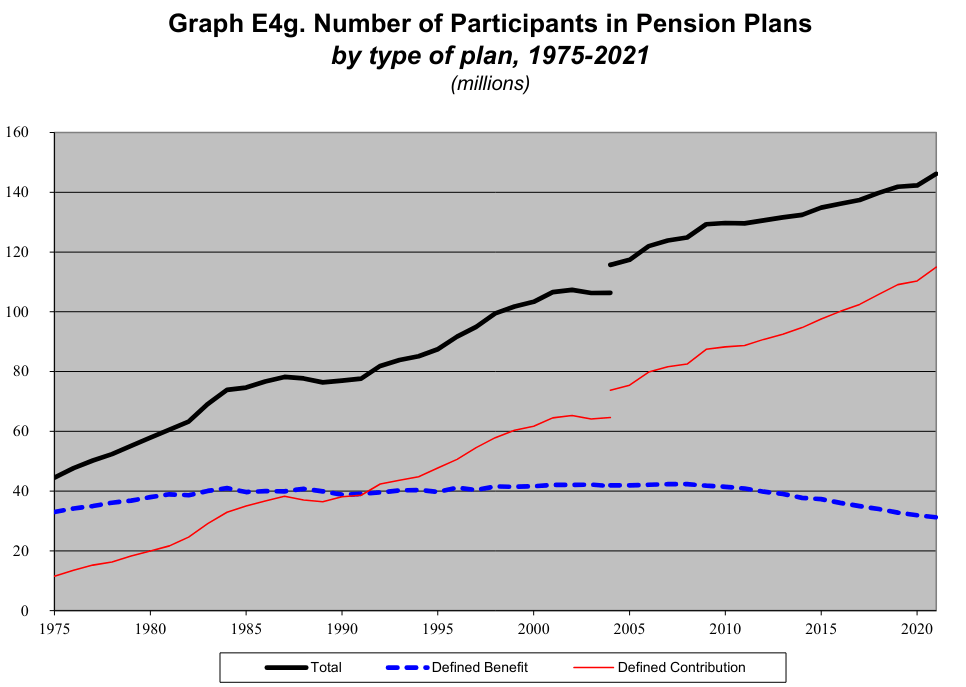
I like to see the company expanding into verticals like retirement accounts and insurance. Paychex, as well as its competitors, benefits from the increasing complexity of HR, of which retirement accounts are a part. Retirement accounts is a huge and growing area with more and more people are contributing to defined contribution plans, which are mostly 401(k)s, as this chart from the Department of Labor shows.
US Department of Labor
In the most recent quarter, the company reported that retirement services saw double-digit revenue growth, and that they had $52bn assets under management for 120,000 clients. They also mentioned that according to their own data, less than half of US employers currently offer a retirement plan.
Insurance is another avenue to get more fees from clients. They are offering products for “property and casualty coverage such as workers’ compensation, business-owner policies, cybersecurity protection, commercial auto, and health and benefits coverage, including health, dental, vision, and life”. I should note here that Paychex is not underwriting the insurance. Taking on such risk and trying to break into a completely different industry would be a big risk, but fortunately, they are just an intermediary picking up fees – a much better idea. It’s difficult to fully grasp the dynamics of this business because the company doesn’t break out the numbers, but I imagine it is quite high margin. It also shows Paychex is taking advantage of the increasing complexity of HR and is likely gaining a greater share of wallet. The insurance vertical has, as the company puts it, “a long-term positive impact on lifetime value in our model”.
In summary, Paychex has created a business which offers essential services to clients with economies of scale, high switching costs, low capital requirements and very high margins. These are extremely attractive qualities and explain why the stock has compounded at such a high rate for such a long time. Now I will look forward to the future of the business and the competition it faces to see if its future can be as successful as its past.
The Future
Growth
In the mid-term, Paychex is targeting high single digit revenue growth and high single digit to low double-digit growth in adjusted earnings and dividends. They intend to achieve this through operating leverage. Such results would be similar to recent history, with revenue having grown 7.7% a year and EPS 10.6% in the last 10 years. In the Investor Presentation, the company estimates that market growth will be around 6% and that it has about 14% of small- and medium-sized business employees in the US on its platform. Therefore, its revenue growth goals seem to be reasonable, projecting only minor growth in market share.
Another potential avenue for growth would be international expansion. Currently, Paychex generates substantially all of its revenue in the US. But this move would come with as many risks as it would opportunities, and despite the potential revenue re-acceleration it could offer, the increased complexity of operating in ever more jurisdictions would increase the complexity of the business’s operations and might result in decreased margins. This is another reason why I think ADP’s margin profile is not as good as Paychex, in spite of its greater scale.
Can Paychex grow earnings faster than revenue, as they intend to do? Paychex’s margins are already astonishingly high, but given the economies of scale inherent in the growth of its software product, it’s also conceivable to see growth in margins. Another positive for margins is that, although interest rates are likely to decline over the next year, over the next 10 years they are likely to be higher than they were on average over the previous 10. Along with a growing base of funds held for clients, this means a substantial amount of high margin interest income which can certainly offer margin support.
The company credits recent increases in operating margin to “our cost-saving initiatives, really trying to find ways to continue to enhance our digital capabilities, find ways to be more productive”. It’s impressive that they can still do this with operating margins over 40%, but it’s not clear to me that this productivity drive will continue to yield results year-after-year. Paychex’s current operating margins put it in the top 5% of the S&P 500, and that 5% includes many companies whose operating margins have seen an unsustainable spike. As outlined above, I can see reasons why margins might expand, but I can also see reasons why they might contract, and with such a high starting point, it’s difficult to imagine very meaningful margin expansion in the future.
Competition
Both payroll and HCM software industries are quite competitive in that there are a lot of solutions on the market. I think the reason for this is that businesses are so varied in their needs that they don’t all choose the same solution. We can see this in the fact that, as far as I can see, only ADP offers a solution to every segment of the market (small, medium and large businesses) while everyone else seems to focus on one or two of those segments.
So what is Paychex’s competitive position? Their software has received the Best SMB-focused Solution in the Core HR/Workforce category at the HR Tech Awards four years in a row. They have also received multiple awards for excellence in technology, most recently from the BIG Innovation Awards. It’s good to see the company getting recognition for its software, but I find it more instructive to look at measures of customer satisfaction, as I think this has a more direct read-through to success in the market.
On the customer side, the picture is not as rosy. In the company’s most recent 10-K, the company says, “Our ongoing investments in our platforms have prepared us well for the demands of the current business and regulatory environments, allowing us to adapt while maintaining strong solutions and support delivery, resulting in high levels of client satisfaction and retention.” However, data from Comparably shows that Paychex has a Net Promoter Score (NPS) of -14, meaning that more people have a negative view of the company’s products and services than have a positive view. The Customer Satisfaction Score (CSAT) comes in at 34. Compared to some of its competitors, we can see that these are not good scores:
|
NPS |
CSAT |
|
|
Paycom |
67 |
92 |
|
monday.com |
51 |
81 |
|
Workday |
31 |
73 |
|
Paylocity |
-6 |
47 |
|
ADP |
-8 |
51 |
|
Paychex |
-14 |
34 |
|
Rippling |
-35 |
41 |
|
Paycor |
-40 |
24 |
Paychex understandably does not share its internal customer satisfaction data, so it’s entirely possible that it shows a different picture. I’m not sure how to assess the accuracy of the data from Comparably, which seems to be crowdsourced from users of the platform. It’s unclear whether these reviewers are verified users of Paychex’s products, and how many of them there are, so Paychex’s internal numbers – whatever they are – will probably be more reliable.
Nonetheless, in the absence of an explanation, a persistence of low NPS and CSAT public scores would be a concern for investors. Although the product is quite sticky by nature, if customers are unhappy enough with it, they will eventually change. So let’s see if they are changing. Fortunately, Paychex does share customer retention details in its annual reports. As you can see, this has been trending upwards over time:
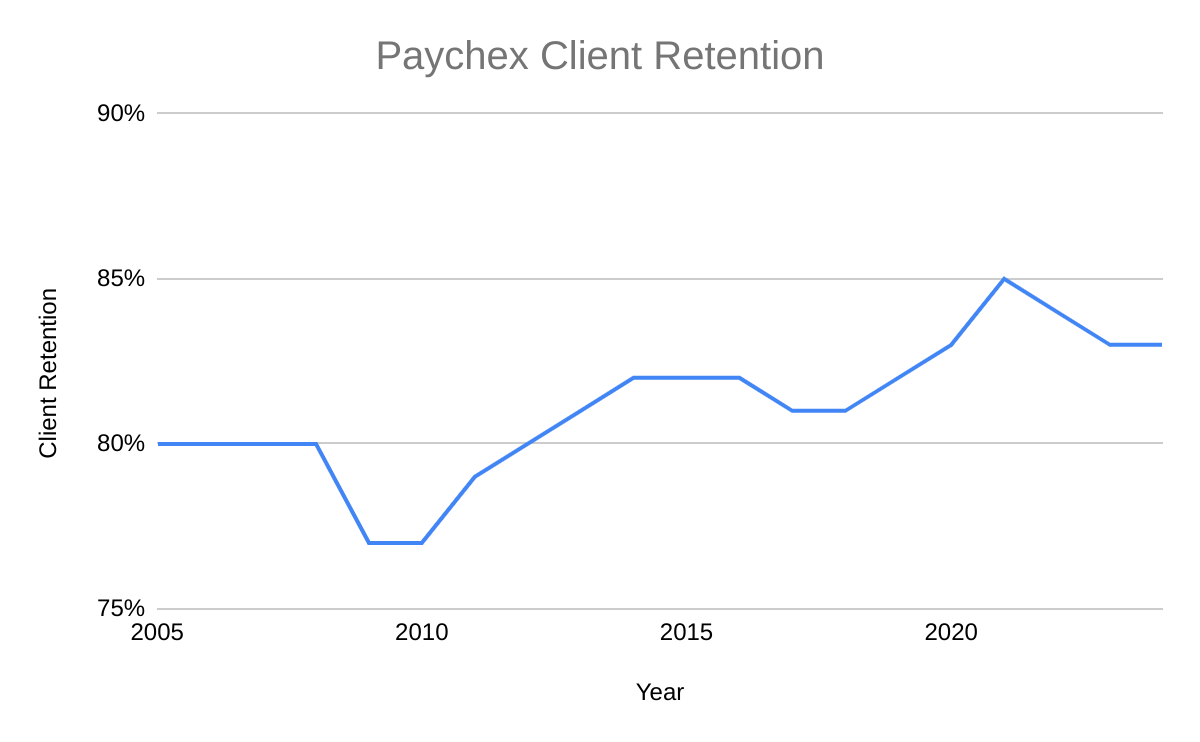
Chart by the Author (Paychex Annual Reports)
These figures are not as impressive as some competitors – Paycom (PAYC) and ADP post 90%+ retention – but the numbers are not directly comparable. Paychex is giving us client retention, meaning the percentage of customers at the start of the year who were still customers at the end of the year. Paycom and ADP are giving us revenue retention, which compares the revenue from customers in one year to the revenue from the same customers in the next. Thus, if a company has 10 clients paying $10m each in year 1, and at the end of year 2, one of those clients has left, and the others spend $11m each, the client retention is 90%, but the revenue retention is 99%. So the difference between the retention rates between Paychex and competitors should not be a huge concern. The fact that it is trending in the right direction (despite reversion from the record level induced by the pandemic) is definitely a positive sign.
In summary, Paychex has created a business with economies of scale, low capital requirements, stability and still some opportunities for high single digit growth. The fact that its product doesn’t seem to be as popular as those of some of its competitors is a concern, but customer retention is on the rise, which suggests that this problem is being addressed.
Capital Allocation
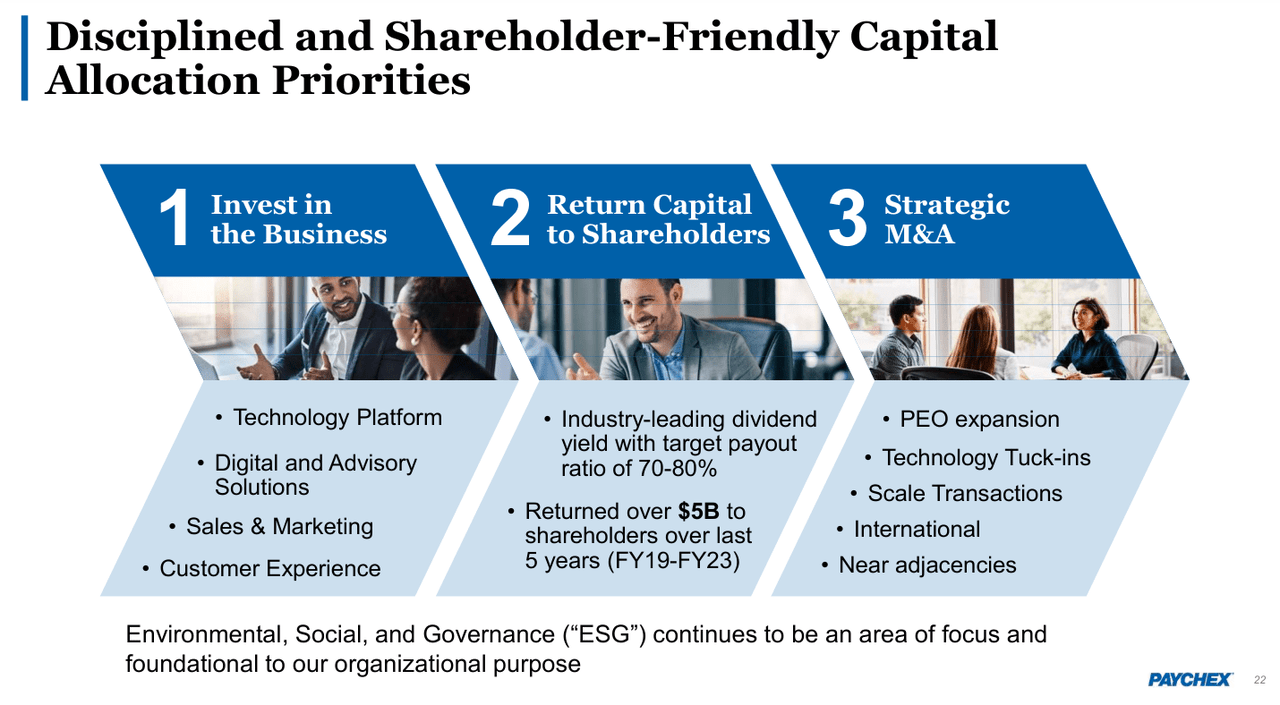
Paychex clearly states its capital allocation strategy in its most recent investor presentation:
Paychex Investor Presentation
This is certainly the right order of priorities for a business in this stage of its life. However, I am not fully on board with the execution of the second priority. For some businesses, a payout ratio this high would be concerning. Not for Paychex. Their earnings are so consistent that they can pay the majority of them out to shareholders immediately without fear of having to cut the dividend. However, I think a more balanced approach to shareholder return of both buybacks and dividends might create more value over the long run.
Paychex does have a buyback authorization of $400m, approved in January. However, that’s less than 1% of the market cap and previous authorizations have served only to offset share dilution, with diluted share count stable over the last 10 years. This is the company’s stated goal of buybacks – to keep share count stable – and although I have looked through earnings transcripts going back to 2017, I can’t find an explanation of why they have chosen not to shrink the float. I think a more balanced approach between buybacks and dividends would have some positive effects:
-
It would make the stock attractive to a wider range of investors. If a company can offer both yield and capital appreciation, it will attract a larger pool of investors. If Paychex’s EPS growth slows a little, unsupported by buybacks, growth investors are likely to give it a pass and leave it to dividend investors. A buyback could add at least a point, maybe two, to annual EPS growth, likely garnering a higher multiple.
-
Depending on the valuation of the stock, buybacks may be a more efficient allocation of capital. If Paychex were trading at 15 times earnings and the management knew they would get through the tough period, buying back shares voraciously would create much more shareholder value long-term than if they chose to pay out 80% of earnings in dividends.
-
Buybacks mean you can spend less on dividends in the future while providing the same payout. Imagine there are two versions of Paychex 10 years from now: in the first scenario there are the same amount of shares outstanding as today, in the second scenario there are 10% fewer. If the dividend payment per share is the same in both scenarios, the company in the second scenario is spending 10% less in dollar terms on dividends.
-
It’s (still) more tax efficient, despite the recent introduction of a buyback tax.
To put these thoughts in context, I’ll quote from Warren Buffett’s 2023 letter to Berkshire Hathaway (BRK.B) shareholders: “I add my usual caveat: All stock repurchases should be price-dependent. What is sensible at a discount to business-value becomes stupid if done at a premium.”
Competitor ADP has adopted this approach and is decreasing its shares outstanding by more than 1% per year. It is also targeting 13% EPS growth compared to Paychex’s 11% despite being a more mature company. Much of this difference is accounted for by the fact that they are reducing share count.
To summarize, I think Paychex’s business will continue to prosper over the long term because it still has room to grow in a growing market, it will continue to benefit from economies of scale, it is run very efficiently, and its product has high switching costs. However, I do have concerns that their product is not as well liked as some others in the industry, though increasing client retention suggests that this has not posed much of a problem so far. I also think that the company is not returning capital to shareholders as efficiently as it could, and this could reduce returns.
Valuation
For my valuation of Paychex I have used the following assumptions:
-
Revenue Growth: 7.5%, in line with the past 10 years and medium-term guidance.
-
Net Margin: slight expansion. Management continues to work on operating efficiency, and some leverage may be left in the scaling of the business. However, margins are already so high and so much better than the rest of the industry that I’m skeptical they can expand hugely, so margin expansion slows in the second half of my model.
-
Shares Outstanding: stable. The company’s policy is to use buybacks only to offset dilution, so I assume that continues.
-
PE Ratio: Paychex does deserve a premium valuation because of its extraordinary margins, predictable business and history of execution. But given current market multiples are at the upper end of the historical range, I expect the P/E ratio may moderate slightly over the projected period.
Here is the result:
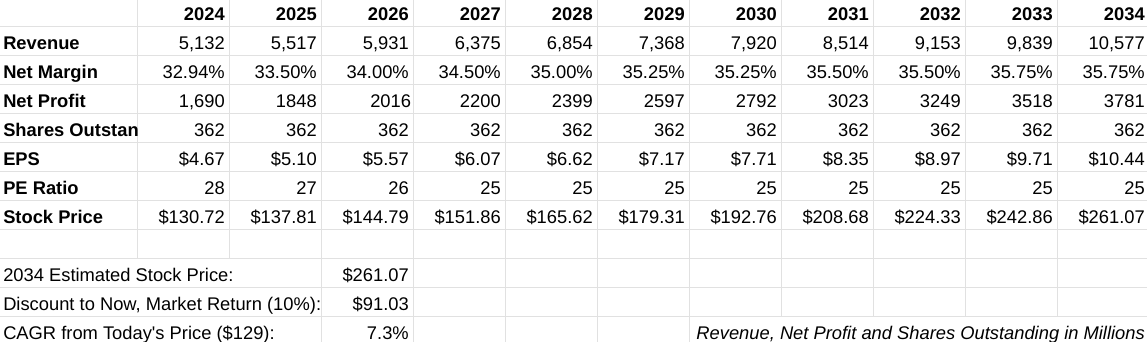
Model by the Author
Given these inputs, Paychex would appreciate at just over 7% a year for the next 10 years. Adding the current dividend yield, we are looking at a TSR of just over 10% a year. This is not to be sniffed at, but is in line with the historical average of the S&P 500. Therefore, I think it’s unlikely that Paychex investors will see great returns in the medium term. To hope for much more than I have bargained for in the model (e.g. double-digit revenue growth or mid-teens EPS growth) would be over-optimistic, and so, I think the most likely scenario in which Paychex investors would see market-beating returns over this period would be if the market sees a period of below-par returns. Paychex, with the predictability of its business and strong model, might do well by comparison.
Given the attractive aspects of Paychex business described above and the likelihood of many of those advantages persisting, I couldn’t recommend that investors sell Paychex. But my analysis also leads me to believe that we’re unlikely to see very good returns over the next 10 years, and even if that were a distinct possibility, the current valuation provides no margin of safety in the event I have miscalculated. Therefore, I rate Paychex shares a hold.
Credit: Source link