




PM Images
Written by Nick Ackerman, co-produced by Stanford Chemist
We last covered Allspring Utilities and High Income Fund (NYSE:ERH) roughly a year ago. This is a closed-end fund that is focused on exactly what its name would imply: investing in utilities and high-yield bonds. This is a rather unique mix, but there are several CEFs that offer a similar approach. After all, it does kind of fit if an investor is looking for a more income-oriented CEF. Utilities tend to pay steady and growing dividends, while the high-yield bonds can help to ‘juice’ up the payout.
Shortly after our prior update, the fund dropped dramatically. This was alongside all income-oriented investments and really the broader equity market as a whole. Risk-free yields climbed to heights not seen since before the Global Financial Crisis last October, which was the main driving culprit – that and a bit of discount widening for ERH as well. However, there has been a fairly dramatic recovery since, even while the discount has widened further.
ERH Performance Since Prior Update (Seeking Alpha)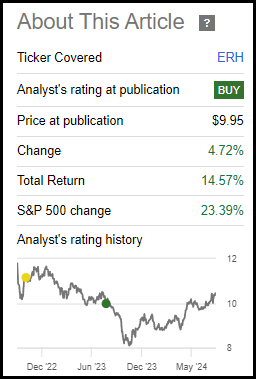
I believe that continues to make it a fairly interesting fund to consider in this space.
ERH Basics
- 1-Year Z-score: 0.83.
- Discount/Premium: -11.24%.
- Distribution Yield: 8.16%.
- Expense Ratio: 1.01%.
- Leverage: 21.76%.
- Managed Assets: $137.9 million.
- Structure: Perpetual.
ERH’s investment objective is “a high level of current income and moderate capital growth, with an emphasis on providing tax-advantaged dividend income.”
To achieve this objective, the fund will simply invest “approximately 70% of its total assets to a sleeve that places a focus on common, preferred and convertible preferred stocks of utility companies and approximately 30% of its total assets to a sleeve of U.S. dollar-denominated below investment grade (high yield) debt.”
There is a small fund, with just over $100 million in net assets. With leverage, they can lift the total managed assets up to nearly $138 million. That still makes it quite small, and that can be an issue for larger investors due to rather limited daily liquidity; exiting and entering sizeable positions could be fairly difficult in a rapid manner.
Performance – Discount Remains Attractive
The fund isn’t at the greatest depths of its discount over the last 1-year period, but it has widened out since our last update. The 1-year z-score comes in at 0.83, which also reflects that while it isn’t a bargain on a shorter-term basis, it also isn’t looking too expensive.
For the longer term, the fund is trading well below its average discount. That doesn’t mean it will ever go back to its average, but it indicates that on a relative basis, it is a much better deal these days.
YCharts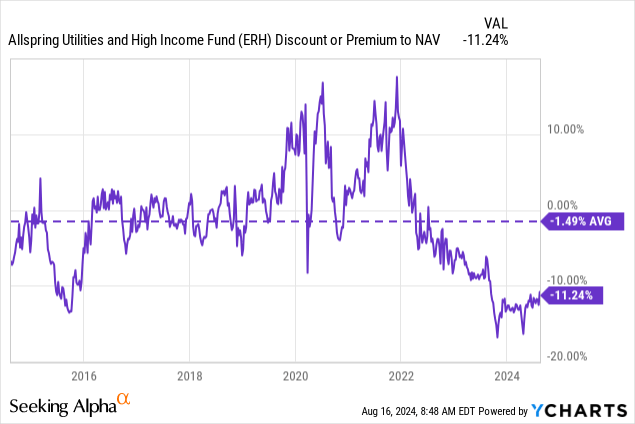
With utilities and fixed-income not being in favor for most of the last several years with higher interest rates and risk-free rates, there is certainly a reason for the wider discount. However, with rate cuts on the horizon, and actually the first one expected to be rather soon in September, that should bode well for ERH. It could benefit from its leverage costs declining, but also if risk-free rates continue to trend lower as they have been, it can make ERH’s underlying portfolio relatively more attractive. In turn, that would also make ERH look relatively more appealing, too.
Therefore, that could be a potential catalyst to push the fund back to a narrower discount, at least from the depths of these double-digit levels. If that occurs, investors would get the benefit of further upside potential.
Distribution – 7% Managed Policy
With the fund’s current distribution policy, the payout is adjusted every month based on 7% of the fund’s average NAV of the prior 12 months. So, as declines were occurring in the underlying portfolio from months ago, it still impacts the payout today, which kept it going lower. Since beginning the strong recovery, it has now leveled off for several months.
ERH 1-Year Distribution History (CEFConnect)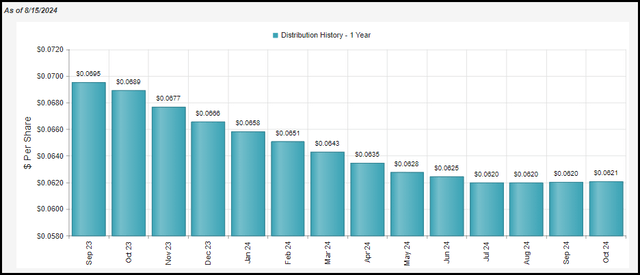
Given the 6.34% NAV distribution rate currently, that indicates that the fund’s distribution is likely to head higher, assuming we don’t see a significant decline or plunge in the near term. As another point, the monthly distribution would be $0.685 if it were calculated at 7% of the NAV today and then divided by 12. Since the fund is trading at a discount, the actual rate investors can collect is also a bit higher, at 7.15%.
They initiated this policy in late 2019, and it had been fairly stable initially. However, given the pressures on utilities and fixed-income investments over the last several years now due to the Fed hiking interest rates and risk-free rates rising, the fund’s distribution had been largely trending lower.
ERH Distribution History (Seeking Alpha)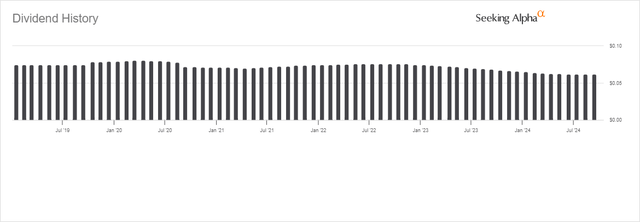
I believe overall, this distribution policy is a good one even if most income-oriented investors that focus on CEFs probably tend not to like the monthly variable nature. They also probably don’t like that it is ‘only’ 7%, but that should actually be an otherwise long-term sustainable rate. With lower rates highly expected over the next year, we should see some of this trend reverse.
To cover the distribution, the fund will rely on capital gains, as does any infrastructure fund. That said, the high-yield bonds within its portfolio also provide some decent net investment income coverage, at least relatively speaking. The latest NII in the semi-annual report puts it at nearly 50%. With a variable distribution, though, each period is going to pay a different amount in distributions.
ERH Semi-Annual Report (Allspring)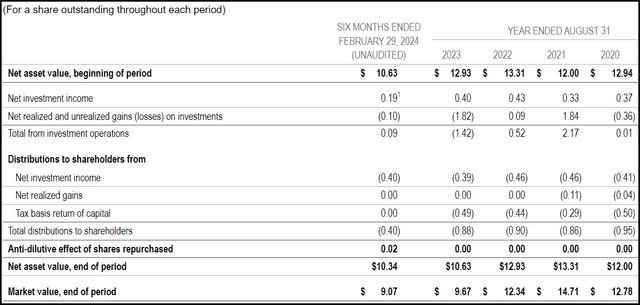
NII was also under pressure with the higher rate environment due to the fund utilizing leverage based on a floating rate. Last year, the interest expense based on the fund’s total managed assets added to the expense ratio of 1.44%, with the latest report showing 1.95%. At the end of fiscal 2022 and 2021, this was as low as 0.32% and 0.17%, for some perspective.
For tax purposes, we have seen the return of capital distributions as the fund has realized losses over the last couple of years.
ERH Distribution Tax Classification (Allspring)
Though the portfolio was still sitting at nearly $4 million in unrealized gains. Further, if utilities climb going forward, those unrealized gains could continue to grow as they have been more recently. That means we might not expect to see ROC in distributions going forward.
Also, while some ordinary income listed could be classified as qualified, given the high-yield bonds, some will likely be taxed at ordinary income rates. For example, they listed that $2,692,682 of the $3,584,511 for fiscal 2023 was considered qualified, but the remainder would have been ordinary income.
ERH’s Portfolio
Consistent with the fund’s policy, utilities comprise the bulk of the portfolio. The fixed-income allocations are then spread amongst various other sectors, which helps to provide some further portfolio diversification. Speaking of diversification, the fund lists 297 holdings with a turnover rate of 23.6%.
The weightings were also fairly consistent with what we saw previously, with utilities at a 66.56% allocation.
ERH Sector Allocation (Allspring)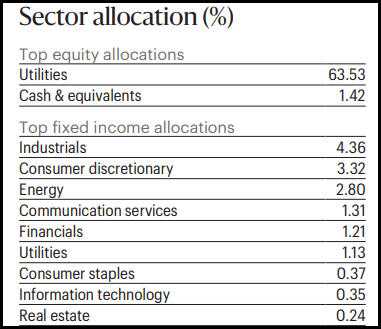
The fixed-income sleeves gyrated a bit, with the top sector weighting being consumer discretionary at 6.62%. On a relative basis, that’s a material shift as it has seen a nearly 50% reduction in the allocation, but on an absolute basis, that isn’t all that meaningful to the overall fund’s exposure.
Looking further at the fixed-income credit quality breakdown, this fund truly is focused on “high income” with its mostly “junk” portfolio. Only a small fraction of this sleeve is allocated to what is considered investment-grade rated at BBB or higher, which comes to 3.06%. The fund is also invested in about 10% CCC and below, which means in default or basically any simple thing that goes wrong, and they will be. Then again, 10% of a roughly 30% sleeve of the portfolio ends up not being very material.
ERH Fixed-Income Portfolio Credit Rating (Allspring)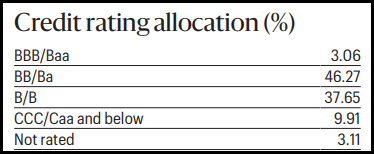
Worth noting is that while there are 297 holdings and utilities make up the largest sleeve by far, there are actually only a relatively small number of these holdings being equity utility positions. As of their latest full quarterly holdings list, it came out to just 22 holdings. That means an overwhelming majority of the number of positions are spread amongst the high-yield bonds. That’s a common approach when it comes to investing in that space, as it will require many to fail to take the fund down with it.
This also translates into meaning that each equity utility position in the fund tends to be larger, which is reflected in the fund’s top holdings. All of these are utility positions, and they are all positions in the common stocks of these holdings as well.
ERH Top Ten Holdings (Allspring)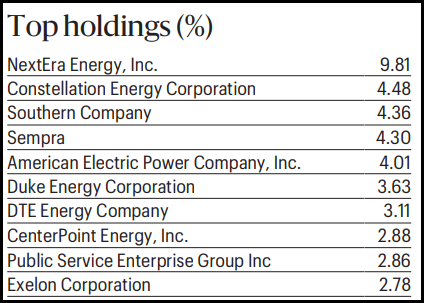
NextEra Energy, Inc. (NEE) has remained the fund’s top holding in the fund, and overall, most of the other top holdings have remained consistent as well. Xcel Energy Inc. (XEL), Dominion Energy, Inc. (D) and CMS Energy Corporation (CMS) are missing names, which have been replaced by Constellation Energy Corporation (CEG), CenterPoint Energy, Inc. (CNP), and Public Service Enterprise Group Incorporated (PEG).
At the end of May, XEL, D, and CMS were still positions in the fund. However, the top ten listed above are as of the end of June 30, from the fund’s fact sheet. It is possible that they sold down or out of those positions during the month. On the other hand, it is quite possible that they are still holding these positions, as it is quite likely that the natural movement of the underlying prices saw the weightings of these changes.
Conclusion
ERH trades at a double-digit discount, which is unusual for this fund. The headwinds of higher rates when running a utility and high-yield fixed-income portfolio were certainly likely factors pressuring this fund to a wider discount.
However, with rate cuts on the near-term horizon, those pressures could start to ease. We’ve already seen a bit of a taste of that recovery since last October, but the Fed hasn’t even actually cut their target rate, which would benefit the fund’s cost of leverage. When that occurs, that could help make ERH look more appealing, as its NII could help to cover more of the distribution. If risk-free rates continue to trend lower, then the underlying income-oriented portfolio could benefit as it becomes more competitive in terms of yield relative to Treasuries.
Credit: Source link