

MoMo Productions
My journey as an investor began sometime around 2008. The financial collapse that occurred from 2008 to 2009 was truly formative for me. But it has only been a little over a year now since I’ve started digging deep into financial institutions. The driver behind this shift was the banking crisis that began in March 2023. At that time, I felt it would be a good opportunity to go bargain hunting, and from that time through today, I have found some rather interesting financial firms for investors to consider.
One of the companies I have since come across is Tompkins Financial Corporation (NYSE:TMP). With a market capitalization of $790.9 million, the institution is not exactly large. But it’s far from the smallest I have looked at. As interesting as I find the company, I sadly can’t be terribly optimistic about it. Based on how shares are priced, both on an absolute basis and relative to similar firms, and based on the overall health of the institution, the best rating that I can give it is a ‘hold’. And even that seems a bit generous.
An interesting financial firm
According to the management team at Tompkins Financial, the company operates as a financial holding company. At its core is Tompkins Community Bank, a wholly-owned banking subsidiary that the company has. At the end of the 2023 fiscal year, this particular business had 56 offices, with 40 of them located in New York and the other 16 in Pennsylvania. Through these, the company has provided customers with a wide array of financial products such as mortgages, consumer loans, commercial loans, agricultural loans, and more. However, this is not a pure play in the banking sector. Like so many other financial institutions that are out there today, Tompkins Financial also has some other assets under its belt.
For instance, the institution has an insurance agency subsidiary known as Tompkins Insurance that it has operated since 2001. Through this, the company originates property and casualty insurance policies, and it also engages in employee benefits consulting, life, long-term care, and disability insurance activities. Its wealth management services fall under a different subsidiary by the name of Tompkins Financial Advisors, with the offices under this name co-located within its bank branches.
Author – SEC EDGAR Data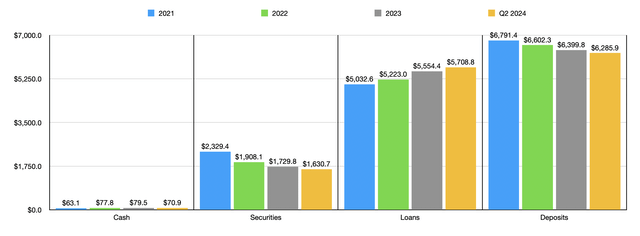
One thing that you want to see from banks is pretty consistent growth in deposits. Unfortunately, you’re not going to get that here. From 2021 through the end of 2023, total deposits at the institution fell from $6.79 billion to $6.40 billion. Unfortunately, deposits continue to shrink into 2024, dropping to $6.29 billion by the end of the second quarter of this year. This has been a pretty difficult environment for banks. I say this because high interest rates have made it difficult for banks to attract and retain capital. And sadly, Tompkins Financial does look to be a casualty of this.
Even in its annual report for the 2023 fiscal year, the company specified that the primary reason for the recent drop in deposits has been ‘inflation and persistent rate competition’ caused by current market conditions. What’s more, while we don’t have data for the most recent quarter, we do know that 45.3% of all deposits at the end of 2023 were uninsured. Admittedly, once we remove collateralized deposits from the mix, this drops to 25%. But the overall amount of 45.3% is well above the 30% maximum threshold I tend to prefer.
Even though the value of deposits has dropped in recent years, the opposite has occurred when it comes to the value of loans on the company’s books. These grew from $5.03 billion in 2021 to $5.55 billion in 2023. By the end of the second quarter of this year, loans had grown further to $5.71 billion. Seeing the value of loans increase at a time when deposits are falling is very uncommon. But this was made possible by a couple of factors. For starters, the value of securities dropped instead, falling from $2.33 billion to $1.63 billion over this window of time. And second, the company saw an increase in debt from $190.8 million to $809.6 million. Meanwhile, cash remained in a fairly narrow range of between $63.1 million and $79.5 million.
Author – SEC EDGAR Data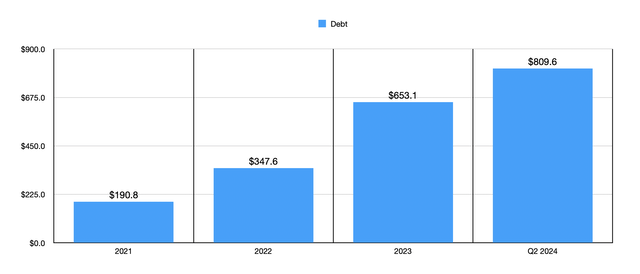
The changes in the company’s balance sheet, combined with contracting net interest margins, caused some interesting changes in the income statement. In 2021, Tompkins Financial generated net interest income of $226 million. This ticked up modestly to $227.5 million in 2022 before falling to $205.2 million last year. Higher rates on deposits, combined with higher rates on a larger amount of debt outstanding, played a role in this. In addition to this, during this three-year window of time, non-interest income for the company plummeted from $78.8 million to $10.2 million. There were multiple drivers behind this. But it is worth noting that the largest, by far, was a massive $70 million loss on securities transactions as the company sold securities in 2023. This was instrumental in pushing net income down from $89.3 million in 2021 to $9.5 million in 2023. For the purpose of valuing the company, I have decided to use an adjusted figure that adds back this loss on securities transactions, and that accounts for the change in taxes from this add-back. In this case, we get an adjusted net income figure of $65.1 million.
Author – SEC EDGAR Data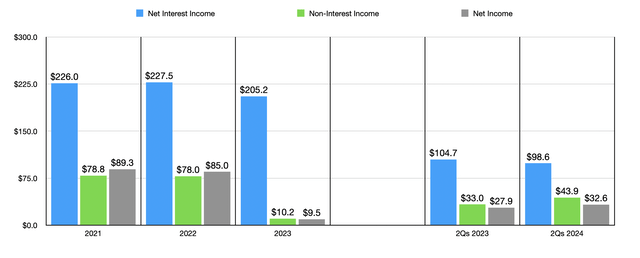
In the chart above, you can also see results for the first half of 2024 compared to the first half of 2023 (as well as for the past three fiscal years). Net interest income, once again, dropped on a year-over-year basis. And thanks in large part to a massive improvement in losses on securities transactions, non-interest income for the bank rose from $33 million to $43.9 million. This was helpful in pushing net income up from $27.9 million last year to $32.6 million this year. So at least we are starting to see some improvement on that front.
Author – SEC EDGAR Data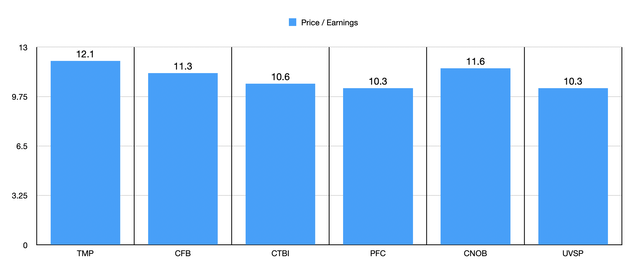
When it comes to valuing the company, there are multiple approaches that we can use. The first would be the price-to-earnings approach. In the chart above, you can see the adjusted price-to-earnings multiple of Tompkins Financial compared to five similar firms. With a reading of 12.1, our candidate was, unfortunately, the most expensive of the group. Another way to value the institution is by using the price-to-book approach and the price-to-tangible book approach. Both of these, stacked up against the same five companies, can be seen in the chart below. On a price-to-book basis, four of the five companies ended up being cheaper than our candidate, while another was tied with it. And on a price-to-tangible book basis, all of them were cheaper.
Author – SEC EDGAR Data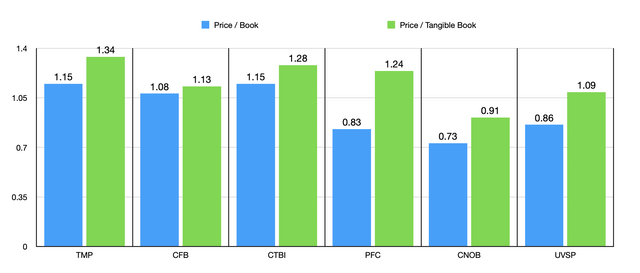
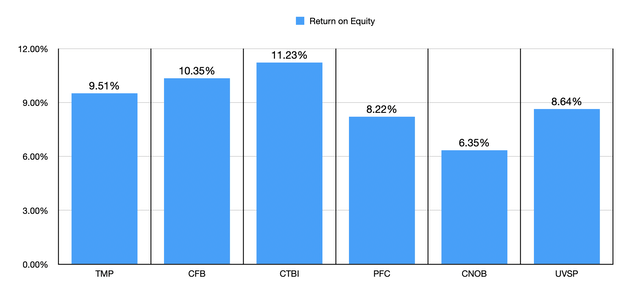
A high valuation can be justified when asset quality is also high. But unfortunately, we don’t see that being the case either. The average return on assets for the institution, shown in the chart below, is just 0.81%. Only one of the five companies that I compared it to have a reading lower than this. The picture is a bit better when using return on equity. The 9.51% reading that we get means that three of the five companies are lower than our candidate.
Author – SEC EDGAR Data Author – SEC EDGAR Data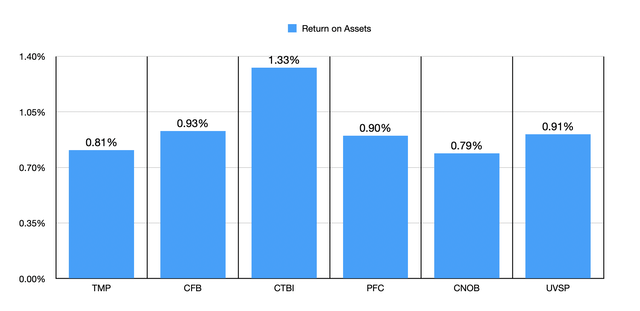
Takeaway
Fundamentally speaking, there’s not a lot about Tompkins Financial that makes me excited. Its price to book multiple was not terrible in a vacuum. The same holds true of its return on equity. I do like that we are seeing some improvement from an income statement perspective and I like seeing the growth in the value of loans on its books. But beyond this, the picture for the company is less than great. Consistent declines in deposits and securities, as well as rising debt, are discouraging. Asset quality is mediocre and shares are a bit lofty on a comparable basis. To be honest with you, I was very close to rating this a ‘sell’. But there’s just enough going right that a ‘hold’ rating can be justified, if only barely.
Credit: Source link