

Robert Way
Investment Thesis
Palo Alto Networks (NASDAQ:PANW) fiscal Q4 earnings results delivered top and bottom beats, with better-than-expected guidance.
However, I’m not convinced of its prospects. Even though there is enough here for me to upgrade my sell rating to a hold rating, I argue that paying 29x forward free cash flow for a business that is delivering mid-teen growth rates is too high a premium, even for a hot area of the market as cybersecurity.
Succinctly put, I believe there are better opportunities in its sector, which I discuss here.
Rapid Recap
Back in July, I said:
I make the case that paying 47x next year’s EPS for PANW is a poor investment.
Most notably, I contend that PANW is a tier-2 company and that investors will see limited upside potential while paying such a high premium for PANW.
Author’s work on PANW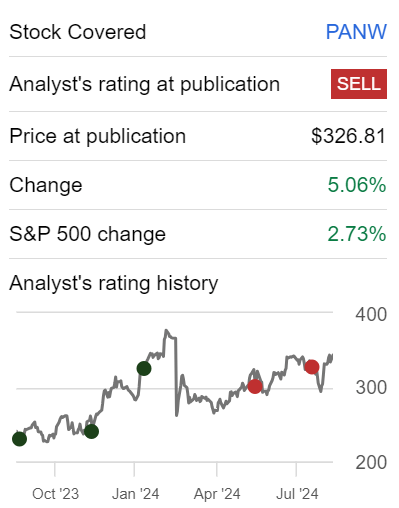
This is a stock that I remain skeptical over its valuation. But I don’t believe there’s enough in my bear thesis to maintain a sell rating on this stock. Therefore, I upgrade my rating to a hold. Here’s how it all breaks down.
Why Palo Alto Networks? Why Now?
Palo Alto Networks is a leading cybersecurity company that provides advanced solutions to protect organizations from cyber threats. They offer a comprehensive suite of products that secure networks, cloud environments, and digital workspaces, helping businesses safeguard their data and operations. Their offerings include firewalls, threat detection systems, and cloud security services, designed to prevent cyberattacks.
Palo Alto Networks is well-positioned for growth, driven by the increasing demand for cybersecurity solutions in response to rising cyber threats. The company’s focus on platformization, which integrates multiple security services into a cohesive offering, has gained significant traction, particularly in their next-generation security offerings. This strategy, along with their innovation in areas like AI and cloud security, is expected to drive continued expansion and help them achieve ambitious revenue targets, such as reaching $15 billion in ARR by fiscal year 2030.
However, Palo Alto Networks faces challenges too. The complexity of integrating new technologies with legacy systems and managing a sprawling product portfolio may slow down its overall topline growth.
What’s more, cybersecurity is highly competitive. The market is crowded with established players like CrowdStrike (CRWD), SentinelOne (S), Fortinet (FTNT), Zscaler (ZS), and more, all competing for the same customer base.
Additionally, as customers increasingly demand integrated, platform-based solutions rather than point products, the company’s ability to effectively scale and differentiate its platformization strategy becomes crucial.
Given this balanced background, let’s now delve into its fundamentals.
Palo Alto Networks’ Revenue Growth Rates Point to 16% CAGR
PANW Revenue Growth Rates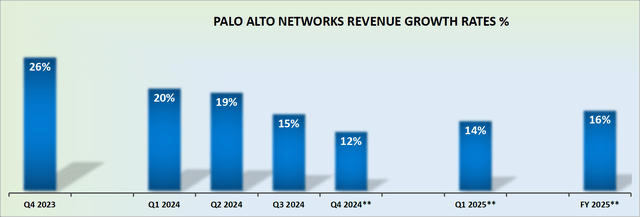
Recall what I said in my previous article:
Author’s work on PANW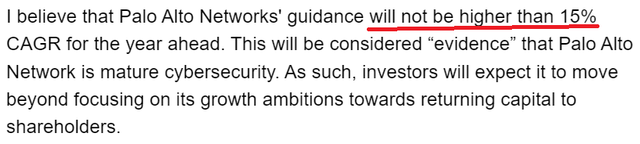
True to my estimate, the high-end of PANW’s guidance points to 14% CAGR, which is not higher than the 15% I forecast as we headed into this earnings report.
Nonetheless, to allow myself some margin of safety, I have immediately raised the high end of management’s guidance by 200 basis points on the presumption that management is being conservative.
What’s more, consider what PANW was guiding towards this time last year.
PANW Fiscal Q4 2023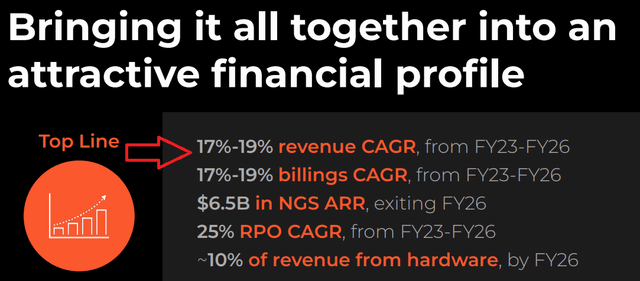
At the time, investors were told that PANW could continue to deliver approximately 18% topline CAGR into fiscal 2026. And now, fast-forward 12 months, not only has this ”formal” guidance been quietly shelved, but the outlook for the next 12 months is decidedly below this previous estimate.
My point is that we shouldn’t be lulled into believing that PANW is the ”sort of company” that is consistently conservative with its estimates, to allow for an easy beat as the quarters unfold.
Furthermore, details matter.
PANW FQ4 2025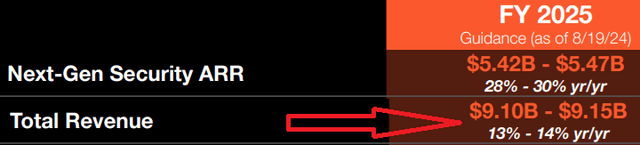
This is not immediately obvious, so I’ll unpack it. PANW’s next-gen security portfolio is growing at a strong clip. For someone who is investing in SentinelOne, this is a positive takeaway, that the future driver of PANW’s business is growing at a strong clip.
However, the issue here is that PANW’s legacy hardware business is delivering minimal growth rates. In fact, I believe that PANW’s legacy business is probably growing at less than 6% CAGR. In practice, given that investors can’t pick and choose what aspects of PANW they are investing in, this may mean that the following year, PANW’s growth rates may dip below 15% CAGR, even as the business comes up against easier comparables from this year. (Disclosure: Deep Value Returns recommends S).
Given this backdrop, let’s discuss its valuation.
PANW Stock Valuation – 29x Forward Free Cash Flow
Look back at my excerpt above. My contention then, and now, is that PANW is being expertly managed to focus on its bottom-line profitability.
This makes sense, given that its legacy hardware operations are not delivering the sort of growth management would like to see; therefore, it stands to reason that PANW should optimize its bottom-line profitability, rather than chase growth for growth’s sake.
PANW Fiscal Q4 2023
Accordingly, I suspect that PANW could deliver $3.8 billion of free cash flow in the coming twelve months. Thus, surely, this is a positive aspect of the bull thesis?
Earnestly, not really. As it stands right now, PANW is being priced at approximately 29x forward free cash flow.
As a point of reference, consider this.
S revenue growth rates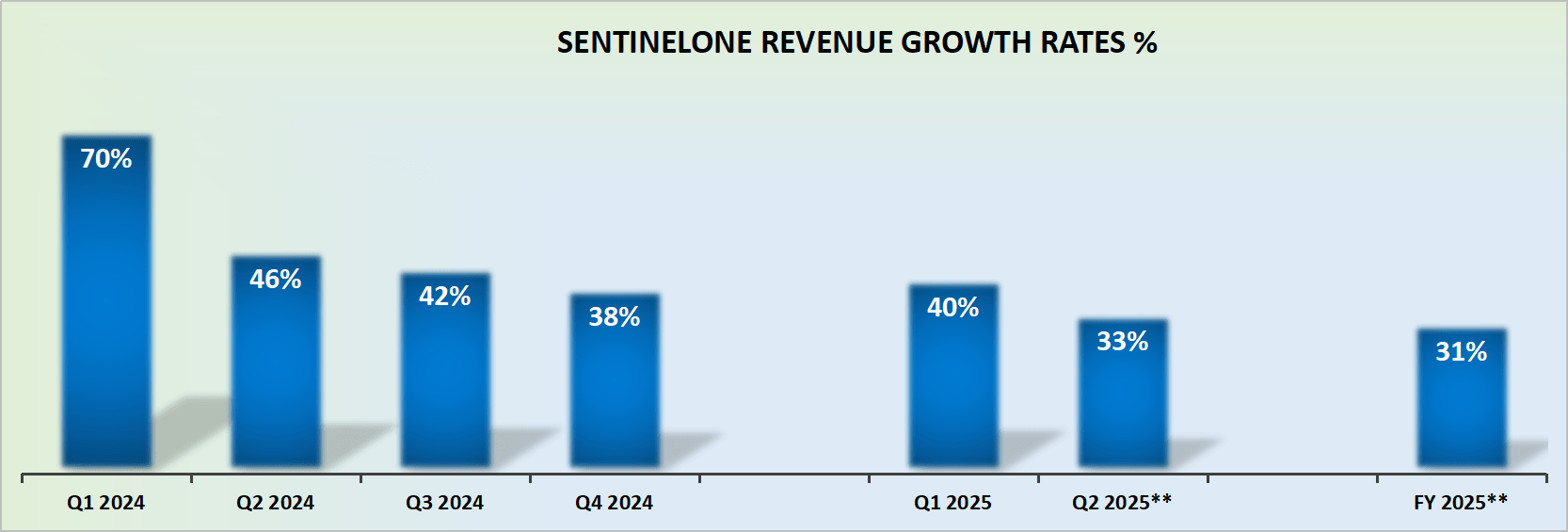
SentinelOne’s topline is expected to grow by approximately 31% CAGR this year, which is double the pace of PANW. What’s more, technically, SentinelOne is a cloud-based end-to-end pure play cybersecurity company. With none of the baggage of CrowdStrike’s global IT outage. Plus, SentinelOne doesn’t have any of PANW’s legacy, mature growth hardware business.
But the icing on the cake is that I estimate that in the next twelve months from now, SentinelOne will see around $100 million of free cash flow and growing rapidly. This puts SentinelOne priced at 73x forward free cash flow.
This may sound substantially more expensive than PANW’s 29x forward free cash flow, but PANW is delivering stable, mature growth. While SentinelOne is still in growth mode and delivering positive free cash flow in the coming twelve months.
When it comes to investing, it’s never about the quarter just reported. It’s always about what the future will bring to investors. Not the far distant future, but what the next 6 to 12 months are expected to bring.
The Bottom Line
Given the competitive landscape and the relatively modest growth rates, paying 29x forward free cash flow for Palo Alto Networks is indeed a steep premium. While the company is well-managed and has shown strong profitability, its mid-teen growth rates, particularly in a sector where faster-growing competitors like SentinelOne are thriving, do not justify such a valuation.
SentinelOne, with its 31% CAGR and focus on cloud-based, next-gen cybersecurity solutions, presents a more compelling investment opportunity. SentinelOne’s lack of legacy hardware constraints and rapid cash flow growth provide a clearer path to outsized returns.
In cybersecurity, staying ahead is crucial, and at this price, Palo Alto Networks may be too focused on the past to offer the best returns for the future – perhaps it’s time to “firewall” your investment dollars elsewhere.
Credit: Source link