

martin-dm/E+ via Getty Images
Over the next decade, 90% of all new internet users will come from emerging and frontier markets.
Whereas the US and China have been the standard locales of the world’s most dynamic internet companies –think Meta and Tencent –those markets are seeing saturation. The locus of real growth will likely come from other parts of the world in the future.
In 2023, six of the world’s most downloaded mobile banking apps originated in Brazil, accounting for more than 130 million downloads in just 12 months. The broader world’s Gen Z population is going through the same “rite of passage” familiar to every American twelve-year old: smartphone ownership and its near total re-circuiting of all shopping and finance activities around mobile-centric platforms.
In other parts of the world, the Gen Z demographic is a sizable piece of the pie. 24% of Southeast Asia’s total population is of that cohort. The percentage rises to 24.5% in Latin America. Astoundingly, 27% of the world’s Zoomers –more than 1 out of every 4– presently live in India.
This phenomenon of billions of young consumers joining the internet (and deploying ecommerce and fintech solutions to expedite their day-to-day lives) is a secular driver that will go unabated for the next decade. While e-commerce penetration in the US was estimated at 22.2% in Q1 2024– well behind China’s impressive 37% –ecommerce penetration in Latin America is estimated to be 11.7%, with India’s being 8.5%. In many respects, these markets are where the US and China were 7 or 8 years ago.
How to play this mega-trend?
Ostensibly, those US investors seeking to gain exposure to EM internet companies should consider the following ETFs: the Emerging Markets Internet & Ecommerce ETF (EMQQ) and The Next Frontier Internet & Ecommerce ETF (NYSEARCA:FMQQ).
However, EMQQ gives significant weight to China’s juggernauts. In fact, of EWEB’s top 10 holdings, four are mainland mega-caps — Alibaba, Tencent, Pinduoduo, and Chinese shopping platform Meituan.) For investors concerned about the mainland’s geopolitical risk, real estate overhang, and generally gloomy consumer market at present, this exposure might not be to their taste.
In contrast, FMQQ circumvents the mainland, and –leaning into its frontier moniker– and seeks more opportunities in India, Latin America, and Southeast Asia.
The ETF: Under the Hood
At first glance, FMQQ’s high expense ratio of .86%, its low AUM, and slight trading volume will give the investor pause.
However, that ratio is lower than its 1.13% category average and FMQQ does offer the long-term investor an interesting opportunity. Four of its top ten holdings have US listings, but the vast majority of other 43 holdings are not. The ETF allows a US investor to roll up many names only available in their local markets, well before they get big enough for western stock exchanges.
Quite a few of FMQQ’s holdings will be new to US investors: Zomato, an Indian restaurant and delivery app; Nu Holdings (NU), a Brazil-based digital banking platform; Kaspi (OTC:KSPI), a Kazakh payments and e-marketplace player; Sea Ltd (SE), a gaming/ecommerce/fintech giant; Grab Holdings (GRAB) the Singapore-based ride sharing / food delivery app.
FMQQ –Top Ten Holdings (August 5, 2024) (Seekingalpha.com)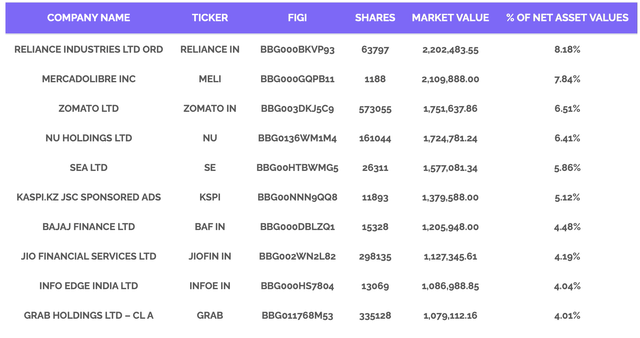
FMQQ’s top holdings will be more recognizable. Reliance Industries, an Indian mega-cap tied to the world’s richest man, is likely known to US investors versed in financial news. It is India’s undisputed streaming and sports TV giant. In February, it announced with Disney the merging of their respective streaming/sports units (Star India and Viacom 18) into a huge, joint venture, one that is expected to have more than 750 million viewers on the subcontinent and among its far-flung diaspora.
FMQQ’s second largest holding is also well-known: MercadoLibre (MELI), the proverbial “Amazon of Latin America” (with a compelling fintech kicker). Just days ago, the company offered a up an impressive double beat for its Q2, with revenues up 42% year over year and net profits doubling. Even sales as measured by Gross Merchandise Value (GMV) rose 20% year-on-year. Its decisive move into Mexico looks to be gaining traction. In terms of green pastures, MELI is where AMZN was 10 years ago. In terms of its stock price, it is up 1,620% in the past ten years.
Digitization and Demographic Destiny
As the continent’s dominant payment, e-commerce, and business lending platform, Mercado Libre is enjoying powerful synergies. Whereas most Americans may have credit cards, accounts, and loans via multiple banks, financial inclusion in Latin America has been painfully slow to materialize. Close to 26% of the adult population of the continent remain un-banked — i.e. no checking account– or underbanked with no access to bank lending or credit.
However, smartphone usage is already challenging this condition, as the unbanked population has been dropping rapidly since 2019. Approximately 160 million of the continent’s population is Gen-Z and they have leapt into smart phone usage thumbs-first, particularly since 2020.
Digitization allows the developing world to “leapfrog” to cloud-based, mobility-centric solutions, avoiding much of the land line and bricks-and-mortar expense of an earlier era.
This is particularly true in parts of Asia and Africa where municipal governance and infrastructural spending were minimal outside the big cities. According to a McKinsey report, the number of tech startups in Africa tripled from 2020 to 2021, with South Africa, Nigeria, and Kenya emerging as key hubs. Opay, Flutterwave, Clipper Cash, and Piggyvest offer smart phone users an interesting array of methods to send, receive, and save money.
Digital payment / e-commerce platforms like MELI, NU, or SE now have an enormous opportunity: to seize the proverbial commanding heights and become the de facto financial institutions for most of the world’s population by 2040. Whereas in the US and Europe it took decades for fintech to even approach banking and high finance, in these new emerging markets, it’s a new game.
Kaspi started out as a bank and over time simply started bolting on adjacent high-value services. Like the proverbial “super apps” likely found in China, Kaspi is now a collection of popular services bundled all together: e-commerce, payments, credit card lending, and even Expedia-like travel purchasing—that caters to the Central Asian market. Its revenue growth and still modest P/E FWD of 10.33 makes it quite attractive, and Kazakhstan more broadly expects strong economic growth over the next two years.
Kaspi — year-over-year revenue growth (Kaspi investment presentation)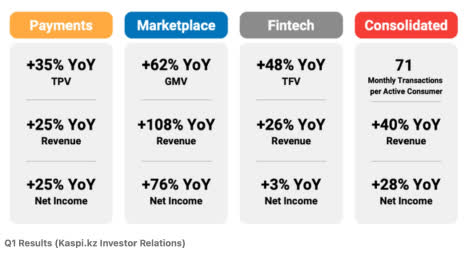
One FMQQ holding that is also worth mentioning is MakeMyTrip (MMYT), a ticker holding that is the 11th size. It is the largest player in India’s online travel agency market, with a 60% share. As an app that can book flights, hotels /packages, and bus/rail tickets with a decent revenue split (39%, 43%, and 18% respectively).
Revenue growth is expected to stay around 25% over the next several years, particularly as a combination of a strong economy and youthful demographics helps the travel sector. India’s population is young, the median age being 27.6 and more than ten years younger than that of most major economies. According to a recent McKinsey study on India’s travel sector: consumption of goods and services, including leisure and recreation, is forecast to double by 2030.
India’s Outbound Travel (McKinsey)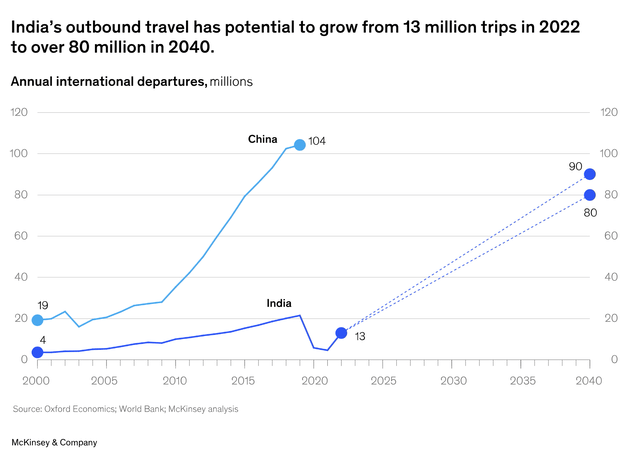
The report expects outbound travel to soar in the next two decades.
(Anecdotally, this is already showing up in the data: the many Bollywood films that feature Switzerland –more than 200 in fact—have started to influence that country’s inbound tourism from Asia.)
Why FMQQ Now? The EM Currency Index and the Fed’s September Cut
A quick look at FMQQ’s weekly chart suggest a significant bounce off the late July low, a site of support from mid-April. Both its RSI and MACD suggest a near-term oversold condition.
FMQQ –technical analysis (Author)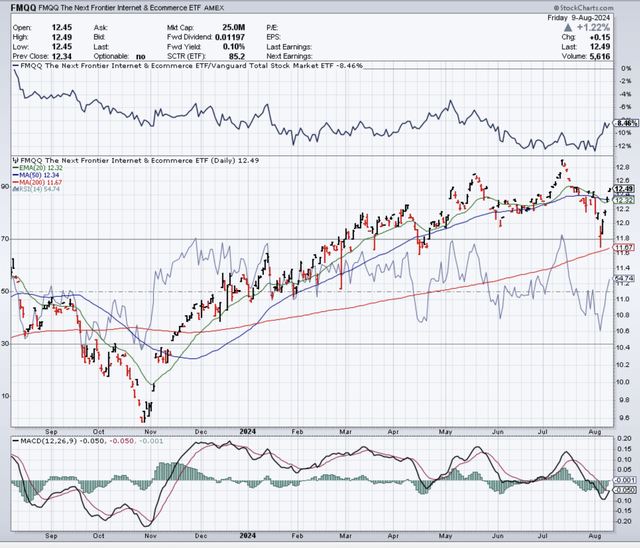
The rapid ascent this month can be explained by two factors. First, MELI –a major holding–offered up a magnificent quarter of operational success, beating EPS estimates by 24%.
Second, the MSCI EM currency index rose 0.7%, closing at the highest level in more than two years. (Brazil’s real posted its best week since late 2022 with a nearly 4% gain, with the currency climbing on hawkish signals from its central bank.)
This could be a decisive pivot for the developing markets more generally. The Fed began raising interest rates in March 2022 to tame inflation and by July 2023, had raised taken them to their highest level in 23 years. That strong dollar has been pressuring EM currencies ever since. July’s sharp surge in the yen also dragged on the EM currencies, with the Brazilian real falling 3% and the Mexican peso sliding 6% against the dollar during that month alone.
However, FX specialists are seeing signs that the fabled yen carry trade unwind –that looked so disorderly two weeks ago—has run its course, arriving at a new level of stabilization. The deep sell-off in dollar-yen between July 3 and Aug. 5 has made leveraged yen carry positions shrink to their smallest net short stance since Feb. 2023.
On August 2nd, the dollar saw a 4-month low. Better labor data also helped dispel a steep US slowdown. A weaker greenback and Fed cuts in September (and December) should give extended relief to emerging market currencies.
If the unwind has truly stabilized and the dollar weakens further into this week’s CPI inflation print (and into the autumn more generally), the recent EM currency strength might be durable.
Risks
Investing in international equities is always fraught with risk. Only a small portion of your portfolio should be allocated to the sector, and even then exposure has been more effective as a diversifier in some decades more than others. International exposure was a return-enhancing hedge during much of the 1980s through the 2000s. It has been less effective over the past 15 years due to the blazing outperformance of US mega-cap growth during the mobility / cloud computing tech revolution.
In the case of FMQQ, there are the obvious political risks of the developing world: corruption, the chances of governmental upheaval, and sudden changes in taxation. More tactically, a crash in US equities in this fall could create a serious risk-off environment. It would temporarily strengthen the dollar vis a vis the EM currencies like it did in October 2008. FMQQ –as a risk-on asset– would fall precipitously in that environment.
The Thai Baht Crisis was due to a dramatic swing from a weak dollar to Rubin’s strong dollar. The Chiang Mai Agreement put an end to that vulnerability in Asia, and over the past two years the EM has handled the strong greenback quite well, with the September Fed cut likely to sap dollar strength materially. Nevertheless, a serious crisis at the center of the financial system –further yen carry trade issues, a US crash– will hurt peripheral equities in the emerging markets most.
Coda
At a macro-level, it will always be a moveable feast for the momentum traders.
After the tech over-investment boom of 1995 – 2000, the emerging markets had a strong commodity-fueled decade due to China’s massive buildout, which (as I have argued here regarding its LGVF debt market) was also speculative. Something similar might happen this time for India, Mexico, and Indonesia as multinationals re-deploy production to those markets for their young workers and young consumers.
It’s has been 23 years since Jim O’Neil of Goldman Sachs coined the BRICs as an investment term. (It has a very interesting origin story which I have explored here). The acronyms that it spawned in the Noughts –the MINTS, CIVITS, etc—have not been seen since the oil crash of 2014.
However, the major markets of FMQQ — India, Brazil, ASEAN/Indonesia, and Kazakhstan– are arguably where the most durable components of real GDP growth can be found. They have large internal markets with big working age populations at the cusp of rising per capita income and better value-add/service sector jobs. (This sense of inherent promise –so reminiscent of the US and Europe from 1945 to 1970 or China 1995 to 2020– is far less apparent in the developed markets these days).
These countries have also established a track record of political stability and investments in education and infrastructure. Mumbai’s recent human capital legislation –the Skill India Initiative (2015) and the National Education Policy (2020)– reminds me of Ireland’s fruitful efforts in the 80s. Jokowi’s Golden Indonesia Vision 2045 has focused the country for the better. Harvard’s Atlas of Economic Complexity sees Southeast Asia’s service sector job mix rising sharply by 2030, with e-commerce in the region tripling by 2026.
FMQQ is a good way to play this EM macro-trend. And it might finally have the FX winds at its back.
Credit: Source link