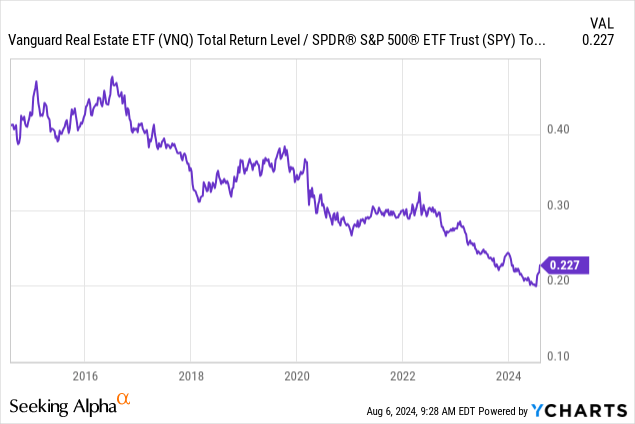
Looking at the ratio between the Vanguard Real Estate Index Fund ETF Shares (VNQ) and the S&P 500 in the chart below, we see that the past few weeks have been kind to REITs, allowing them to outperform the market for the first time since the fourth quarter of 2023.
Data by YCharts
Although it needs to be seen if this is the start of a long-term trend or just a brief countertrend in a downtrend that started in 2016, there’s certainly a lot to be upbeat about.
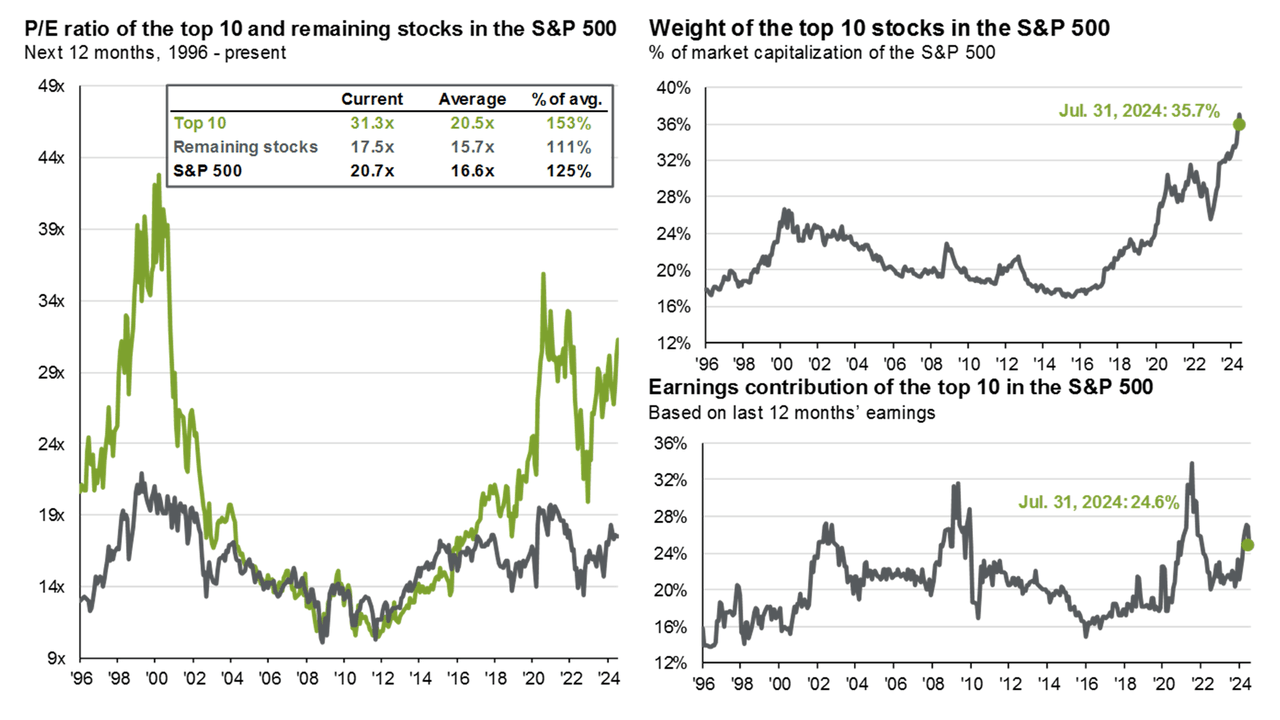
For starters, the market has become extremely top-heavy since last year, as the biggest ten S&P 500 stocks accounted for roughly 36% of the entire index! While this is slightly down from its high in June, it’s almost ten points above the peak during the Dot-com bubble.
JPMorgan
One big reason for this outperformance is the Japanese yen carry trade. Because the Japanese central bank was so dovish, investors borrowed yen (at low rates) to buy high-growth tech stocks in the United States – among other assets.
When that trade unwound, investors had to cover their positions, resulting in a quick decline in the prices of high-flying tech stocks and other investments that had done very well since last year.
To add a very valuable comment from Bloomberg (emphasis added):
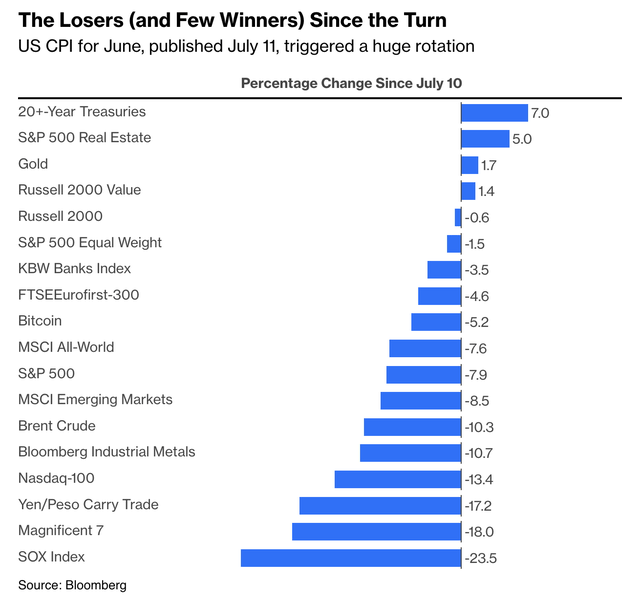
Last week saw more data, including a disappointing US unemployment report and varied responses from the world’s central banks. This has created many losers and a few winners. Securities that pay a generous and reliable yield have suddenly looked attractive, while small-value stocks are up for the selloff. Those assets most sensitive to the economy, or most heavily crowded by speculators, are down a lot. Here are the more notable moves since July 10:
Bloomberg
As we can see below, the drop in treasury yields propelled bond prices and made the S&P 500 Real Estate index one of the best-performing “assets.”
Although I cannot make the case that real estate is out of the woods yet, it is clear that the market is finally seeing value in a sector that I have increasingly covered in recent quarters.
One of the winners is Crown Castle Inc. (NYSE:CCI), a tower REIT I covered on May 19 in an article titled “Crown Castle: This 6%-Yielding REIT Is No Sucker Yield.“
Since then, shares are up 11%, including dividends. The S&P 500 has lost 2% during this period.
Data by YCharts
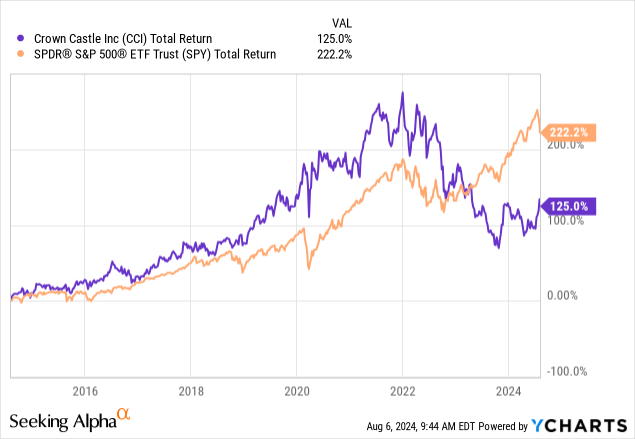
As we can see in the chart above, Crown Castle has returned just 125% over the past ten years, lagging the 222% return of the S&P 500 by a huge margin.
However, that wasn’t always the case. Until 2022, the REIT was one of the best places to be in its sector, benefitting from consistent capital gains and dividend growth.
In this article, I’ll update my thesis, using its just-released earnings and new developments that continue to hint at a very favorable risk/reward for income-focused and value-oriented investors.
So, let’s get to it!
A Deep-Dive Into Its CCI’s Numbers
Crown Castle is a fascinating REIT, as it focuses on one of the biggest growth trends in the real estate sector: connectivity.
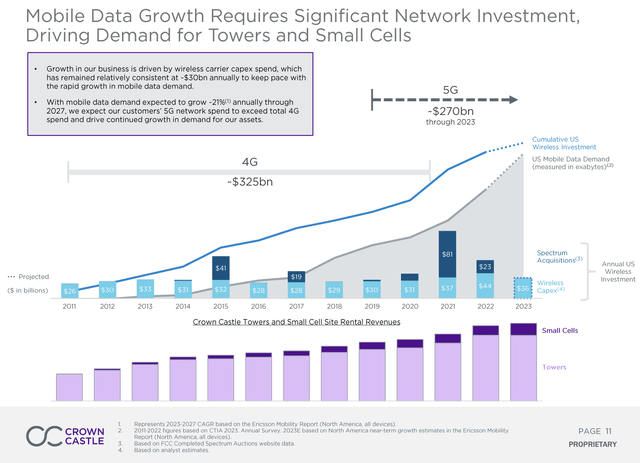
In the 2011-2020 period, carriers spent roughly $325 billion on 4G connectivity. In the much shorter 2020-2023 period, spending was $270 billion, with expectations of steady annual spending close to $30 billion.
Crown Castle
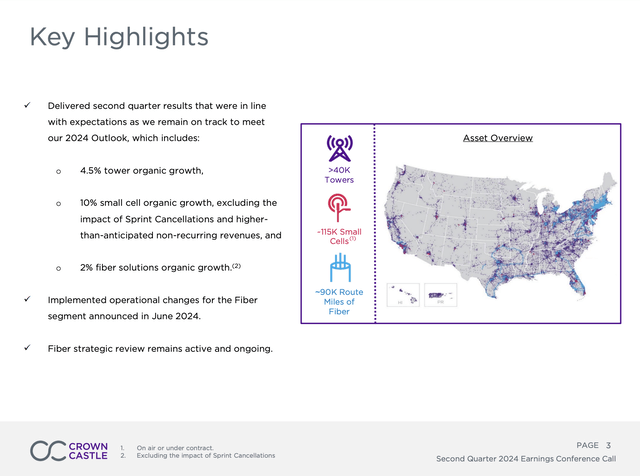
During its 2Q24 earnings call, the company explained that it expects organic revenue growth of 4.5% in its tower business this year. Even better, this number is expected to accelerate, driven by three key factors:
The stability that is provided by holistic master license agreements with major customers.
The ongoing expansion needs of wireless carriers amidst the 5G build cycle.
Crown Castle’s strategic focus is on becoming a leading provider of low-cost shared infrastructure.
Crown Castle
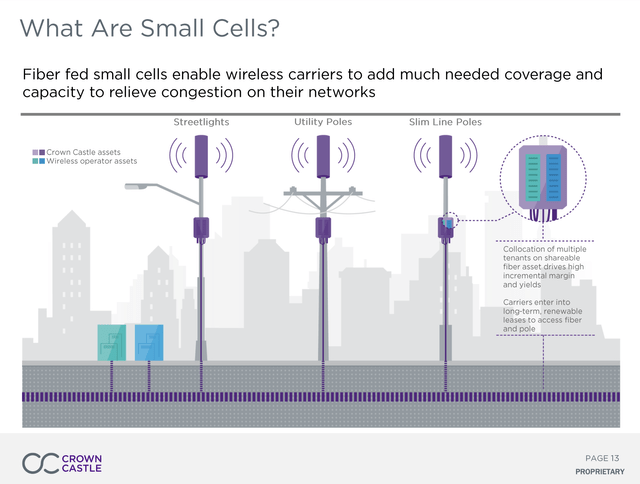
On top of that, the company has made significant progress in improving its operational efficiencies, especially in its fiber and small cell business.
This includes a number of changes designed to boost profitability while reducing capital spending requirements. According to the company, these changes are expected to generate roughly $100 million in annualized savings, with $60 million expected by the end of this year.
Essentially, by focusing on near-net fiber connections and small cell locations, Crown Castle aims to improve capital efficiency and achieve a long-term organic revenue growth rate of 3% per year in its fiber solutions segment.
Crown Castle
With that said, as some readers may know, the company is actively working on a strategic review of its fiber segment, looking into alternatives to improve shareholder value.
According to the company, it worked with potential third parties that show interest in its fiber solutions and small cell business. However, that’s all the company can say.
While we can assume it could see a deal to sell these assets to reduce debt and focus on opportunities with more growth, it’s just speculation at this point.
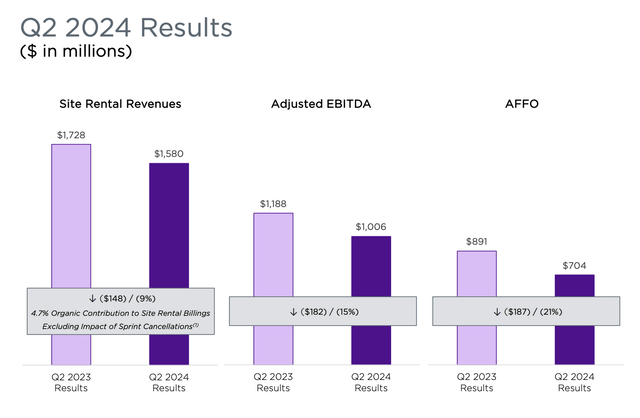
Having said all of this, in the second quarter, the company grew its organic revenue by 4.7%, driven by strong growth in small cells and fiber solutions.
Small cell revenue surged by 11%, enjoying tailwinds from an increase in new billable nodes, which is expected to rise to between 11 thousand and 13 thousand in 2024, compared to 8 thousand in 2023.
Meanwhile, the tower business grew by 4.4%, which is according to the company’s expectations. Fiber solutions saw 3.2% growth, beating its 3% growth target.
With that said, this is what non-organic growth looks like:
Crown Castle
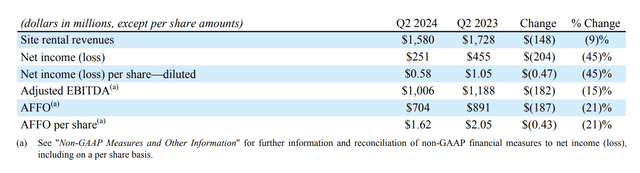
Despite positive organic growth, the company has negative total growth due to a number of significant (non-recurring and non-cash) items.
The biggest impact came from Sprint cancellations, which led to a $106 million decline in site rental revenues.
Additionally, the company saw a $105 million decline in straight-line revenues and prepaid rent amortization (both are non-cash items). It also saw a $22 million decline in service margin contribution due to lower tower activity and its exit from the construction and installation business.
Crown Castle
With that said, and with regard to its balance sheet, the company ended the second quarter with a leverage ratio of 5.9x EBITDA. Excluding non-recurring advisory fees, the multiple would have been 5.7x.
In general, the company, which has an investment-grade rating of BBB, has done a great job improving its balance sheet. I added emphasis to the quote below.
The resilience of our top-line growth is complemented by our strong balance sheet, which is well-positioned to provide stability and flexibility as we continue to evaluate strategic paths forward. We finished the second quarter with 89% fixed rate debt, a weighted average maturity of 7 years, only 8% of our debt maturing through 2025, and approximately $5.5 billion of liquidity under our revolving credit facility. – CCI 2Q24 Earnings Release.
So, what does all of this mean for shareholders?
A Rosy Outlook, Juicy Dividend, And Attractive Valuation
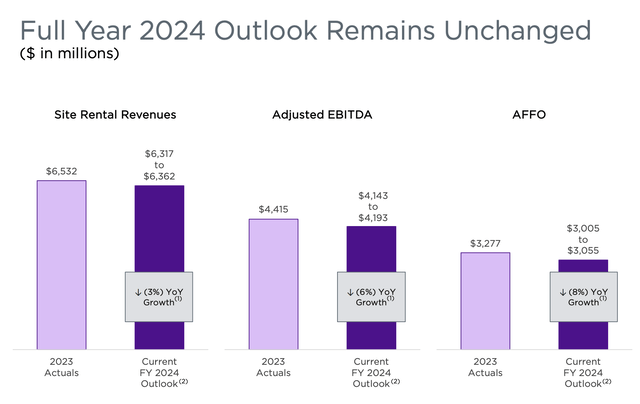
Despite challenges, the company maintained its full-year guidance.
As we can see below, Crown Castle expects a 3% contraction in site rental revenues, a 6% contraction in adjusted EBITDA, and an 8% decline in adjusted FFO (funds from operations).
Crown Castle
Analysts agree and expect the company to gradually find its way back to growth.
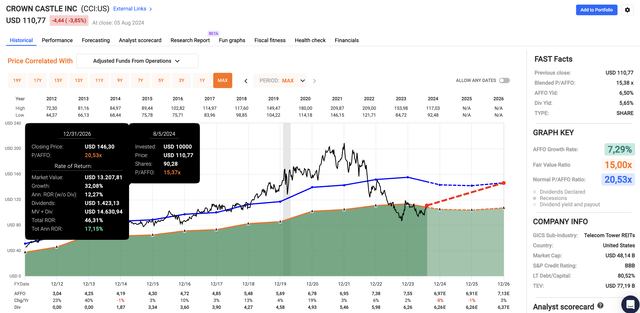
Using the FactSet data in the chart below, analysts expect an 8% lower per-share AFFO in 2024, potentially followed by a recovery to a 1% contraction in 2025 and a 3% growth in 2026.
FAST Graphs
While these numbers are not spectacular, there’s good news.
The company is recovering. It’s a slow recovery, but it seems there’s a path to sustainable growth. Major divestitures will likely accelerate this process.
The market has priced in a lot of weakness.
Currently, CCI trades at a blended P/AFFO multiple of 15.4x, below its long-term average of 20.5x.
Although the stock won’t return to 20.5x AFFO until there’s a clear path to low-single-digit annual AFFO growth, I believe the company is in a great spot to return north of 10% per year.
A multiple of slightly higher than 17x would “get the job done.”
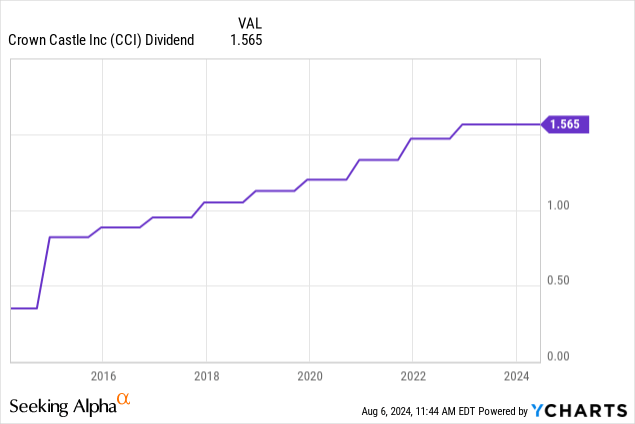
This total return outlook also includes its 5.7% dividend, protected by an 88% AFFO payout ratio, and has a five-year CAGR of 7.2%, which is not half bad for a stock that yields more than 5%.
Data by YCharts
All things considered, I believe CCI offers tremendous value. While current times may be tough, it has a fantastic business model, secular growth tailwinds, an increasingly healthy balance sheet, and the chance to use divestitures to focus on its best assets.
As such, I stick to a Buy rating, believing the stock is one of the best value opportunities in real estate.
Takeaway
REITs have started to make a comeback, and Crown Castle is a prime example of this trend.
Despite recent challenges, including non-recurring revenue declines and Sprint cancellations, CCI has shown strong organic growth in its tower and fiber segments.
With a solid balance sheet, strategic focus on (5G) connectivity, and the potential for divestitures to improve shareholder value, Crown Castle offers significant upside potential.
Trading at a significant discount to its historical valuation and offering a juicy 5.7% dividend yield, I believe CCI presents a very attractive opportunity for income-focused and value-oriented investors.
Hence, I maintain a Buy rating on this high-potential REIT.
Pros & Cons
Pros:
Strong Organic Growth: CCI is experiencing strong organic growth in its tower and fiber segments, driven by increased demand for connectivity.
Attractive Valuation: Trading below its long-term average, CCI offers a significant value opportunity.
Lofty Dividend: With a 5.7% yield and a healthy payout ratio, the dividend is quite attractive.
Solid Balance Sheet: An investment-grade rating and strategic financial management provide stability and flexibility.
Cons:
Non-Recurring Revenue Declines: Recent revenue declines from Sprint cancellations and other non-cash items could weigh on near-term results.
Slow Recovery: The recovery in AFFO may take time, as analysts expect modest growth in the next few years.
Uncertainty in its Fiber Segment: The ongoing strategic review of its fiber business creates some uncertainty about future operations and growth.