

Colin Anderson Productions pty ltd
We previously covered RTX Corporation (NYSE:NYSE:RTX) in May 2024, discussing its robust prospects across commercial and defense aerospace markets, with the growing backlog offering great insights into its long-term top/ bottom lines, further aided by the management’s cost reduction initiatives.
Combined with the underway powdered metal remediation and peak Aircraft On Ground [AOG] by FQ1’24 with things to moderate through 2026, we had maintained our Buy rating then.
Since then, RTX has outperformed at +8.9% compared to the wider market at +4.6%, thanks to the double beat FQ2’24 earnings call and the raised FY2024 guidance.
Combined with the robust commercial and defense spending trends as the macroeconomic outlook slowly recovers/ consumer travel rebounds and the uncertain geopolitical events continue, we believe that the stock remains compelling for growth and dividend oriented investors.
RTX’s Investment Thesis Remains Robust, Thanks To The Promising Commercial & Defense Spending Trends
RTX 1Y Stock Price
Trading View
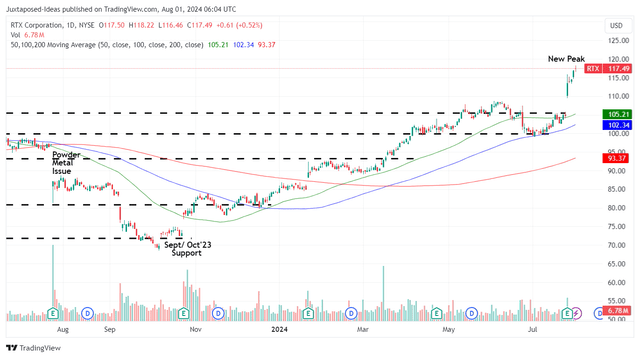
RTX has had a painful pullback after its FQ2’23 earnings call, mostly attributed to the negative press related to the powdered metal manufacturing quality issues and the potential impact on its financial performance.
Even so, the recent rally from the September/ October 2023 bottom and the subsequent breakout after the excellent FQ2’24 earnings call further underscore the reversal in market sentiments, implying that the powder metal issue may very well be behind us.
Readers must note that the recent break out is also attributed to RTX’s double beat FQ2’24 earnings call, with adj revenues of $19.8B (+2.5% QoQ/ +8.1% YoY), adj EPS of $1.41 (+5.2% QoQ/ +9.3% YoY), and Free Cash Flow generation of $2.2B (+2,100% QoQ/ +1,039% YoY).
From the robust profitability, it is apparent that the management’s assumptions surrounding the powder metal issue and ongoing AOG have worked out as expected, significantly aided by the favorable support agreements covering the majority of the impacted fleet.
At the same time, demand remains robust, as observed in RTX’s growing multi-year backlog of $129B for commercial contracts (+3.2% QoQ/ +15.1% YoY) and $77B for defense contracts (inline QoQ/ +5.4% YoY).
The excellent backlog growth in its commercial segment is unsurprising indeed, with the same already estimated by Boeing (BA) at a projected +3% increase in airplane deliveries over the next twenty years and over 44K in new commercial airplanes by 2043.
At the same time, due to the ongoing geopolitical events in Ukraine and Gaza, it is only natural that more countries are beefing up their defense capabilities.
The same has been observed in Lockheed Martin’s (LMT) outsized defense multi-year backlog of $158B and the US government’s upsized FY2024 defense spending worth $2.12T (+39.4% YoY), along with RTX’s new defense contracts from Germany, amongst others.
Furthermore, readers must note that the US government under President Trump had increased the defense budget by approximately $225B then, with defense spending likely to remain elevated to “counter Russia and China.” This also coincides with the “strategy of peace through strength:”
The idea is that if you have strength then that discourages your neighbor’s bad people from attacking you. (Reuters)
And it is for these reasons that RTX’s growing capex and capacity ramp up may support its long-term growth opportunities in the commercial and defense new contracts/ aftermarket services.
Perhaps this is why the management has raised their FY2024 guidance, with revenues of $79.12B (+14.8% YoY) and adj EPS of $5.40 (+6.7% YoY), despite the impacted Free Cash Flow of $4.7B (-14.5% YoY), compared to the original guidance of $78.5B (+13.9% YoY), $5.32 (+5.1% YoY), and $5.7B (+3.6% YoY), respectively.
With the impacted Free Cash Flow only attributed to the $1B of one-time payment related to the prosecution agreement with the Department of Justice, we believe that readers need not be concerned indeed.
This is especially since the final sum remains more than sufficient to cover its annualized dividend obligations of $3.32B.
The Consensus Forward Estimates
Tikr Terminal
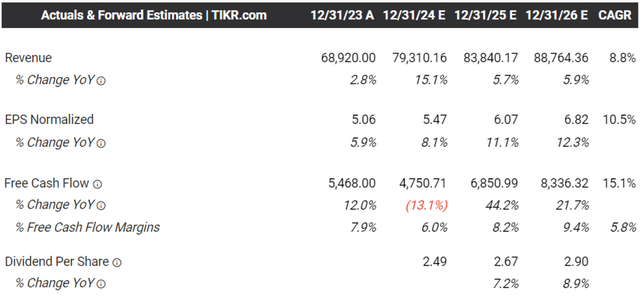
As a result of the excellent visibility into its intermediate term top/ bottom-lines and more ‘significant wins’ expected in H2’24, it is unsurprising that the consensus have raised their forward estimates, with RTX expected to chart an accelerated top/ bottom-line growth at a CAGR of +8.8%/ +10.5% through FY2026.
RTX Valuations
Seeking Alpha
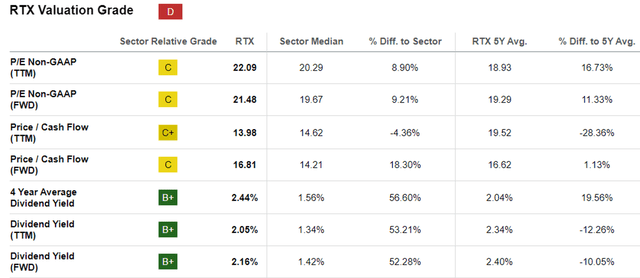
With these growth projections well exceeding the pre-pandemic levels of +8.3%/ +7% and the original estimates of +8%/ +9.6%, respectively, it is unsurprising that the market has also upgraded RTX’s FWD P/E valuations to 21.48x, compared to its 5Y average of 19.29x.
Even when compared to its aerospace and defense peers, such as LMT at FWD P/E valuations to 20.25x with the projected adj EPS growth at a CAGR of +2.8% through FY2026 and Rolls-Royce Holdings (OTCPK:RYCEY) (OTCPK:RYCEF) at 28.31x/ +13.6%, it is apparent that RTX is still reasonably valued here, offering interested investors with a decent margin of safety.
So, Is RTX Stock A Buy, Sell, or Hold?
RTX 5Y Stock Price
Trading View
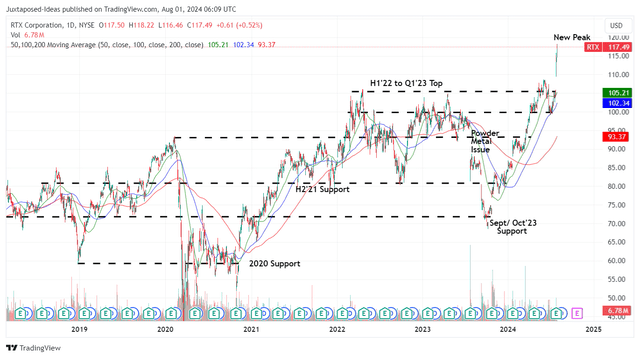
For now, RTX has finally charted a new peak at the time of writing, while breaking out of its previous trading ranges and running away from its 50/ 100/ 200 day moving averages.
For context, we had offered a fair value estimate of $102.10 in our last article, based on the LTM adj EPS of $5.17 and the FWD P/E valuations of 19.76x (nearer to its 5Y mean). This is on top of the long-term price target of $133.50, based on the consensus FY2026 adj EPS estimates of $6.76.
Based on RTX’s higher LTM adj EPS of $5.29 and the same P/E, we are looking at an updated fair value estimate of $104.50, implying that the stock is still trading at a notable premium at current levels.
Even so, based on the upgraded consensus FY2026 adj EPS estimates of $6.82 (+0.8%), we are looking at an updated long-term price target of $134.70, with there remaining a decent upside potential of +14.6% despite the recent rally.
While the recent capital appreciation has impacted RTX’s forward yields at 2.16%, compared to its 4Y average of 2.45%, we are not overly concerned indeed since its overall return profile remains excellent.
Does this mean that we are still rating the stock as a Buy?
Yes indeed, though with a few caveat.
Risk Warning
One, with RTX already charting an impressive 1Y return of +34% well outperforming the SPY at +22%, there may be near-term uncertainties as the wider market rotates from high growth stocks and as we enter the typically slow summer doldrums in August.
As a result, interested investors may want to hold on their dry powders and observe the stock movement for a little longer before adding upon a moderate pullback, preferably to its previous support levels of $104s – with those levels also nearer to our fair value estimates.
Two, with RTX set to pay out their next dividend in September 05, 2024, we may see moderate selling pressure occur after the ex-dividend date of August 16, 2024, as typically observed with dividend stocks.
As a result, investors may consider waiting until then to add/ dollar cost average, attributed to the recent jump in stock prices by +12% after the recent FQ2’24 earnings call
All in all, a moderate amount of patience is recommended for an improved margin of safety.
Credit: Source link