



JLGutierrez
In a labor market report that’s sure to relax the Fed after the already visible dovish tilt to its latest FOMC statement, the unemployment rate rose to 4.3% for July. Three features together make the latest number particularly noteworthy:
- It’s the fourth consecutive month of an increase
- The number is the highest in over two-and a half years (see chart below)
- It’s now higher than the Fed’s own projection of 4% by the final quarter of the year (Q4 2024). In fact, with the latest release, the average unemployment rate for 2024 so far is already at ~4%.
Monthly Unemployment Rate, US, 5yrs (Source: Trading Economics, Bureau of Labor Statistics)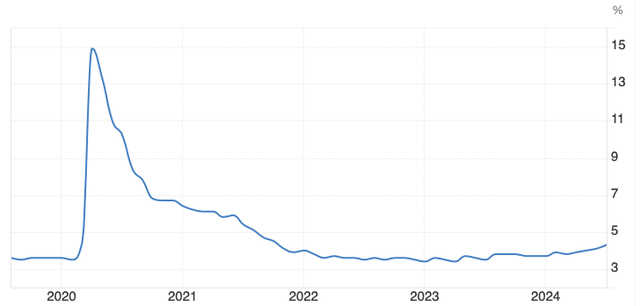
What next for GDP growth?
If the unemployment rate continues to rise at the present pace through the remainder of the year, it follows that it could overshoot the Fed’s median projections. This raises the question of what are the implications for GDP growth, if any, now.
Okun’s law
This question takes us directly to Okun’s law, which is based on the findings of Yale professor and economist Arthur Okun, who observed the inverse relationship between the unemployment rate and GDP growth.
According to a study published last year by economists at the Federal Reserve Bank of San Francisco, this holds true for the US economy over a 75 year period (see chart below). Specifically, they say that a percentage point rise in the unemployment rate correlates with a 1.5 percentage point fall in growth .
Source: Federal Reserve Bank of San Francisco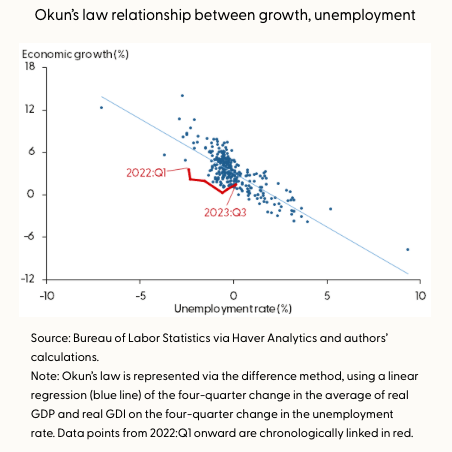
Indeed, a closer look at the Fed’s projections (see table below) shows that the range of individual projections cover the possibility of both higher unemployment rates and lower GDP growth rate. An unemployment rate forecast of 3.8% to 4.4% is in place, while the GDP growth rate can potentially fall to as low at 1.4% and not any higher than has been observed already in 2024.
Source: Federal Reserve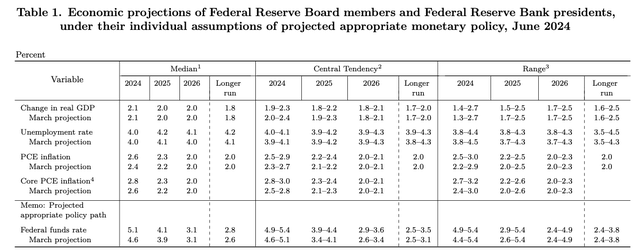
However, it bears mentioning that there have been occasions when Okun’s law has not borne out in actuality. The San Francisco Fed’s study also talks about the recent pandemic and early post-pandemic period to demonstrate this.
This suggests that there could be still a likelihood that a higher unemployment rate with limited disruption to the US economy. This leads us to the next question.
What do other economic indicators show?
To get a broader assessment of whether Okun’s law will play out now, a look at other economic indicators is in order too. How do these look?
Non-farm payrolls are weak too
The non-farm payroll figures in the latest job reports certainly pointed towards weakness. At 114,000 in July, the number saw a decline for the second consecutive month and was also at a three month low (see chart below). This is weak enough, but the really glaring fact is that the number is 47% below its 12-month average. Moreover, the numbers of May and June were also revised downwards.
While average hourly earnings for all employees on private non-farm payrolls continued to grow, they rose only just, by 0.2% month-on-month.
Non-farm Payrolls (Source: Trading Economics, Bureau of Labor Statistics)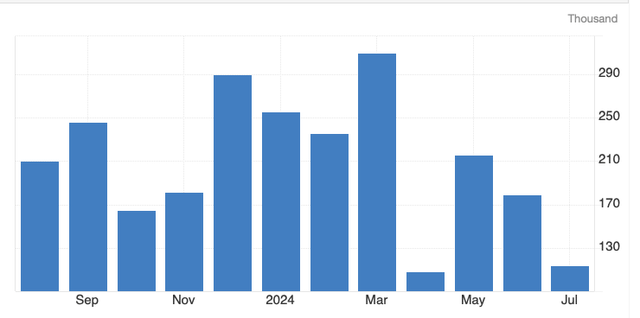
GDP strong, inflation softens
It is, still, hard to overlook the robust GDP numbers seen for Q2 2024 at 2.8%, the decline in CPI inflation to the lowest levels in a year of 3% year-on-year (YoY) as of June. Also, the Fed’s target PCE inflation, is already at 2.6%, at the median projection for 2024 (a more detailed discussion on these figures can be found in the second link in the introductory paragraph).
How should equity investments be made now?
That said, the markets are clearly not taking a balanced view on the macro economic situation right now. As I write this Friday after the report’s release, all US markets are in the red. The NADAQ 100 (NDX) tracker fund Invesco QQQ Trust ETF (QQQ) is worst impacted, with a 2.6% fall. The S&P 500 (SP500) tracker the SDPR S&P 500 ETF Trust (SPY) and the Dow Jones Industrial Average (DJI) tracker SDPR Dow Jones Industrial Average ETF Trust (DIA) are down by 2% as well.
Economic uncertainty becomes more pronounced
They may well stabilise soon enough. After all, all three are up year-to-date [YTD], particularly the SPY (see chart below). We can’t take that for granted though, with economic uncertainty underlined by the latest labor report. If unemployment rate does rise to the upper end of the Fed’s projection range of 4.4% by Q4 2024, we could well see sub-trend GDP growth again by the end of year as well, as per Okun’s law. And it may well be stickier in a time of higher unemployment than just the scare seen in Q1 2024.
This raises the final question, how should the world of equity investments be navigated now?
Price Performance, Key US Stock Indices (Source: Seeking Alpha)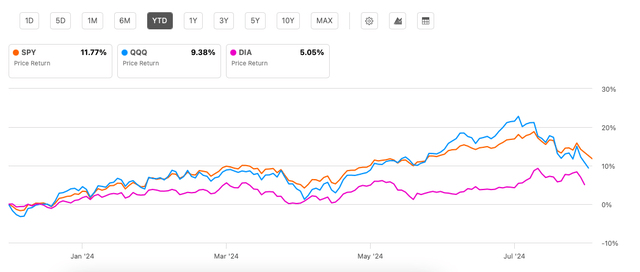
Focus on value stocks
Keeping this in mind, to repeat what I already said after the release of the FOMC statement day before, it’s a time to be cautious. Based on that here I reiterate what I said then, along with an addition:
- Attractive sectors: Defensives like healthcare, along with gold, which has seen quite the run-up this year look like good ones to consider now. Real estate is another one to consider for investors who don’t mind a bit of risk, considering that interest rate cuts are expected and the sector has underperformed this year. Since I’ve already talked about it in some detail in the previous article, they are only mentioned here.
- Value stocks: But it could also well become the time to buy value stocks, especially if the markets weaken. As far as these go, the well-known Warren Buffett quote “Be greedy when others are fearful” can truly apply. Two stocks that are already seen a come-off are worth watching as they fast drop. The first of the two stocks to watch right now is the big French luxury fashion company LVMH (OTCPK:LVMUY), which I wrote about recently. While it still got a Sell rating, with the luxury market slowdown in place, it’s getting closer to a point where it will flip into a buy. In fact, I’d say that the entire luxury set is worth watching now. Proven industrial metal miners is another set that’s getting more interesting as weak commodity prices drag their fundamentals down. A case in point is the Australian mining giant BHP (NYSE:BHP), which has lost 8% of its value in the past two weeks alone since I last wrote on it.
In conclusion
In sum, the labor market report further confirms that economic weakness is here. Statistical analysis based on Okun’s law would suggest that GDP growth can slow down from here. However, past trends don’t always predict the future and going by good economic growth in Q2 2024, this maybe one of those times.
Still, uncertainty about economic conditions is getting more pronounced, as evident in the market reaction to the latest numbers. While segments like healthcare and gold can offer a safe opportunity for this time, it’s also a time to focus on value stocks, that can lose their footing as the market turns. The point being, that the potential market weakness can offer a good opportunity to load up on otherwise great stocks at relatively lower prices.
Editor’s Note: This article discusses one or more securities that do not trade on a major U.S. exchange. Please be aware of the risks associated with these stocks.
Credit: Source link