




Klaus Vedfelt
Introduction
About a year ago, I published an article on Sodexo (OTCPK:SDXAY) (OTCPK:SDXOF), a French services company, and in that article I explained the sole reason to consider buying Sodexo was to benefit from the spinco. That Spinco is now trading as Pluxee (OTCPK:PLXNF), which operates the benefits and rewards division of Sodexo. This is a fast-growing segment, and I was more interested in this capital-light side of the business rather than the archaic on-site food and dining facilities that stayed behind under the Sodexo umbrella.
Pluxee Investor Relations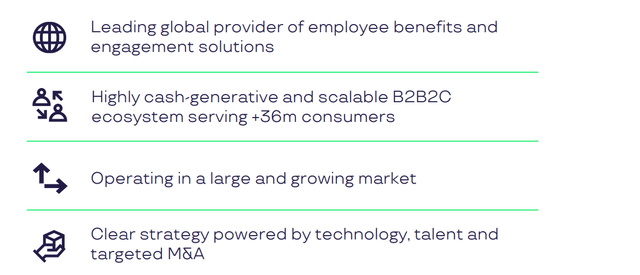
As Pluxee is now trading as an independent company, I will follow Pluxee from much closer.
Yahoo Finance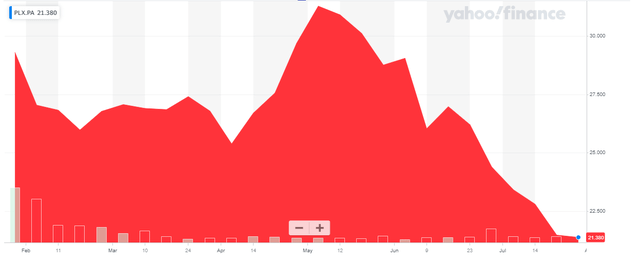
Pluxee has its main listing on Euronext Paris, where it is trading with PLX as its ticker symbol. The average daily volume is almost 200,000 shares and the current market capitalization is around 3.1B EUR based on the share count of 147M shares (there also are special voting shares but those mainly have voting power and are not included in the per-share calculations). Surprisingly, the share price lost in excess of 30% since its high in May, and I wanted to check if this perhaps creates a good opportunity to initiate a long position in the spinco.
The second guidance hike in as many quarters bodes well for the future
I was a bit surprised when I saw the share price starting to slide in the past few months, as Pluxee’s financial results weren’t so bad after all. In this article, I’ll first discuss the results of the first semester (which ended in February) and the subsequent trading update. As the company appears to be on track to meet (and actually exceed the original) expectations, my interest is triggered.
Pluxee Investor Relations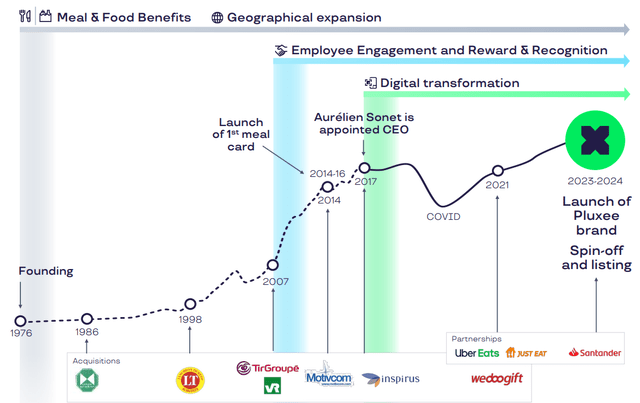
In the first half of the current financial year, Pluxee generated a total revenue of 593M EUR, including a 75M EUR revenue on the float. While Pluxee is not an insurance company, it also has access to a float of approximately 4B EUR, as companies pay for the meal vouchers in advance, and employees only gradually use them. This means that in a high-interest rate environment, Pluxee is making quite a bit of cash on its float. This perhaps also explains the weakness in the company’s share price as decreasing interest rates on the financial markets will reduce the impact of the interest-generating float.
Pluxee Investor Relations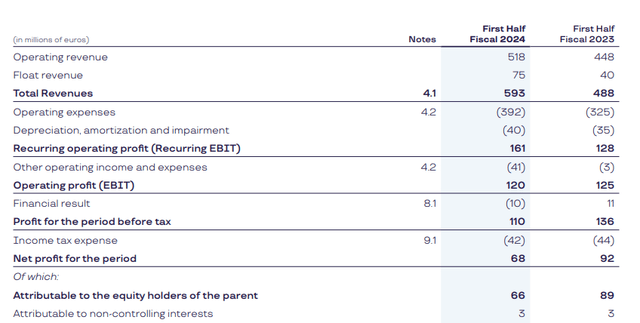
In any case, the 593M EUR in revenue resulted in a 161M EUR recurring EBIT. On a reported basis, there were some non-recurring elements which reduced the reported EBIT to 120M EUR which ultimately resulted in a 110M EUR pre-tax income. The total tax bill was 42M EUR resulting in a net profit of 68M EUR of which 66M EUR was attributable to the shareholders of Pluxee. This represented an EPS of 0.45 EUR per share.
That’s disappointingly low, but there are a few elements I need to discuss here. The 41M EUR in non-recurring items includes a 11M EUR impairment charge and a 32M EUR expense related to the spin-off. This means the normalized pre-tax income was approximately 153M EUR. Additionally, the 42M EUR tax expense represents an average tax rate of 38%. That’s extraordinarily high, even for Europe and France, and the explanation is simple: the expenses related to the Spinco weren’t deductible. This means the tax bill was relatively high, but this also is a one-time event.
Pluxee Investor Relations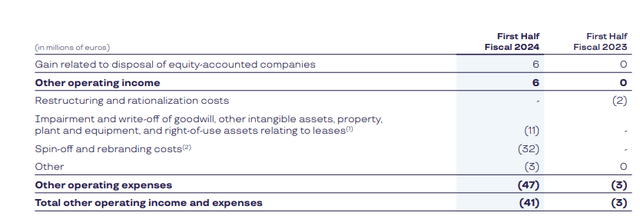
This actually means that about 40M EUR in non-recurring expenses had a direct negative impact on the bottom line, and the underlying net income would have exceeded 100M EUR, resulting in an underlying EPS that would have been closer to 0.70 EUR per share.
That’s also confirmed tin the company’s cash flow statement. As you can see below, Pluxee reported an operating cash flow of 117M EUR before changes in the working capital position, but this includes a 49M EUR tax payment while only 7M EUR was due; Additionally, it excludes the 5M EUR in lease payments which means the adjusted operating cash flow was approximately 119M EUR. Keep in mind this still includes the 32M EUR expenses related to the spinoff and rebranding. So on an underlying basis, the operating cash flow was roughly 151M EUR.
Pluxee Investor Relations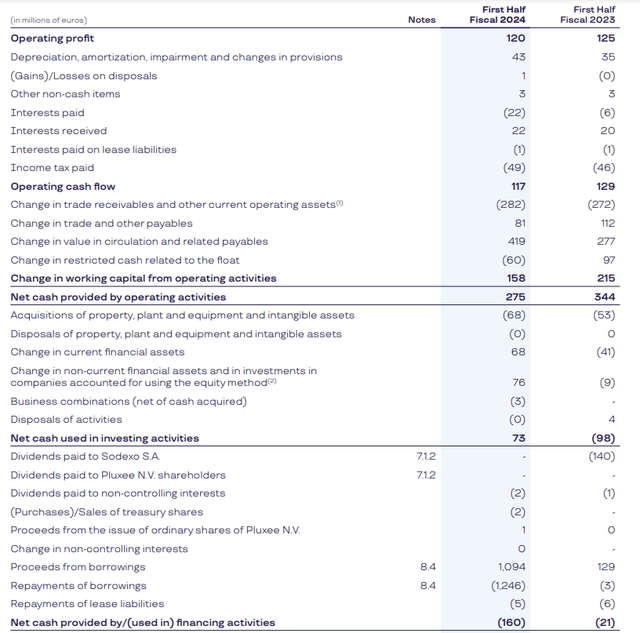
The total capex was 68M EUR, resulting in a net free cash flow of 83M EUR. That’s again lower than what you’d expect but keep in mind the normalized depreciation and amortization expenses would be 32M EUR per year while the company spent 73M EUR on capex and lease payments. A very clear sign Pluxee continues to invest in growth.
The company started the financial year strong, and in a Q3 trading update, Pluxee confirmed the strong performance and it actually upgraded its expectations. It now expects an organic revenue increase of 18% for the current financial year with a recurring EBITDA margin of 35%. The midterm objectives also remain unchanged with an additional low double-digit revenue growth rate in both FY 2025 and FY 2026 while the recurring EBITDA margin should expand to 37% by FY 2026.
The total revenue in FY 2023 was 1.05B EUR and applying an 18% and subsequent 11% and 10% organic revenue increase implies a FY 2026 revenue of 1.51B EUR. Applying the anticipated 37% EBITDA margin to that number implies a total EBITDA of 560M EUR. That would compare very favorable to the 363M EUR recurring EBITDA generated in FY 2023 as it represents a 54M EUR increase.
We know the D&A expenses will likely be around 80M EUR per year, while I also anticipate the net finance expenses to be minimal, and I will use 25M EUR per year as net finance expense (up from a zero net finance expense in H1 FY 2024). This results in a pre-tax income of 455M EUR. Applying an average tax rate of 30%, the net income would be approximately 315M EUR. Divided over 147M shares, I anticipate an EPS of around 2.14 EUR per share by the end of FY 2026.
Investment thesis
I’m a bit surprised by the weakness in Pluxee’s share price considering the company has upgraded its expectations in July. I think the stock is now trading at approximately 10 times earnings based on my FY 2026 projections and given the asset-light and capex-light business model while the company is operating in a growing market, I think the forward P/E of 10 is very attractive. A sharp decrease in the benchmark interest rates would put pressure on the revenue generated from the float, but this should be manageable in the greater scheme of things.
I currently have no position in Pluxee, and I am currently leaning towards writing put options in a combination of in the money and out of the money put options. Looking at the December 2024 expiry date, a P20 and P22 have an option premium of 0.94 EUR and 1.80 EUR respectively. Should the stock trade below 22 EUR per share, I will be able to grab stock at an attractive price while I would simply retain the option premiums if the share price trades above those levels on the expiry date.
Editor’s Note: This article discusses one or more securities that do not trade on a major U.S. exchange. Please be aware of the risks associated with these stocks.
Credit: Source link