

ryasick
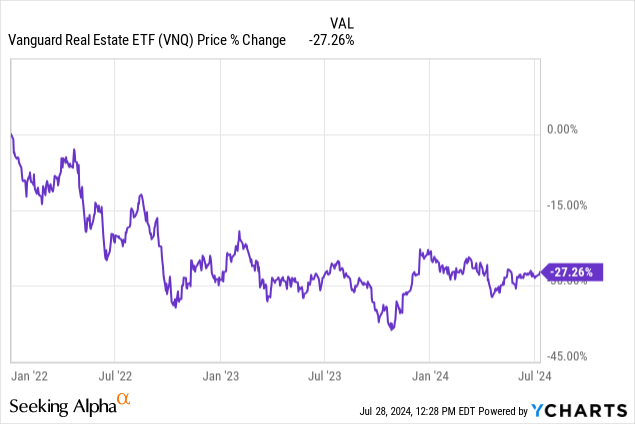
I have posted many articles making the case for real estate investment trusts, or REITs (VNQ), over the past year.
In short, their share prices had crashed, and their valuations had dropped to the lowest levels in 16 years, with most REITs trading at large discounts relative to the value of the real estate they own.
Still today, it is not uncommon to find individual REITs that trade at a 30, 40 or even a 50% discount relative to their net asset values. Such low valuations are truly exceptional for REITs and seem to imply that they are facing some severe headwinds.
But that isn’t the case. Yes, interest rates have surged, and it is slowing down their growth. However, the reality is that REIT entered this rate hiking cycle with the strongest balance sheets in their entire history, with low levels of debt and long debt maturities. Moreover, it is also important to mention that interest rates had only surged because inflation was hot, which was also very beneficial for REITs as it resulted in rapid rent growth.
Therefore, I have often argued that the sell-off was overdone and that REITs had become opportunistic. The best proof of this is that most REITs actually kept growing their cash flows and dividends in 2022, 2023, and 2024 even as their share prices crashed to lower levels.
But here’s my warning to you:
It appears that the window of opportunity could now be closing on us.
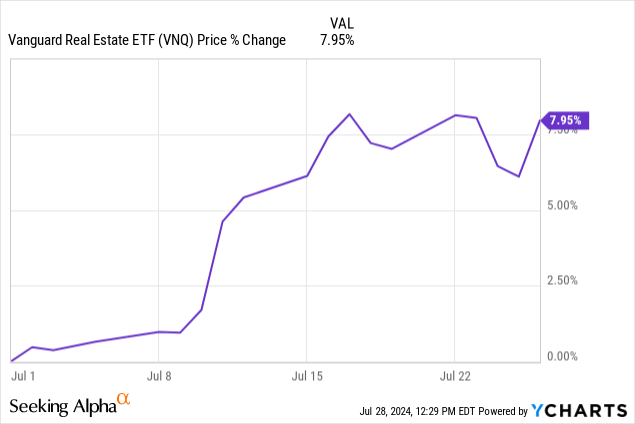
The market is slowly regaining its senses, and REITs have already begun their recovery.
They are up by 8% over the past month, and I think that this is just the beginning, but time is now running out:
The reason REITs are surging is that it now appears likely that the Fed will cut interest rates in September. The debt market is now pricing a 100% chance of at least one cut, and that’s merely one month away:
FedWatch Tool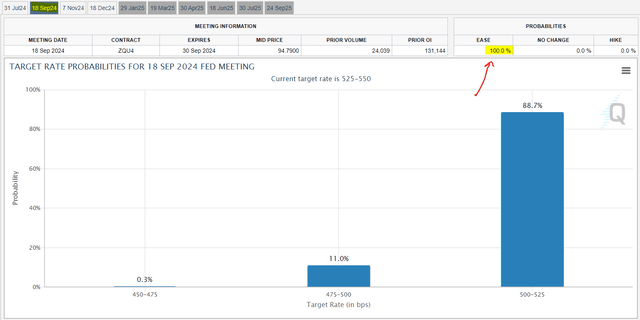
But here’s why this rally has legs.
- Inflation has now been defeated
- Therefore, we are likely to see many more rate cuts
- Valuations remain low even following the recent rally
- Rent growth is about to accelerate
- Blackstone and others are loading up on REITs right now.
Let’s discuss each one by one:
Inflation has now been defeated
Inflation surged following the pandemic because of three key reasons:
- It caused severe supply chain issues, reducing the supply of goods.
- It distorted the consumer behavior for certain goods, increasing demand.
- The government gave out money in the form of stimulus checks.
Not surprisingly, this caused a temporary spike in inflation. This period of high inflation was then also extended by Russia’s brutal invasion of Ukraine.
But now things are slowly returning to normal.
The world has long reopened. The supply chain issues have been mostly resolved. Stimulus money has dried up. Consumer behavior has normalized.
As a result, we have now returned to the pre-pandemic economy and inflation has also cooled down. It is at just 1.8% right now based on independent private market appraisals of Truflation. The official headline rate is still at 3%, but that’s only because the way they measure shelter is lagging in their index, but this is well-known to the Fed.
Interest rates are likely to be cut substantially
Interest rates were hiked at an unprecedented speed to a multi-decade high to fight inflation and make sure that it does not spiral out of control.
This has now been achieved. The job is done and therefore, these high interest rates aren’t needed anymore. Yes, the nominal rate may not seem particularly high relative to what we had decades ago. However, remember that it is the real rate that matters, and with low inflation, our real rates are actually quite high and it is needlessly weakening the economy.
Therefore, the Fed has emphasized that interest rates are likely to return to much lower levels, likely to where they were before the pandemic.
The debt market is today pricing 150-200 basis points lower interest rates within a year from now, and that’s assuming that we avoid a recession. The cuts could actually be much greater and faster in case of a hard landing.
This means that the first 25 basis point cut of September is likely to be the first of many, and the gradual reduction in interest rates will bring a steady flow of good news to the REIT sector.
Valuations remain low even following the recent rally
REITs valuations are still near the lowest levels in 16 years, with most REITs trading at low multiples of their cash flows and large discounts relative to the value of the real estate they own.
Therefore, it is not too late just yet to invest in them.
Just consider the following examples:
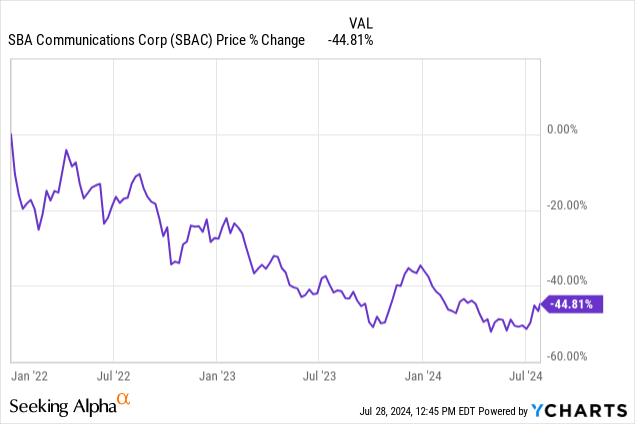
SBA Communications Corporation (SBAC): the cell tower REIT is down 45% since 2022 even despite growing its cash flow by 25%:
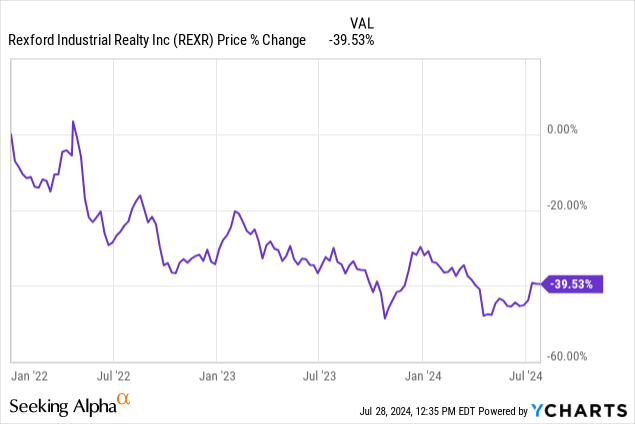
Rexford Industrial Realty, Inc. (REXR): the industrial REIT is down 40% since 2022 even despite growing its cash flow by 20%:
And Camden Property Trust (CPT): the apartment REIT is down 37% since 2022 even despite growing its cash flow by %:
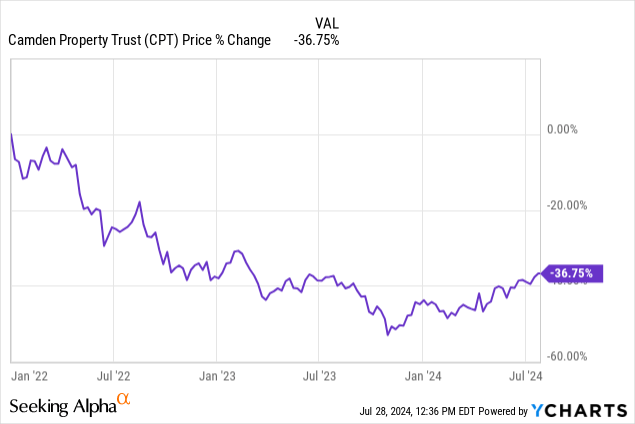
These are all blue-chip, investment-grade-rated REITs with low levels of debt, strong growth prospects, and yet, they are priced at their lowest valuations in a very long time, especially when adjusted for the rapid growth that enjoyed recently.
Rent growth is about to accelerate
Another strong catalyst for REITs in the near term is that rent growth is expected to accelerate. It suffered a bit in 2023 and 2024 because the ultra-low interest rates of the pandemic fueled a new wave of construction activity, and this new supply is now hitting the market. There is always a 1-2 year delay because it takes time to build properties.
However, the surge in interest rates and inflation then put most new construction activity on halt. It has now dropped to the lowest level since the great financial crisis. Therefore, the new supply will dry up soon and rent growth is expected to accelerate sometime in 2025 and especially in 2026. That’s happening right as interest rates are also returning to lower levels, resulting in an avalanche of good news for the REIT sector.
Blackstone and others are loading up on REITs right now
The combination of lower interest rates, accelerating rent growth, and low valuations should be enough on its own to push REITs to a lot higher levels in the coming years.
But if the market fails to reprice REITs accordingly, we also know that Blackstone-like (BX) private equity players are flushed with cash, and they are ready to pay big premiums to buy out REITs.
Blackstone has already acquired two of them this year for $17 billion, and they recently made the following remarks on a conference call: [emphasis added]
“So, if you went back to the financial crisis, in the summer of 2009, asset values bottomed. And for the next three years, you had lots and lots of negative headlines of troubled assets that came through the system. But if you are an investor, you wanted to start deploying capital then, which we started doing in earnest. And I think there are a lot of similarities to what we’re seeing right now…
…So, is there still plenty of bad news and headlines that will come through the system? Yes. But in the spot market, has the impact of what’s happened in the office sector, has the impact of higher rates, is that now reflected in real estate values? Yes. And so, what you see us doing is making some very large announcements… We’ve announced two public to privates in the rental housing space. $17 billion of enterprise value since the year started.
Now, I’m not saying this is some sort of sharp V-shaped recovery. But as you get to this bottoming period, what you want to do is try to deploy capital into this. And most people are going to be very cautious because they’re going to keep reading a lot of negative headlines from the past, and those are going to continue.”
And they are not alone. There are many other private equity companies also circling REITs right now because valuations are low, and they sense that the window of opportunity could be closing given that interest rates are now going back to lower levels.
Closing Note
If you stayed away from REITs for the past two years, congrats! You avoided the bear market, and your timing was a lot better than mine or even that of Blackstone.
But the narrative is about to flip.
Today, REITs are still discounted because of fears of a “higher for longer” environment, but as the talking point returns to “there is no alternative,” I expect REITs to strongly recover as fixed-income investors return to the REIT market and bid them up.
Now could be your last chance to buy them at these heavily discounted valuations.
Credit: Source link