

Richard Drury
Introduction
I often think about stocks that I am confident will continue to perform well over the long-term. Ones whose businesses remain strong and are likely to see solid growth over the next decade or so. Even through uncertain periods in the economy.
But some businesses remain resilient during turbulent times, and are likely here to stay. This is because of their recession-resistant business models, strong fundamentals, and exceptional management teams that keep them operating at high levels.
These are also ones that I think if I bought them, turned on DRIP and walked away, my income would have grown at an exponential rate when I decided to come back. In this article I list 3 stocks I would that could offer stellar total returns over the next decade.
Portfolio Construction/Diversification
When building a portfolio an important factor to consider is diversification. It’s easy to build a portfolio full of tech stocks and ride the wave, likely getting some great capital appreciation along the way. Similarly, if you are an income-focused investor, it’s easy to buy a bunch of BDCs or REITs and hold them.
But if you’re a long-term investor, diversification is key. In my opinion, a stock portfolio of 10 – 15 stocks is ideal, but this all depends on preference. Some investors own hundreds of stocks in their portfolio, but in my opinion, this can be hard to manage.
I think 10 to 15 with no more than 20 to 25 is perfect. And diversifying amongst sectors is important. If you’re an income investor, capital appreciation is great, but owning stocks for the next decade and watching your income stream grow is something that gets your juices flowing. Capital appreciation + growing income is the perfect combo. Without further ado, I give you 3 stocks that will likely continue to reward dividend investors with both.
Stock #1: Agree Realty (ADC)
I’ve been pounding the table on Agree Realty since my second article published on Seeking Alpha in May of 2023. And although the sector (XLRE) has been hit pretty hard with high interest rates, ADC has continued to perform well.
Several high-quality, large-cap businesses have seen their fair share of struggles due to the current macro environment. A lot of this is due to tighter financials amongst consumers leading to decreased spending. This, in turn, has resulted in decreased foot traffic and lower sales for certain businesses.
For REITs in particular, this has led to slower growth as REITs are highly sensitive to high interest rates. That’s why instead of investing solely based on yield or popularity, you should consider the company’s fundamentals.
For starters, ADC is smaller with roughly 2,200 properties, which means they have a lot of room for expansion, likely for many years to come. Unlike their direct peer, Realty Income (O), who was in Agree Realty’s shoes back in 2010. At the end of 2010 O had 2,496 properties in 49 states.
And now O has more than 15,000 properties. I say that to say ADC has a lot of room for further growth. Additionally, they can expand into untapped markets like Europe, something their CEO has been adamant about not doing in the past. But as the company grows larger, this is something they may delve into down the line.
Additionally, ADC has an attractive monthly dividend that has been growing over the past 10 years. And although the dividend was cut during the Great Financial Crisis, the company was much smaller back then. But with their recession-resistant portfolio concentrated in grocery, home improvement, and tire & auto service stores, it’s safe to say Agree Realty is here to stay.
No matter what happens, 10, 20, or 50 years from now, people will still need to eat, buy items for their homes, and require services for their vehicles. Moreover, 68% of their portfolio consists of investment-rated tenants like Walmart (WMT), Tractor Supply (TSCO), Lowe’s (LOW), The Sherwin-Williams Company (SHW), and Home Depot (HD).
|
Company |
Founded |
|
HD |
46 years ago |
|
WMT |
62 years ago |
|
TSCO |
86 years ago |
|
LOW |
103 years ago |
|
SHW |
158 years ago |
Past performance doesn’t predict future performance of course, but businesses with long, successful operating histories is an important factor. This says they know how to adapt to changing environments, consumer habits, and know how to deal with periods of uncertainty.
This also gives the company experience to navigate future downturns successfully. Anything can happen, but the chance of the business grows less with each downturn they navigate through.
ADC recently reported their Q2 earnings with a growth rate of 6.04% on AFFO. This stood at $1.04 for the quarter, well-above their current quarterly run rate of $0.75. They also raised their AFFO & acquisition guidance for the full-year.
They now expect AFFO to come in a range of $4.11 – $4.14, up from $4.10 – $4.13 prior. Acquisition volume is expected to be $700 million, up from $600 million.
But importantly, ADC has handily outperformed their peer Realty Income and the S&P in total returns. ADC is up more than 250% compared to 189% for the index and nearly 117% for O over the past decade. And although this can change going forward, as a result of their smaller size, stellar management, recession-resistant portfolio, fortress balance sheet with a pro forma net debt to EBITDA of just 4.1x, their outperformance will likely continue.
Seeking Alpha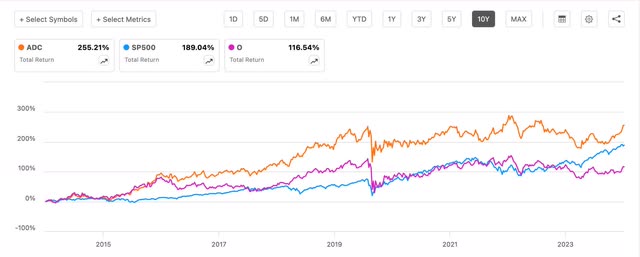
Stock #2: Main Street Capital (MAIN)
A favorite in the BDC sector is Main Street Capital. If you’re a dividend investor focused on growing income, you can’t mention investing for dividends without at least mentioning this BDC. One reason investors may love this BDC is their internally-managed structure and their monthly dividend.
Investing in monthly-paying companies allows you to compound dividends at a much faster pace. Buying, reinvesting the dividends for the long-term is a sure-fire way to build your income stream. Additionally, unlike some its peers, Main Street Capital has never cut its dividend.
Moreover, as some BDCs have struggled as they lend to lower, middle-market companies who are sometimes distressed, MAIN has been exceptional with low non-accruals, or non-performing loans. These stood at 0.5% at fair value and 2.0% at cost.
Additionally, their dividend coverage was strong with net investment income coming in at $1.11 during Q1, well-above their $0.735 quarterly run rate. They also award special dividends with the last one paid out this past June. Most of their portfolio is invested in Internet & Software Services, a recession-resistant business.
Like ADC, they’ve also outperformed some of their peers and the index when it comes to total returns. In the chart below I compare MAIN to Gladstone Investment (GLAD) due to both paying monthly dividends. GAIN outperforms MAIN when it comes to total returns, however Main Street Capital handily outperformed the S&P over the past decade.
Seeking Alpha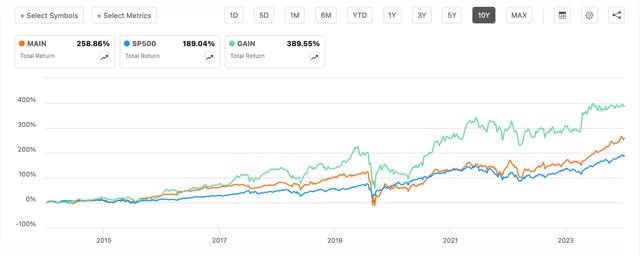
Comparing Main Street to Gladstone Investment, the former outperformed the latter in terms of capital appreciation over the past 3 years. MAIN has more than doubled GAIN’s performance, up 27.44% compared to 11.70%. Additionally, MAIN enjoyed a much stronger balance sheet with leverage well-below the sector average at 0.72x. This allows MAIN to take advantage of investment opportunities in the future.
Seeking Alpha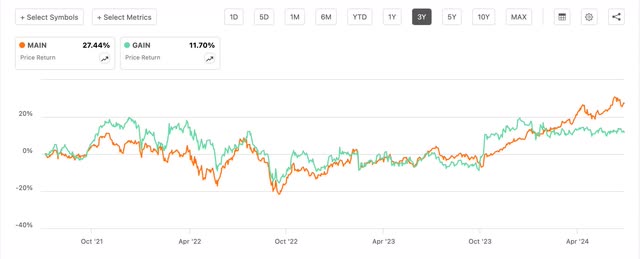
Stock #3: Visa (V)
Last on the list is Visa, another favorite amongst dividend investors. Unlike Agree Realty and Main Street Capital, Visa is likely to give investors much more capital appreciation.
As previously mentioned, that’s why it’s important for investors to diversify. Each investment should be looked at like employees on a job. While REITs and BDCs may reward you with capital appreciation, their main jobs should be income. In the case of V, their job is a little bit of both.
And despite what some consider underperformance during their recent earnings with a miss on revenue, V still managed to grow this year-over-year by 10%, which is still solid considering the macro environment. With consumer financials impacted from high interest rates, it’s expected to see lower or slower payment volumes.
Additionally, with surging credit card and household debt, it should be expected consumers will use their cards less, in turn, impacting payment volumes. However, V still managed to grow this 7% year-over-year. The stock reacted negatively to the news however with a drop in share price. But long-term investors should be taking this opportunity to add more.
Visa is a business that requires very low capital expenditures and has growing cash flows. Unlike the two stocks listed prior, Visa is not required to payout 90% of their earnings. Over the past few years V’s payout ratio has averaged in the teens. This means they have ample liquidity for buybacks and investments if need be. In Q3 alone they bought back $4.8 billion worth of stock!
Moreover, over the past 5 years the stock’s dividend has more than doubled from $0.25 to $0.52, and seeing by their low payout ratio, this will likely continue for the foreseeable future. Looking at the chart below V has outperformed the S&P but trailed behind peer Mastercard (MA), up 442% compared to 530% for Mastercard.
Seeking Alpha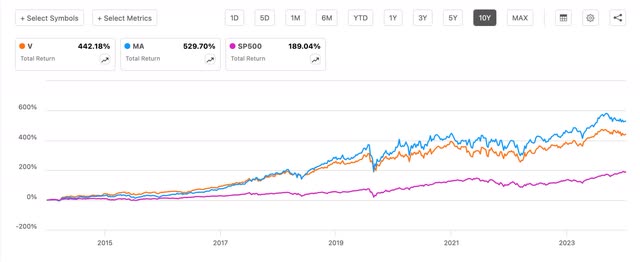
However, Visa doesn’t hold their consumer debt like Mastercard, making them more resistant in times like now. They also had a very strong balance sheet with only $20 billion in debt. Very low compared to a market cap of more than $500 billion. Furthermore, their cash position was strong with nearly enough to satisfy their debt load at $17 billion. This is in comparison to MA, who had debt of roughly $16 billion and $8 billion in cash.
Investor Takeaway
When investing for dividends, one should also consider diversification as well. Although REITs and BDCs are seen as income vehicles, holding stocks like Visa can provide not only income diversification with higher growth, but resilient businesses who won’t suffer as much during economic downturns as well. Stocks outside these two sectors also provide the likelihood of higher capital appreciation. If you’re looking for companies that will likely continue to reward you with strong total returns and outperformance vs the S&P, these 3 stocks are a great start.
Credit: Source link