



• bitcoinBitcoin(BTC)$85,814.00-0.11%
  • ethereumEthereum(ETH)$2,736.27-0.13%
  • tetherTether(USDT)$1.000.01%
  • binancecoinBNB(BNB)$786.55-0.01%
  • rippleXRP(XRP)$1.603.97%
  • usd-coinUSDC(USDC)$1.000.01%
  • solanaSolana(SOL)$117.380.24%
  • tronTRON(TRX)$0.342830-1.78%
  • zcashZcash(ZEC)$1,604.716.85%
  • Figure HelocFigure Heloc(FIGR_HELOC)$1.031.76%
  • HyperliquidHyperliquid(HYPE)$95.630.89%
  • dogecoinDogecoin(DOGE)$0.0998701.38%
  • moneroMonero(XMR)$568.81-0.05%
  • whitebitWhiteBIT Coin(WBT)$86.23-0.18%
  • chainlinkChainlink(LINK)$12.93-0.09%
  • USDSUSDS(USDS)$1.000.01%
  • cardanoCardano(ADA)$0.2541182.34%
  • RainRain(RAIN)$0.012913-4.64%
  • leo-tokenLEO Token(LEO)$8.97-0.05%
  • stellarStellar(XLM)$0.2169172.23%
  • bitcoin-cashBitcoin Cash(BCH)$356.5032.93%
  • uniswapUniswap(UNI)$10.1214.27%
  • nearNEAR Protocol(NEAR)$4.632.18%
  • avalanche-2Avalanche(AVAX)$11.081.55%
  • Ethena USDeEthena USDe(USDE)$1.000.02%
  • litecoinLitecoin(LTC)$62.673.62%
  • daiDai(DAI)$1.000.01%
  • CantonCanton(CC)$0.113029-3.43%
  • USD1USD1(USD1)$1.000.01%
  • hedera-hashgraphHedera(HBAR)$0.0975282.45%
  • suiSui(SUI)$1.020.19%
  • the-open-networkGram (prev. Toncoin)(GRAM)$1.451.50%
  • shiba-inuShiba Inu(SHIB)$0.0000060.37%
  • BittensorBittensor(TAO)$310.06-2.55%
  • crypto-com-chainCronos(CRO)$0.0669730.74%
  • Global DollarGlobal Dollar(USDG)$1.000.00%
  • MemeCoreMemeCore(M)$1.28-4.34%
  • paypal-usdPayPal USD(PYUSD)$1.000.01%
  • tether-goldTether Gold(XAUT)$4,318.230.06%
  • okbOKB(OKB)$124.061.04%
  • BitwayBitway(BTW)$0.9515.97%
  • Circle USYCCircle USYC(USYC)$1.140.01%
  • Ripple USDRipple USD(RLUSD)$1.000.00%
  • aaveAave(AAVE)$149.575.62%
  • BlackRock USD Institutional Digital Liquidity FundBlackRock USD Institutional Digital Liquidity Fund(BUIDL)$1.000.00%
  • Ondo US Dollar YieldOndo US Dollar Yield(USDY)$1.15-0.04%
  • mantleMantle(MNT)$0.684.90%
  • EthenaEthena(ENA)$0.2134251.23%
  • OndoOndo(ONDO)$0.4367050.61%
  • pepePepe(PEPE)$0.000005-1.87%
TradePoint.io
  • Main
  • AI & Technology
  • Stock Charts
  • Market & News
  • Business
  • Finance Tips
  • Trade Tube
  • Blog
  • Shop
No Result
View All Result
TradePoint.io
No Result
View All Result

SpaceX roars back to orbit barely two weeks after in-flight anomaly

July 27, 2024
in Market & News
Reading Time: 3 mins read
A A
SpaceX roars back to orbit barely two weeks after in-flight anomaly
ShareShareShareShareShare
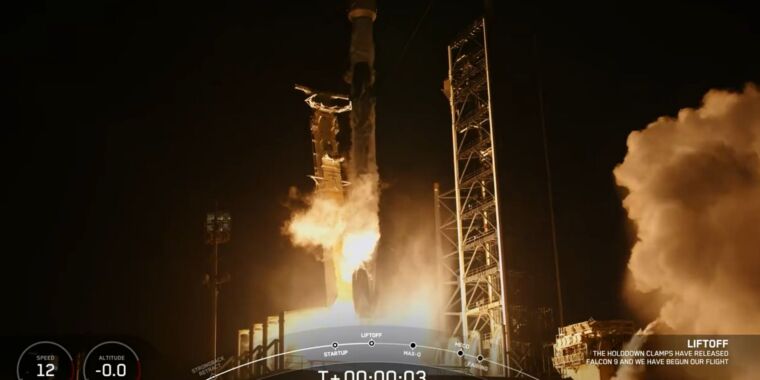
Enlarge / The Starlink 10-9 mission lifts off early Saturday morning from Florida.

SpaceX webcast

YOU MAY ALSO LIKE

FDA approves groundbreaking new drug for pancreatic cancer

Nepal search efforts underway in difficult terrain of flooded Himalayan foothills

Early on Saturday morning, at 1:45 am local time, a Falcon 9 rocket soared into orbit from its launch site at Kennedy Space Center in Florida.

By some measures this was an extremely routine mission—it was, after all, SpaceX’s 73rd launch of this calendar year. And like many other Falcon 9 launches this year, the “Starlink 10-9” mission carried 23 of the broadband internet satellites into orbit. However, after a rare failure earlier this month, this particular Falcon 9 rocket was making a return-to-flight for the company, and attempting to get the world’s most active booster back into service.

And by all measures, it performed. The first stage booster, B-1069, made its 17th flight into orbit before landing on the Just Read the Instructions drone ship in the Atlantic Ocean. Then, a little more than an hour after liftoff, the rocket’s second stage released its payload into a good orbit, from which the Starlink spacecraft will use their on-board thrusters to reach operational altitudes in the coming weeks.

A crack in the sense line

The Falcon 9 rocket only failed a little more than 15 days ago, during a Starlink launch from Vandenberg Space Force Base, California, at 7:35 pm PDT (02:35 UTC) on July 11. During that mission, just a few minutes after stage separation, an unusual buildup of ice was observed on the Merlin vacuum engine that powers the second stage of the vehicle.

According to the company, the Merlin vacuum engine successfully completed its first burn after the second stage separated. However, during this time a liquid oxygen leak developed near the engine—which led to the buildup of ice observed during the webcast.

Engineers and technicians were quickly able to pinpoint the cause of the leak, a crack in a “sense line” for a pressure sensor attached to the vehicle’s liquid oxygen system. “This line cracked due to fatigue caused by high loading from engine vibration and looseness in the clamp that normally constrains the line,” the company said in an update published prior to Saturday morning’s launch.

This leak excessively cooled the engine, and caused a lower amount of igniter fluid to be available prior to re-lighting the Merlin for its second burn to circularize the rocket’s orbit before releasing the Starlink satellites. This caused a hard start of the Merlin engine. Ultimately the satellites were released into a lower orbit, where they burnt up in Earth’s atmosphere within days.

The sense line that failed is redundant, SpaceX said. It is not used by the flight safety system, and can be covered by alternate sensors already present on the engine. In the near term, the sense line will be removed from the second stage engine for Falcon 9 launches.

During a news briefing Thursday, SpaceX director Sarah Walker said this sense line was installed based on a customer requirement for another mission. The only difference between this component and other commonly flown sense lines is that it has two connections rather than one, she said. This may have made it a bit more susceptible to vibration, leading to a small crack.

Getting back fast

SpaceX identified the cause of the failure within hours of the anomaly, and worked the Federal Aviation Administration to come to a rapid resolution. On Thursday, the launch company received permission to return to flight.

“It was incredible to see how quickly the team was able to identify the cause of the mishap, and then the associated corrective actions to ensure success,” Walker said.

Before the failure on the night of July 11th, SpaceX had not experienced a mission failure in the previous 297 launches of the Falcon 9 rocket, dating back to the Amos-6 launch pad explosion in September 2016. The short interval between the failure earlier this month, and Saturday’s return to flight, appears to be unprecedented in spaceflight history.

The company now plans to launch two more Starlink missions on the Falcon 9 rocket this weekend, one from Cape Canaveral Space Force Station in Florida, as well as Vandenberg Space Force Base in California. It then has three additional missions before a critical astronaut flight for NASA, Crew-9, that could occur as soon as August 18.

For this reason, NASA was involved in the investigation of the second stage failure. Steve Stich, manager of NASA’s Commercial Crew Program, said SpaceX did an “extraordinary job” in identifying the root cause of the failure, and then rapidly looking at its Dragon spacecraft and first stage of the Falcon 9 rocket to ensure there were no other sensors that could cause similar problems.

Credit: Source link

ShareTweetSendSharePin

Related Posts

FDA approves groundbreaking new drug for pancreatic cancer
Market & News

FDA approves groundbreaking new drug for pancreatic cancer

September 23, 2026
Nepal search efforts underway in difficult terrain of flooded Himalayan foothills
Market & News

Nepal search efforts underway in difficult terrain of flooded Himalayan foothills

September 23, 2026
Dollywood visitors share memories about Dolly Parton
Market & News

Dollywood visitors share memories about Dolly Parton

September 23, 2026
1985: Tim Curry on playing the butler in ‘Clue’
Market & News

1985: Tim Curry on playing the butler in ‘Clue’

September 23, 2026
Next Post
TikTok collected US user views on issues like abortion and gun control, Justice Dept. claims

TikTok collected US user views on issues like abortion and gun control, Justice Dept. claims

Leave a Reply Cancel reply

Your email address will not be published. Required fields are marked *

Search

No Result
View All Result
Your AI Governance Plan Has a Night-Shift Problem – Unite.AI

Your AI Governance Plan Has a Night-Shift Problem – Unite.AI

September 18, 2026
At least two dead after catastrophic Grand Canyon flooding

At least two dead after catastrophic Grand Canyon flooding

September 20, 2026
Vanderbilt recovers fumble with 1 second left to stun NC State – ESPN

Vanderbilt recovers fumble with 1 second left to stun NC State – ESPN

September 19, 2026

About

Learn more

Our Services

Legal

Privacy Policy

Terms of Use

Bloggers

Learn more

Article Links

Contact

Advertise

Ask us anything

©2020- TradePoint.io - All rights reserved!

Tradepoint.io, being just a publishing and technology platform, is not a registered broker-dealer or investment adviser. So we do not provide investment advice. Rather, brokerage services are provided to clients of Tradepoint.io by independent SEC-registered broker-dealers and members of FINRA/SIPC. Every form of investing carries some risk and past performance is not a guarantee of future results. “Tradepoint.io“, “Instant Investing” and “My Trading Tools” are registered trademarks of Apperbuild, LLC.

This website is operated by Apperbuild, LLC. We have no link to any brokerage firm and we do not provide investment advice. Every information and resource we provide is solely for the education of our readers. © 2020 Apperbuild, LLC. All rights reserved.

No Result
View All Result
  • Main
  • AI & Technology
  • Stock Charts
  • Market & News
  • Business
  • Finance Tips
  • Trade Tube
  • Blog
  • Shop

© 2023 - TradePoint.io - All Rights Reserved!