
Vertigo3d/E+ via Getty Images
Company Overview
American Airlines built Sabre (NASDAQ:SABR) in the 1960s to give travel agents access to airline price and availability data. Roughly 70% of Sabre’s revenue comes from its global distribution system (GDS)—software that sits between travel agencies and airlines, allowing travel agents to see flight inventory, prices, and availability. The GDS business has historically been good because contracts are 3-5 years, and customers typically renew.
Also, the GDS market is an oligopoly because Sabre, Amadeus, and Travelport control nearly the entire market. Sabre has the strongest presence in the US, whereas Amadeus has the strongest presence in Europe. Travel buyers will often pick the GDS with the most flights in their region, so each GDS has a competitive advantage in its regions.
Additionally, the business is defensive because airlines drop ticket prices during crises/recessions, and the number of global passengers boarded falls minimally (Sabre is paid per flight booked).
Sabre Investor Presentation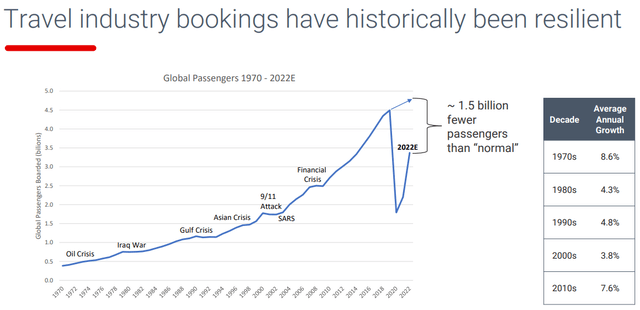
GDS Issues
GDS systems haven’t changed much over time. People describe them as “archaic” because they still use command-line interfaces (how computers worked before graphical user interfaces were popularized in the 1980s). GDSs are also notoriously inflexible, making it difficult to integrate new features and technologies into them.
In addition to GDS systems being difficult to use, airlines dislike them for multiple reasons:
- After sending their inventory data to a GDS, airlines lose control over how their data is displayed
- Information remains in the GDS, so airlines don’t have access to customer data
- Airlines lose ancillary sales (seat selection, boarding and overhead bin access, flight changes, Wi-Fi, etc.)
Airlines are low-margin businesses, so they’ve wanted to cut out the middleman (Sabre) for a long time. The consensus seems to be that GDSs are expensive relative to the value they provide in the transaction chain. Lufthansa previously stated that it’s several times as expensive for them when a flight is booked through a GDS relative to other methods (such as booking through Lufthansa’s website)
New Distribution Capability (NDC)
New Distribution Capability is a data exchange format that enhances communications between airlines and travel agents. The old data exchange format, Electronic Data Interchange for Administration, Commerce, and Transport (EDIFACT), used in GDSs, is less capable (for example, EDIFACT limits the number of prices an airline can offer).
Airlines like NDC because it allows them to upsell perks (baggage allowance, frequent flier points, onboard WiFi and entertainment, pre-ordered meals, day-of-departure changes, and upgrades). Customers are given more flexibility because they can choose their seats and apply loyalty program miles.
The other benefit of NDC is continuous pricing. Airlines are restricted to 26 price points because of GDS limitations, but they can offer unlimited price points with NDC.
Travel Industry Blog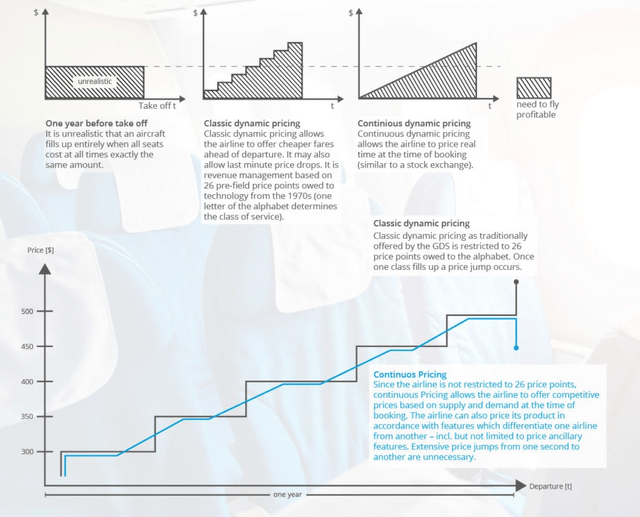
Weak COVID Recovery
Sabre entered COVID as a significantly more leveraged company relative to Amadeus. As a result, Sabre was forced to lay off thousands of employees. In contrast, Amadeus retained employees and took market share (Sabre’s market share fell from 38.8% in 2019 to 33.8% in 2023, according to Sabre’s investor presentations). Sabre’s employee count dropped from 9,250 in 2019 to 6,232 in 2023, whereas Amadeus’s full-time employee count increased from 16,518 in 2019 to 18,629 in 2023.
Sabre has faced other challenges. For example, airline consolidation and industry conditions allowed airlines to negotiate lower fees during COVID-19. Also, it appears that Sabre’s product offerings are weaker relative to Amadeus. Expedia withdrew inventory from Sabre during COVID-19 to simplify its operations but chose to expand its relationship with Amadeus. There are other reports of Amadeus taking business from Sabre as well.
NDC Implementation
NDC will be implemented over time in one of three ways: through a GDS, flight aggregator, or direct connection between an airline and the seller.
Altexsoft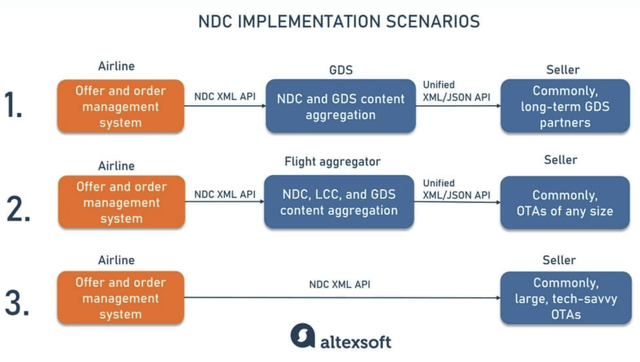
NDC-Enabled GDS Bookings
GDSs are already adapting and investing hundreds of millions of dollars into NDC. Almost all major airlines list NDC content in Sabre, Amadeus, and Travelport.
However, NDC-enabled GDS bookings are likely less profitable than typical GDS bookings. During Sabre’s 2023 Q1 conference call, an analyst said, “What we’re hearing is NDC booking fees are generally lower when we compare to the EDIFACT channels.” Management’s response to the analyst was vague – they said that the economics are sometimes neutral and sometimes different between EDIFACT and NDC.
My view is that NDC-enabled GDS bookings are less profitable. Michael Strauss, CEO of PASS Consulting, estimates that “airlines will pay the GDSs approximately $3 per passenger name record for NDC-enabled bookings, versus $16 to $20 under the legacy model.” I believe the economics are worse because airlines are pushing for more favorable terms during negotiations. For example, Sabre could not negotiate another deal with Emirates because Emirates was “not committed to achieving a mutually favorable agreement.” Airlines might be price comparing between NDC-enabled GDS bookings and direct-connection bookings, so in a sense, GDS providers are negotiating against a new low-cost option.
NDC Aggregators
GDSs now face more competition because the shift to NDC allowed NDC aggregators to enter the market. NDC aggregators offer benefits, such as lower prices and faster integration processes. Players in this space include AirGateway, DRCT, Duffel, HitchHiker, and Travelfusion. I believe that NDC aggregators are increasing competition and forcing Sabre to charge lower transaction fees for NDC-enabled GDS bookings.
Direct Connection
Direct connection poses the most significant risk to GDSs. It’s been reported that leisure customers, which account for 50% of Sabre’s GDS business, are leaving travel agencies and buying directly through airline websites. Even the bookings that are still going through travel management companies (TMCs) could stop going through the GDSs because next-gen TMCs are directly integrated with Airlines. I believe that next-gen TMCs could potentially disrupt legacy TMCs because they have cost advantages and are more innovative than legacy TMCs (who are reluctant to switch to NDC).
In addition to TMCs, online travel agencies (OTAs) make up a large portion of Sabre’s business. Unfortunately, OTAs have been directly connecting with airlines during COVID. Sabre doesn’t disclose how much of their GDS volume is from OTAs, but “OTA volumes remain a very meaningful contributor to the GDS industry,” according to Sabre’s management. Therefore, Sabre still has a lot of volume to lose.
Other factors point to increased direct connection momentum. Garner, an airline consultancy founded by former American Airlines executive Cory Garner, continues to push the direct channel.
Garner LinkedIn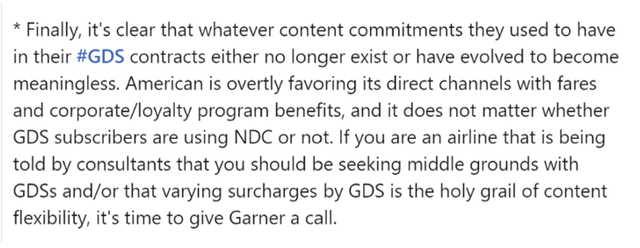
Also, airlines such as Lufthansa make direct connection bookings more attractive by charging for NDC-enabled GDS bookings.
Guidance
Yahoo Finance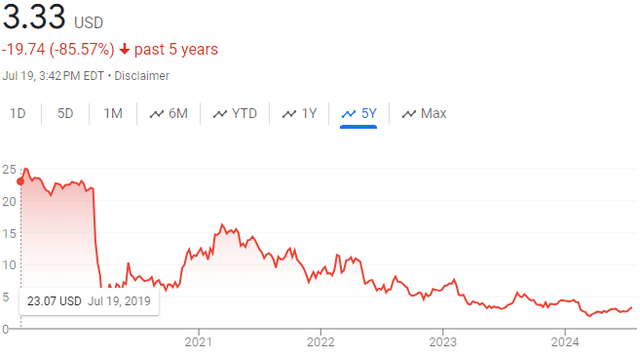
Sabre initially performed well post-COVID because investors bet on Sabre recovering to pre-COVID levels. Management’s initial 2025 targets were very optimistic and surpassed pre-COVID levels.
Sabre Investor Presentation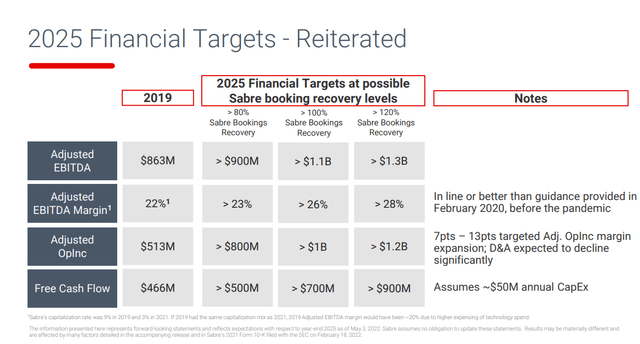
However, guidance was reduced in 2023 to management’s most conservative case.
Sabre Investor Presentation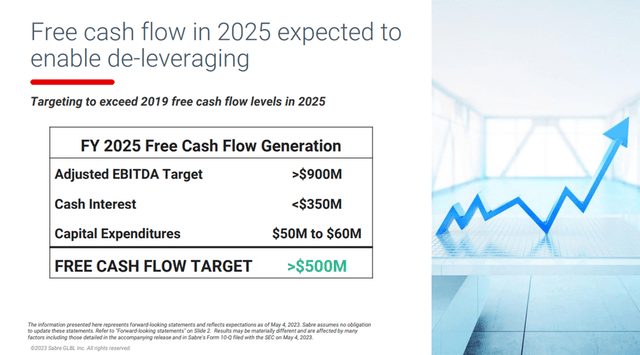
Guidance was downgraded again in 2023. In Sabre’s Q4 2023 conference call, management claimed their initial guidance assumed GDS industry growth of 1-2 points per quarter, but growth came in below those numbers.
Sabre Investor Presentation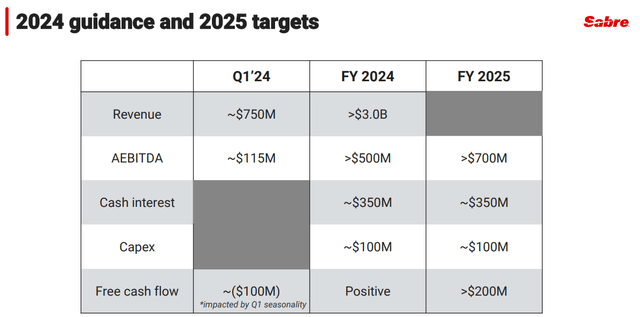
My view is that NDC and direct connections are behind the GDS market’s weak recovery. I also believe corporate travel is lower because Zoom has replaced some travel.
Valuation
Revenue Growth
I have revenue for the hospitality segment growing 10% annually over the next ten years because management said they expect double-digit growth for 2024. This assumption is probably optimistic because revenue grew slower than 10% annually pre-COVID. However, I think there’s room for this segment to grow because the value proposition is strong (some argue that hotels shouldn’t build software in-house).
I estimate that revenue will grow 6% annually for the airline IT solutions and distribution businesses. I believe this is fair because Amadeus previously said the GDS business grows at 1.5x GDP (the risk-free rate is around 4% right now, which is my proxy for GDP growth; 4% * 1.5 = 6%). I have the IT solutions business growing at the same rate as the GDS business because the airline industry tends to grow faster than GDP (so the airline IT solutions business should grow at a similar rate).
I then account for direct connect/NDC customer loss by adjusting the distribution revenue growth rate down. In my base case, I assume that Sabre will lose 20% of its 2033 revenue.
Author’s Calculations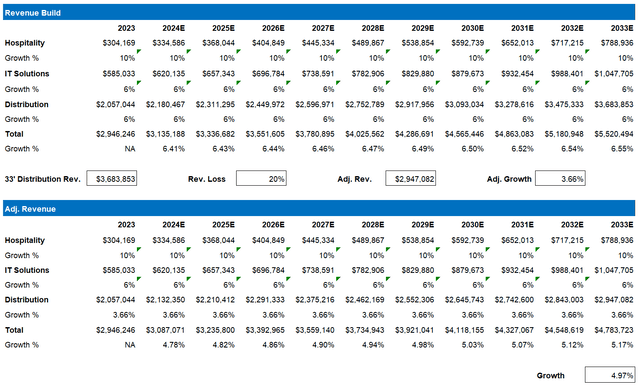
EBIT Bridge
I use management’s guidance to estimate normalized EBIT.
Sabre Investor Presentation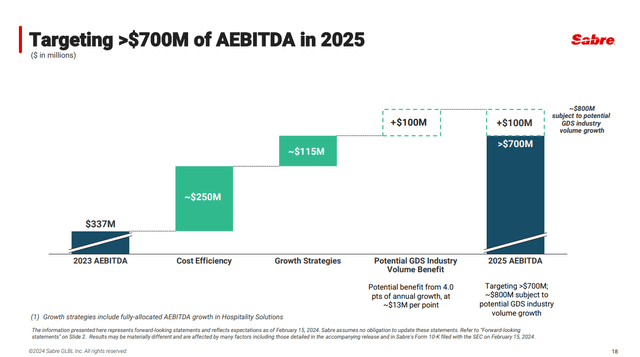
However, management adds back multiple items to arrive at adjusted EBITDA/operating income.
Sabre 10-K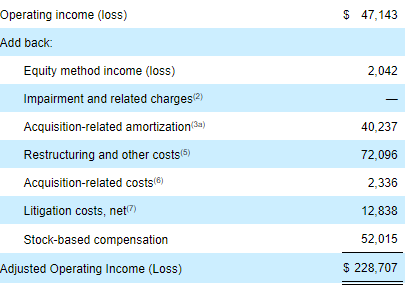
I disagree with adding back stock-based compensation (because I see it as a real expense), litigation cost (because it shows up consistently), acquisition-related costs (also shows up consistently), equity method income (I account for this later), and acquisition-related amortization (also shows up consistently, and I add amortization back later in my DCF). However, restructuring should be a one-time expense, so I add this back to my estimate of normalized EBIT. I also subtract ~$15 million from 2023 EBIT because I believe normalized stock-based compensation will be higher than 2023 levels.
I then add management’s estimate of cost efficiency ($250 million) to 2023 EBIT. I believe this number makes sense because layoffs in 2023 and tech investments (cloud migration) should substantially reduce Sabre’s operating expenses.
Management also expects $115 million in EBITDA from their growth strategies and $100 million in EBITDA from GDS industry growth. Analysts expect ~$300 million in revenue growth from 2023-2025, so I assume all this growth is from growth strategies. Then, I subtract 2% of the $300 million to account for stock-based compensation and 13% of the $300 million to account for D&A (13% is Sabre’s pre-COVID average D&A/revenue). To account for the $100 million in GDS EBITDA, I first assume that GDS revenue grows 8% (the $100 million in EBITDA is contingent on 4% annual GDS growth during 2024/2025) from 2023 levels (~$164 million in growth). Then, I account for SBC and D&A to get an EBIT estimate of $75,315.
Author’s Calculations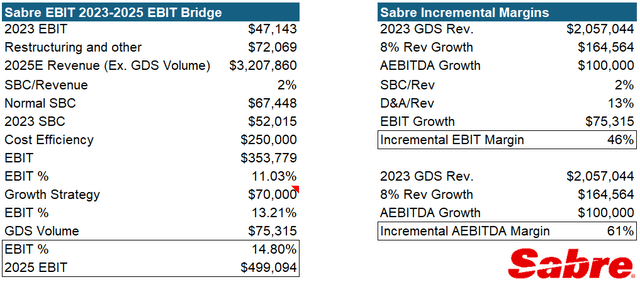
I also estimated incremental EBIT margins to demonstrate the operating leverage inherent in Sabre’s business. Management claims that a 1% increase in GDS industry volume increases Sabre’s adjusted EBITDA by $13 million (a 1% increase in GDS sales should increase revenue by ~$20 million).
Intrinsic Value
View my model here.
Author’s Calculations Author’s Calculations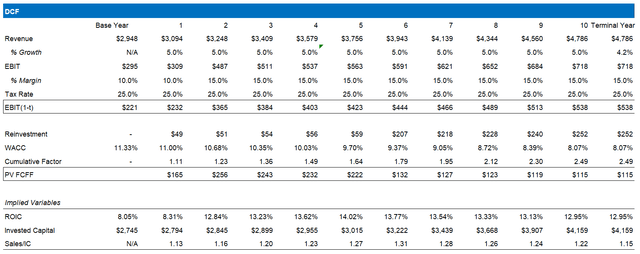

Other Assumptions
I use a 25% tax rate (global average corporate tax rate). For reinvestment, I use a Sales/(Invested Capital) ratio of three to reflect that sales growth is driven by recovery from COVID and not reinvestment (for years 1-5). Then, the Sales/(Invested Capital) ratio drops to 0.9 (typical for software companies).
Terminal Value
I use a terminal growth rate of 4.16% (the 10-year bond rate, which is a proxy for the economy’s growth rate). I use a terminal ROIC of 10.57%, which is 2.5% higher than my terminal year WACC, to reflect that Sabre has some competitive advantages (which will allow it to earn modest excess returns). In my calculation of Debt & Other, I include ~$70 million in unfunded pension liability and ~$70 million in leases. I also incorporate a failure risk of 23.7% based on Sabre’s B- debt rating (failure risk for B- companies taken from Aswath Damodaran’s data).
S&P Capital IQ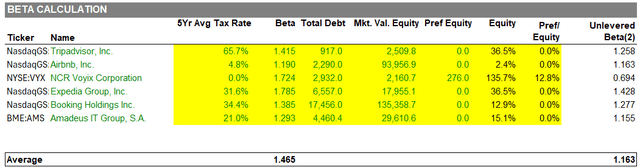
For my initial WACC, I use an unlevered beta of 1.163 (the average unlevered beta of Sabre’s peer group). My implied equity risk premium is from Damodaran’s website. I use a pre-tax cost of debt of 11% (YTM on Sabre’s long-term bonds).
Author’s Calculations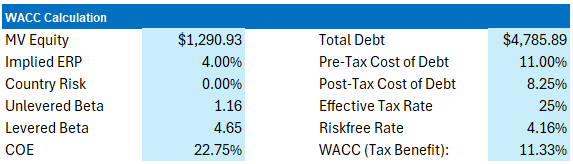
My initial WACC falls to my terminal WACC linearly over ten years. I assume that Sabre’s debt ratio falls to pre-COVID levels as management deleverages the balance sheet. I have Sabre’s pre-tax cost of debt at 6.37% because I assume that Sabre will become a BB-rated company (like it was pre-COVID). I use a default spread of 2.21% (BB-rated default spread according to Damodaran’s data).
Author’s Calculations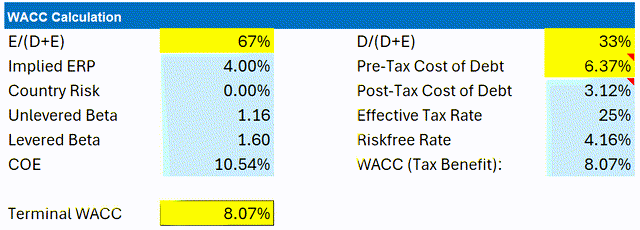
I calculate the market value of debt instead of using its book value. I estimate that the market value of debt is ~$200 million lower than its book value.
Author’s Calculations
I identified GDS customer base loss, EBIT margin, revenue growth (impacted by customer base loss), and excess returns in perpetuity as the primary drivers of Sabre’s intrinsic value. I created two scenario analyses below. Sabre is a leveraged company, so the range of outcomes is wide.
Author’s Calculations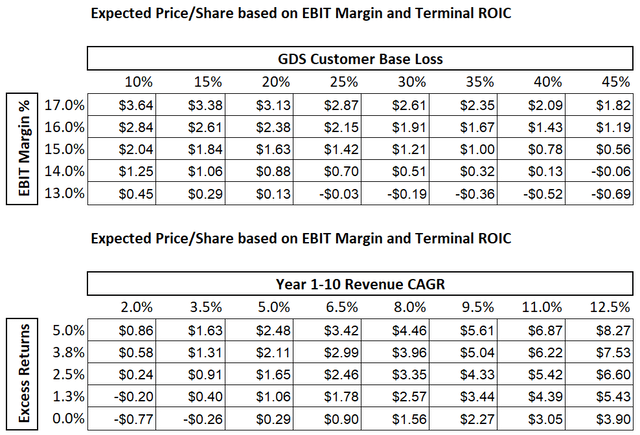
Risks
NDC Resistance, GDS Resilience
NDC recently lost momentum because American Airlines reversed its NDC strategy in late May. American Airlines previously removed 40% of its fare content from GDSs, but management decided to return most of it because of customer pushback.
It’s also possible that customers will stay with GDSs instead of directly connecting with airlines. GDSs are still liked for their simplicity and familiarity. TMCs, in particular, are avoiding both NDC and direct connections.
GDS Recovery
Analyst estimates may be conservative because corporate travel has only recovered to 75% of its pre-COVID levels on a unit basis. Revenue estimates are relatively low (consensus revenue growth is ~4-5%), so corporate travel may rebound and cause Sabre to exceed estimates.
Sabre traded for ~15x+ EBIT pre-COVID. I believe it shouldn’t trade at these levels because interest rates are no longer zero, and NDC risk is more of a concern now. However, I can envision a scenario where management deleverages the business, GDS revenue returns, margins expand, and management makes a good acquisition (causing the business to trade at 15x-20x EBIT again).
S&P Capital IQ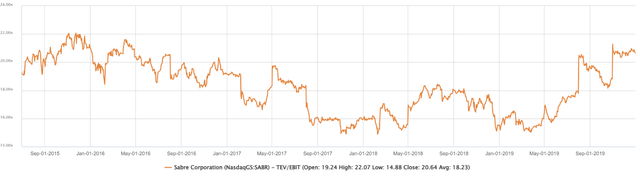
I outline two scenarios below. The more conservative scenario uses my previous EBIT estimate for 2025. My bullish scenario assumes a 17% normalized EBIT margin (margin expansion from operating leverage).
Author’s Calculations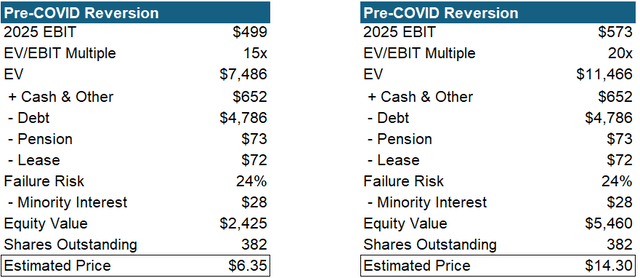
Conclusion
Although it’s possible to envision scenarios where Sabre’s stock increases 2-5x from current levels, I’m still not excited because these scenarios seem highly unlikely, the core business is being disrupted, and Sabre is overleveraged. I think the risk/reward doesn’t look interesting until Sabre trades for <$2/share.
Credit: Source link