




Olemedia
I published my last article about Morningstar, Inc. (NASDAQ:MORN) in February 2024, and I rated the stock as a “Hold” (as I rate many stocks at the moment). In my conclusion, I wrote:
Going into the earnings release on Thursday, I would be very cautious about Morningstar. I am not necessarily expecting a huge drop on Thursday following earnings, but I don’t see much upside potential in the coming quarters either (and it is not my style of investing – or trading – to buy stocks for a 5-10% potential gain).
And since the article was published, the stock gained about 11% and the performance was in line with the overall stock market as the S&P 500 also gained 11% in the same timeframe. Although Morningstar did not outperform the overall market and is remaining below the all-time high of late 2021, the performance is solid, and the expected huge drop did not occur so far. In the meantime, the company reported quarterly results twice and the results were still good.
Quarterly Results
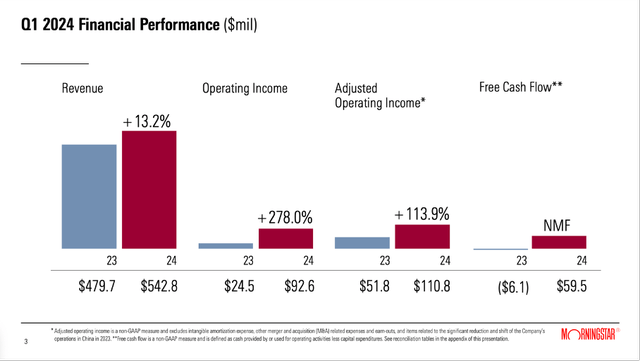
We start by looking at the first quarter results for fiscal 2024, which Morningstar reported on April 24, 2024. Revenue increased again from $479.7 million in Q1/23 to $542.8 million in Q1/24 resulting in 13.2% year-over-year top line growth. Organic revenue growth was 12.9% in Q1/24. Operating income also increased from $24.5 million in the same quarter last year to $92.6 million this quarter, resulting in 278% year-over-year growth. And instead of a diluted loss per share of $0.18 in Q1/23, the company reported $1.49 in earnings per share this quarter. And free cash flow also “switched” from a negative free cash flow of $6.1 million in the same quarter last year to $59.5 million this quarter.
Morningstar Q1/24 Presentation
Bigger Picture
But as always, it is important to look at the bigger picture and not just at quarterly results from one single quarter. And when looking at the last few years, we see that Morningstar clearly struggled in 2022, but since then, the trends and numbers improved again.
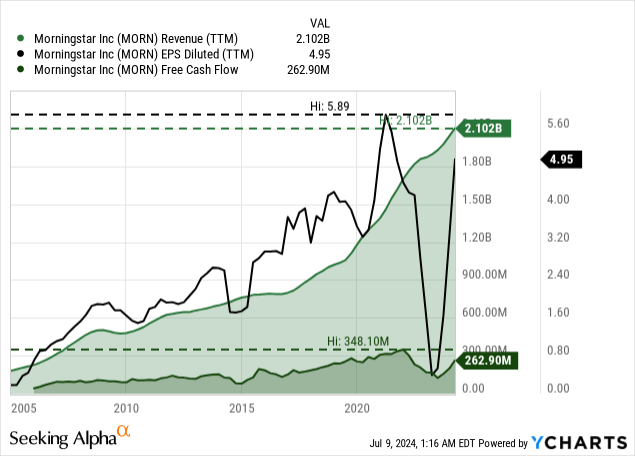
It is also not difficult to see (and not surprising) that Morningstar is moving more or less in line with the overall stock market as Morningstar’s revenue is dependent in some ways on the current sentiment, we see on the stock market.
And it seems not like an excessive statement to assume that Morningstar will continue to perform more or less in line with the overall stock market. As I personally don’t expect much good for the stock market in the years to come – especially in the United States – I am also assuming that Morningstar will struggle in the years to come. A few weeks ago, I explained in an article why I think the yield curve is still working as an early warning indicator and why it is just taking unusually long between the first warning signs and the recession actually occurring. In my opinion, we should take the warning sign by the yield curve serious and deal with the very real possibility of the U.S. economy being on the brink of a recession.
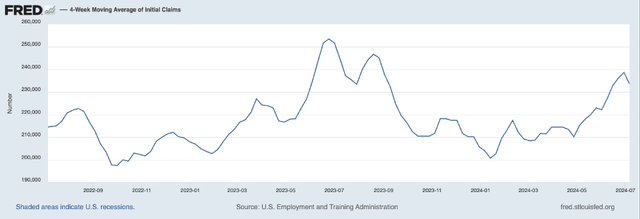
One number we can look at are the initial claims for unemployment insurance and since January 2024, we see the number creeping higher, which could be another warning sign. However, we must be very cautious in interpreting these numbers as fluctuations are normal and in 2023, we see a similar rise without a recession occurring, and we are already seeing the number declining again a little bit. On the other hand, it is not just the initial claims increasing in the last few months, the unemployment rate is also constantly increased from 3.4% in April 2023 to 4.1% in June 2024.
FRED
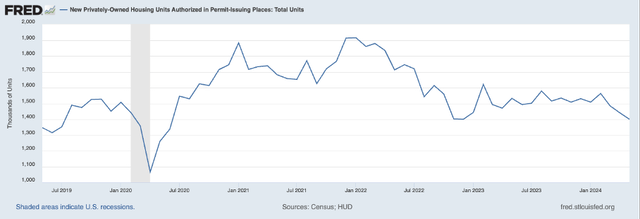
A second metric worth mentioning here are the new privately-owned housing units authorized in permit-issuing places. When looking and the housing market, this metric is one of the best early warning indicators, as permits are among the first steps people have to take when building a house. This metric already started declining in 2022 and after declining for one year, it was stabilizing at a lower level and remained in a narrow corridor in 2023 and early 2024. However, in the last few quarters, the number started declining again, which is not a good sign.
FRED
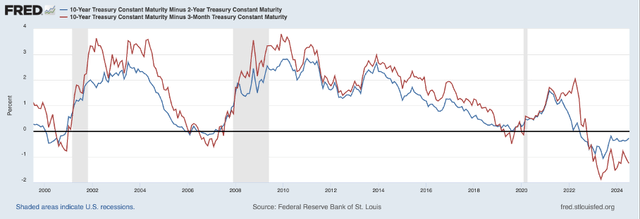
And finally, the yield curve itself is also interesting. As mentioned above, the yield curve is giving us an early warning sign about a potential recession when the yield curve is inverting. However, the yield curve is not just giving us one signal – we often get a second signal before the recession actually occurs. Not only does the yield curve invert before the recession occurs, the yield curve usually also gets back to normal before the economy enters the recession.
FRED
When looking at the last few decades, we can see that the yield curve was usually not inverted anymore when the U.S. economy entered the recession. But right now, the yield curve is still inverted, and we can assume it might take a few more months before the U.S. economy will enter a recession. Of course, history only rhymes and does not repeat in the exact same way, but this is a pattern we saw before many recessions in the recent past.
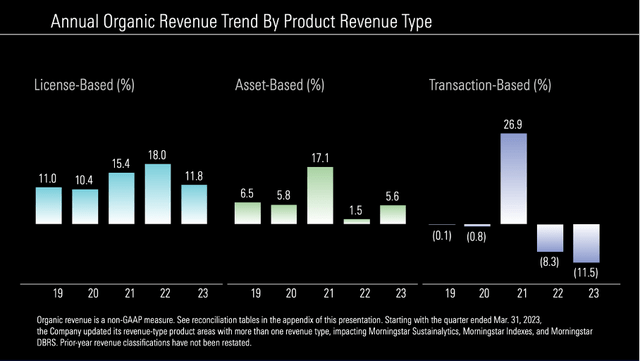
And when talking about Morningstar again, it is especially the asset-based revenue, which will be affected in a negative way by a bear market and lower asset prices. Declining asset prices lead to lower fees (as fees are usually a percentage of the asset value) and additionally, declining prices and the bearish sentiment is often leading to clients selling assets (leading once again to lower fees). In 2022, when the major U.S. indices declined about 20%, asset-based revenue grew only 1.5%. And not only asset-based revenue struggled, transaction-based revenue declined rather steep in 2022 and 2023 as well.
Morningstar 2023 Annual General Meeting
Only licensed-based revenue continued to grow with a solid pace, and actually reported the highest growth rates of the last five years in 2022 (the year when the stock market in the United States clearly struggled).
Long-term Investment
On the other hand, we can also make the argument why Morningstar is still a good long-term investment – despite the business being somehow dependent on the performance of the stock market (and other assets).
Morningstar Q1/24 Presentation
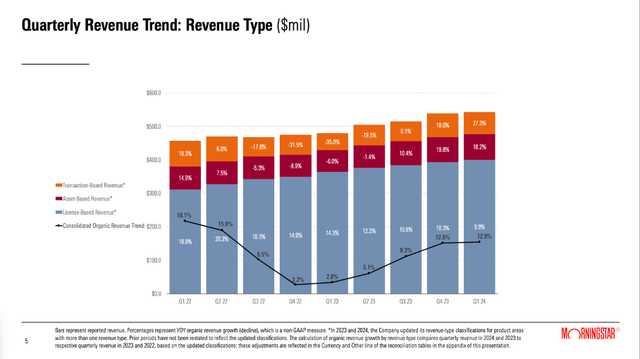
When looking at the results by revenue type in the last few quarters, we can see why Morningstar might still be a good long-term investment. Asset-based revenue and transaction-based revenue, which are rather dependent on the state of the economy and stock market, make up only a small fraction of overall revenue. Additionally, we see high double-digit growth rates again in the last few quarters, reflecting the state of the stock market in the recent past. In Q1/24, asset-based revenue increased 18.2% YoY and transaction-based revenue increased 27.3% YoY.
But the biggest part of revenue is stemming from licensed-based revenue and, in contrast to the other two revenue types, licensed-based revenue is rather stable. We also saw continued growth in 2022 and 2023 (in 2022, Morningstar reported the highest YoY growth for licensed-based revenue in the last five years). When looking at the quarterly revenue trend, the picture is actually a little different. Licensed-based revenue is still growing with a solid base, but we see growth rates slowing down over the last few quarters to only 9.9% growth in Q1/24 (and since Q2/22, revenue growth declined every quarter).
Overall, we can assume that licensed-based revenue will be much more stable – even during a bear market and/or recession, as switching costs play a huge role here. And these switching costs are generating a wide economic moat around Morningstar. In a recession, some clients will terminate some contracts, but many customers will probably stick with Morningstar as they are already familiar with the products and switching to a cheaper alternative might lead to countless hours of training and transferring data leading to additional costs.
Summing up, Morningstar will most likely be affected by a recession and bear market. But the switching costs for several of its products might lead to some levels of stability and make Morningstar not the worst investment. But in every analysis, the intrinsic value plays an important role in the final investment decision, and here lies another problem.
Still Expensive
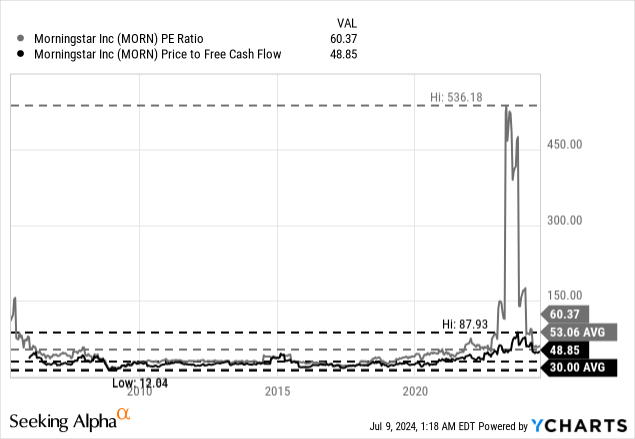
The problem remains that Morningstar is continuing to trade for high valuation multiples. And we certainly cannot argue that the stock is cheap in any way. At the time of writing, Morningstar is trading for 49 times earnings and 60 times free cash flow. Now we can argue that earnings per share and free cash flow are rather low at this point and Morningstar is able to generate a higher profit margin and a higher free cash flow conversion in the future, which will lead to lower valuation multiples. Nevertheless, I think we should be cautious at this point.
Aside from looking only at simple valuation multiples, which can be sometimes a bit misleading, we can also calculate an intrinsic value by using a discount cash flow calculation. We are using the last reported number of diluted outstanding shares of 43.0 million and, as always, we are calculating with a 10% discount rate. I often use the free cash flow of the last four quarters as the basis in our calculation. In the case of Morningstar, I might be a little more optimistic this time, and we are calculating with $350 million in free cash flow (the peak reported number of 2022).
When calculating with these numbers, Morningstar must grow 12% annually for the next ten years followed by 6% growth till perpetuity in order to be fairly valued and for us to expect an annual return of 10%. And while Morningstar could be able to grow 12% annually in theory, I don’t think such growth rates are possible – especially in the next few years.
Conclusion
At this point, Morningstar is a “Hold” at best. Considering that the company is a great long-term investment, shareholders can continue to hold the stock for the long run, but must be prepared for several years of declining stock prices. I personally would not buy Morningstar at this point. Not only is the stock rather expensive and trading for 50- or 60-times earnings/free cash flow. Especially when assuming that the U.S. economy is headed for trouble, which will most likely lead to a (long-lasting) bear market, we should be very cautious about investing in Morningstar as the company was always moving in a similar way as the overall stock market.
Credit: Source link