filo/iStock via Getty Images
Despite the economy floundering and market experts starting to push rate cuts, Bank of America (NYSE:BAC) and other large bank stocks trade at multi-year highs. The sector has gotten a boost due to dips in capital requirements, but the sector faces an environment of lower rates and potentially higher loan risks. My investment thesis is more Neutral on the large banking stock of above $40 after pushing investors to repeatedly buy the stock down closer to $30 and below in the last year or so.
Source: Finviz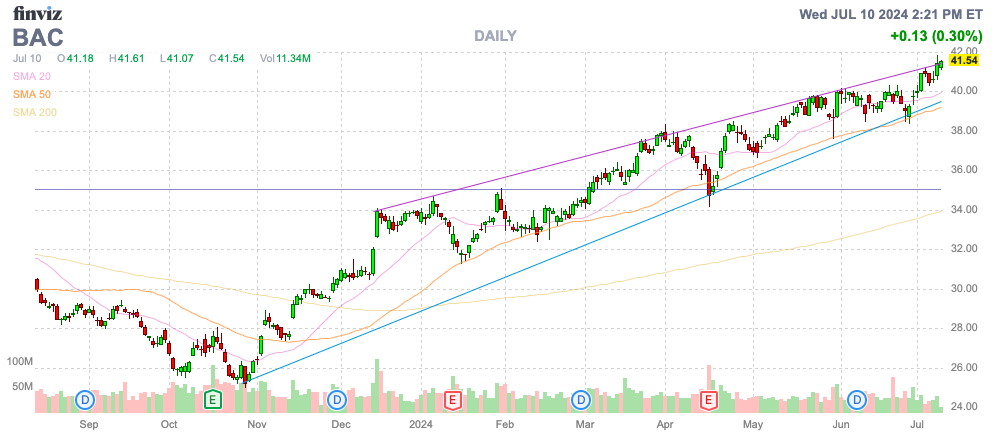
Q2 ’24 Earnings Preview
BoA heads into Q2 earnings on July 16 before the market opens on Tuesday with limited expectations. The consensus analysts’ estimates have the large bank watching EPS slip in the just ended June quarter.
The forecast is for BoA to report an EPS of $0.80 after reporting $0.88 last Q2. The results appear in line with the expectations for JPMorgan Chase (JPM), whose analysts forecast EPS to dip by double-digits from last year, as shown below.
Source: Reuters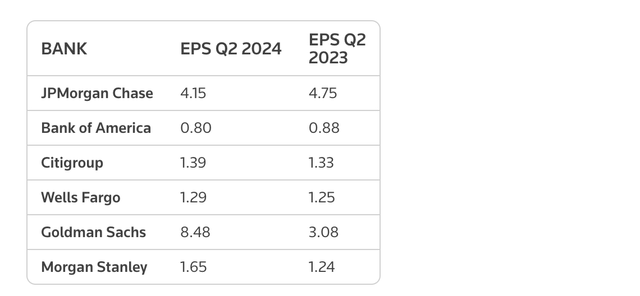
Due to high interest rates, BoA faces major NII headwinds and a tepid lending environment. NII was down $0.4 billion YoY in Q1, and Q2 is forecast to slip even further, with net interest yield of just 1.99% in the last quarter.
Source: BoA Q1’24 presentation 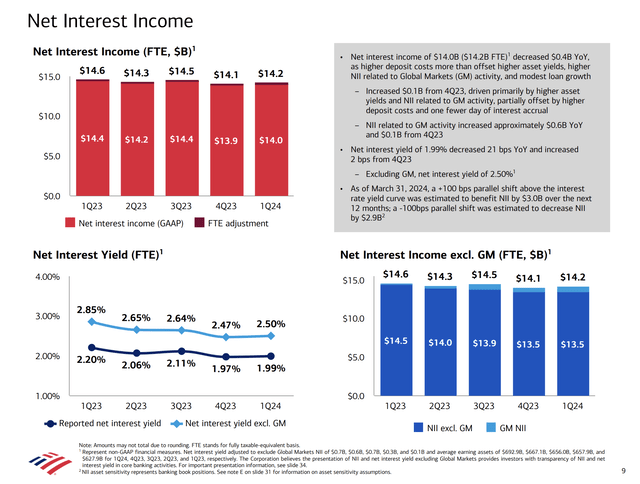
The environment isn’t expected to improve until the Fed cuts interest rates later this year with 1 or 2 rate cuts. The large bank forecasts a $3 billion impact to NII over the next 12 months based on a 100 bps shift in interest rates with a benefit from a parallel shift above the interest rate yield curve.
Piper Sandler analyst R. Scott Siefers forecast the NII bottoming at ~$13.9 billion in Q2 ’24 and reaching a level of up to $14.6 billion by Q4. The prediction is for the net interest yield to bounce back to 2.3% to 2.4% over the coming years, providing a tailwind to the business.
Asset Quality Focus
On the flip side of the NII benefit ahead, a big focus of the Q2 earnings report is the ongoing issues in asset quality. BoA posted a jump in net charge-offs to $1.5 billion in the March quarter, nearly double YoY.
Source: BoA Q1’24 presentation 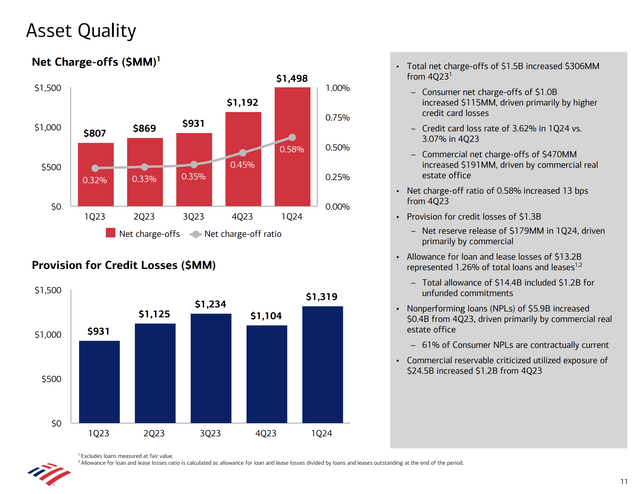
The large bank still has very minimal net charge-off rates of 0.58%. BoA actually reported a net release of reserves ending with an allowance for loan loss of just $13.2 billion.
BoA has total loans and leases of $1.05 trillion at the end of Q1. The biggest risk to the investment story is larger charge-offs from weaker credit cards and commercial loans during a potential recession in the year ahead.
The large bank is reporting quarterly pretax income in the $7 to $8 billion range, so any increase in the provision for credit results would have a substantial impact on financials. A big reason for the lower EPS this year is the nearly doubling of the net charge-offs leading to much higher loan provisions.
BoA recently announced an 8% hike to the dividend after passing the stress test. The company will start paying a quarterly dividend of $0.26 for a dividend yield of 2.5%.
The bank had a CETI ratio of 11.9% after Q1 earnings, and the new requirement for the CET1 ratio following the stress test is 10.7% on October 1. The Fed is apparently looking at reducing the GSIB requirement, as the large banks have pushed back on the excess capital requirements layered onto the large banks over the last decade.
The stock trades at ~12x 2025 EPS targets of $3.55, requiring ~10% growth from the 2024 EPS targets. BoA would be far more appealing, if the stock wasn’t trading at multi-year highs and nearly 1.7x tangible book value.
BoA has a solid dividend yield of 2.5% going forward, but the stock price is clearly overbought after the big rally over the last year. According to Bespoke, the whole banking sector is overbought, with stocks like BAC and JPM in the extremely overbought area being ~6% above the 50-dma.
Source: Bespoke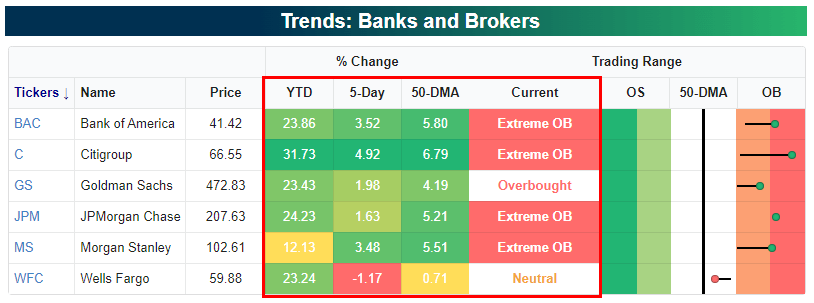
Takeaway
The key investor takeaway is that Bank of America Corporation stock is less appealing now, trading near multi-year highs, and likely facing more loan provisions due to a weakening economy. The stock offers a solid dividend for long-term investors, but the capital returns are likely tapped out here above $40. Investors should wait before a pullback to buy more shares.
Credit: Source link