Manoj Madusanka/iStock via Getty Images
The Company
Workday, Inc. (NASDAQ:WDAY) was founded in 2005 by a team that started PeopleSoft, which became the leader in traditional on-premise enterprise HR software. PeopleSoft was ultimately sold to Oracle (ORCL) in 2005, and shortly after, Workday was created with the idea to bring the first cloud-native Human Capital Management application focused on the large enterprise. The application’s modern architecture features flexibility, speed, ease of use, and lower total cost of ownership than other third-party or home-grown applications. In addition, Workday offers a financial suite (FINS+) to replace existing Finance and Accounting applications.
Workday has more than 4,850 customers in HCM and over 1,700 customers using FINS+. The company is dominant in Enterprise HCM, with 60%+ of the Fortune 500, 70%+ of the Fortune 100, and 20% of the Global 2000 as customers. Clients span all major industry groups and include the likes of Salesforce, Walmart, and Netflix.
Investment Thesis
The addressable market is very large relative to Workday’s revenue of around $8 billion this year. According to the company, the total addressable market (“TAM”) is $142 billion, which includes $58 billion from HCM and $84 billion from Financials. Fortune Business Insights’ measure of the market puts the global HCM market size at a more conservative $31 billion (2024) but expects that market to grow 9% annually over the next 8 years. Importantly, many legacy ERP systems are 10-15 years old and are positioned for a refresh. For example, according to Workday, less than 25% of the FINS+ market is currently in the cloud. The technology is dated and on-premise configuration is significantly pricier than cloud solution. We expect these updated systems to aid continuous growth in both the HCM and Financials markets for several years.
Workday has a dominant competitive position. Workday has won more than 60% of the Fortune 500 and 70%+ of the Fortune 100 as customers. Yet, from the outside, the HCM market appears to have a large set of competitors. These include HCM-focused companies such as ADP (ADP), Paycom Software (PAYC), UKG (private), and Dayforce (DAY), as well as ERP providers SAP (SAP) and Oracle (ORCL).
However, the overlap with the HCM players is minimal, as most of their revenue comes from small and middle market customers. ADP and UKG have enterprise solutions, but based on their existing HCM logos, their presence is small. SAP and Oracle obviously have a significant presence in the enterprise, but a large portion of these remain legacy, on-premise solutions. Many of Workday’s wins come from ORCL/SAP clients that are looking to move to a cloud-based solution and decide that Workday has a better platform.
Relative to competitors, WDAY’s solution offers greater ease-of-use, real-time analytics, and great mobility features. By eliminating maintenance and upgrades of on-premise software, WDAY brings the total cost of ownership (TCO) down relative to peers.
Workday’s growth model should be sustainable for a very long time. Net revenue retention (excluding new products to existing customers) is consistently over 95% and gross revenue retention (including new products to existing customers) has tracked over 100%. Client losses are infrequent, many customers add products, and growth in the client employee base adds to existing client revenue over time. With the opportunities to sell FINS+ and Analytics into the current base, the company should be able to sustain growth of 15%+ for many years.
Recent softening sentiment among enterprise software companies is less relevant to WDAY. The spectacular rise in the outlook for Artificial Intelligence has brought some level of concern that enterprise spending priorities have shifted. If companies are spending more on pricey AI chips, maybe they spend less on their enterprise platforms. While we acknowledge that reality, we consider this a short-term concern. HCM and Financials are core platforms that companies must maintain. Importantly, the WDAY platforms will benefit from AI through better workforce analytics.
Valuation
Despite the success of WDAY recently, the stock is about where it was 5 years ago, despite a rise of more than 85% for the S&P 500 (SP500).
SA Graph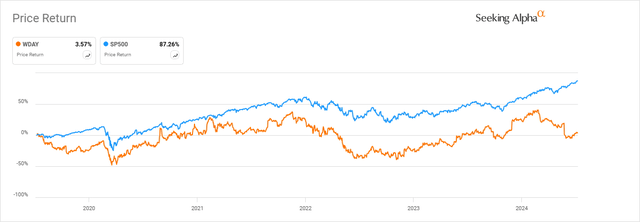
The lack of recent stock price performance can be partially attributed to historically generous stock grants, as shares outstanding have grown almost 25% over that period. However, valuation metrics, including EV/EBITDA and P/FCF, have contracted significantly.
| FYE 2019 | F2024 | |
| EV/EBITDA | 97x | 28x |
| P/FCF | 102x | 31x |
We consider this a window of opportunity to own a high-quality asset trading near historically low valuation levels. We believe WDAY will grow EPS and FCF 20% annually over the next 5 years, with annual revenue growth of around 15%. This assumes only modest margin expansion, and an aggressive share repurchase plan that more than offsets dilution. WDAY has $3.8 billion in net cash on the balance sheet today, so they have ample room to execute either a larger share repurchase and/or M&A to build out new capabilities.
Risks
- Macroeconomic slowdown would likely cause a slowdown in new business and employee growth, which would negatively affect revenue growth.
- Workday is still relatively early in gaining traction with FINS+. The company may need to accelerate investments in the platform, which would negatively impact margins.
- Although we consider the valuation to be reasonable on WDAY today, valuations in the overall SaaS universe can be volatile.
Conclusion
Workday is a very strong business with several growth vehicles that should allow the company to sustain rapid revenue growth and margin expansion over a long period of time. We believe the stock could be a good long-term compounder and recommend owning it.
Credit: Source link