

Dilok Klaisataporn
Introduction
It is always an interesting struggle for me to determine how to take some chips off the table when it comes to my positions of Invesco QQQ Trust ETF (QQQ), which is an important part of my growth portfolio. On one hand, QQQ keeps making all-time highs in the past two months or so. On the other hand, concerns about high technology concentration are increasingly high in the recent weeks.
It occurs to me that one smart approach to deal with the situation is to switch to an option income ETF such as the Nationwide Nasdaq-100® Risk-Managed Income ETF (NYSEARCA:NUSI). The ETF pays the monthly dividend to the shareholders while still maintaining reasonable exposures to the great growth stocks in the QQQ portfolio. I call the approach “QQQ Income Rotation”. With a dividend at 6.79%, NUSI has achieved a good balance between producing enough high-yield for cash needs and maintaining a good potential for capital appreciation in the current bull market. I have a buy rating on NUSI and recommend it to investors who want to take some profits on the fast growing QQQ.
NUSI ETF highlight
NUSI is an ETF actively managed by NEOS Investment Management. Based on the ETF official site,
The Nationwide Nasdaq-100® Risk Managed Income ETF is designed for income-focused investors seeking to lower their exposure to market volatility and minimize the potential for losses during down markets. It can be used to enhance and diversify core income-oriented portfolio allocations
The main goals of the ETF are to offer high-yield income and reduce the volatility risk for the (QQQ) portfolio. The internal strategy is a bit complicated because it is “a rules-based options collar strategy“, according to the ETF official description. The collar method typically involves acquiring put options for protection and writing the covered call options for income at the same time.
NUSI deploys some of the premium collected from option selling to reinvest the underlying portfolio and maintain its growth. This is the key difference between NUSI and the other more popular QQQ option income ETFs, which will be discussed in more detail later in the article.
The underlying portfolio is the same as QQQ with the following top 10 holdings shown below:
NUSI Top 10 Holdings from morningstar.com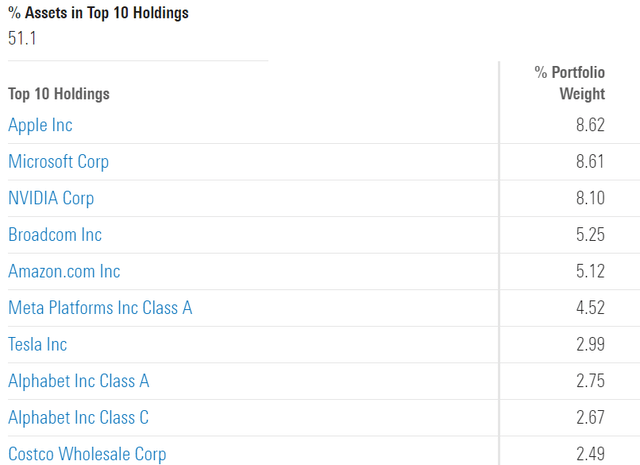
NUSI has the total assets that are currently valued at $383.17M. The ETF’s size is relatively small, considering its focus on the big tech companies (from QQQ). Launched on December 12, 2019, It is still a young fund with a history slightly over 4.5 years. Expense Ratio is 0.68%, which is higher than QQQ’s 0.20%, due largely to the management activities required for the option trading.
Inherited from QQQ, the portfolio is heavy on the top 10, accounting for over 50% of the portfolio and the technology companies, in particular the big technology ones, like “Magnificent 7”.
Time to switch to “Growth Income”
Concerns over high tech concentration have been elevated recently. However the concentration itself is not a problem for growth stocks. The seemingly slowing economy is casting a huge cloud in the future outlook of the technology companies in 2024. Based on the jobless claims reported on July 5, the unemployment is higher than expected in June. This clearly indicates that the US economy is experiencing a decline in growth. Therefore investors are getting more nervous about the record highs the market keeps making, such as the most recent one led by the big high-tech stocks, as reported by nasdaq.com on July 5. I believe that it is about time to take some profit off the table from QQQ and keep monitoring the growth market closely.
Before I get into the details of how to take profit off QQQ, I want to point out that I’m still bullish on the market. I think the growth market (QQQ) will have a great year in 2024 with an ending price higher than the current level. Growth may be slowing down, but it is still intact. There are also potential rate cuts FED can use to boost the business activities. Hence I don’t want to put a complete stop on the growth stocks. Instead, I’m taking an approach called “QQQ Income Rotation,” which will be focusing more on the growth income. The following is some details:
- Look for an ETF that is still tied to QQQ. QQQ has been proven to be very hard to outperform. 100 holdings are my favorite number that is sufficient for a diversified portfolio but also allows room to pursue “smart” beta or partial alpha.
- The fund will produce monthly income with a yield that I am comfortable with. A dividend of 6.8% like NUSI’s current yield is a nice base. It is doubling the high dividend of about 3.4% in many stocks. It is not only higher than 4%-rule withdrawal plan but also close enough to support the 7%-rule plan that investors may need to combat the high inflation.
- It features a low volatility for the portfolio, that can help ride through the current market uncertainty. The following shows the NUSI’s volatility posture. The 52-week HV (12.9) is much smaller than QQQ’s 16.2.
NUSI Volatility from marketchameleon.com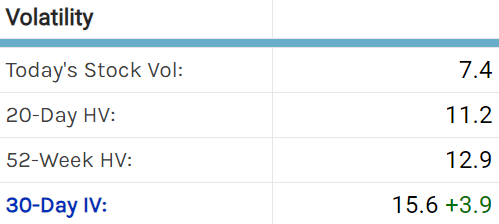
Based on the above analysis, I view NUSI one of top choices for “QQQ Income Rotation”
“FOMO” for AI growth is live and well for good reasons.
NUSI provides less capping on the capital appreciation than the ones with conventional covered calls, due to the reinvesting approach. So it offers a better performance compared to the other option income ETF based on QQQ. The following dataset seems to support such a projection. Based on the most recent 90-day stats, NUSI has a better average return than SPY and, more interestingly, its Sharpe ratio is much better, indicating a more attractive risk-adjusted return.
NUSI Stats from marketchameloen.com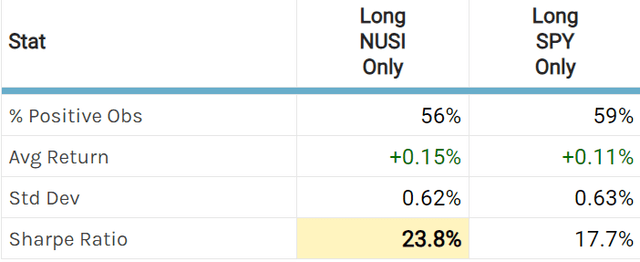
I think the “FOMO” is still pretty well and alive, in particular with the AI secular growth story, which is still loved by the mainstream investment community. The AI chip market will be growing at a rapid pace in the future as projected. Buyers will still pick up the big technology stocks whenever there is a dip in the market. So I want to pick a QQQ income ETF, which will allow me to keep a good portion of the capital appreciation from the strong growth market.
The following shows a comparison among a few known QQQ-based income funds with market cap more than $1B:
- JPMorgan Nasdaq Equity Premium Income ETF (JEPQ): Market Cap $15.36B Dividend (TTM) 8.80%
- Global X NASDAQ 100 Covered Call ETF (QYLD): Market Cap $8.30B Dividend (TTM) 11.49%
- Nuveen NASDAQ 100 Dynamic Overwrite Fund (QQQX): Market Cap $1.38B Dividend (TTM) 6.55%
One-Year Price Comparison with QQQ Option Income ETFs form SA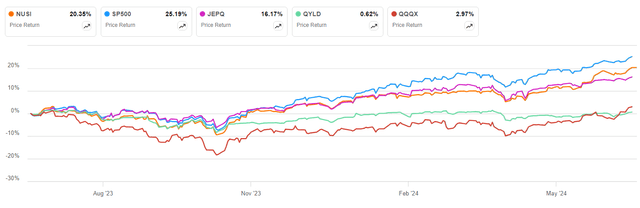
The one-year price chart clearly shows that NUSI is the closest to price appreciation of S&P 500. It is up over 20% beating JEPQ, QQQX and QYLD.
In terms of the total return for the last 12 months, NUSI still has the highest gain among the income funds, even though two of them offer the higher dividends. Note that NUSI has actually outperformed S&P 500 in total return.
One-Year Total Return Comparison with QQQ Option Income ETFs form SA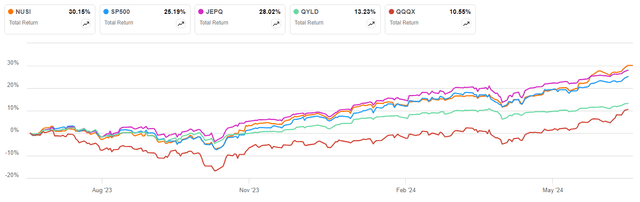
Looking forward, I believe that the market is still tilted with a strong bullish sentiment but the QQQ stock price appears to be toppy, in the overbought territory. NUSI ETF looks very promising in offering a great place to park some money while still keeping the growth ball rolling. NUSI is a smart buy as investors navigate the uncertain months ahead in 2024 and it is also a solid long term play for the technology growth as well.
Note that the ETF has received a buy rating from SA Quant Rating, as shown below:
NUSI SA Quant Rating from SA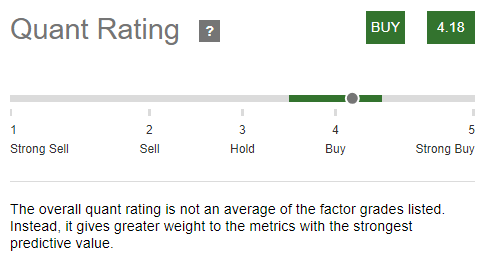
Risks & caveats
NUSI is relatively unknown and has low trading volumes, indicating its low popularity in the market. It may not be a problem for the income investors who are in it for the long haul. But trading and swapping positions with other QQQ option income ETFs could be a bit inconvenient, some trade planning may be needed ahead of the time. Depending on the risk tolerance target, investor could choose a different (QQQ) option income ETFs such as the ones listed above. I view NUSI on the aggressive side of the risk spectrum.
There is also a risk of the price underperformance compared to QQQ itself. NUSI’s total return will lack behind QQQ significantly if the market continues its super-charging momentum in the near future.
Closing thoughts
As we move into the Q2 earning season, QQQ and the big-cap growth market are sitting at record highs. It is a smart strategy to switch high growth holdings to NUSI ETF or other QQQ option income ETFs. NUSI offers 6.8% monthly-paid dividend while reducing the volatility level of the growth portfolio, making it prepared for the choppy summer season of the stock market. NUSI looks also promising in maintaining a comfortable room for potential capital appreciation.
Credit: Source link