

Aleksandr Rybalko/iStock via Getty Images
Shares of bunion surgery device manufacturer Treace Medical Concepts, Inc. (NASDAQ:TMCI) cratered 63% one day after revising its FY24 top-line outlook due to an altered competitive landscape. Specifically, minimally invasive surgery (MIS) osteotomy devices and knockoffs to its Lapiplasty System are eroding the company’s market share. With only 29% surgeon penetration after eight years in the market, but two MIS devices of its own expected to launch by YE24, the recent insider buying merited a deeper dive. An analysis follows below.
Seeking Alpha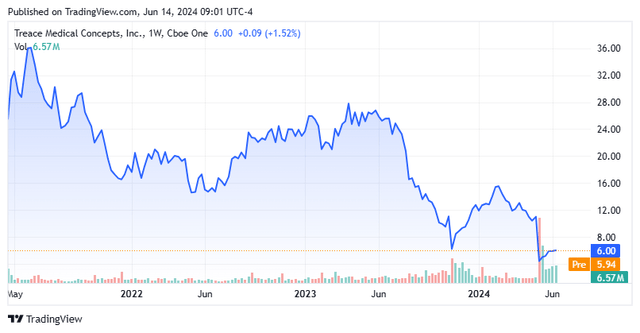
Company Overview:
Treace Medical Concepts, Inc. is a Ponte Vedra, Florida-based medical technology concern focused on the development of devices for the surgical management of bunions and related deformities. The company markets a series of instruments, implants, and methods designed to surgically correct all three planes of bunion deformity known as Lapiplasty 3D Bunion Correction System. Treace was formed as a medical device consulting business in 2013, quickly narrowing its emphasis to the foot and ankle market in 2014. Six years after receiving 510(k) clearance of its Lapiplasty System, the company went public in 2021, raising net proceeds of $107.6 million at $17 per share. Treace’s stock trades around six bucks a share, translating to an approximate market cap of $370 million.
Bunions
As most know, a bunion (hallux valgus) is a painful disfiguring deformity of the foot characterized by a deviated position of the big toe and a large bump at its base. Largely described as a bone overgrowth that needs to be shaved down, bunions, in the vast majority of cases, are complex 3D (or three-plane) malformations caused by an unstable joint in the middle of the foot.
Bunions affect ~67 million Americans, of which ~4.4 million seek medical attention. Of those, approximately one-fourth are deemed candidates for surgery, placing Treace’s total addressable market at more than $5 billion. Of the 1.1 million in need, approximately 450,000 currently undergo a surgical procedure each year.
Until the introduction of the company’s correction system, there were two predominant two-plane procedures. One is osteotomy (~75% of procedures), which involves cutting the metatarsal bone (one of five long bones in the foot) and shifting the offending bump inward. Since this does not address the unstable joint in the middle of the foot, recurrence rates are high (up to 78%) and somewhat inversely proportional to patient satisfaction. The second approach is known as Lapidus Fusion surgery (~25%), under which a patient’s metatarsal bone is realigned and the unstable joint fused. However, the procedure is technically challenging, with outcomes a function of the surgeon’s skill. Furthermore, recovery times are elongated, with patients compelled to endure six to ten weeks of non-weight bearing recovery. That said, the long and painful post-op recuperation does not guarantee a permanent fix, with recurrence rates as high as 38%.
Lapiplasty 3D Bunion Correction System
To address the shortcomings of those procedures, Treace developed Lapiplasty 3D Bunion Correction System (henceforth L3DBCS), which is designed, through the use of surgery, instrumentation, and titanium implant kits, to rotate the entire metatarsal bone permanently into its normal anatomical position in all three dimensions, eliminating the bump while addressing the root cause of the bunion. On average, patients can return to weight-bearing activity (via a walking boot) in 8.4 days with an extremely low chance of recurrence (1.1% at 36 months). Furthermore, patients experience an 81% reduction in pain through two years and over 90% improvements on measures of walking, standing, and social interaction. Since being green-lit by the FDA in 2015, over 100,000 procedures employing L3DBCS have been performed domestically.
Treace markets its Lapiplasty systems to physicians, surgeons, ambulatory surgery centers, and hospitals through a combination of its own in-house ~227-member sales force (responsible for 82% of 4Q23 sales) and independent distributors. The blended average selling price (BASP) for a kit was $6,306 in FY23, up 10% from $5,753 in FY22, which was 7% above the BASP in FY21. The company’s top line has grown at a five-year CAGR of 60% (ending 4Q23) with FY23 sales reaching $187.1 million, up 32% over FY22 with a gross margin of 81.2%.
Treace’s top line will be further supported by ten new product launches in 2H23 and FY24, including the Adductoplasty Midfoot Correction instrument for the resolution of metatarsus adductus deformity and osteoarthritis of the midfoot, as well as a hammertoe corrective device – the combined introduction of which should expand the company’s TAM by $750 million. Another two products are an attempt to respond to a competitive threat – more on that undercurrent below.
Share Price Performance
Treace believes it achieved 6.6% market penetration at YE23. Given its eight plus years on the market at that time and the seeming superiority of its system, the figure is pedestrian – no pun intended.
Part of its market share problem lies in its initial sales and marketing effort, relying more on distributors versus its own dedicated sales effort to generate interest among surgeons. As such, in 2019, 73% of the company’s revenue was derived from distributors, and in the year it went public (2021) that figure was still 48%. More to the point, only 997 (out of ~10,000) foot surgeons were employing L3DBCS at YE19 (1,783 at YE21). Although that figure has improved to 2,855 at YE23, with only 29% surgeon penetration since approval with a more permanent solution (in ~99% of cases at 36 months) than the competition, it can be adduced that Treace has been self-sabotaged by poor marketing.
As a consequence, after a well-oversubscribed IPO featuring a $24.50 opening trade and an all-time high of $37.17 approximately two months thereafter, shares of TMCI failed to maintain that momentum over the subsequent two years but still maintained a premium to its $17 IPO pricing until August 2023. Concentrating on growth, the market gave the company a pass on its inability to approach profitability, when it posted a loss of $0.42 a share (non-GAAP) and Adj. EBITDA of negative $12.4 million on revenue of $94.4 million in FY21, followed by a loss of $0.69 a share (non-GAAP) and Adj. EBITDA of negative $25.0 million on revenue of $141.8 million in FY22.
This protracted period of strong top-line growth with improving (although relatively limited) market penetration and no profitability continued through FY23, with Treace producing a loss of $0.81 a share (non-GAAP) and Adj. EBITDA of negative $24.4 million on revenue of $187.1 million. Shares of TMCI continued their decline, closing out, 2023 at $12.75. And with only 18% of its surgeons employing L3DBCS for more than two years, Treace’s lack of domination provided a large opening for competing products.
1Q24 Financials & Revised Outlook
That dynamic came to light when the company reported 1Q24 financials on May 7, 2024, posting a loss of $0.30 per share (GAAP and non-GAAP) and Adj. EBITDA of negative $8.3 million on revenue of $51.1 million, versus a loss of $0.08 per share (non-GAAP) and Adj. EBITDA of negative $10.0 million on revenue of $42.2 million in 1Q23. The quarter wasn’t a disaster relative to expectations, missing Street consensus by $0.01 a share on the bottom line and $2.0 million at the top.
It was the revised FY24 forecast that grabbed the market’s attention, with management lowering its revenue guidance from $222.5 million to $206 million (based on a range midpoint), owing to competitive pressures from both knock-off Lapiplasty products and MIS osteotomy offerings from concerns such as Stryker (SYK). These alternatives have cut into the number of procedures the company’s surgeon base will perform with L3DBCS in FY24. To counteract these incursions, Treace is set to launch two MIS osteotomy systems by YE24 and potentially pursue legal action against the knockoffs where it believes its IP has been violated. Its FY24 Adj. EBITDA forecast did not change, at approximately negative $12.2 million.
The market focused on Treace’s top-line revision, collapsing its stock price 63% in the subsequent trading session to $4.17 a share.
Balance Sheet & Analyst Commentary:
Thanks to a February 2023 follow-on secondary, the company’s balance sheet is in solid shape, reflecting cash and marketable securities of $110.0 million against debt of $54.0 million as of March 31, 2024. Unprofitable and still in a (now truncated) growth phase, Treace does not pay a dividend nor buy back shares.
After seeing the company’s issues shift from poor marketing to a challenging competitive landscape, Street analysts jumped ship en masse with six downgrades after its 1Q24 report. On average, they expect Treace to lose $0.90 a share (non-GAAP) on revenue of $205.4 million in FY24, followed by a loss of $0.8 a5 share (non-GAAP) on revenue of $229.5 million in FY25.
Founder & CEO John Treace did not share the Street’s pessimism, opting to purchase 150,000 shares of TMCI at an average price of $5.12 on May 14, 2024. That addition places his and his wife’s combined ownership interest at 19%.
Verdict:
Mr. Treace’s conviction notwithstanding, it is too early for Treace Medical Concepts, Inc. to have a line of site on the evolving competitive landscape, and it certainly has none on profitability. Furthermore, shares of TMCI have since bounced some 45% off their May 8, 2024, close. Trading at 1.8 times FY24 sales, investment may sound appealing with gross margins north of 80%, but the company’s inability to push meaningfully towards breakeven as it loses market share is enough reason to stay away.
Credit: Source link