
JHVEPhoto
Dave & Buster’s Entertainment, Inc. (NASDAQ:PLAY) operates entertainment and dining venues, offering arcade games and live sports watching among other entertainment. The company recently reported its Q1 results on the 13th of June prior to market openings, posting a wide miss for both revenues and EPS. The stock has reacted negatively in the post-market, being at nearly -12% at the time of writing.
The company has soon spent a decade on the stock market, and has returned quite well in the period with a total return of 178% at the time of writing excluding the pre-market fall to the Q1 results. Dave & Buster’s has priorly paid out an annual dividend, but quit amid the Covid pandemic and as the company’s acquisition of Main Event and growth has required a significant amount of capital.
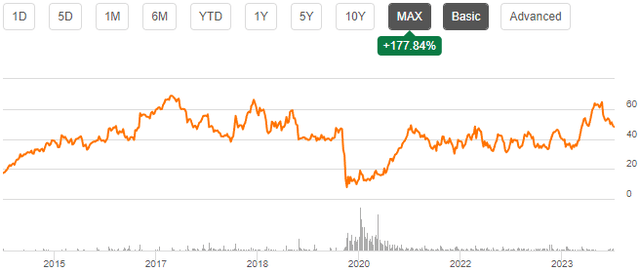
Stock Chart From IPO (Seeking Alpha)
Q1 Financial Report Shows Continued Weakness
Dave & Buster’s Q1 report showed a weak performance from the quarter. Comparable store sales fell by -5.6% year-over-year resulting in revenues of $588.1 million, a decrease of -1.5% from the prior Q1. Looking at prior performance in comparable store sales, the performance is quite in line – in Q4, the metric weakened by -7.0% on a pro forma basis. The weakness in sales also trickled down to net income, as the adjusted EPS came in at $1.12 compared to $1.52 a year ago.
Wall Street analysts estimated revenues of $615.9 million and an adjusted EPS of $1.70, making the reported results a wide miss – the revenue miss was -4.5% even though Dave & Buster’s has relatively predictable sales, and the EPS missed by over a third. With hindsight, I find the estimated quarter financials very optimistic as a similar comparable store sales performance had already been seen in prior quarters. The Q4 weakness was related to adverse weather that wasn’t mentioned again in Q1, but macroeconomic factors seem to drive weaker traffic.
Investors should have some caution as Dave & Buster’s continues to experiment with higher pricing and other initiatives. The weakness could also be partly related to failed pricing initiatives, and the initiatives could deteriorate comparable sales into a weaker level over the long term. In the June 2023 investor day, Dave & Buster’s laid out a strategic games pricing plan to bring revenues up by $80-120 million, which could have backfired with entertainment revenues showing an especially weak performance.
Long-Term Store Growth Still Continues
Dave & Buster’s still continues to grow well with four new stores opened during the first quarter. After Q1, the company has 165 opened Dave & Buster’s locations and 59 Main Event locations, up from just 61 Dave & Buster’s and 11 Main Event locations in 2012 after a long runway of store expansion.
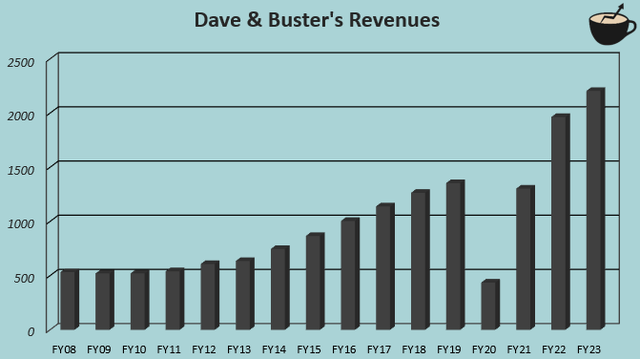
Author’s Calculation Using TIKR Data
Long-term potential is seen at 550 stores as told in the 2023 investor day, showing confidence in a long runway. The store investments do take up significant capital and slow the potential ramp-up down, though, with capital expenditures of $330.2 million in FY2023.
The Main Event Acquisition Is Now Integrated
Dave & Buster’s completed a significant acquisition in 2022 as the company acquired the Main Event branded stores, a family entertainment venue operator in the United States, for an enterprise value of approximately $835 million. The sum represents an EV/EBITDA of 9 with 2021 financials. The acquisition was made with cash on hand and debt financing, and was completed in June of the same year. The management team was switched as talent from Main Event was brought onto Dave & Buster’s, including the CEO’s position.
Nearly two years have now passed since the acquisition was completed. Dave & Buster’s anticipated around $20 million of synergies to be achieved in the first two years, and expected the acquisition to be accretive to both growth and earnings. A success can be seen at least in margins – despite softness in comparable sales, Dave & Buster’s operating margin reached 14.4% in FY2023, up from a five-year average of 13.2% from FY2015 to FY2019 prior to the pandemic. Main Event store growth hasn’t accelerated too aggressively yet.
The balance sheet continues to carry a higher amount of debt than prior to the acquisition with $1289.2 million after Q1, leveraging the company and investment.
Dave & Buster’s Valuation Has Some Upside
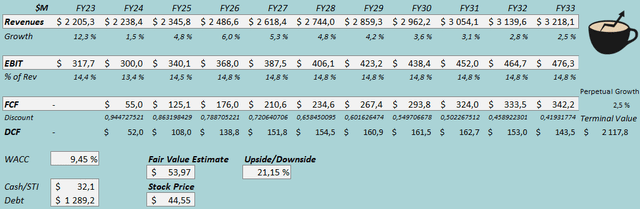
To estimate a fair value for the stock, I built a discounted cash flow [DCF] model. In the model, I estimate quite conservative growth with just 1.5% in FY2024 due to weak comparable sales. Afterwards, I estimate acceleration into 4.8% in FY2025 and 6.0% in FY2026 with gradual slowdown afterwards into 2.5% perpetual growth. The total revenue CAGR is estimated at 3.9%, showing quite conservative store growth estimates.
For the EBIT margin, I estimate turbulence for FY2024 but improvements into 14.8% in the two years after as comparable sales show more strength. While the growth estimates are quite conservative, the growth seems to take quite a heavy amount of investments worsening cash flows in years of growth.
DCF Model (Author’s Calculation)
The estimates put Dave & Buster’s fair value estimate at $53.97, 21% above the stock price at the time of writing showing moderate upside. The growth estimates are quite conservative, but in my opinion justified with recent weak performance. At a current return on capital of 6.1%, more aggressive growth wouldn’t affect the estimated value too dramatically due to heavier investment requirements.
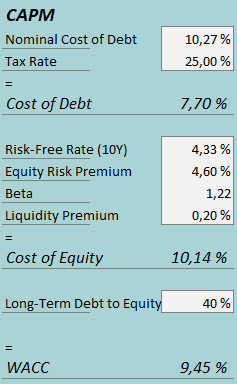
A weighted average cost of capital of 9.45% is used in the DCF model. The used WACC is derived from a capital asset pricing model:
CAPM (Author’s Calculation)
In Q1 Dave & Buster’s had $33.1 million in interest expenses, making the company’s interest rate a high 10.27% with the current amount of interest-bearing debt. The company continues to have quite a high amount of debt, and I estimate some debt payoffs with cash flows into a long-term debt-to-equity ratio of 40%.
To estimate the cost of equity, I use the United States’ 10-year bond yield of 4.33% as the risk-free rate. The equity risk premium of 4.60% is Professor Aswath Damodaran’s latest estimate for the United States, updated on the 5th of January. Seeking Alpha estimates Dave & Buster’s beta at 1.22. Finally, I add a liquidity premium of 0.2%, creating a cost of equity of 10.14% and a WACC of 9.45%.
Takeaway
Dave & Buster’s reported weaker-than-expected results in Q1 as comparable store sales continued at a weak level. While macroeconomic turbulence seems to account for some part of the weakness, I also see a possibility that higher games pricing plan could have backfired on the company’s sales. Long-term growth still continues well with four new stores opened in Q1. With Main Event now integrated into the company, Dave & Buster’s posts healthy margins despite some softness in sales. The valuation has moderate upside, but I still initiate Dave & Buster’s stock at Hold due to recent challenges requiring caution and the upside’s quite moderate size.
Credit: Source link