

Daniel Grizelj
I recently wrote about the SPDR Euro Stoxx 50 ETF (FEZ), and given the recent ECB rate cuts, I thought the time was ripe to visit a similar ETF to compare different European vehicles since the old continent is top of mind for me right now. Today I’ll be talking about the iShares MSCI Eurozone ETF (BATS:EZU).
Similar but distinctive offerings
Let’s start with some key differences between EZU and FEZ. EZU tracks the MSCI EMU Index, which diverges mainly in its number of holdings. While the Euro Stoxx follows 50 blue chip European countries, the MSCI EMU has a much broader remit, covering 250 countries strictly within the European monetary bloc. Overall, this makes EZU a significantly more diversified fund.
When comparing the funds from a country perspective, we see some strong similarities. EZU’s country allocation (pictured below) is heavy France, Germany, and the Netherlands. FEZ is more heavily allocated to France (~40%), while it’s allocations to Germany and the Netherlands are nearly identical.
ishares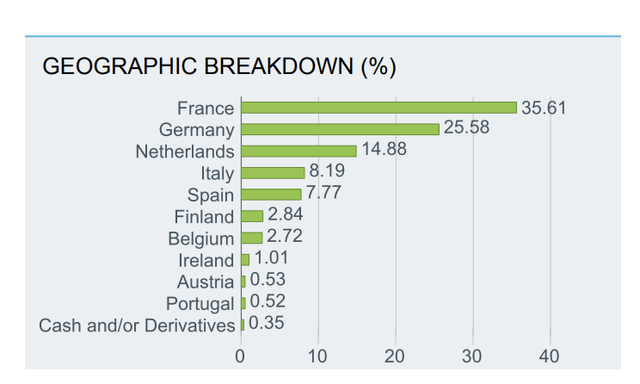
From a sector perspective, these vehicles are also similarly weighted. Financials, tech, and industrials all take the top spots for EZU. While this is similar for FEZ, there is a roughly 3% delta in tech allocations – EZU comes in at ~16% tech weighting, while FEZ rounds out to about a 19% weighting to tech.
Seeking Alpha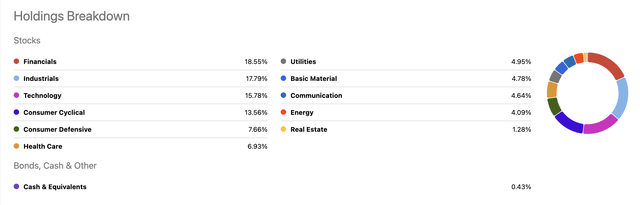
At the individual holdings level, we start to see a wider variation, which is intuitive given the breadth of holdings that EZU has compared to FEZ. Both funds’ top allocation goes to ASML Holdings (ASML), Louis Vuitton (OTCPK:LVMHF), and SAP (SAP), though FEZ is allocated more heavily to all 3. ASML is a Dutch company, that specializes semi-conductor manufacturing. It has seen huge momentum in the last year, on the back of ravenous interest in the AI space. ASML has posted +41.77% on a trailing 1-year basis. EZU diversification profile is on display when looking at the percentage of assets in its top 10 holdings – only roughly 30% of its assets reside there.
Larger fund, higher price tag
One way that iShares maintains its competitive edge as an ETF provider is its relatively low expense ratios. This is not the case when it comes to EZU, which is priced at 51 bps vs. FEZ’s 29 bps. The price tag has not incentivized investors to buy into FEZ over EZU, however. At the time of writing EZU has about double the total dollars in assets under management, at $7.8B versus FEZ’s $3.9B. EZU has taken in an enormous amount of flows over the trailing 5-year period. It has seen positive net flows, beginning in 2021, when the fund netted a whopping $1.7B. Both 2023 and 2024 have been positive for FEZ as well, though the fund saw net outflows in 2022.
ETF.COM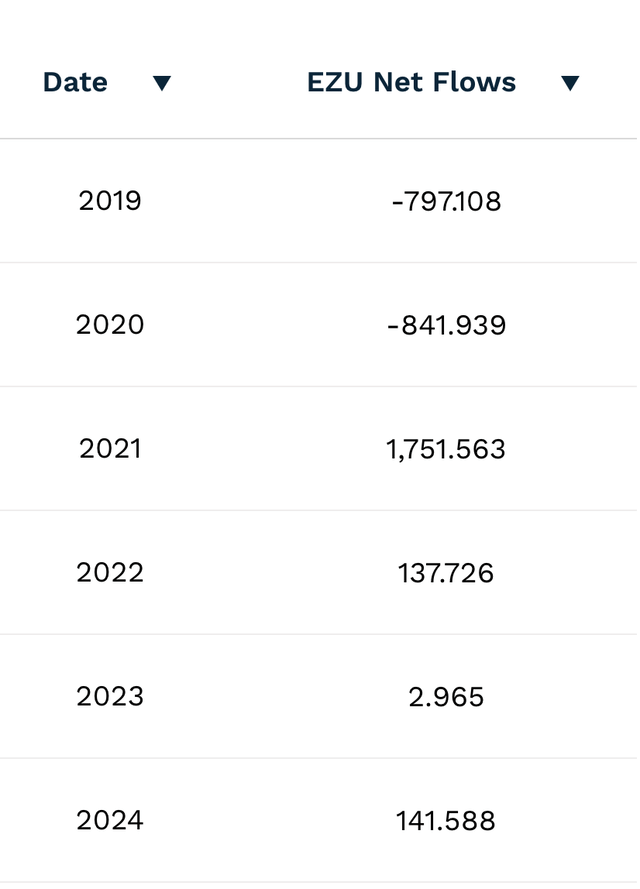
FEZ slightly outperforms
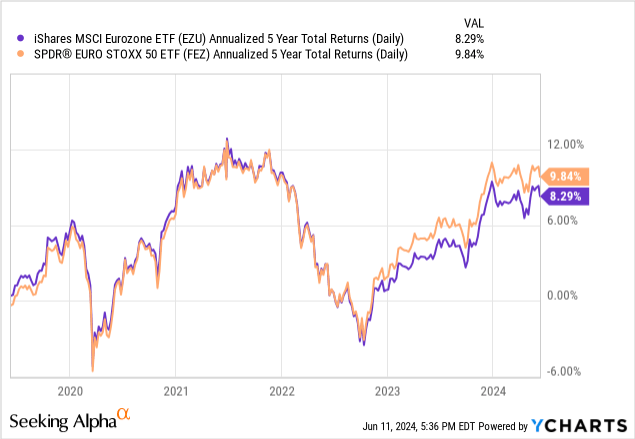
From a total return perspective, EZU has underperformed FEZ in several different performance periods. In the chart below, we look at annualized 5 year daily returns, which account for the onset of the COVID period and shows the gradual weakening of the Euro area as inflation set in and growth contracted. We see that FEZ marginally outperformed EZU.
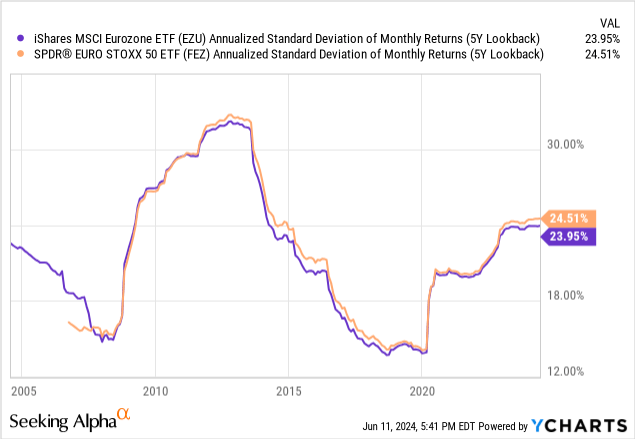
From a volatility perspective, we see similar levels, with EZU having a marginally lower volatility profile than FEZ.
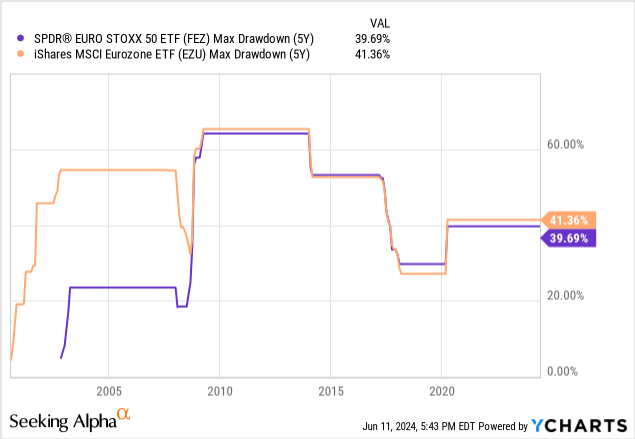
From a downside protection perspective we see once again that both funds are very comparable, with FEZ offering a slightly larger amount of downside protection when compared with FEZ.
Currency risk more concentrated in EZU
The ECB cut rates last week, the first TIME since 2019, but was explicit in that people should not expect there to be a linear decline in the rate path. Since then, the Euro has declined slightly against the dollar. This could take a toll on European importers, which will pay higher costs that will have pass-through effects for some consumers. However, that impact will likely be offset by overall lower borrowing costs. EZU is slightly heavier financials when compared to FEZ, which could be negative in a lower interest rate environment, as interest income on deposits will total a lower overall value. On the flip side, for smaller companies (of which EZU is more inclusive when compared with FEZ), this could be a positive. Smaller companies tend to be more highly levered, and as such have the opportunity to fare better in risk-on environments. They also tend to have more growth opportunity.
Google Finance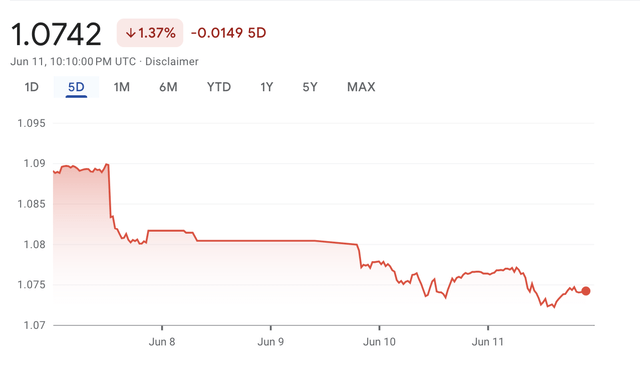
Conclusion
While the future of rate cuts remains very unclear, I see this first cut as a green light for European funds which have performed well, albeit more modestly when compared to the S&P500. Given the recent decline in Euro pricing vs. the dollar, this is an opportunity for American investors to get in more cheaply. And while I like both funds, the I see the diversification benefits of EZU as attractive, as we could be at the turning point for a more “risk-on” Europe. I currently rate EZU as a buy.
Credit: Source link