

J Studios/DigitalVision via Getty Images
We could think of just one reason that an investor would buy Global X SuperDividend REIT ETF (NASDAQ:SRET) back in June of last year.
The only reason you might want to buy one share of this ETF is to track exactly how blind yield chasing and running behind the biggest yields without due diligence performs over time. Outside that, we don’t see this as a viable investment and it likely will perform even worse if we enter a recession.
Source: SRET Came Into 2023 Chasing Yields And Buying Mortgage REITs
This fund’s chunky monthly payout (13 to 13.5 cents during this time) has backstopped the price erosion that has happened since then.
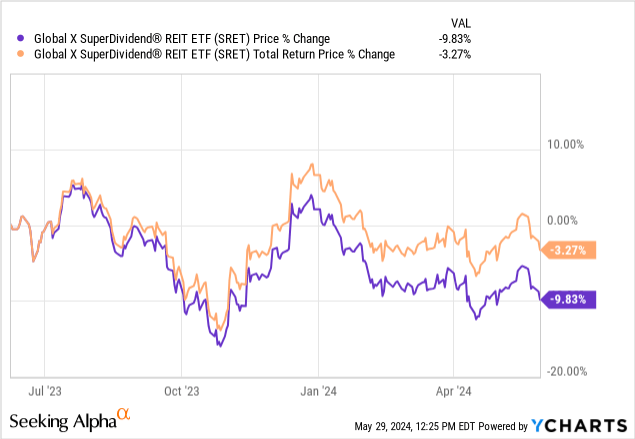
All in all, the total returns are around where one would expect considering its history.
splithistory.com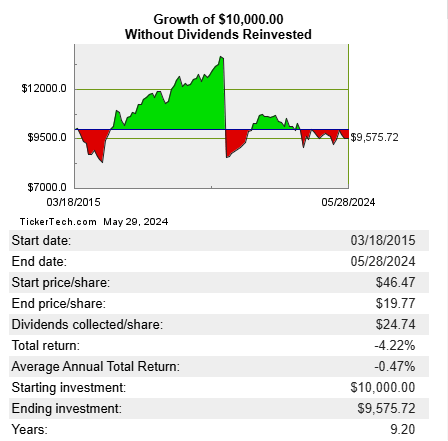
We have provided the returns without dividends reinvested, as that is the favored route for income investors. That counts the dividends, but assumes you spend those on finding a financial advisor.
The Fund In A Nutshell
SRET invests in “30 of the highest yielding REITs in the world” and excludes the highly volatile candidates. This ETF is passive, which means that it does not go scouting the globe for its portfolio incumbents, and instead follows a benchmark which satisfies its investment objective. In SRET’s case, the benchmark is Solactive Global SuperDividend REIT Index. At least 80% of the fund’s total assets are invested in the index components and securities from the outside that exhibit the fundamental and investment characteristics of the benchmark. SRET has an annual expense of 0.59% and the index has no expenses. In a head to head versus the index, its performance is around where one would expect, considering the expense handicap.
SRET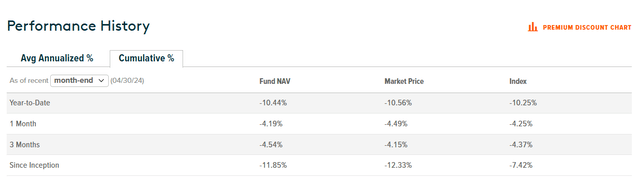
While it has done a good job tracking its index, this is not a lean, mean money making machine, notwithstanding its juicy yield. For those curious, we will review the specifics of what makes this fund’s strategy disturbing, yet the income investors cannot look away.
Specifics
SRET is primarily focused on the US, though it does manage to buy some arcane stocks from around the world.
SRET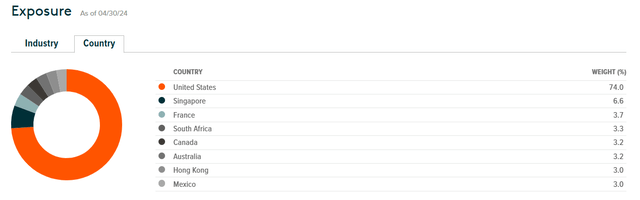
We often run into at least one company on its roster that we have never heard of previously. It is also quite probable that SRET knows nothing about the company other than it has the highest yield.
SRET’s strategy of finding the highest yielding REITs has led it straight into the arena of mortgage REITs within the US. Currently, almost 40% of the fund’s exposure has come from this area.
SRET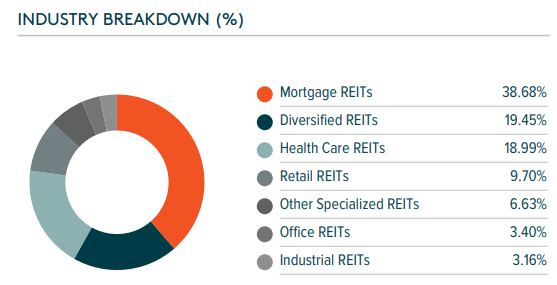
It is then about evenly split between diversified REITs and health care REITs. Interestingly enough, office REITs are now at just 3.4%. All of this is quite a remarkable change from the last time we looked at this, where Office REITs were about 4 times as much and mortgage REITs were at “just” 14.28%.
SRET April 30, 2023 Profile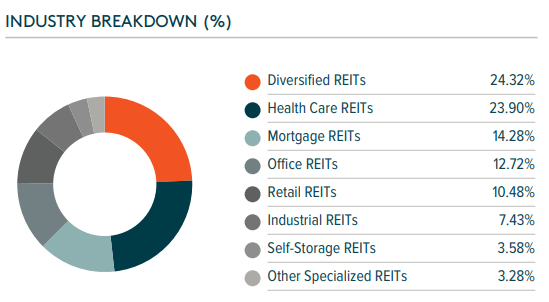
While SRET has always been a poor performer, we think the risks dial up an extra notch when it goes wading into the most dangerous sectors without understanding the fundamentals. Here, it has dialed down the Office REIT exposure, likely because of some price appreciation and some dividend cuts. But it has increased exposure to mortgage REITs and that makes the fund even more dangerous than before. We have the Rithm Capital Corp. (RITM), Ladder Capital Corp. – REIT (LADR), Dynex Capital Inc. (DX) and Annaly Capital Management (NLY) in its top 10 holdings.
SRET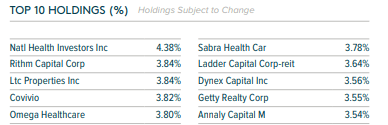
VanEck Mortgage REIT Income ETF (MORT), which is a great proxy for the mortgage REIT sector, has struggled to make 1% in annual total returns over the last decade. The price erosion has been quite extreme as well.
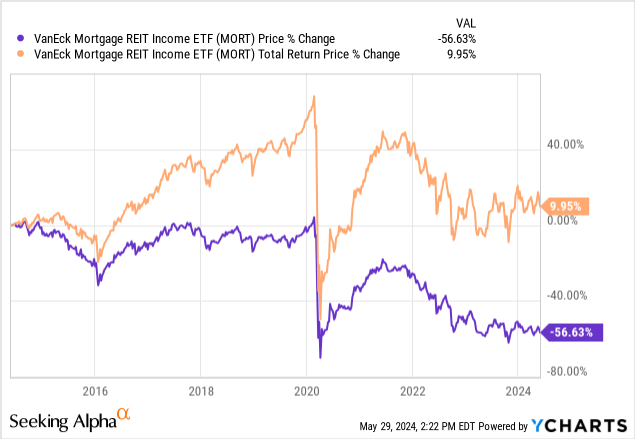
This fund is a vanilla, index-following, fund and buys and holds all mortgage REITs in an equal opportunity manner. We would wager that if it did try any of those creative antics like buying the highest yielding mortgage REITs, its performance (total return) would be deeply in the red.
Looking beyond the mortgage REIT exposure, we can get a sense of where SRET is going with its yield hunt.
SRET
The short answer for that is senior housing and nursing care. Sabra Health Care REIT (SBRA), National Health Investors Inc. (NHI), Omega Healthcare (OHI), and LTC Properties Inc. (LTC) are all REITs which focus on senior housing and nursing care. These have tended to have the higher yields in the sector for a long time. At this point, though, the fundamentals might be turning around for these and their occupancy and margin gains could continue to provide solid tailwinds.
Verdict
Sure, SRET has some REITs that we like. One example would be Broadstone Net Lease (BNL). We have a favorable view of the fundamentals and the valuation. The baseline yield plus our covered calls give us a good 14% annualized return, even if the stock stays flat. But we found it worthy because it had an amazing credit rating, good management and a sustainable dividend. We did not buy it because it had the highest yield we could land in the REIT sphere. SRET is not going to make that distinction. For the longest time, it owned NorthWest Healthcare Properties REIT (NWH.UN:CA) in Canada. It was fairly obvious to anyone looking at the financials that the REIT would cut its distribution. It did, and then it disappeared from SRET. We do use SRET as one of our benchmarks, and it is a fairly good reminder of what yield chasing does to a portfolio.
Conservative Income Portfolio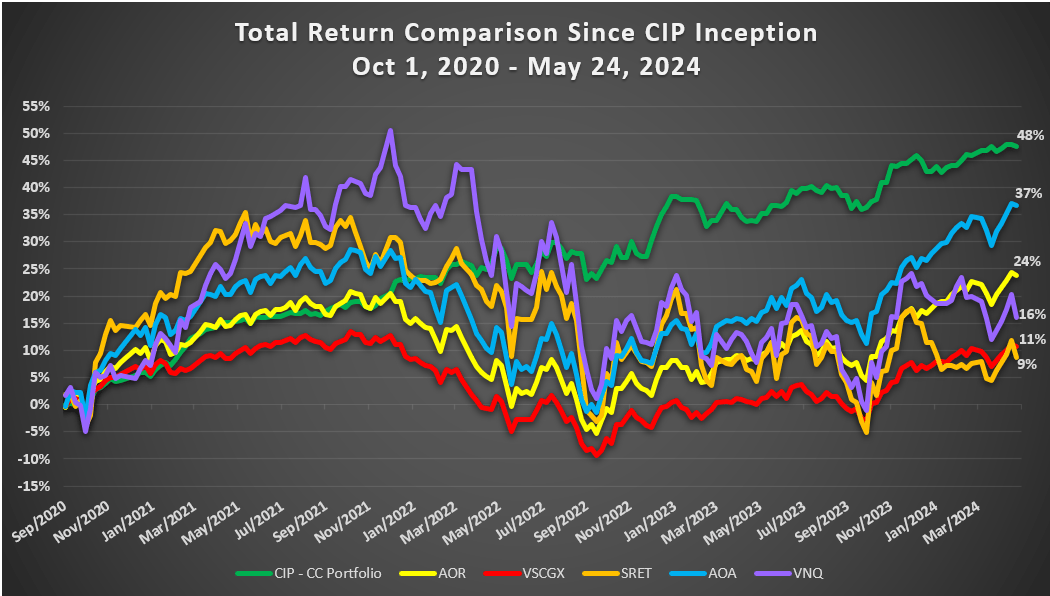
The setup today is possibly the worst this ETF has faced. It is diving headlong into the mortgage REITs above, as well others like Ready Capital Corporation (RC) and BrightSpire Capital Inc. (BRSP). BRSP is one which we have written something about recently, but below is the Cliff Notes Edition.
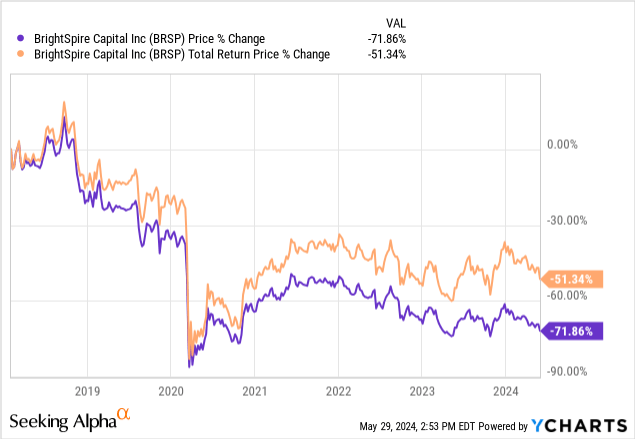
The odds are high that the next 12 months hands a very big negative total return for SRET versus the flattish outcome you have had for the last 12. We would avoid this fund (and mortgage REITs) like the bubonic plague.
Credit: Source link