

avid_creative
Introduction
Constellation Software Inc. (OTCPK:CNSWF) reported Q1 earnings some weeks ago and held its Annual General Meeting (“AGM”). The company does not host earnings calls, so the AGM is mostly the only time during the year when shareholders get to hear about the business’s qualitatives. This article will bring a snapshot of the company’s earnings and the AGM highlights.
Constellation is currently the largest position in our Investing Group portfolio, so I monitor it very closely. The good news is that the management team can be trusted (the AGM brought more proof of this), which makes holding it relatively easy. Management is always an essential part of a business, but more so when the company’s primary business is deploying capital into acquisitions.
Without further ado, let’s get on with the quarter.
The numbers
Constellation reported a great quarter (shocker, I know). The company’s top line grew 23% year-over-year, and its net income flipped positive now that the redeemable preferred expense (recall, a non-cash expense) caused by the Lumine spin-out started to subside:
Constellation’s MD&A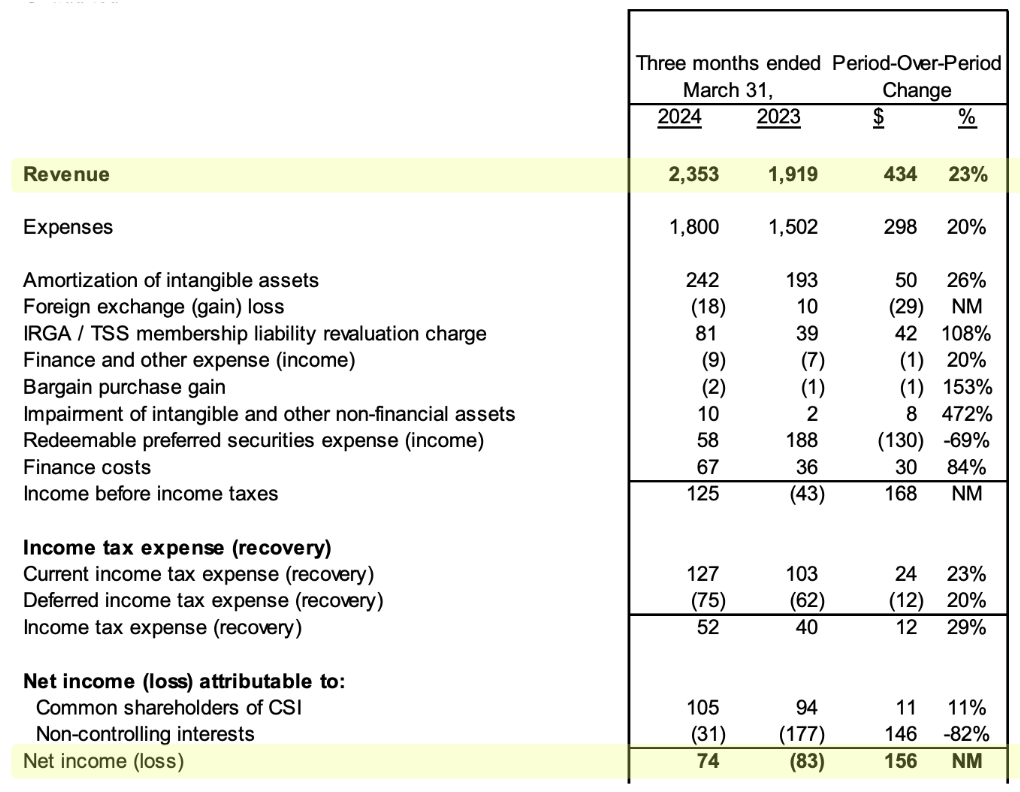
Just like last year, Constellation enjoyed operating margin expansion again. As discussed in previous articles, this might somewhat be related to the fact that organic growth has become a more significant contributor to the company’s growth than in the past:
Constellation’s MD&A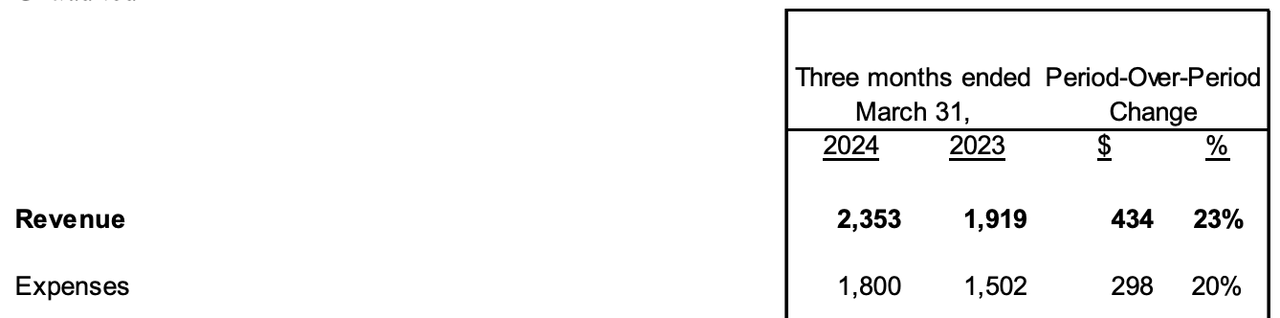
Quarterly revenue growth decelerated compared to last quarter but remained at an acceptable level. Since the first article I uploaded on the company, I have repeatedly stated that, with most growth coming from acquisitions, it would be normal to see a lumpy pattern. This is precisely what we are witnessing with Constellation, as the company deployed large amounts of capital in 2022 and 2023, which helped lift its growth:
Finchat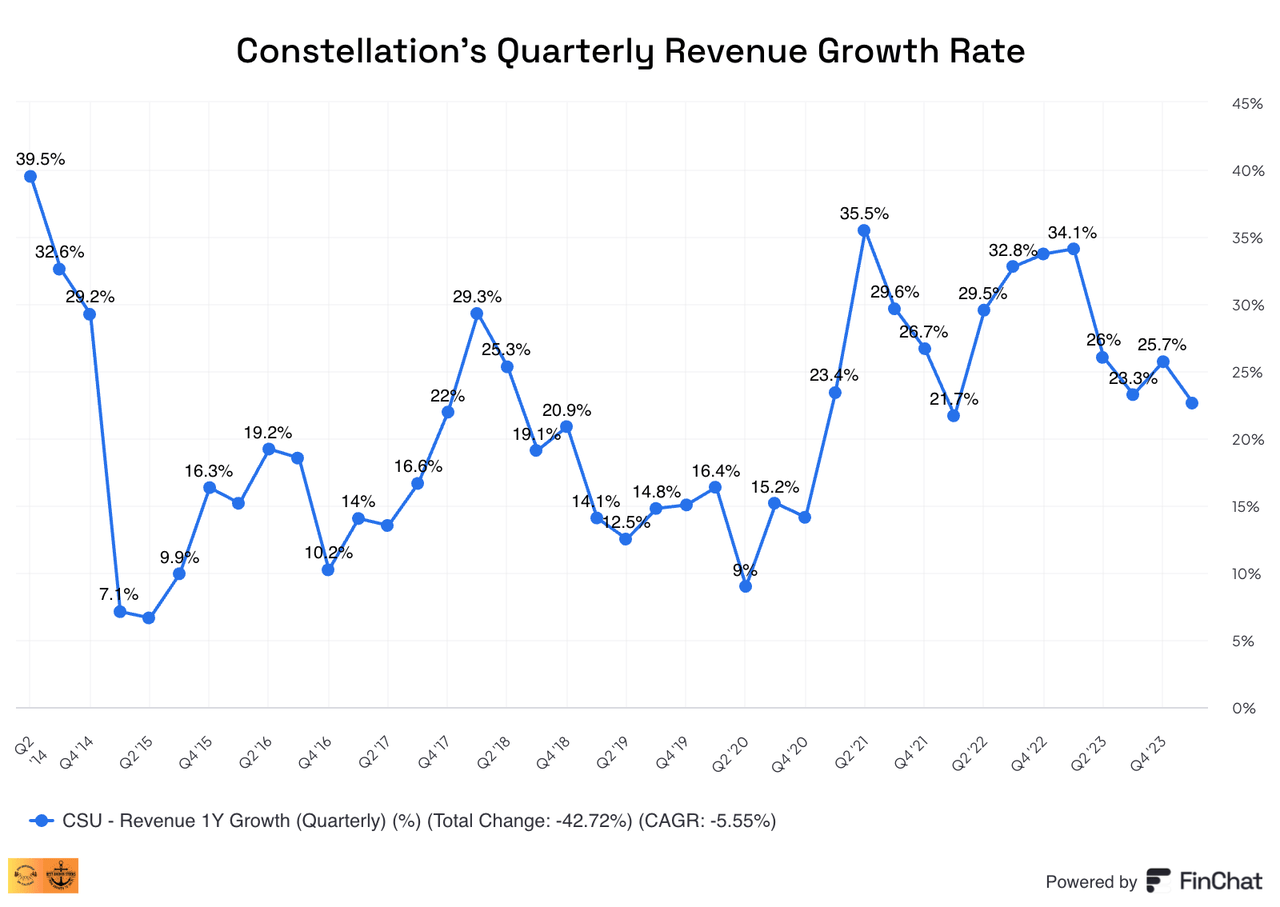
Let’s not forget that Constellation is a company growing 23% at an $8.4 billion revenue run rate. I used Finchat’s screener to find out how many companies of a similar scale are growing at Constellation’s pace, and the result was…32. Even though this is a small number considering the universe of publicly traded companies, I think it’s still quite significant. However, I’ll note that several companies on the list face easy comps or are outright cyclical.
If I change the criteria for a revenue 3Y CAGR of 25% or above, the list is reduced to 13 companies, and a good portion of these operate in the leisure industry and come from easy comps from the pandemic. Here’s the list in case you want to dig deeper into any of them:
Finchat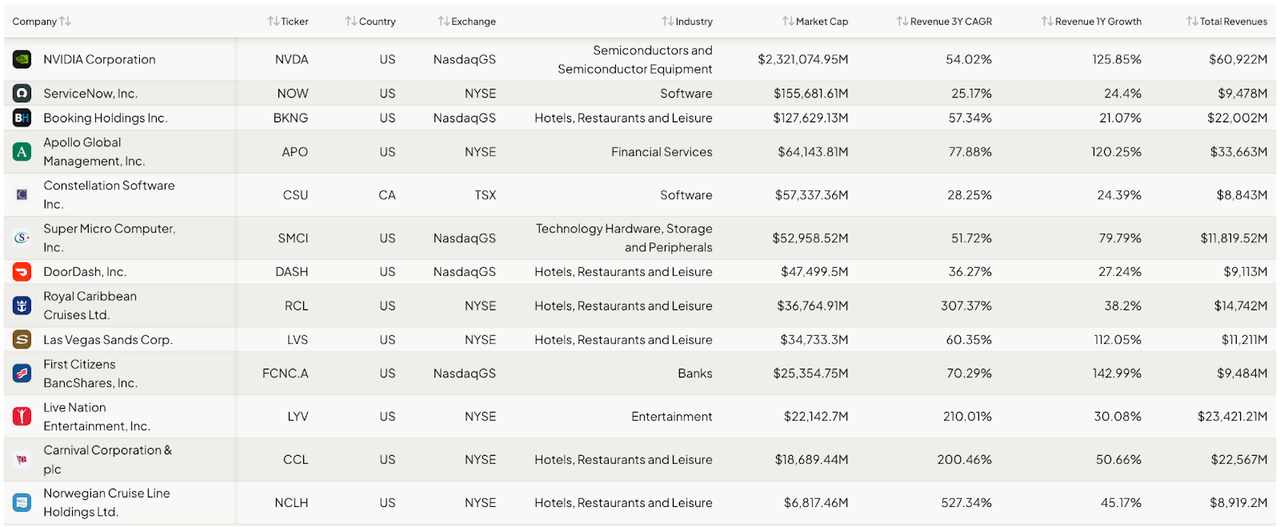
Digging deeper into revenue
Constellation has two sources of revenue growth: acquisitions and organic growth. Acquisitions were again responsible for the bulk of the company’s growth, but organic growth remained resilient despite decelerating over the past few quarters:
Finchat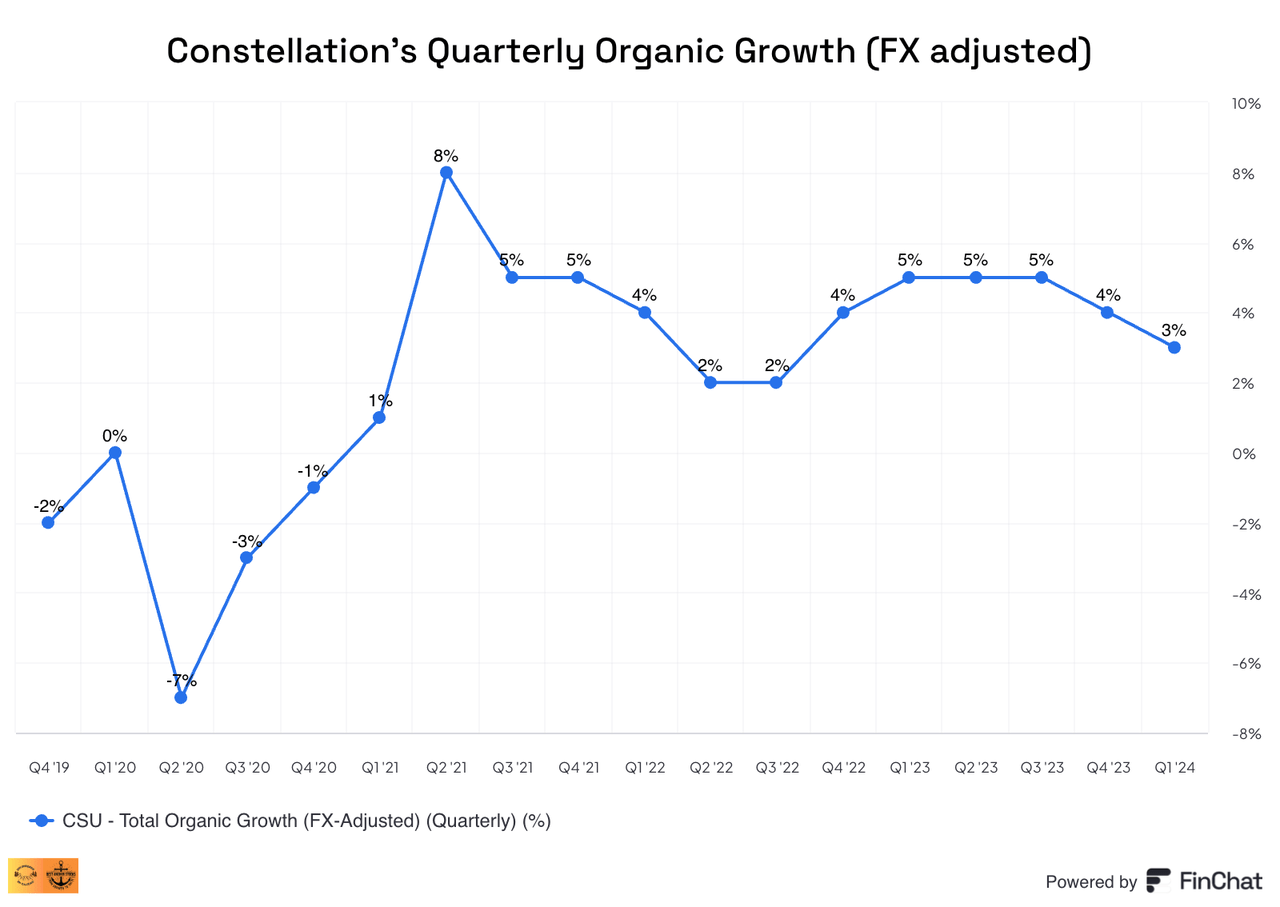
The good news, though, could be found in management’s preferred revenue source: maintenance and recurring revenue. For yet another quarter, the company managed to grow this revenue source organically ahead of overall organic growth. Maintenance and recurring revenue organic growth has been above the 5% mark for 12 quarters in a row:
Finchat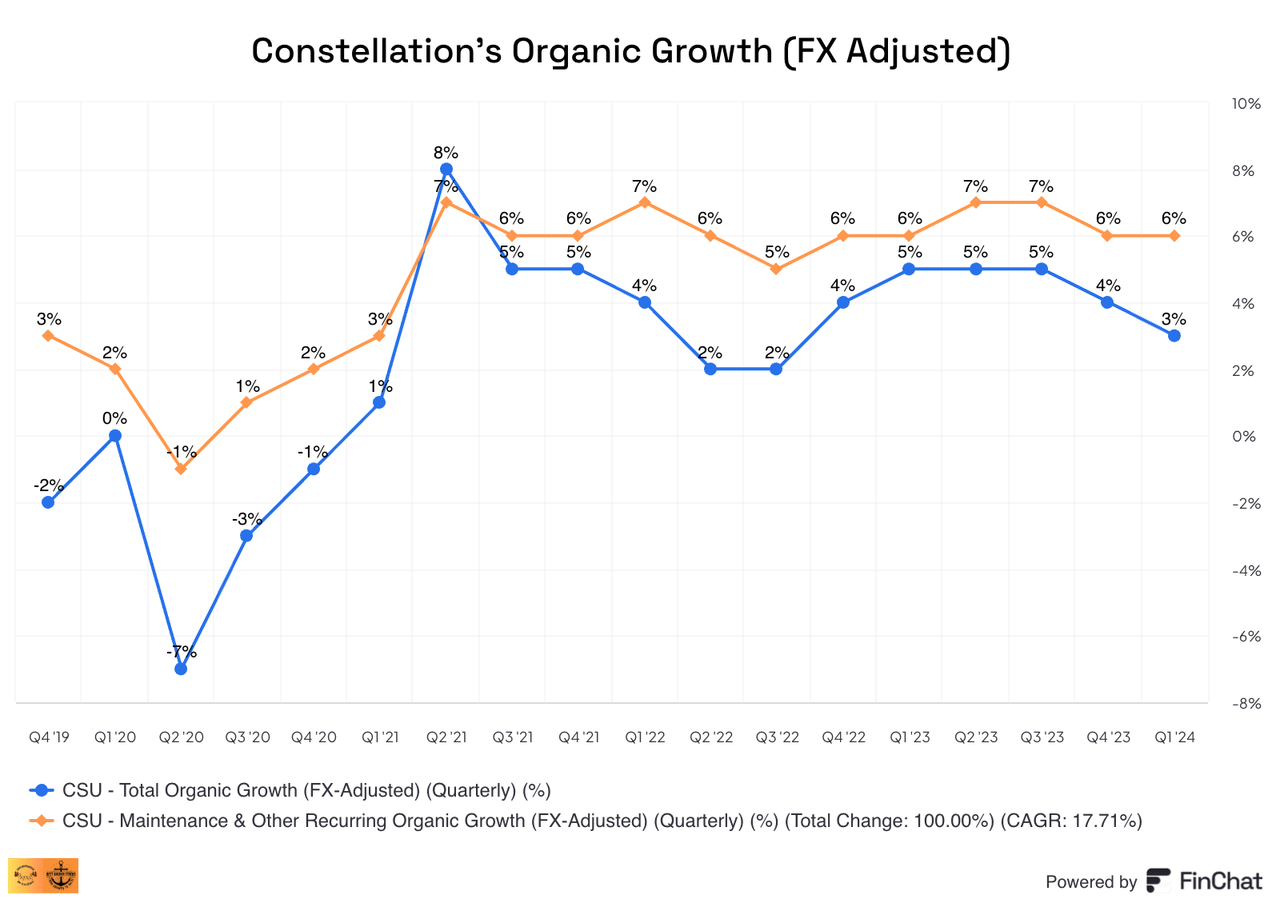
We should be cautious in extrapolating the recent organic trend into the future, as these might be related to price increases to offset inflationary pressures. Mark Leonard said the same thing during the AGM, so there you go: better not to count on the continuation of this trend. Constellation is still trying to improve its organic growth profile, but there’s no denying that the bread and butter is still in the M&A engine.
As usual, management shared how Topicus, Lumine, and Altera impacted its organic growth profile. Not much news on this front: Altera and Lumine were dilutive to the company’s organic growth whereas Topicus was accretive.
Constellation’s MD&A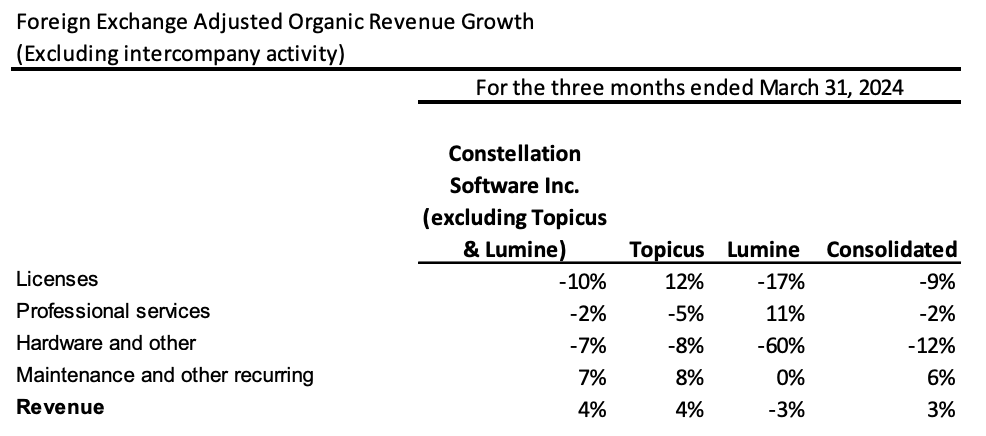
Despite being dilutive to overall organic growth, Altera was again a highlight due to the turnaround Constellation is achieving. The company has managed to…
-
Stabilize Altera’s growth
-
Improve the margin profile: expenses have decreased sequentially for 7 quarters in a row
-
Improve the cash conversion profile
Made by Best Anchor Stocks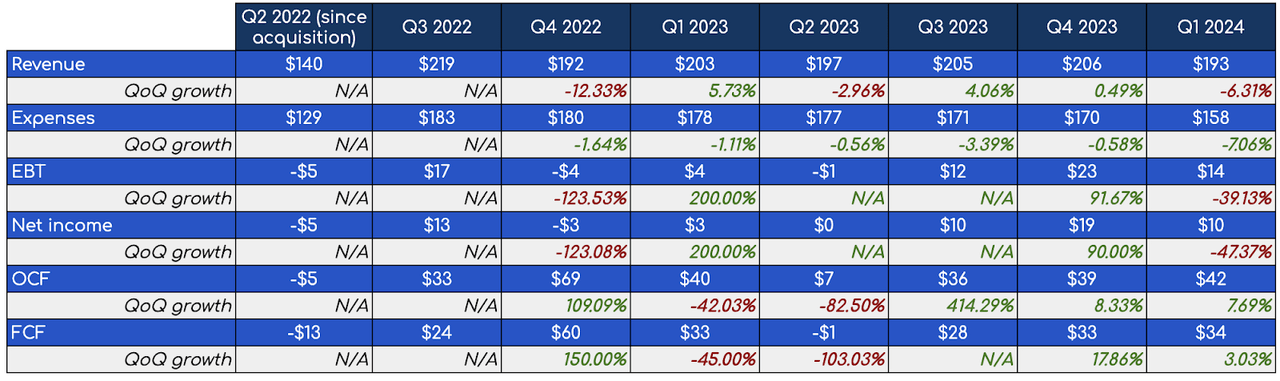
This has translated into what now seems like a pretty good investment: Altera has generated almost $200 million in free cash flow since its acquisition. Let’s not forget that the company was acquired barely two years ago for an enterprise value of $892 million. In my opinion, this good performance portrays that Constellation can also enjoy great returns across large-cap land, which reduces the risk profile considerably.
Looking at the expense side – Less noise after the Lumine conversion
Constellation’s accounting is now becoming moderately less misleading; this is until the next spinout, of course! All of Lumine’s preferred shares were converted to subordinate voting shares during the quarter. This had two impacts:
-
It significantly reduced the redeemable preferred expense: the reduction was $130 million, which is quite significant considering that this quarter’s Income Before Income Taxes was $125.
-
Constellation now owns 61.4% of Lumine, so its non-controlling interest is 38.6%. Before this conversion, the non-controlling interest was 100%.
This said, there was still some noise on the expense side. The usual suspects were the IRGA liability and Foreign exchange gain and loss. Although they both went in opposite directions:
Constellation’s MD&A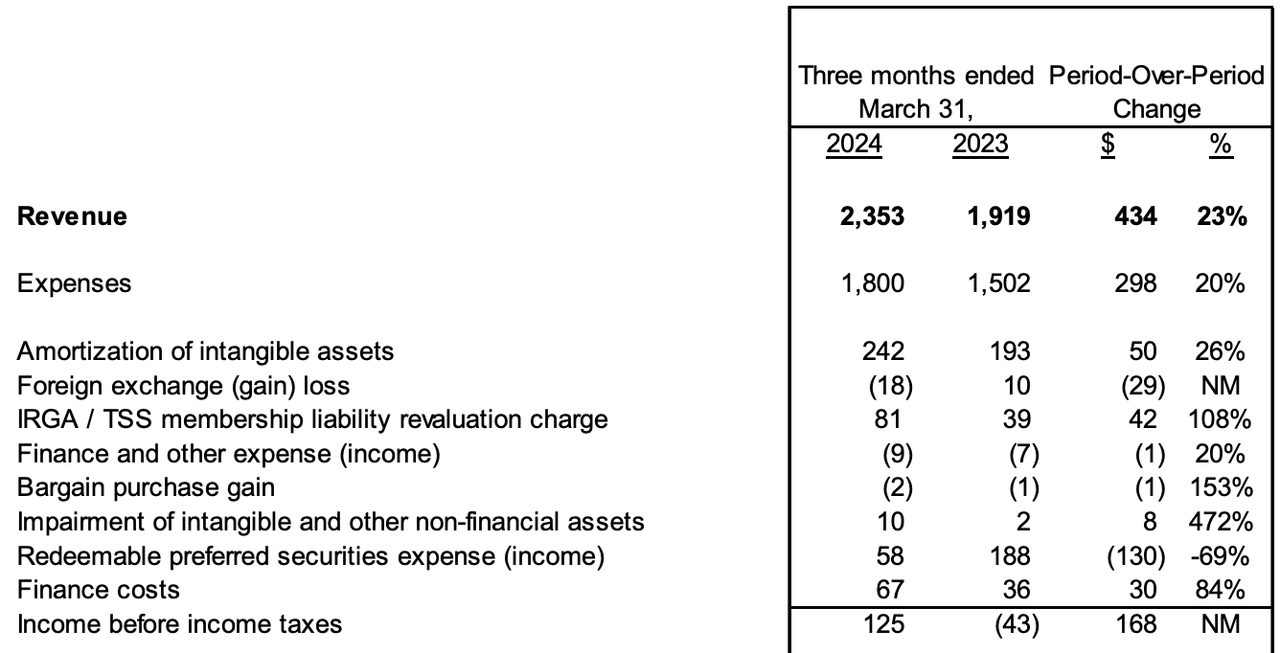
Constellation went from a $10 million foreign exchange loss in Q1 2023 to an $18 million gain in 2024. That’s a $29 million differential, which, again, is quite considerable, considering income before income taxes was $125 million. The IRGA liability was an even more significant item; it increased from $39 million to $81 million, a 108% increase. In case you don’t know what the IRGA liability is…
The IRGA liability is a provision that Constellation records in case some of Topicus’ preferred shareholders exercise their right to sell their shares back to Constellation (it’s tough to explain in a sentence, but that’s basically it). The increases or decreases come from the movements in certain variables, and it doesn’t mean it will happen; it’s just that Constellation assumes it will happen.
There is not much more to discuss when looking at expenses, although looking at “other, net” is always interesting:
Constellation’s MD&A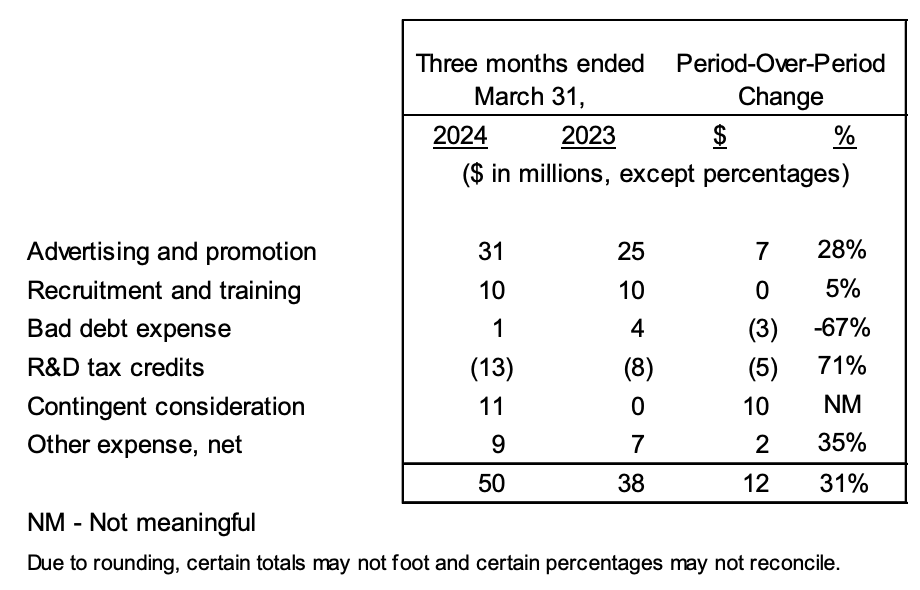
“Other, net” expenses increased 31%, or by $12 million. The main driver of this increase was good news, though: contingent consideration. Recall that contingent considerations are payments the company has to make if the investment achieves some pre-determined goals or, in plain English: if the investment is working better than expected.
The opposite side of the coin (expenses incurred when the investment is not going as expected) is impairments, which increased by 472%. Now, this might sound worrying, but considering the amount of capital the company has deployed lately, $10 million in impairment does not seem like much!
Made by Best Anchor Stocks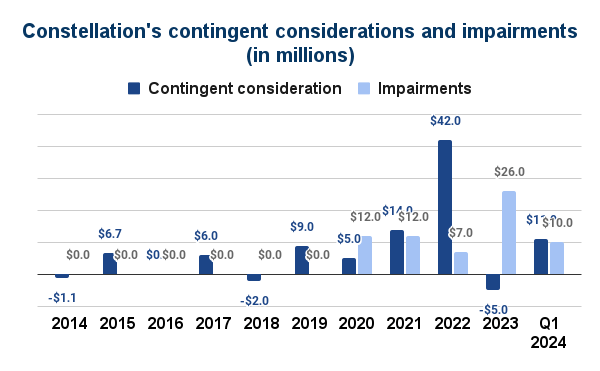
It’s natural to see these increase in absolute numbers as the company deploys more capital. I’d say that impairments are not currently worrying. They show management is not always right, but it’s pretty obvious they tend to be right more than they are wrong.
Noise in cash flows
Cash flows are what any investor looking at Constellation should focus on, but they were a bit noisy this quarter. The company grew its operating cash flow by 16% year over year, but its FCFA2S (“Free Cash Flow Available to Shareholders”) decreased slightly:
Constellation’s MD&A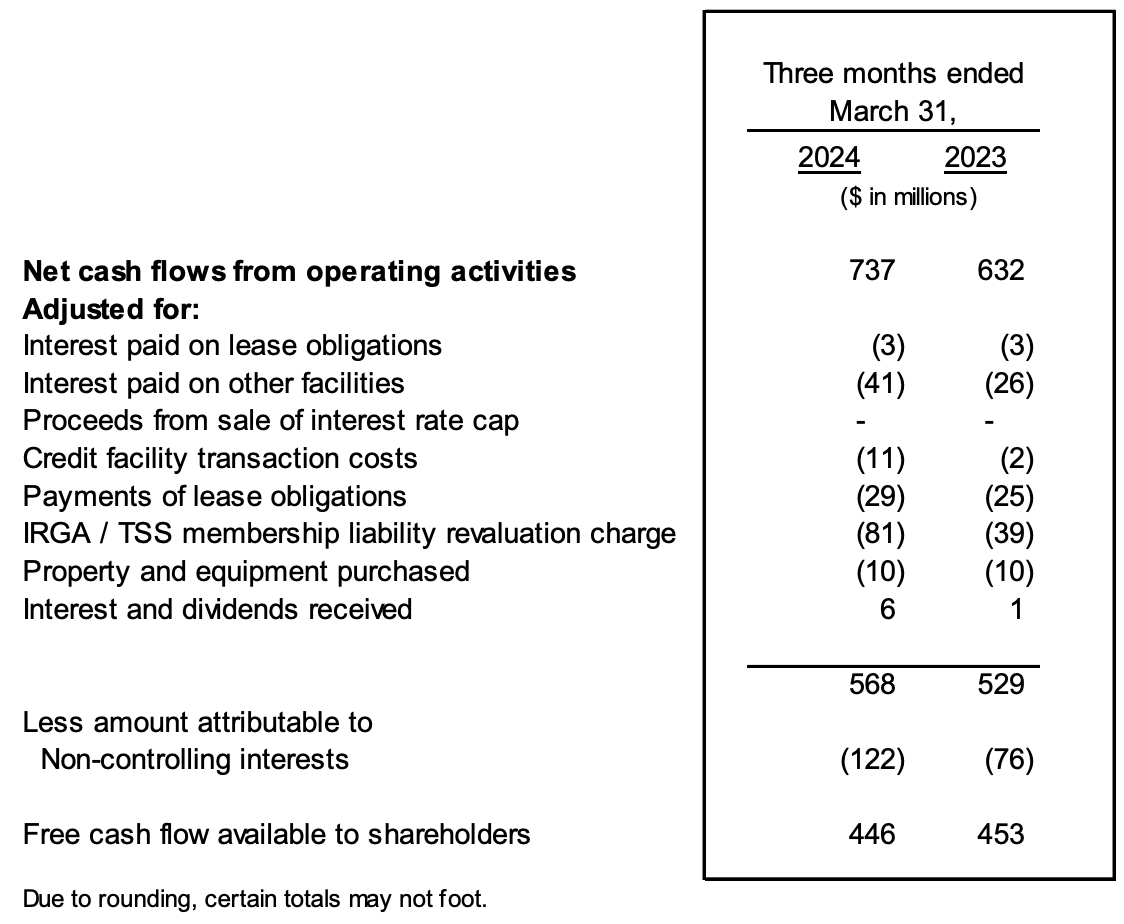
The reason could be found in the increase in the IRGA liability that I discussed above. Some people might consider this a non-cash expense, but I think it makes sense to consider it here because it might eventually become a cash outflow and the decision is not in Constellation’s hands.
Acquisitions – Strong start to the year
Constellation had another strong start to the year in terms of capital deployment. The company deployed $288 million into acquisitions during the first quarter. This does not seem impressive, but recall that capital deployment is always lumpy, and there’s a quote in the company’s MD&A (Management Discussion and Analysis) that shows just this:
Subsequent to March 31, 2024, the company completed acquisitions for a total consideration of $395 million.
Q2 is shaping up to be a strong quarter in terms of capital deployment.
Highlights from the AGM
As discussed at the beginning of the article, the company also hosted its Annual General Meeting last week. It was a rare AGM because Mark Leonard turned his cam on, something quite unusual for him:
Mark Leonard
Although I will share my highlights below, I highly recommend watching the whole event if you are a shareholder. It should give you a sense of how prudent and honest Mark Leonard (and the entire management team) is.
Here are my highlights:
-
On the organic/inorganic debate, ML (Mark Leonard) mentioned that inorganic investments still produce a much better return on investment than organic initiatives, so they will continue deploying most of the company’s capital on M&A.
-
The Topicus Operating Group (which is an operating group of the publicly traded company Topicus) continued to report double-digit organic growth. This operating group is still using an incentive system based on organic growth. ML mentioned that Constellation is “working on an idea that could impact organic growth related to compensation.” This means we might see a similar incentive system applied to Constellation’s compensation (or some operating group) in the future.
-
VMS is characterized by high switching costs, primarily because most customers have on-premise servers, and installation costs are high. However, it was interesting to see management claim that switching costs in the cloud and on-premise are similar. I did not expect this.
-
Of course, there were also questions about AI and how it might impact the business. ML mentioned that Constellation also has some businesses that generate “meaningful revenue from AI” and that Perseus has been developing AI since the 2010s. The management team sees it as another tech shift like mobile, to which they have already adapted in the past.
-
Many people are worried about the company’s M&A pipeline and competitive pressures, but ML reassured investors, claiming that the market is growing and Constellation is holding its share of acquisitions.
-
The pipeline is growing especially fast in large M&A, where the company’s relationships with brokers are improving. Returns are somewhat lower in large M&A, but the range of outcomes is tighter (meaning that the risk-return relationship is still favorable). ML also mentions that shareholders should view the shift to large M&A as an evolution, not a strategic shift.
-
The company ended its current partnership in Japan but is looking for a better partner. ML believes Japan could potentially become a great market for Constellation, although penetrating without a strong local partner is almost impossible.
-
Interestingly, management has moved the hurdle rates higher due to inflation. Very few companies would set their benchmark higher and be so transparent about it with investors. It makes total sense, though.
-
ML mentioned he is not against using equity to complete transactions, although he noted that leverage is currently the preferred option. Talking about leverage… Robin van Poelje mentioned that Topicus is currently running on low leverage and that he is used to more leverage in TSS. He claimed he is looking for the optimal capital structure and that shareholders should not take the news about the special dividend as an indication of less capital deployment opportunities.
-
Most of us were shocked to see Mark Leonard claim that he is open to repurchasing stock if it becomes undervalued. He has previously mentioned that he hates buybacks. That said, I highly doubt this will happen in his lifetime because Constellation has to be very cheap for the management team to consider it undervalued (due to how conservative they are).
All in all, it was a great AGM. There was not a lot of news because one of the management team’s most relevant traits is consistency and discipline, but it’s always great to listen to Mark Leonard.
Conclusion
Constellation Software Inc. reported a great quarter once again (surprise!) and gave some indication during the AGM about a long runway to continue deploying capital into acquisitions.
Meanwhile, keep growing!
Editor’s Note: This article discusses one or more securities that do not trade on a major U.S. exchange. Please be aware of the risks associated with these stocks.
Credit: Source link