













































PM Images
Written by Nick Ackerman, co-produced by Stanford Chemist.
Since the last time we gave the Guggenheim Active Allocation Fund (NYSE:GUG) a look, the discount has narrowed, but it still trades at a wide discount, which makes it an interesting choice. In particular, as its sister fund, Guggenheim Strategic Opportunities Fund (GOF), once again starts looking a bit richer in the premium department, it could be seen as a more compelling choice.
GUG Basics
- 1-Year Z-score: 1.63
- Discount: -10.60%
- Distribution Yield: 9.65%
- Expense Ratio: 1.7%
- Leverage: 22.35%
- Managed Assets: $699.5 million
- Structure: Term (anticipated liquidation date of November 22, 2033).
GUG’s investment objective is “to maximize total return through a combination of current income and capital appreciation.” To achieve this, the fund will
“pursue both a tactical asset allocation strategy, dynamically allocating across asset classes, and a relative value-based investment strategy, utilizing quantitative and qualitative analysis to seek to identify securities with attractive relative value and risk/reward characteristics.”
In doing this, the fund’s “sub-adviser seeks to combine a credit-managed fixed-income portfolio with access to a diversified pool of alternative investments and equity strategies.” Allowing them to invest in both fixed-income and equities means they will be quite a flexible fund, leaving the management to invest where they see fit. So far, the fund has tended to favor a heavier weighting to fixed-income investments, as we had suspected would be the case.
The fund’s total expense ratio came to 3.53% when including their leverage expenses as of their last semi-annual report. Similar to most other closed-end funds, or CEFs, they’ve been dealing with higher borrowing costs as the Fed raised their target rates. Since our last update, the fund has increased its borrowings from the ~$108 million level to around $156.3 million today. Relatively speaking, compared to some of its multi-sector bond funds peers, they are running with a mild amount of leverage. That said, any leverage will amplify returns to the upside but also to the downside, adding more volatility and risk.
GUG Leverage (Guggenheim)
Still The Better-Looking Valuation
As I often do in my GUG updates, I suggest that it is an alternative to GOF. Since our last update, GOF has outpaced the fund, and the valuation still favors GUG here despite seeing the fund’s discount narrow since our previous update.
Ycharts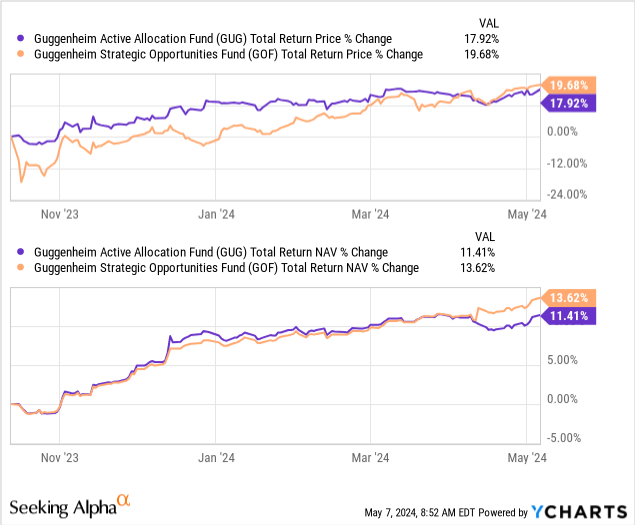
Also, to be fair, that update was last October when the overall market was correcting, and valuations in closed-end funds were widening meaningfully. Both have seen strong results in terms of performance since that update, and they correlated quite closely in terms of total NAV returns. That was until recently, when they diverged a bit. GOF saw a NAV bump while GUG slumped.
Admittedly, since the inception of GUG, GOF has been able to outperform materially better—even on a total NAV return basis. They have been performing more closely together since the start of 2023, with the notable exception being that divergence more recently, which has started to see GUG underperform once again. However, thanks to valuation differences, GUG easily outperformed on a total share price basis.
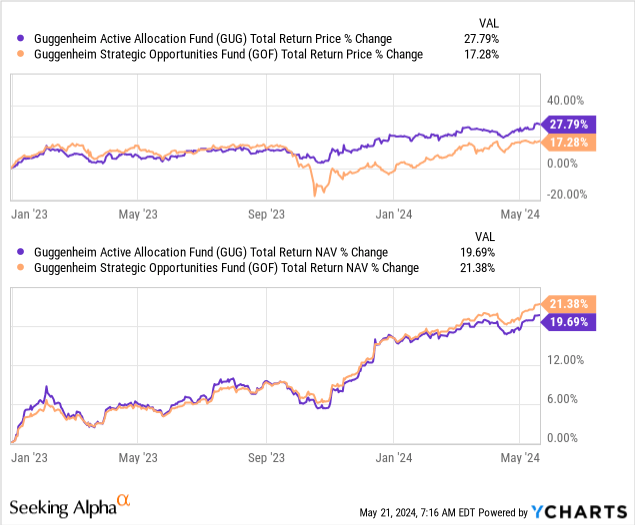
GUG also launched near the end of 2021, which was pretty bad timing for launching a fixed-income fund in terms of heading into a higher-rate environment. That saw the fund’s NAV decline quite materially shortly after launch, which, of course, was a similar trajectory to what we saw for GOF as they weren’t immune to these declines either.
Last October, GOF even hit a discount, albeit briefly, but that has been almost unheard of since the Global Financial Crisis. Still, today, GUG looks like a better potential candidate based on valuation. GOF has a significantly longer history and a higher distribution yield, which likely continues to entice investors to stick with that fund.
However, that premium for GOF has once again started to become stretched out on the higher end, which warrants some potential caution for investors in that fund who are willing to be more tactical.
Ycharts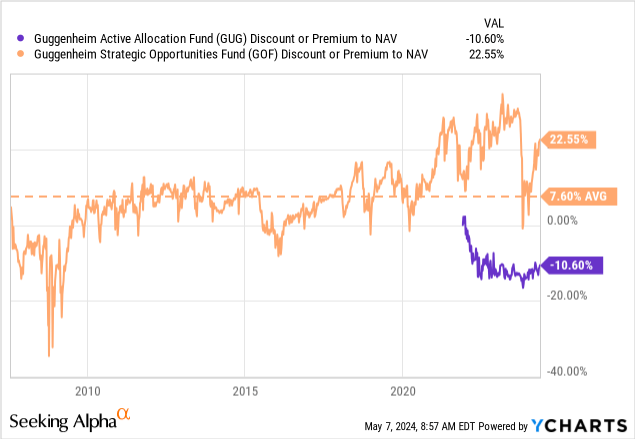
I’ve generally been more hesitant on GOF for a while now, but I naturally become even more negative as the premium rises further.
I believe the combination of the higher premium and the long-term unsustainable nature of their distribution can set up investors for losses. The hard part is that funds can pay elevated rates for years, so the timing of knowing when the cut will come is always difficult.
If I had covered the fund more regularly, when it hit a discount, I would have likely given it a “Buy” rating. So I’m not a permabear on GOF or anything.
GOF Rating History (Seeking Alpha)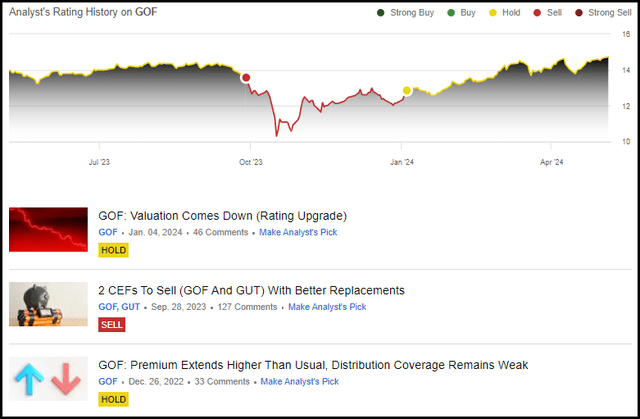
Going back to GUG, in our previous update, GUG carried a discount of over 14%. My main takeaway is that even with the current discount, it still looks like a relatively attractive opportunity as GOF becomes more elevated once again.
Similar to what we saw above from the 2023 to-date chart, where GOF could outperform with its underlying portfolio relative to GUG—as measured by the fund’s total NAV returns—the total share price returns could still favor GUG due to these valuation differences.
Distribution Looks Attractive
Given the fund’s discount, the distribution yield for shareholders today comes to 9.65%, compared to the fund’s NAV rate of 8.63%. That’s the rate plus the fund’s operating expenses that they’ll have to achieve to have the payout covered. They started with a $0.1188 monthly distribution, and that’s what the fund is continuing to pay today.
GUG Distribution History (CEFConnect)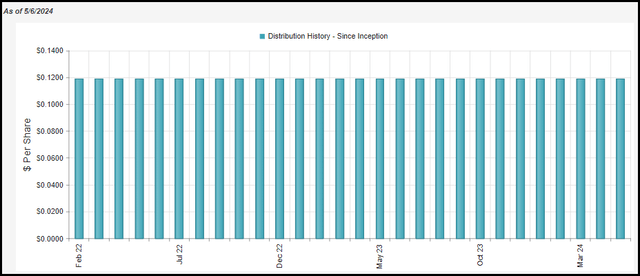
Of course, one of the greatest selling points of GOF is that they’ve never reduced their distribution and have an inception that pre-dates the GFC. To be fair, that is quite an impressive record, but with an NAV rate pushing 18%+ these days for that fund, they need to find significant capital gains to cover that payout.
GUG will also require capital gains to fund its distribution because, according to the latest semi-annual report, net investment income coverage is around 64.5%.
GUG Financial Metrics (Guggenheim)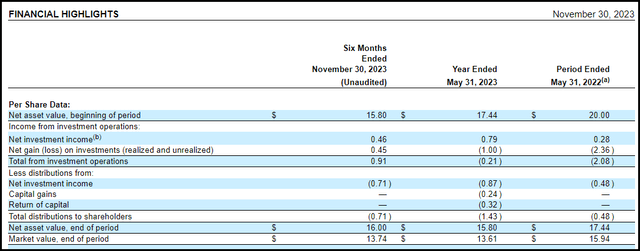
For GOF, their NII coverage comes to around 38.5% for some greater context. Both should benefit from a reduction in the Fed’s target rates in the next year or two. With that smaller gap for GUG, given the lower distribution rate it is currently paying, it seems a bit more sustainable in the current environment.
One of the main benefits of GOF, with its elevated premium, is that it can issue new shares through an at-the-market offering and its DRIP. Since these shares are being issued at a premium, they are accretive to NAV and should help provide some better distribution coverage. GUG does not get that same luxury as the shares have been trading at some wide discounts.
Ultimately, Guggenheim has shown they don’t so much mind paying a distribution that isn’t being covered. GOF has seen its NAV erode over the last decade as a testament to that. This would lead me to believe that with a more reasonable distribution on GUG currently, they wouldn’t have plans to cut anytime soon.
In terms of taxes for distributions, as a fixed-income focused fund, we see a meaningful amount characterized as ordinary income, which is to be expected. We also see some return of capital characterized, which also isn’t overly surprising given the fund’s lack of distribution coverage. Generally speaking, as the fund is focused primarily on fixed income and receiving interest-based income, it would usually be more appropriate for a tax-sheltered account.
GUG Distribution Tax Classification (Guggenheim)
GUG’s Portfolio
The fund’s turnover rate last came to 12%, and the prior full year before that, it came to 21%. That means they aren’t necessarily the most active, but they are making some changes within the fund. The fund does allow exposure to investments outside the fixed-income asset class; however, this tends to be a fairly limited part of the portfolio overall. Instead, the fund heavily emphasizes fixed-income exposure.
GUG Portfolio Asset Class Breakdown (Guggenheim)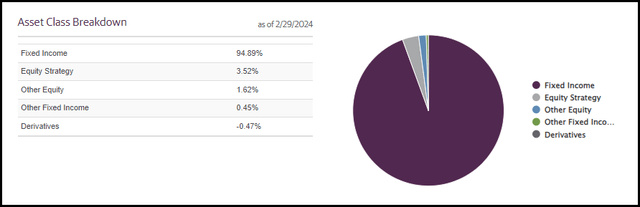
In fact, the fixed-income sleeve has grown since our last update. It now has ramped up to nearly 95% of the fund’s total asset class breakdown, climbing from the 86.23% listed previously.
In looking more specifically at what types of fixed-income instruments this fund is carrying, one will find they are primarily tilted toward the lower end of the quality spectrum.
GUG Portfolio Credit Quality (Guggenheim)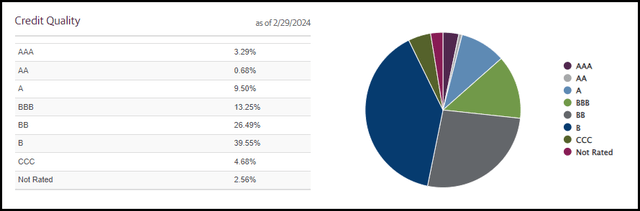
However, on the lower end is where the more attractive yields are, as that’s the payoff of taking greater risks. Looking further at the portfolio, we also see that the fund is carrying some significant exposure to floating rates. With that, it’s why we’ve observed that the fund’s last reported NII figure puts it on pace to be higher than what we saw for the full fiscal 2022. That’s even as they deleveraged a bit last year.
Further, it helps to bring down the fund’s weighted average duration, which comes in at 3.11 years. That’s the measurement of how interest rate sensitive the fund is; with every 1% change in interest rates, we should see the portfolio move 3.11%—either up or down, depending on the direction that rates are moving.
The floating rate exposure would include the bank loan exposure, which is the fund’s second-largest portfolio concentration. It’s also by quite a wide margin, as the portfolio is primarily split between high-yield corporate bonds and bank loans. Asset-backed securities also carry a rather meaningful sleeve of the portfolio, but it is rather dwarfed by the first two allocations. Within the ABS portfolio, collateralized loan obligations, or CLOs, are the largest sub-category.
GUG Investment Allocation (Guggenheim)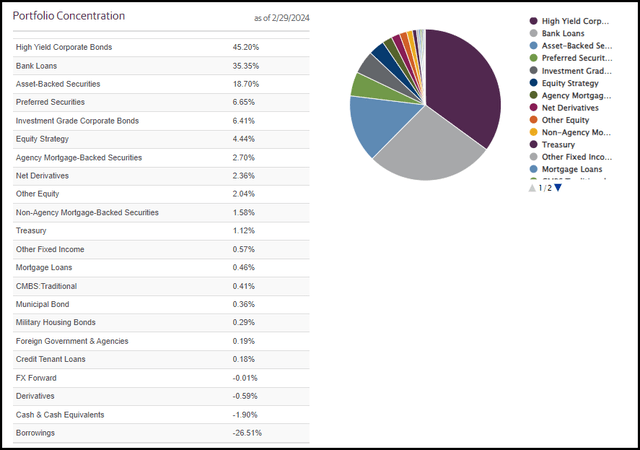
In looking at the fund’s top holdings, it’s quite notable that the weightings of each position are fairly small.
GUG Top Ten Holdings (Guggenheim)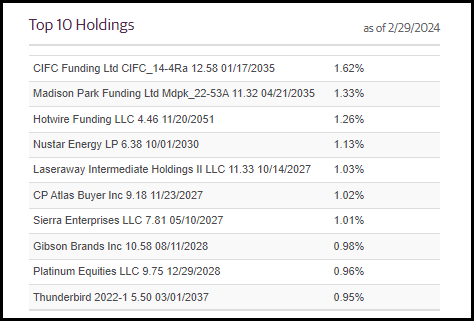
Like most high-yield focused funds, GUG diversifies significantly to reduce risk. However, GUG’s diversification goes to another level, as CEFConnect lists 1215 different holdings. GOF similarly has 1376 number of holdings listed. These also don’t include the fact that when we look at securitized investments like the ABS positions, there are hundreds or thousands of underlying loans within each of these pooled together as well.
With that said, and as we noted previously, they hold many incredibly small positions. In particular, many of the equity positions are where they hold hundreds of positions at $1k or less being invested. There are plenty that are being held that come to less than $100 worth even. Just for a quick example, here is a breakdown of some of the fund’s smallest industrial equity positions.
GUG Small Equity Positions (Guggenheim)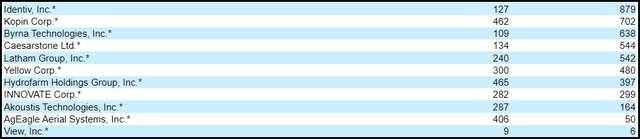
I’m not entirely sure of the purpose of holding all of these types of small positions when they get this small. If something like View Inc (OTC:VIEWQ), a penny stock that has since filed for bankruptcy from this holding report, were even to have a 100x return, that would take a $6 value to $600. At the very least, I suppose that the counterargument would be that if it goes to $0, as it is heading toward now, then it likewise wouldn’t hurt the fund materially.
Conclusion
Guggenheim Active Allocation Fund looks like an interesting choice in the multi-sector space, which places a heavy emphasis on fixed-income exposure. With its valuation, it is looking once again more compelling than its sister fund, GOF. GOF’s premium has been climbing higher more recently, which could set up GUG to perform better on a total share price basis, as we’ve seen previously. The distribution rate for GOF is currently higher with no cuts in its history, and that certainly can be alluring for income investors.
However, a CEF can essentially pay whatever it would like as long as the NAV stays above $0. These funds are both lacking NII coverage. That said, a slight edge to GOF would be that thanks to the elevated premium, they can issue shares accretively. That can help the NAV otherwise hold up a bit better, relatively speaking. Still, the difference in valuation and the larger lack of coverage based on the higher NAV rate trumps that positive, in my opinion.
Credit: Source link








