MCCAIG/iStock via Getty Images
It has been a while since we took a look at the inflationary expectations that are built into bond yields.
To obtain a measure of inflationary expectations, we take the nominal yield on a government bond of a specific maturity and then subtract from this yield, the yield on a government bond that is indexed for inflation.
The difference between the two yields is referred to as the compound rate of inflation that market participants expect for the duration of the bonds used in the calculation.
For example, the nominal yield on U.S. Treasury bonds with a 10-year maturity on Monday, May 20, 2024, is right around 4.40 percent.
The yield on U.S. Treasury bonds that are indexed for inflation is right around 2.10 percent.
Thus, subtracting the latter number from the former one, we get 2.30 percent.
We can say that the expected compound rate of inflation built into 10-year government bonds is 2.30 percent.
Note, that this compound rate of inflation is not too far off from the inflation target that the Federal Reserve is hoping to achieve.
The expected inflation built into 5-year U.S. Treasury notes is 2.23 percent, derived from the nominal yield on a Treasury security that has a 5-year maturity, 4.46 percent, and a 5-year Treasury bond indexed for inflation with a yield of 2.23 percent.
It can be noted that the 5-year compound inflation rate and the 10-year inflation rate are not too far apart.
Inflation is expected to run roughly at a 2.2 percent rate over the next 5-year period, and inflation is expected to run roughly at a 2.3 percent rate over the full 10-year period.
Inflationary Expectations in 2024
Inflationary expectations have been relatively constant throughout 2024.
Averaging daily figures from the start of the year through May 17, 2024, we get the following results.
January 2024 2.25 percent
February 2024 2.35 percent
March 2024 2.35 percent
April 2024 2.45 percent
May 2024 2.35 percent
So, inflationary expectations for the next 10 years have averaged just about 2.35 percent through May 17, 2024.
Again, the estimate has been relatively constant and has not been too far off of the Fed’s target rate of inflation.
I might suggest at this point that the Federal Reserve would be very, very happy if the compound rate of inflation for the next 10 years came in around 2.35 percent.
Market Performance
For the first five months of 2024, the nominal yield on the 10-year U.S. Treasury note has risen by 43 basis points, from 3.95 percent to 4.38 percent.
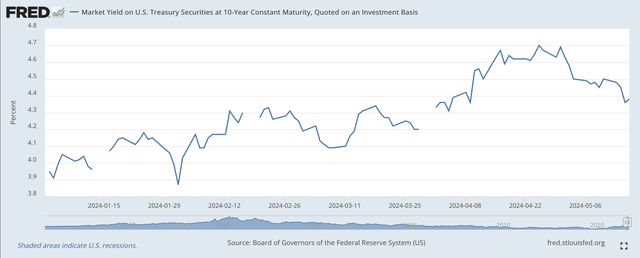
Market Yield on 10-Year U.S. Treasury Notes (Federal Reserve)
The yield on the 10-year inflation-indexed U.S. Treasury security has risen by 33 basis points during this time, from 1.74 percent to 2.23 percent.
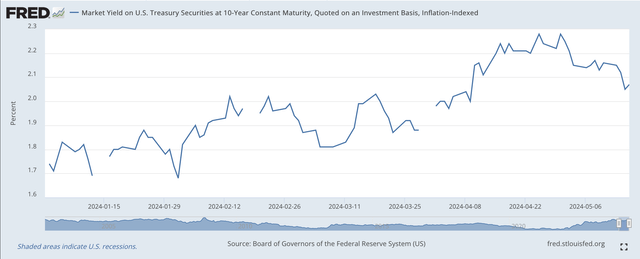
10-Year Inflation-Indexed Treasury Securities (Federal Reserve)
So, the rise in the nominal yield on the 10-year U.S. Treasury note was 43 basis points and 33 of these basis points came due to the increase in the “real” interest rate, in the inflation-indexed yield.
The yield on the inflation-indexed government securities usually is connected with market expectations about how fast the economy will be growing in the future.
Thus, the 33 basis point rise in the “real” interest rate suggests that investors, in May, believed that the U.S. economy would be growing faster over the next 10 years, than was the expectation back at the start of the year.
In other words, the investment community now seems to believe that the economy will be growing faster, by 33 basis points, over the next 10 years than they did at the start of the year, and that inflation would go up but only by 10 basis points.
Again, I think that the Federal Reserve is happy with this interpretation.
Conclusion
To me, this is a very good outcome associated with the policy efforts of the Federal Reserve.
The Federal Reserve has been working at quantitative tightening for 26 months.
The inflation rate has come down.
The expected inflation rate has come down.
But, expectations about economic growth have been revised upwards for the next ten years, upwards by a fairly decent amount, given that we are talking about compound rates of increase.
But, the last point I want to make is about the trust that investors have built up about the Federal Reserve and what it is doing.
For one, just look at how stable the financial markets have been over the past five months. Look at how stable inflationary expectations have remained.
Look at the fact that the stock market has hit a substantial number of new historic highs during this time.
Yes, there are looming problems hanging around, problems that could evolve into substantial disturbances to markets and the economy.
Yet, the financial markets have remained very stable.
As I have just mentioned in recent posts, we are now in a time period where the Federal Reserve will try…very hard…to not disrupt the financial markets…one way or another…and thereby influence the presidential election…one way or another.
I believe that market participants understand that the Federal Reserve needs to act in this way.
The good news is that it seems as if the financial markets are in a good position to “ride out” these next six or seven months.
If the Federal Reserve gets through this time period with inflation relatively dormant, and with the economy continuing to rise in the 2.0 percent to 2.5 percent range, it should be applauded.
One year ago, I don’t think many people…investors or analysts…thought that we would ever be in the position we are now.
If all of this is true, the Federal Reserve has really done a remarkable job.
Credit: Source link