
Stocktrek/DigitalVision via Getty Images
Introduction
In my last article, I reviewed Imperial Brands PLC (OTCQX:IMBBY, OTCQX:IMBBF) interim results and reiterated my optimistic stance – even though the company remains focused on conventional cigarettes and does not have a meaningful smoke-free portfolio. In this article, I will take a fresh look at the tobacco company that operates at the other end of the spectrum – Philip Morris International Inc. (NYSE:PM) aka PMI. With its IQOS heated tobacco franchise and following its acquisition of Swedish Match, it is the undisputed leader in smoke-free alternatives.
But is PM stock really as safe as it appears to be – and what its valuation suggests? Let’s find out in this update, in which I reassess in light of PMI’s first quarter 2024 results.
Philip Morris International Q1 2024 Performance: ZYN Going Vertical
I’m inclined to say that, as expected, Philip Morris beat both adjusted earnings per share (EPS) and net revenue consensus, coming in at $1.5 per share and $8.8 billion respectively. Full-year adjusted EPS guidance was raised from $6.25 to $6.38 (+2.1%) and from $6.49 to $6.61 (+1.8%), excluding the impact of currency.
Q1 cigarette shipment volume was essentially unchanged year-over-year (Figure 1), which is solid given the current above-average industry decline rate. Compared to a few years ago, the decline in cigarette volumes is now also significantly impacted by the growing acceptance of alternatives, particularly vaping and heated tobacco products (e.g., slide 34 of PMI’s full year 2023 presentation). Focus on solid execution ensures that PMI continues to generate strong free cash flow from its (still) bread-and-butter segment.
Figure 1: Philip Morris International Inc. (PM): Quarterly cigarette shipment volume and year-over-year change in percent (own work, based on company filings)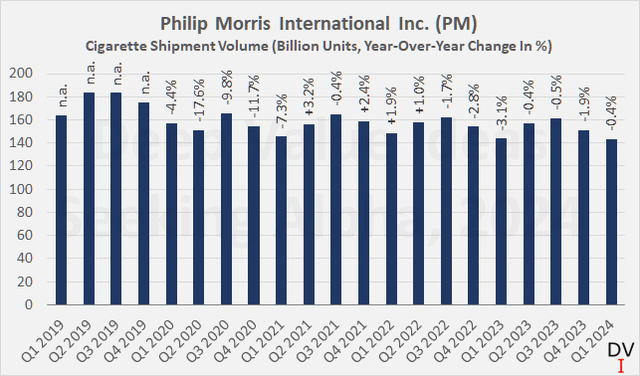
Heated tobacco volume grew by almost 21% year-over-year and exceeded 130 billion heated tobacco units (HTUs, Figure 2) in the last twelve months. IQOS is the leader in eleven markets and has exceeded the 10% share mark in Europe (9.3% in Q1 2023, 9.7% in Q4 2023). In Japan, IQOS is approaching the 30% share mark and has gained 3.1 percentage points in just one year.
Management expects HTU volume growth of 14% to 16% in 2024, which translates to 143-145 billion HTUs shipped. So even if PMI’s cigarette volume decline were to suddenly accelerate to 2.9% to 3.3%, the total volume would still remain flat. Of course, this is not a realistic and certainly far too conservative expectation, but even if HTU volume merely offsets the decline in cigarette volume, earnings should ultimately continue to rise due to the higher profitability of HTUs.
Overall, and including oral nicotine products (see below), PMI’s total volume grew by 3.6% year-over-year – this is phenomenal growth for a tobacco company, especially when considering that we are still at an early stage in the development of heated tobacco and oral products.
Figure 2: Philip Morris International Inc. (PM): Quarterly heated tobacco unit shipment volume and year-over-year change in percent (own work, based on company filings)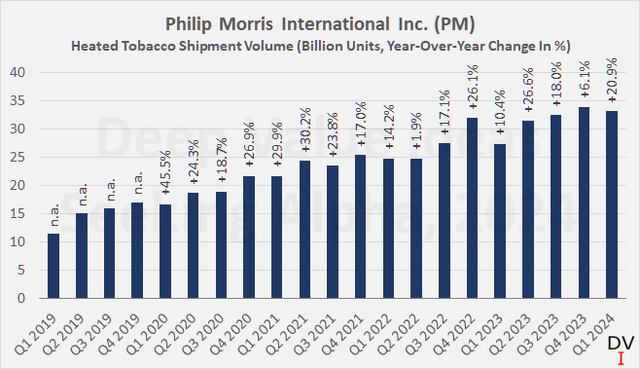
In terms of market share, Philip Morris’ premium cigarette-focused brand portfolio has lost a few percentage points compared to five years ago, but the situation has stabilized – despite comparatively high inflation and the fact that consumers are increasingly trading down to discount brands (see the discussion on U.S. discount cigarettes in my last article on Altria Group, Inc., MO). In heated tobacco, IQOS continues to take market share and Philip Morris’ overall share is now back above 28%, an improvement of more than 3% year-over-year (Figure 3).
Figure 3: Philip Morris International Inc. (PM): Cigarette and heated tobacco market share (own work, based on company filings)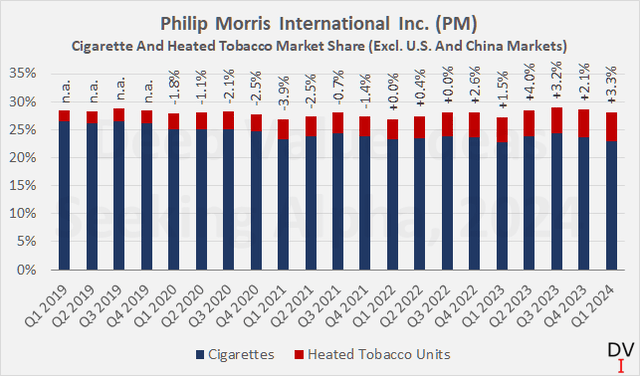
Oral nicotine product volume grew by 40% in the first quarter of 2024, but when we look at the U.S. shipment volume of ZYN (the flagship product acquired through Swedish Match), the recent acceleration in growth is nothing short of spectacular. In the first quarter, volumes were up almost 80% year-over-year, compared to “only” 45% growth last year (Figure 4). It will only take another quarter or two for PMI to pass the 500 million cans shipped over 12 months mark.
Philip Morris is clearly pulling the right levers and is even (temporarily) struggling to deliver enough product amid strong growth (see Q1 earnings call Q&A session). The growth recorded this quarter is particularly encouraging given that Philip Morris increased the price per can by $0.15, or about 3% of the median U.S. retail selling price for ZYN (calculated based on data found on slide 142 of PMI’s full-year 2023 presentation).
However, ZYN has not only grown strongly in terms of volume and net revenues, but has also further increased its category volume market share – from 67.4% in Q1 2023 to 74.3% in Q1 2024. In terms of net retail value share, ZYN held 79.3% in the first quarter.
Looking ahead, PMI’s management expects U.S. shipment volume to be around 560 million cans in 2024, which is about 40 million cans (+7.7%) more than guided for last quarter. For the remaining three quarters, however, this implies growth of only around 38%. In my view, management is taking a very conservative approach here and is probably setting the market up for a nice positive surprise.
I have repeatedly pointed out that I do not think the takeover price for Swedish Match was expensive – even after the increased offer (see this article). Given the recent acceleration in volume growth and numbers that are more typical of the technology sector than the consumer staples sector, I’m inclined to say that PM bought Swedish Match at a very compelling valuation in retrospect.
Figure 4: Philip Morris International Inc. (PM): ZYN U.S. shipment volume and year-over-year change in percent (own work, based on company filings)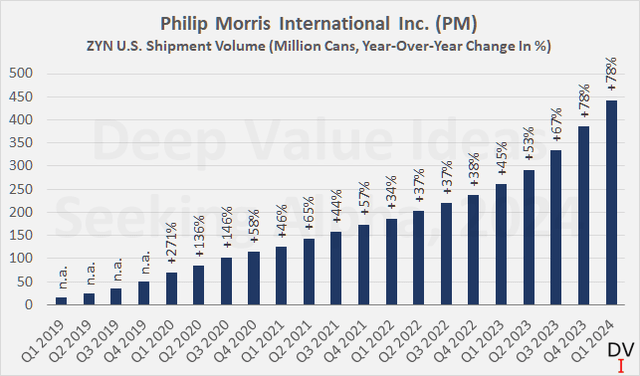
The strong investments in the business are clearly paying off, but this does not mean that the “capex bonanza” is abating. Philip Morris has recently increased its capital expenditures again (e.g., 3.8% of net revenues in 2023, Figure 5). The trailing twelve months figure is even higher, but capex spending is expected to be around $1.2 billion in 2024, so just over 3% of consensus net revenues of $37.0 billion.
Figure 5: Philip Morris International Inc. (PM): Capital expenditures in absolute and relative terms (own work, based on company filings)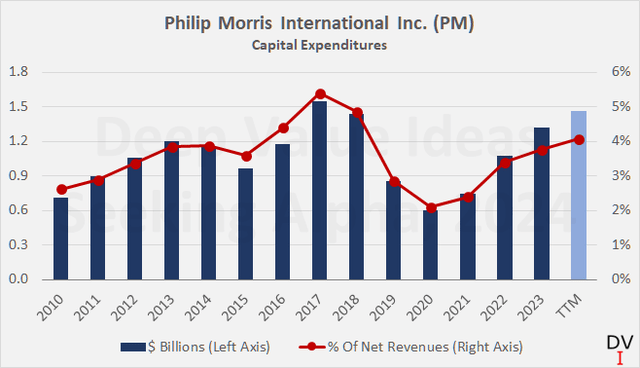
Taken together, Philip Morris is clearly performing very well, and its relentless focus on building the leading smoke-free portfolio is certainly paying off. However, as I have discussed in detail in my previous articles, leverage has increased significantly as a result of the heavy investment, particularly the acquisition of Swedish Match.
So if there is one thing that prevents me from being 100% positive on Philip Morris, it is the combination of free cash flow, which is still treading water (Figure 6), and high debt. Net debt at the end of the first quarter of 2024 was $46.4 billion, which translates to a leverage ratio of 4.8 times the average free cash flow of 2021-2023 (Figure 7). Given the reliability of PMI’s free cash flow and its largely recession-resistant business model, this is of course not overly concerning. However, one should keep in mind that Philip Morris paid out almost $8.0 billion in dividends in 2023, so there is not much room for deleveraging. The payout ratio typically hovers between 70% and 100% of free cash flow, leaving around $1 billion a year to pay down debt (ten-year average excess free cash flow).
Figure 6: Philip Morris International Inc. (PM): Free cash flow before and after adjustments for working capital movements and stock-based compensation (own work, based on company filings and own estimates) Figure 7: Philip Morris International Inc. (PM): Net debt at period-end (own work, based on company filings)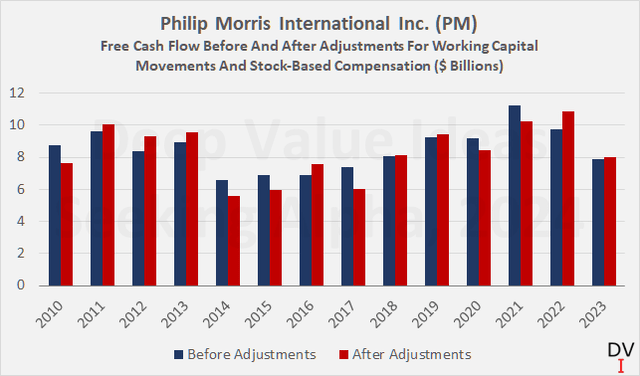
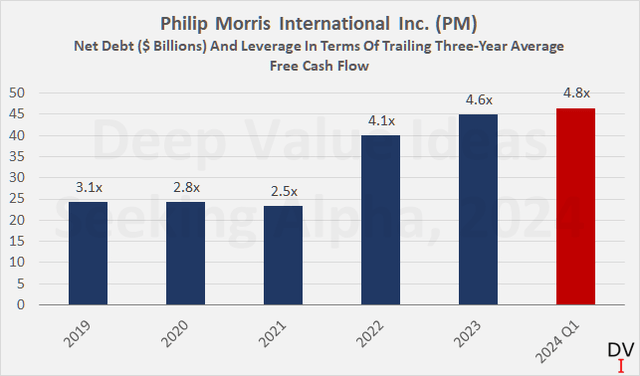
In this way, it will take quite some time for Philip Morris to return to a leverage ratio of 2.5x free cash flow. But of course, it is only reasonable to expect that capital expenditures will eventually decline, and free cash flow growth will increase, especially after IQOS is brought to scale globally. To give you an idea of how long it could take, I’ve modeled 4% annual free cash flow growth and subtracted dividend payments, assuming 2% annual growth. I then subtracted the excess free cash flow from net debt and calculated the leverage ratio.
So if PMI can increase its free cash flow at this rate over the next few years, debt should be back in check by 2030 (Figure 8). However, given the superior economics of oral nicotine products and heated tobacco sticks, there is considerable scope for margin expansion, and it should also be remembered that PMI is increasingly exposed to a highly profitable market to which it previously had no access – the U.S. Overall, my expectation of a return to a leverage ratio of 2.5x free cash flow by 2030 is probably a bit on the conservative side.
Figure 8: Philip Morris International Inc. (PM): Theoretical development of leverage assuming free cash flow and dividend growth of 4% and 2% respectively (own work, based on own calculations)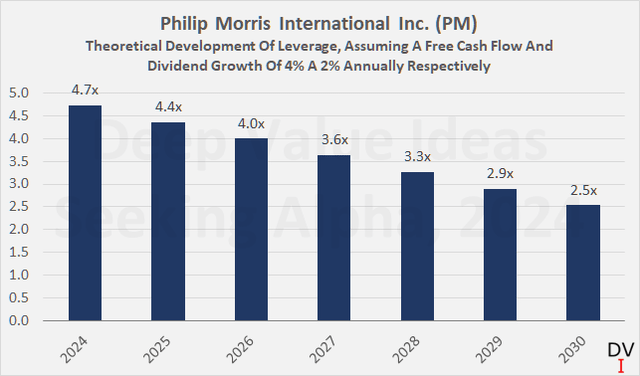
Conclusion And Valuation Update – Is PM Stock Still A Buy After The Rally?
Philip Morris reported excellent results for the first quarter of 2024, with oral nicotine products volumes in particular significantly exceeding expectations. The recent acceleration of ZYN shipment volume growth in the U.S. to almost 80% year-over-year makes the takeover price for Swedish Match look almost like highway robbery in retrospect.
Guidance has – unsurprisingly – been revised upward, but considering the updated expectation of 560 million ZYN cans to be shipped in 2024, I think management is being rather conservative here, setting the company up for a nice positive surprise. In my view, there is little chance that ZYN’s growth will suddenly drop from 80% to below 40% in the remaining three quarters. While management pointed out that supply is not quite keeping up with demand, I would not take the full-year guidance as an indication of worsening supply issues.
Philip Morris has built the leading portfolio of smoke-free products, and considering that the highly profitable U.S. market is not even tapped yet in terms of heated tobacco, one can expect much more from PMI going forward. This makes the high debt level (net debt at the end of Q1 2024 of $44.7 billion, leverage ratio of 4.4x) less of an issue, and even under conservative assumptions, leverage should decline to 2.5x free cash flow by 2030, when I expect a return to share buybacks and more meaningful dividend growth.
Recently, the market has come to appreciate Philip Morris International Inc.’s solid business fundamentals a little more, but one could argue that the rise in PM stock price has been a consequence of general rotation to value stocks rather than a PMI-specific reaction. At a current price of $100 per share, my discounted cash flow (“DCF”) sensitivity analysis suggests that an investor demanding a cost of equity of 8.0% would expect Philip Morris to grow at a perpetual rate of 2.0% per annum. This is not a particularly demanding valuation in light of the obvious growth prospects and rather stable combustible volumes, but it is of course much more optimistic than that of close peer British American Tobacco p.l.c. (BTI, OTCPK:BTAFF, see my last article).
I have added to my PM position on past dips and continue to think the stock is a solid buy at or below $90, as explained in my previous articles. Of course, a 10% increase in valuation doesn’t change much for a long-term investor, so considering the solid results for Q1, I’m inclined to upgrade the stock to “Buy” at current levels. However, I prefer to maintain my “Hold” rating as per my previous articles published at this price level and continue to monitor PMI’s performance for the rest of 2024. If growth does indeed remain as strong as it is, I feel comfortable raising my fair value estimate later this year.
Figure 9: Philip Morris International Inc. (PM): Theoretical development of leverage assuming free cash flow and dividend growth of 4% and 2% respectively (own work, based on own calculations)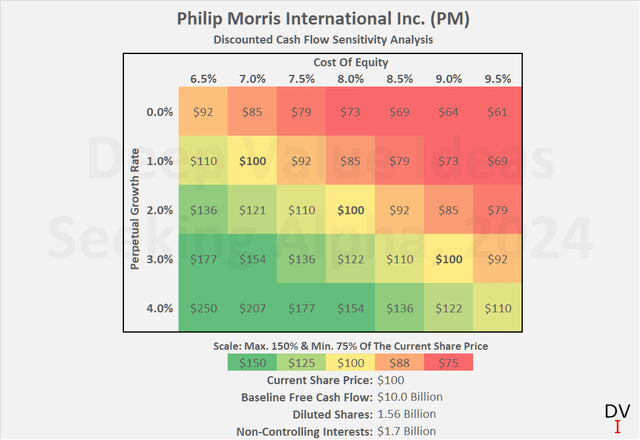
Thank you very much for reading my latest article. Whether you agree or disagree with my conclusions, I always welcome your opinion and feedback in the comments below. And if there’s anything I should improve or expand on in future articles, drop me a line as well. As always, please consider this article only as a first step in your own due diligence.
Credit: Source link