

bunhill
I previously bought Kinder Morgan (NYSE:KMI) stock back in late February. Since then, the stock has delivered very attractive returns, significantly outperforming the broader midstream (AMLP) sector as well as the S&P 500 (SPY) over that period:
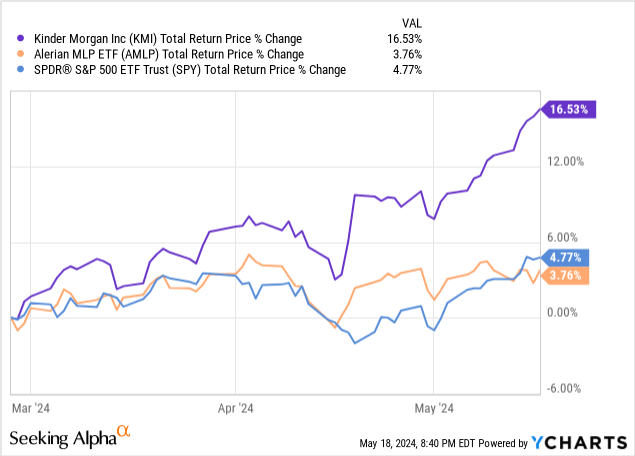
However, I recently sold my shares, locking in very attractive returns in a short period of time. In this article, I detail why.
My Original KMI Stock Investment Thesis
My thesis was based on the premise that its fundamentals were at an inflection point where the company had effectively deleveraged the balance sheet well below its 4.5 times target, its dividend was now covered by roughly two times its distributable cash flow, and the company’s organic business had stabilized and was poised to generate relatively stable cash flow moving forward, making its meaningful growth project investments highly accretive and likely to drive very strong growth for years to come.
Meanwhile, the ever-lower leverage ratio could give management significant capacity to accelerate shareholder returns through opportunistic buybacks and, hopefully, dramatically accelerated dividend growth from the company’s recent, very low 2% dividend growth rate. This, in turn, would likely drive significant valuation multiple expansion for the stock, leading to outsized total returns in the process. Even if it took a while for the market to wake up to the improved situation at KMI, I would gladly collect the attractive (and hopefully rapidly growing) dividend while I waited and possibly even add to my position further.
Why I Sold KMI Stock
However, it appears that despite this 2% growth rate being below the rate of inflation, the company has no plans to accelerate its dividend growth rate for the foreseeable future. This is in spite of the fact that they are projected to grow their distributable cash flow per share at an 8% rate this year and the fact that other midstream companies like Western Midstream (WES), Plains All American (PAA)(PAGP), and Energy Transfer (ET) have all seen their unit prices increase rapidly in response to very strong distribution growth hikes. Instead, management seems to think that they can earn more respect from Mr. Market by investing as much cash flow as possible into new growth projects.
Given that their yield is already on the low end for the sector at just over 6%, and they only plan to grow it at about 2% moving forward, it’s hard for me to see, barring some transformational transaction at a really attractive multiple, a catalyst that would drive the stock materially higher relative to other stocks in the sector, for the foreseeable future. In light of this de-emphasis on shareholder capital returns, I reduced my Buy Under Price from $20 to $19 and downgraded it from Buy to Hold.
Moreover, while they are expecting to generate strong growth this year, over the long term their expectation is to be able to generate on average about $400 million in new EBITDA per year from growth projects coming online, which would equate to roughly 5% growth. This amount should be choppy year to year, but on average should be about 5% based on their forecasted returns and capital investment budget. This is decent, but not outstanding growth, given their large amount of retained distributable cash flow and intent to retain and reinvest most of it.
Another reason why this emphasis on capital spending over capital returns does not appeal to me is that KMI’s track record of successfully deploying capital is very weak, especially when compared to peers in the sector like Enterprise Products Partners (EPD). As a result, I think they would serve shareholders much better over the long term by returning more capital to them, even if it was just increasing the dividend growth rate by a few hundred basis points each year to a 4-5% rate that is likely to beat inflation over time in order to preserve the purchasing power of the dividend.
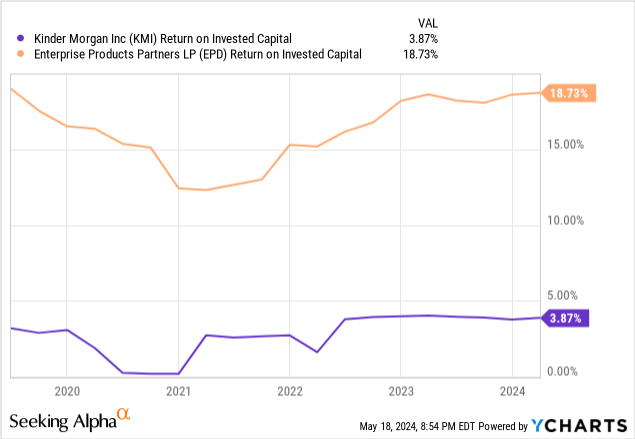
Overall, I do not think KMI is a particularly good fit for my portfolio anymore due to the lack of attractive upside potential, good but not great dividends, and weak dividend growth outlook. While the cash flow per share growth outlook is improved, it is still not particularly great, and it is evident that management does not even think that the stock is particularly cheap at the moment as they are not buying back stock and the only recent insider transactions have been sales.
Investor Takeaway
KMI seemed to be another case of PAA/PAGP, ET, and WES with the company reaching an inflection point in its balance sheet and organic business and appearing poised to dramatically accelerate its shareholder capital returns. We expected this to cause the stock price to soar to new heights, just as it did for these other midstream businesses. However, management appears to be content to maintain a very low below-inflation rate of dividend growth for the foreseeable future while pouring capital into growth projects where they have a spotty track record of achieving success.
As a result – when combined with the strong run-up in the stock price since we bought it a few months ago, we recently decided to sell our position and recycle the capital elsewhere into much more promising opportunities. We are currently neutral on KMI stock as we think the underlying business is solid, the balance sheet is in strong shape, and the current dividend yield is still fairly attractive. However, we think KMI will be hard-pressed to generate significant alpha moving forward unless they begin to return capital more aggressively to shareholders.
Credit: Source link