simon2579/E+ via Getty Images
Thesis
On (NYSE:ONON) currently fulfills all the desires of an investor straight out of a textbook, exhibiting outstanding profitable growth. Following the playbook of Nike (NKE) in certain ways, On might just be the fresher brand, and with its premium strategy, has the potential to become a serious threat to the market leaders.
- In this analysis, I approach the company On using integrated financial planning as a basis for a simplified DCF (Discounted Cash Flow) valuation, from which I transition to discussing the qualitative and market aspects of On.
- It will be noticeable that I engage in backward-engineering at several points — a method with which I attempt to align the high growth with the high valuation, thus understanding market expectations.
- These market expectations, along with their possible limitations, I then discuss against the backdrop of On’s brand quality, the highly competitive market, and the market leader, Nike.
- In summary of this discourse, from my perspective, On earns a cautiously positive hold rating – with an inclination to buy.
Brilliant Top Line
On has achieved an annual revenue growth of no less than 67% since 2019. All segments grew at comparable rates and shoes still accounted for by far the largest share at 96%. With 60% exposure in the USA, the Swiss company, which reports in CHF, is largely subject to the exchange rates between USD and CHF. Due to the strong Swiss Franc in 2023, this led to significant foreign currency losses. However, in the first quarter of 2024, the depreciated Swiss Franc caused the opposite effect, resulting in substantial foreign currency gains.
Regarding top-line goals, the management has consistently exceeded its own forecasts by a wide margin in the double-digit percentage range over the past two years. For the current fiscal year, management expects a revenue of approximately USD 2.5 billion, in line with the analyst consensus according to Seeking Alpha. The analyst consensus from Aktienfinder.net, using FactSet as the underlying data source, shows slightly more conservative estimates up to 2026, which I rely on for cautious planning. Thus, USD 3.6 billion is expected for 2026, compared to the management’s own expectation of about USD 3.9 billion. Beyond 2026, management expects annual sales growth of 20-25%. I personally rely on more conservative assumptions, gradually approaching a terminal growth rate of still a high 14-15% over 2027 and 2028. Alternatively, I could have extended the planning period and then set a lower perpetual growth rate. I will explain the derivation of the perpetual growth rate after 2028 in more detail later. The major target competitor Nike, due to its size, naturally grows at a much slower single-digit rate. In terms of scale, On would grow to about 10% of Nike during the planning period, which seems quite plausible. Nike’s margins will also play a role in On’s further planning.
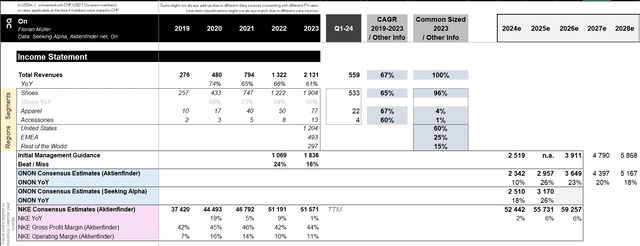
On Top Line Income Statement (Author | Data: Seeking Alpha, Aktienfinder.net, On)
Any Investor’s Dream: Increasingly Profitable Growth
On has an impressively high gross margin of 60% and an EBIT margin of 10%. In contrast, Nike has averaged 44% and 12%, respectively, over the past five years. In my model, I assume that On will gradually approach these values over the planning period and up to the terminal value in order to approximate a well-established industry peer. In summary, this means a gross margin growing slower than revenue as the marginal profit for additionally acquired customers might decrease with increasing market penetration, but an operational margin growing faster thanks to economies of scale. Determining tax rates in Switzerland is less straightforward than in some other countries, which I will not go into detail about. I found different corporate tax rates from Deloitte than from Damodaran, which again differ from On’s historical effective tax burden, so I settle on the middle of the three values at 15% for planning. This may be inaccurate. All in all, my own planning on the EPS level is more conservative compared to analyst estimates up to 2025 according to Seeking Alpha, with the $1 mark being surpassed only in 2026, whereas analysts already expect over $1 in 2025.
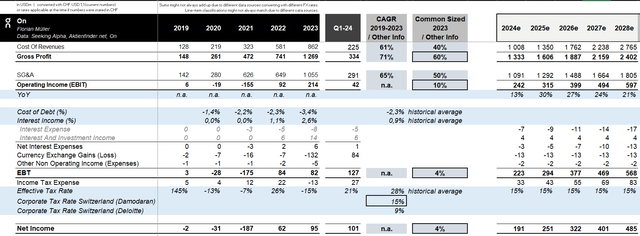
On Bottom Line Income Statement (Author | Data: Seeking Alpha, Aktienfinder.net, On)
Technical Valuation Assumptions
As in previous analyses, I will spare you the details of further model planning in the balance sheet and cash flow areas and will only briefly summarize the key methodological points:
- Cash balance as a result of total cash flow planning.
- Planning inventory, accounts receivable, and accounts payable based on historical turnover rates.
- PP&E based on the upcoming CAPEX plans, which I increase alongside EBIT under the assumption that no growth can be possible without capacity expansions. From this, historically implied depreciation rates are subtracted. On’s balance sheet essentially lists capital lease assets, which I have simplistically treated as PP&E during the planning period.
- Planning for equity by adding net income. I have not assumed any buybacks or distributions due to the young company still being in its growth phase. I also think that the company has now reached a stage where further growth is possible on its own without additional shareholder dilution.
- Total Cash Flow calculated and planned indirectly by adjusting for or adding (non)-cash effects from balance sheet deltas (Operating part), subtracting CAPEX necessary for growth (Investing part), and assuming increasing capital lease liabilities partly financing CAPEX (Financing part).
Regarding WACC, I rely on 30-year US Treasury spot yields for the risk-free rate, as the available estimates are derived in USD. There may have been minor inconsistencies, as some analyst estimates might have been planned in CHF and then converted to USD. Since I want to avoid planning for FX effects, this approximation seems sufficient to me. Particularly significant is On’s high beta factor, averaging 2 based on Seeking Alpha’s values for 24 and 60 months. This results in high costs of equity of almost 16%, which are only reduced to a WACC of 15% due to low leverage. This is slightly lower than the ROIC of about 15-25% that I expect during the planning period, and which the company has already nearly achieved with reaching profitability over the past two years. As a growing company, I assume almost complete reinvestment of profits, which can enable the previously mentioned high terminal growth of 14-15%.
And now I am being completely honest with you: especially in the technical valuation part, I did some backward engineering to arrive at the magnitudes on which On is currently valued to see what assumptions the market seemingly has for the young company – and all this in a coherent and integrated planning model. The reason I did this is because with such growth, the parameter assumptions are far too sensitive for me to want to commit to a valuation, as at around 15% WACC and almost as high long-term growth, the decimal places in the assumptions can massively influence the value. Thus, my conclusion is that On could indeed be fairly valued with a WACC of around 15% and a similarly high perpetual growth assumption. My indicative valuation result lands at USD 45, which implies a 1-year forward P/E ratio of 74 based on my more conservative own planning and a 1-year forward P/E ratio of 49 based on analyst estimates. Both are acceptable multiples for earnings growth over at least 5 years, which could certainly be around or above the 20% mark. The question remains whether one wants to attribute such growth potential to On. The history and success on paper would certainly support this, although the path forward is unlikely to continue with the same ease.
Doing What Nike Does – Indistinguishability or a Chance at the Podium?
And here is where I want to dive a bit into the qualitative and market aspects of On. On is one of the brands I see potentially being competitive enough through high-quality branding to be a threat to Nike in the long run (pun intended). Therefore, I feel very comfortable using the giant Nike as a comparable company in some instances.
On is adopting a key distribution strategy from its largest competitor: cutting out the middleman. Nike follows the strategy of increasingly selling its products directly through its own stores and online channels, rather than having its margins reduced by intermediaries. Currently, Nike generates 44 percent of its revenue through direct sales, while the larger portion is still handled by third-party sellers. For On, 38 percent of its revenue comes from DTC at the moment, with the rest coming from wholesale. However, there is a positive trend towards DTC, as this channel is significantly outgrowing the wholesale sector and gaining a larger share of revenue.
And it is precisely these direct customer relationships, brand building, and marketing that are so crucial in such a competitive market. Because at the end of the day, it’s about shoes, not irreplaceable rocket science. Nike recognizes this as well, and according to management, a new multi-year innovation and growth cycle is set to begin. This means a renewed focus on a sharpened and targeted brand identity, close customer relationships, and improved storytelling around the brand. Nike products are intended to be nothing less than “must-haves,” and the shopping process directly through Nike, whether online or in physical stores, should become an experience. Whether this plan will succeed is uncertain, but Nike is certainly capable of achieving it.
The biannual surveys conducted by Piper Sandler among average 16-year-olds in the U.S. provides a snapshot of the most popular brands among this crucial young age group, important for sustainable market positioning. On one hand, it shows that Nike’s DTC strategy appears to be effective, as Nike is already among the most popular shopping websites for clothing. This, in turn, validates On’s strategy. At the same time, the survey reveals that in the U.S. market, On faces an overwhelmingly dominant incumbent in Nike, which holds a significant lead in popularity as a footwear and clothing brand among young people. However, the slightly decreased approval ratings in the short term suggest that Nike’s position is not unassailable and can indeed be challenged — an opportunity for On within this risk.
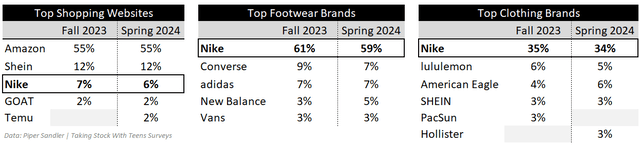
Piper Sandler’s Taking Stock With Teens Survey Results (Author | Data: Piper Sandler)
Ambitious Or Megalomaniacal?
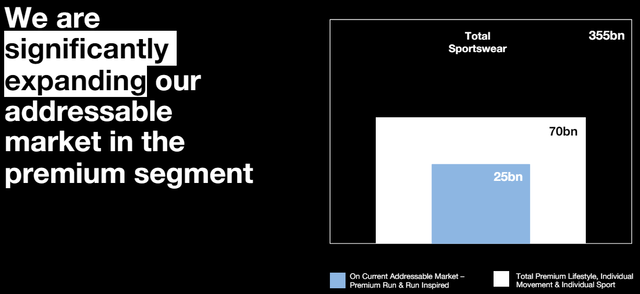
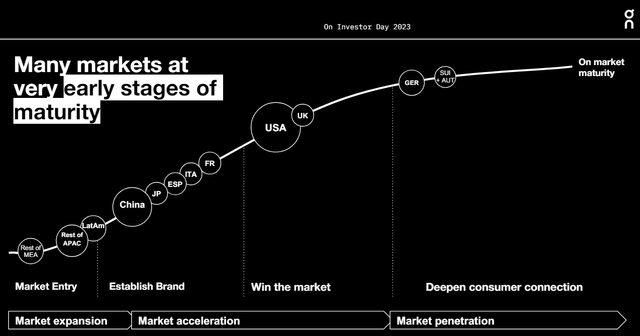
On’s goal is nothing less than to become the most premium global sportswear brand. The following graphics summarize where On sees further growth. This is partly through expanding its application areas beyond running — all within the premium segment. Out of a $25 billion addressable market focused on running, where On currently holds nearly 10%, the market is expected to expand to $70 billion by tapping into other apparel. Beyond 2026, On aims to significantly increase its apparel share beyond 10%. The second growth driver is global expansion, as shown in the second graphic below. On aims to raise its China-share to over 10% after 2026. In the shorter term, the Olympic Games in Paris might serve as an additional catalyst for On, but it is also a stage that will undoubtedly be utilized by all the other sportswear brands, which puts this opportunity into perspective.
On
On
Just Another Nike – Maybe Better, Maybe Not
This time’s Hold rating is to be interpreted with an inclination towards a Buy. This is because there is very little speaking against On’s current fundamental operative performance and potential, and given this kind of growth, the valuation could even be plausible. However, all of this is built on a big marketing machinery that might not yet be as established as that of big players like Nike. Because at the end of the day, all of them offer high-quality sportswear – nothing irreplaceable, although some claim On’s products to be of inferior quality. Furthermore, the size, long-standing presence, and inertia of large corporations like Nike could open the door for On in this vast market and seriously threaten the market leaders. However, personally, in this scenario, I would prefer to bet on the attractively valued, albeit slower-growing, industry leader Nike. But this is a personal preference, and at the same time, I see On as one of the most promising challengers.
Credit: Source link