
cyano66/iStock via Getty Images
Introduction
My regular readers know my bullish stance on tobacco stocks in general, and while I’ve been mostly covering Altria Group, Inc. (MO), British American Tobacco p.l.c. (BTI, OTCPK:BTAFF) and Philip Morris International Inc. (PM) here on Seeking Alpha, I’ve been rather silent on Imperial Brands PLC (OTCQX:IMBBY, OTCQX:IMBBF).
The company is undoubtedly the most unpopular in an already broadly shunned sector, mainly due to its dividend cut in May 2020 and its elusive smoke-free product portfolio. Given that IMBBY is a more or less pure-play cigarette company, the stock served as an excellent example to explain my personal approach to valuing tobacco stocks (see my December 2023 article).
The “ugly duckling” in a sector shunned by most investors published its results for the first half of fiscal 2024 on Wednesday, May 15. Judging by the share price jump of more than 6% on the London Stock Exchange, it must have been a solid report. The stock is now up almost 20% in just over a month and has returned more than 33% since October 2023 – even outperforming the mighty S&P 500 (SP500) by a significant margin.
But after such a strong rally, are Imperial Brands shares really overvalued now, and was the share price pop following the results announcement truly justified in the first place? And what about the fact that Imperial’s net debt increased 24% compared to fiscal 2023 year-end?
Let’s find out…
Imperial Brands Half-Year Fiscal 2024 Earnings Review
Imperial Brands on Wednesday released its interim results for the first six months of fiscal 2024, reporting gross revenues of £15.1 billion, down 2.3% year-over-year. After deducting excise taxes and excluding distribution-related revenue, Imperial reported net revenues of £3.64 billion from tobacco and NGP (Next Generation Products) sales, a decrease of 0.7% year-over-year (Figure 1). Excluding currency effects, net revenues from the tobacco and NGP business increased by 2.8% year-over-year. Operating profit decreased by 2.6% on a reported basis, but increased by 2.8% after adjusting for foreign exchange. Management maintained its guidance for the full year, meaning that an improvement in performance in the second half of the year is likely, given the expectation of mid-single-digit adjusted operating profit growth (see below).
Figure 1: Imperial Brands p.l.c. (IMBBY, IMBBF): Tobacco and next generation product revenues on an annual and semi-annual basis (own work, based on company filings)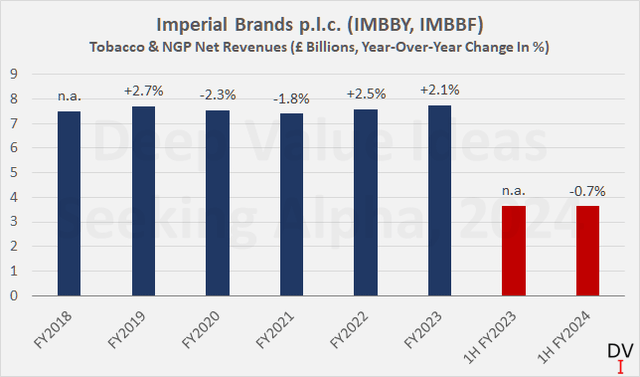
Considering the above-average decline in volumes faced by the industry as a whole, currency-adjusted revenue and operating profit growth of almost 3% is definitely a solid result. Consolidated tobacco volumes fell by 6.4% year-over-year, significantly better than in fiscal 2023, but still well above the historical average (Figure 2).
Figure 2: Imperial Brands p.l.c. (IMBBY, IMBBF): Tobacco volume on an annual and semi-annual basis (own work, based on company filings)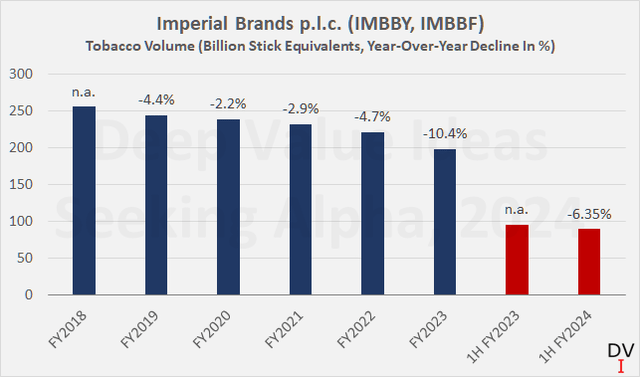
Europe, Imperial’s largest segment in terms of net revenues, recorded a decline in volume of 4.5%. In terms of net revenues, however, the segment recorded growth of 5.3%, or 7.0% at constant exchange rates. In my view, this is strong evidence of Imperial’s pricing power and continued good value proposition. Segment operating profit increased by 2.9%, or 7.9% at constant currency. NGP sales increased by 13.7%, but still accounted for well below 10% of the segment’s net revenues. Imperial has launched new products, such as a new version of blu (e-vapor), which is equipped with a removable battery to counteract the ban on disposable products with non-removable batteries. Nevertheless, the NGP segment remains a loss-maker and I do not currently expect this to change in the foreseeable future.
In the Americas, tobacco volumes contracted by 10.3%, slightly worse than the U.S. cigarette industry as a whole (see my last article on Altria Group). Pricing – adjusted for currency effects – more than offset this sharp decline (2.2% growth), but on a reported basis, net tobacco and NGP revenues were down 2.6%. Operating profit was down 5.3% on a reported basis, mainly due to currency effects (+1.4% at constant currency), but judging by the figures, the loss from the NGP segment also contributed to the decline. With NGP-related net sales of just £15 million (a 25% year-over-year decline), I don’t understand why Imperial continues to operate in this segment (recall that it discontinued its NGP offerings in the Africa, Asia and Australasia segment in 2022). Possibly, however, to further improve consolidated profitability, an announcement of the exit from the NGP business in the U.S. may be around the corner.
Finally, in Africa, Asia, Australasia and Central and Eastern Europe, tobacco volumes fell by 7.3% and pricing was unable to offset this decline, even at constant exchange rates. For the first half of fiscal 2024, Imperial reported net tobacco and NGP revenues of £945 million, down 6.6% and 2.6% respectively at constant exchange rates. Operating profit was only £384 million, down 14% on a reported basis and down 8% at constant exchange rates. However, the year-over-year comparison should not be over-interpreted, as in the first half of fiscal 2023, Tobacco and NGP net revenues increased by 4.9% and operating profit by 9.3% – despite a decline in volume of almost 18%, 12 percentage points of which is attributable to the exit from the Russian business. In addition, part of the decline in the first half of fiscal 2024 is due to supply chain disruptions in the Red Sea and stricter border controls, which management expects to ease somewhat in the second half of the year.
Why Imperial Brands’ Net Debt Increase By 24% In Six Months Is Of No Concern
Looking at the balance sheet, Imperial had net debt of £10.4 billion (including lease liabilities) at the end of March 2024, up 4% year-over-year and 24% sequentially. The increase in net debt is due in particular to movements in working capital and, of course, share buybacks (see below).
In the first half of fiscal 2024, the company reduced its payables by £823 million, increased its inventories by £297 million and increased its receivables by £286 million – all three negatively impacting operating cash flow (OCF). Overall, Imperial’s cash flow from operations after tax, interest and lease payments was negative £251 million in the first half of fiscal 2024.
What at first glance appears concerning should not be interpreted as a sign of financial distress, but merely a timing issue. If we look at Imperial’s previous half-year reports, it is clear that the company routinely records significant negative working capital movements, but these are usually offset in the second half of the year. Overall, since fiscal 2017, Imperial has recorded an average negative impact on OCF of £1.04 billion in the first half of each fiscal year, while working capital movements have been more or less negligible on a full-year basis (a positive impact on cash flow of £25 million on average):
Figure 3: Imperial Brands p.l.c. (IMBBY, IMBBF): Working capital movements during the first half of the year and the full year for fiscal 2017 to fiscal 2024 (own work, based on company filings)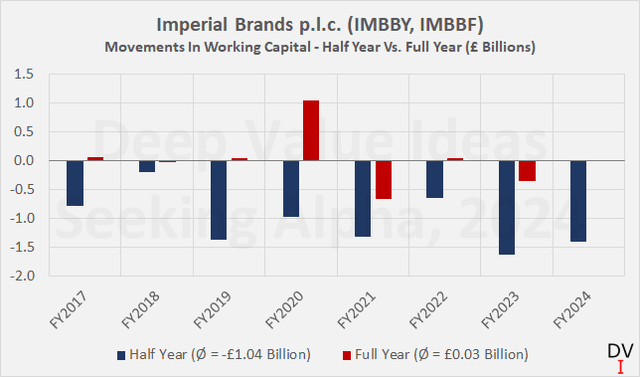
Can Imperial Brands Afford Its Share Buybacks, And What Is The Impact?
The second reason for the significant increase in net debt compared to fiscal 2023 year-end is due to share buybacks and dividend payments. Including payments to non-controlling interests, Imperial paid £1.0 billion in dividends and spent £605 million on share buybacks in the first half of the fiscal year. This justifies questioning whether Imperial Brands can actually afford such a generous return of cash to shareholders.
Absolutely, in my view.
Over the years, the company’s free cash flow (FCF) has grown steadily, from around £2.2 billion in fiscal 2019 to £2.6 billion in fiscal 2023 (adjustments such as non-controlling interest dividends and working capital movements, see my previous articles). Due to essentially flat net revenues, FCF growth is mainly attributable to margin expansion (27% in fiscal 2019, 32% in fiscal 2023), confirming strong execution and financial discipline. The FCF figure for fiscal 2023 compares very favorably with dividend payments to common shareholders of £1.3 billion (50% payout ratio), and even after share buybacks of £1.0 billion, there remains some excess free cash flow.
Before concluding, let’s take a look at the impact of the share buybacks. As I pointed out in my last article, Imperial Brands’ stock is cheap even under very (!) conservative assumptions. With this in mind, buying back shares strikes me as an excellent use of cash rather than desperately trying to play catch-up with smoke-free products – a race I think Imperial lost a long time ago (and which management acknowledges). The combustibles business continues to generate significant cash, so I welcome management’s focus on execution in its traditional business. In my view, it will be a long time before Imperial Brands’ free cash flow can no longer cover the dividend.
Share buybacks – paid for with FCF and not debt – began to have a significant impact on earnings (and FCF) per share growth in fiscal 2022, when the company reached its target leverage ratio (net debt of 2.0 to 2.5 times EBITDA). Figure 4 shows the impact on growth in percentage points. The fact that share buybacks of £1.0 billion in fiscal 2023 could boost EPS growth by 2.7 percentage points I think nicely underlines how cheap the stock is. It is rare that a company can reduce its outstanding shares by 2.6% by spending well under 50% of its free cash flow on buybacks.
Figure 4: Imperial Brands p.l.c. (IMBBY, IMBBF): The impact of share repurchases on earnings per share growth (own work, based on company filings)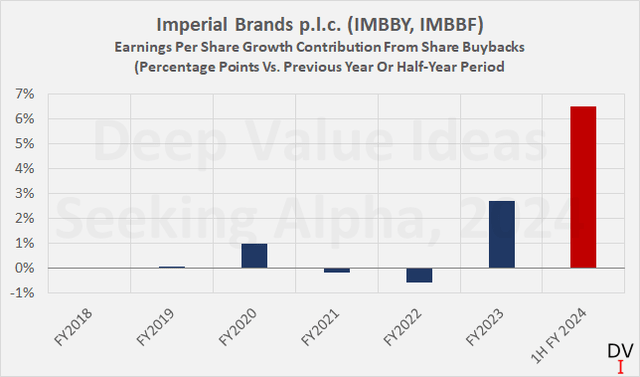
In this context, fiscal 2024 has started very well and the diluted weighted-average shares outstanding have fallen by 6.1% year-over-year (red bar in Figure 4), meaning that Imperial has reduced its share capital by more than 9% since initiating the share buybacks in October 2022. At the end of the first half of fiscal 2024, approximately £500 million remained under the current buyback authorization, so at the current Imperial Brands share price of £19.7, more than 25 million shares could be retired, representing approximately 2.9% of the diluted weighted-average shares outstanding during the first half of fiscal 2024.
Conclusion – And Why Imperial Brands Stock Remains A Buy After Earnings
Imperial Brands, the most shunned company in an already very downbeat sector, announced its results for the first half of fiscal 2024 on Wednesday. Currency headwinds made the results look worse than they actually were, and investors should keep in mind the difficult comparison with fiscal 2023, when sterling depreciated significantly against both the euro and the dollar.
The company’s smoke-free portfolio remains elusive, but I, personally, do not view Imperial Brands’ investment case to be hinged on a gradual shift to oral nicotine, vaping and heated tobacco products. Instead, I see Imperial Brands as a pure-play cigarette company focused on continuing to improving its already solid profitability to increase free cash flow despite flat revenues. Even if price increases eventually fail to offset volume declines, I think it will be a very long time before Imperial Brands’ dividend (current yield 7.5%) is jeopardized.
I think it is absolutely the right move to continue to focus on share buybacks and thus reduce the cash outflow for dividends (despite an already comfortable payout ratio of 50%). In a way, Imperial Brands is winning by being the sector’s loser (in smoke-free products). The fact that the “ugly duckling” of Big Tobacco was able to reduce its share capital by more than 9% in just 1.5 years shows very nicely how cheap Imperial Brands’ stock is.
However, even after the post-earnings pop and against the backdrop of a favorable trading environment – Imperial shares have returned more than 30% since October 2023 – it would be an exaggeration to call them expensive with a free cash flow yield still above 15% (considering the remaining share buybacks for fiscal 2024).
To make this clearer, I have updated the first scenario discussed in my previous article, which assumes that Imperial Brands ceases operations after 30 years and its three-year average free cash flow declines by 3% per year. Based on these assumptions and today’s share price of £19.7 (approximately $24.9), IMBBY stock is discounting an expected return of 10.1% per annum (Figure 5). If we consider a cost of equity of 9.1% to be an appropriate return, Imperial Brands’ free cash flow could decline by 3% per annum until fiscal 2043 and then fall to zero. Given the still evident pricing power, the ongoing margin expansion and the likely somewhat more moderate decline in combustibles volumes going forward, I believe this is an overly pessimistic expectation that would still see Imperial Brands stock yield a market-beating return.
Figure 5: Imperial Brands p.l.c. (IMBBY, IMBBF): Discounted free cash flow model assuming a terminal decline rate of 3% annually and a cutoff after 30 years (own work, based on company filings and own calculations)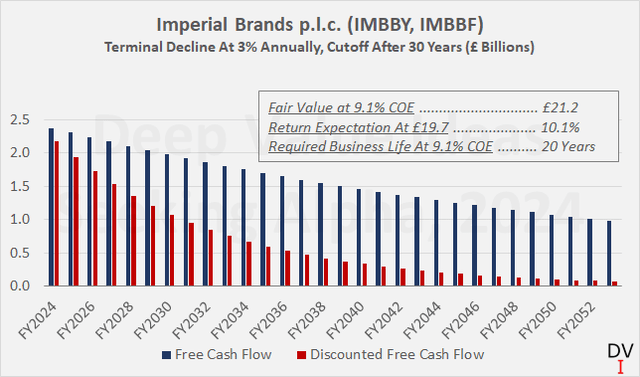
No wonder that vulture investor Kenneth Dart also increased his stake in Imperial Brands (alongside BTI, see my detailed article) in fiscal 2023 (Figure 6). His stake currently represents about 6.3% of the diluted weighted-average shares outstanding in the first half of fiscal 2024. Due to the lack of related filings, we cannot determine if he has increased his position since September 30, 2023, but considering that he has increased his stake in BTI once again (he now owns more than 10% so was required to file an amendment, see this commentary), it is only reasonable to assume that he has also increased his IMBBY/IMBBF position.
Figure 6: Imperial Brands p.l.c. (IMBBY, IMBBF): Shares owned by Kenneth Dart’s investment firm Spring Mountain Investments Ltd. (own work, based on company filings)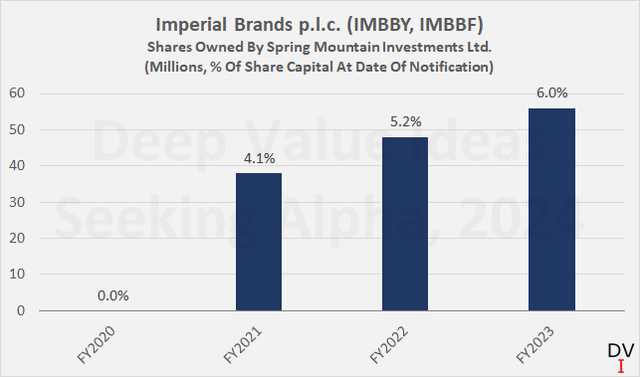
For these reasons, I am sticking to my “Buy” rating for Imperial Brands stock. Personally, I have added to my position on previous dips, expect to continue to do so over time.
Thank you very much for reading my latest article. Whether you agree or disagree with my conclusions, I always welcome your opinion and feedback in the comments below. And if there’s anything I should improve or expand on in future articles, drop me a line as well. As always, please consider this article only as a first step in your own due diligence.
Editor’s Note: This article discusses one or more securities that do not trade on a major U.S. exchange. Please be aware of the risks associated with these stocks.
Credit: Source link