
Mordolff
After the close of Tuesday’s regular session, video and display enhancement chip designer Pixelworks, Inc. or “Pixelworks” (NASDAQ:PXLW) reported Q1/2024 results largely in line with previous guidance:
Press Releases and Regulatory Filings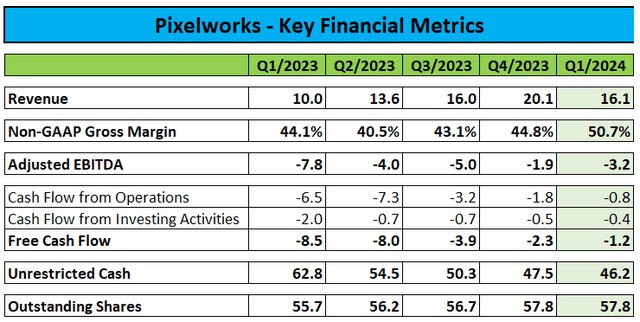
While the company remained unprofitable, revenues were up significantly on a year-over-year basis and non-GAAP gross margin eclipsed 50% for the first time in recent quarters.
In addition, cash usage continued to decrease. Pixelworks finished the quarter with $46.2 million in cash and cash equivalents and no debt.
However, on the conference call, management admitted to a number of near-term headwinds and provided disappointing Q1 guidance:
- The company’s largest mobile phone customer has decided to pause orders after experiencing slower-than-expected sell through, which is likely to impact both the company’s second and third quarter results.
- The release of Pixelworks’ next-generation mobile visual processor will be delayed until later this year due to “technical hurdles“. As a result, the company will miss a couple of customer design-in windows in the second half.
Particularly, the second issue is concerning, as the lack of near-term design wins is likely to impact the company’s revenues in 2025 and potentially beyond. In addition, the execution doesn’t look great.
Consequently, the company expects Q2 revenues to fall well short of consensus expectations as outlined by management on the call (emphasis added by author):
(…) total revenue for the second quarter will be lower than previously anticipated, primarily a result of the near-term headwinds in our mobile business. Considering these factors and based on our existing backlog, we currently expect total revenue for the second quarter range of between $8 million and $9 million.
While Pixelworks expects to return to sequential growth in the second half of the year, full-year revenues are likely to be a far cry off the $77.5 million currently expected by analysts.
Assuming FY2024 revenues of $55 million, Pixelworks would have to almost double its top-line performance next year in order to meet 2025 consensus expectations:
Yahoo Finance
Given the magnitude of the projected revenue shortfall, I would expect the company’s cash usage to increase significantly going forward and wouldn’t be surprised to see the company’s remaining cash balance dropping to below $25 million by year-end.
Management appears to be well aware of the issue, as the company has started to review near-term operating expense levels and “areas to maximize operational efficiencies“.
But the bad news does not stop here.
Similar to semiconductor substrates provider AXT, Inc., or “AXT” (AXTI), the company has been looking to list its Chinese operating subsidiary Pixelworks Semiconductor Technology (Shanghai) or “PWSH” on the Shanghai STAR Market, but an IPO is not likely to happen anytime soon as outlined in the company’s quarterly report on form 10-Q:
The process of going public on the STAR Market is lengthy and includes several periods of review by various government agencies of the People’s Republic of China (“PRC”), such as the Shanghai Stock Exchange (“SSE”) and the China Securities Regulatory Commission (“CSRC”).
The CSRC and the SSE have recently tightened the standards for the STAR Market and are currently advising companies that are not yet profitable under China GAAP standards against filing an IPO application in the present environment.
The Company believes this is in large part due to the current economic conditions in China and the recent performance of companies already listed on the STAR Market that were not profitable at the time of their IPO.
PWSH is not currently profitable under China GAAP standards. There is no guarantee that PWSH will be approved for a Listing at any point in the future.
Similar to AXT, Pixelworks has sold a minority stake in its Chinese subsidiary to certain private equity and strategic investors in China including entities controlled by the employees of PWSH and its subsidiaries:
Under the Capital Increase Agreement, during 2021, the Investors invested approximately $30,844 in exchange for a redeemable non-controlling equity interest of 10.45% of PWSH and the ESOP entities invested approximately $12,329 in exchange for a redeemable non-controlling equity interest representing 5.95% of PWSH (…).
But with the agreed deadlines approaching quickly, the company might be required to repurchase the PWSH stakes later this year (emphasis added by author):
Additionally, pursuant to our August 2021 Capital Increase Agreement and the agreements for the employee-owned entities that have invested in PWSH (“ESOP”), PWSH agreed to attempt to complete all requirements to qualify for a Listing such that the Listing is consummated prior to a certain date (for the private equity and strategic investors (“Investors”), June 30, 2024, and for the ESOP, December 31, 2024).
If PWSH has not consummated the Listing before those dates, or if it seriously violates certain other restructuring actions required by the Capital Increase Agreement such that a Listing by such dates becomes impossible, the respective purchasers may elect to require that we repurchase the purchaser’s respective equity interest for a price equal to the initial purchase price paid by the purchaser (and for the ESOP, plus annual simple interest at a rate of 5%).
As noted above, various elements in the Listing process are outside our control or may be subject to conditions that are unacceptable to us, and if we fail to obtain the Listing, the provisions of the Capital Increase Agreement would require a use of cash for purposes not otherwise planned for, which in turn would negatively impact our plans for growth and our cash position.
According to statements made in the 10-Q, PWSH is engaged in discussions with the investors regarding an extension or removal of the redemption option.
Given the current business headwinds and resulting likelihood of substantially increased cash burn for the next couple of quarters, Pixelworks needs to come to terms with the Chinese investors, as the company won’t have the funds to repurchase the non-controlling interests in PWSH.
Considering the company’s financial condition, the Chinese investors don’t seem to have much of a choice at this point, but an extension isn’t a given by any means.
However, even assuming a deadline extension, elevated cash usage might still require the company to raise additional capital next year.
Not surprisingly, market participants were heading for the exits on Wednesday, with the stock ending the session down 35%.
Bottom Line
Pixelworks is facing some material near-term business headwinds, which are likely to result in substantially lower revenue levels and elevated cash burn for at least the next couple of quarters.
Adding insult to injury, the company is approaching the STAR Market IPO deadlines for its Chinese subsidiary, which could result in the requirement to repurchase minority stakes in PWSH at an aggregate price of approximately $44 million.
Considering the ugly combination of severe business headwinds and near-term PWSH IPO deadlines, investors should consider selling existing positions and moving on.
Upside Risks
Quite frankly, given the company’s dismal near-term outlook, it’s difficult to come up with credible upside scenarios as Pixelworks does not have the funds for a share buyback or self-tender offer.
In my opinion, management should consider putting the company up for sale in order to maximize shareholder value. However, I don’t consider this a likely outcome at this point.
Editor’s Note: This article covers one or more microcap stocks. Please be aware of the risks associated with these stocks.
Credit: Source link