










































Jetta Productions Inc/DigitalVision via Getty Images
An interesting speciality retail for investors to be aware of is Boot Barn Holdings (NYSE:BOOT), a retailer of western and work-related footwear, apparel, and accessories. After the market closed on May 14th, the management team at the company announced financial results covering the final quarter of the 2024 fiscal year. Revenue, earnings, and adjusted earnings, all exceeded forecasts. Initially, shares fell in after-hours trading because of concerns over guidance for 2025, but the stock ended up closing higher by 2.8% on May 15th.
This may cause some investors to be encouraged to buy in, especially given the market’s reaction. But given how the stock is currently priced, I find it difficult to get terribly excited. Perhaps if the stock falls another 15% or 20% beyond this, I might get excited. But with shares looking fairly valued on an absolute basis and pricey compared to similar firms, I think that a ‘hold’ makes the most sense for it right now.
It is worth mentioning that, in July 2023, I rated the company a ‘hold’. That was based on a couple of factors, including weakness in same store sales and how the stock was priced. Usually when I rate a business a ‘hold’, it’s my view that the stock is unlikely to outperform the broader market for the foreseeable future. Since then, the stock has outperformed the market slightly, experiencing upside of 19.8% compared to the 16.5% the S&P 500 has risen by. But this doesn’t factor in the after-hours drop that shareholders had to contend with. So at the end of the day, I think this call has so far been pretty accurate.
Some good and some bad
Author – SEC EDGAR Data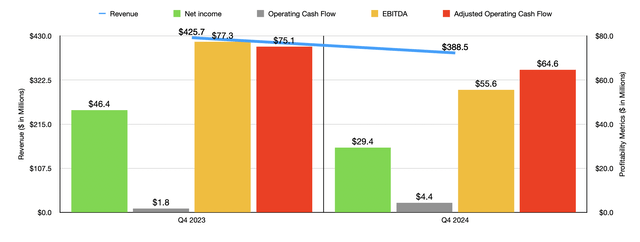
The final quarter of the 2024 fiscal year was both positive and negative for Boot Barn Holdings. Sales, for instance, came in at $388.5 million. This is negative because it represents an 8.7% drop from the $425.7 million generated just one year earlier. However, this does require some adjustment. The same quarter last year had an extra operating week. Without this, revenue would have declined by only 2.2% year over year. This came in spite of an increase in the number of locations in operation from 345 to 400. And it was driven by a decline in same store sales amounting to 5.9%. Even ecommerce revenue took a hit on a same store basis, dropping by 7.6% year over year. Despite this pain, revenue actually came in $3.4 million higher than what analysts expected. So as far as the market is concerned, this was a net positive.
Boot Barn Holdings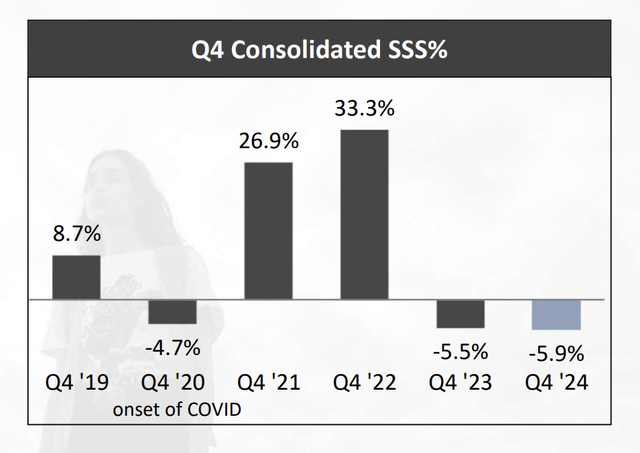
On the bottom line, we saw something very similar. Earnings per share plummeted from $1.53 to $0.96. This translated to a decline from $46.4 million to $29.4 million when it came to net profits. However, earnings per share exceeded forecasts by $0.07, while adjusted earnings per share of $1.01 beat forecasts by a hefty $0.12. Obviously, the drop in revenue contributed to this. However, the company also saw a contraction in its gross profit margin from 36.6% to 35.9%. And that was largely the result of 230 basis points of deleveraging when it came to buying, occupancy, and distribution center costs, all related to the decline in revenue. The picture would have been even worse had it not been for a 160-basis point improvement that the company experienced when it came to merchandise margin that was driven by reduced freight expenses and supply chain efficiencies.
Author – SEC EDGAR Data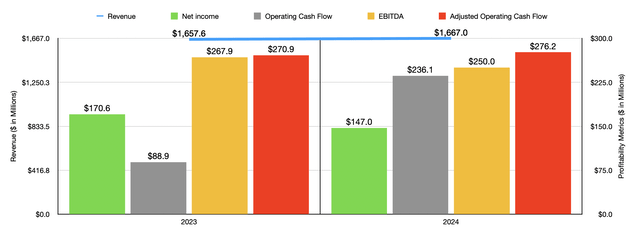
Most other profitability metrics worsened during this time. The one exception to this was operating cash flow. It managed to jump from only $1.8 million to $4.4 million. But if we adjust for changes in working capital, we get a decline from $75.1 million to $64.6 million. Over the same window of time, EBITDA for the company fell from $77.3 million to $55.6 million. It is worth mentioning that, with the exception of revenue and adjusted operating cash flow, the 2024 fiscal year in its entirety relative to the 2023 fiscal year looked a lot like the final quarter. As you can see in the chart above, revenue actually increased slightly during this time, driven mostly by a rise in store count that more than offset a 5.6% drop in retail same store revenue and a 10.6% decline in ecommerce same store sales. Total same store revenue was down 6.2% year-over-year as a result. Net profits and EBITDA took a hit year over year, while operating cash flow and adjusted operating cash flow improved.
Boot Barn Holdings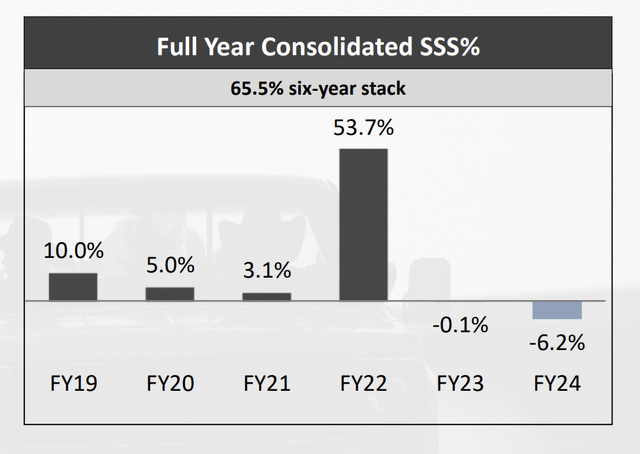
Normally, results like this would push a stock up. However, management provided some lackluster guidance for the 2025 fiscal year. Revenue should come in at between $1.766 billion and $1.80 billion. That would represent, at the midpoint, an increase of 7% compared to what the company saw for the 2024 fiscal year. However, this should only be because of an increase in store count, with 60 additional stores expected to be added to the firm’s network throughout the year. Same store sales should actually fall by between 1.6% and 3.6%. That should be driven in large part by a decline in retail same store sales of between 2% and 4%. Net profits, meanwhile, should be between $140.2 million and $149.3 million. The midpoint here of $144.8 million would represent a modest drop from the $147 million reported for 2024. Management has not provided guidance when it comes to other profitability metrics. But if those change at the same rate that net earnings are expected to, we should expect adjusted operating cash flow of about $272 million and EBITDA of somewhere around $246.2 million.
Boot Barn Holdings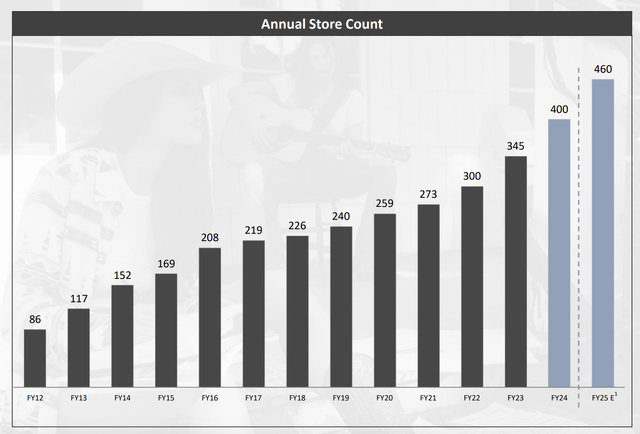
In the near term, the company is definitely facing some issues from a same store sales basis. Management definitely needs to find some way to correct that. In the long run, this won’t do shareholders anything other than cause pain. However, the company does seem fixated on a different strategy. And that is to focus more on physical expansion. After all, back in 2012, the company had only 86 stores spread across eight different states. It now has 400 locations in 45 states. Management wants to continue growing this, with the goal of increasing the store count to roughly 900 locations by the year 2030.
Boot Barn Holdings Boot Barn Holdings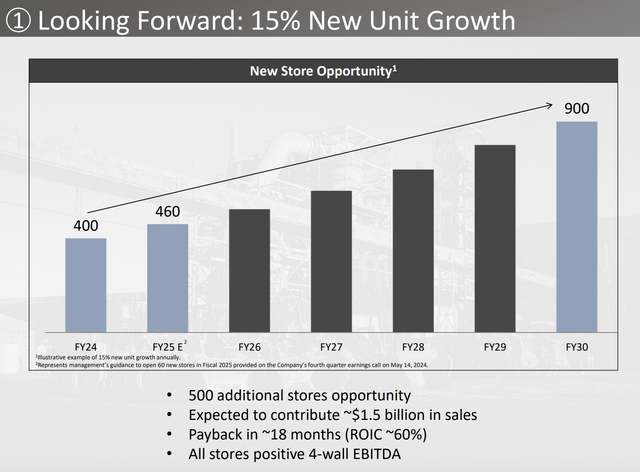
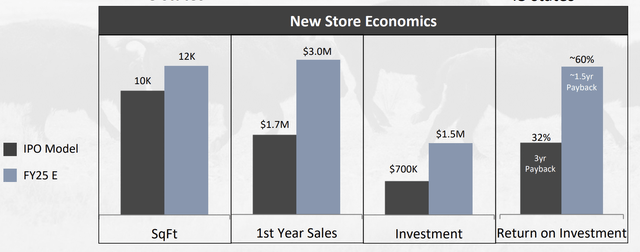
The addition of 500 new stores would have an expected contribution of $1.5 billion in additional revenue for the company. This strategy is not as good as ensuring that same store sales increase. However, with management estimating that new stores will have a 1.5 year payback period, it’s understandable why the company is so interested in growing its physical footprint. It is also worth noting that the company has so far succeeded in growing to its current size while maintaining a net cash position. That number today is $75.8 million. So in all likelihood, internally generated cash flows will allow it to continue this kind of growth moving forward.
Author – SEC EDGAR Data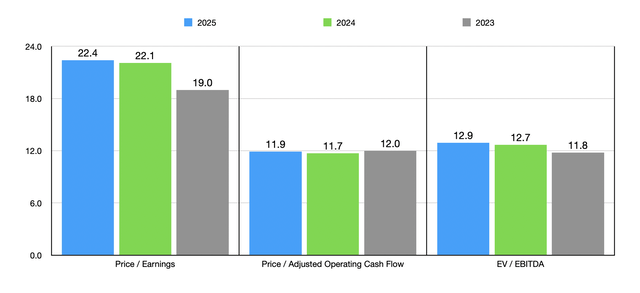
Using the historical results from 2023 and 2024, as well as the estimates that I detailed above for 2025, it becomes easy to value the company as shown in the chart above. To me, these multiples make the company look more or less fairly valued. However, when compared to five similar firms as shown in the table below, the stock does look pricey. Four of the five companies ended up being cheaper than it on a price to earnings basis. All five ended up being cheaper when using the other two profitability metrics.
| Company | Price / Earnings | Price / Operating Cash Flow | EV / EBITDA |
| Boot Barn Holdings | 22.1 | 11.7 | 12.7 |
| The Buckle (BKE) | 8.9 | 7.7 | 5.8 |
| Guess? (GES) | 9.4 | 5.5 | 4.9 |
| Abercrombie & Fitch (ANF) | 21.9 | 11.0 | 9.3 |
| Urban Outfitters (URBN) | 13.8 | 7.8 | 6.9 |
| American Eagle Outfitters (AEO) | 28.7 | 8.4 | 7.4 |
Takeaway
Even though I am not a huge fan of retail, I do like niche retailers like Boot Barn Holdings. But just because I like the company doesn’t mean that I can be optimistic about it and its future. I suspect that, over the long run, revenue, profits, and cash flows, will all increase nicely. But given how the stock is currently priced and the challenges that it faces from a same store sales basis, I think that a ‘hold’ rating still makes the most sense.
Credit: Source link









