

stevecoleimages/E+ via Getty Images
ACCO Brands (NYSE:ACCO) is a manufacturer of consumer products largely focused on office and school environments, as well as certain electronic products which serve those markets and extend beyond into gaming. ACCO’s primary historical feature from an investment standpoint is as a perpetual value stock – regardless of cash flows and earnings, the company’s shares have always been cheap from an objective standpoint. We’ve previously argued that a key factor for this perpetually low valuation was the company’s longstanding track record of wasting shareholder assets on questionable acquisitions which ultimately yielded little in terms of revenue, profitability, or intrinsic value.
Indeed, our last article on the company – in June 2021 – expressed our view that management was uniquely capable of wasting the company’s cash flows on poor acquisitions that had generated no significant benefits for shareholders despite hundreds of millions in acquisition costs. The article was met with a handful of comments from more optimistic investors, less skeptical of the company’s prospects – including one bold prediction that the shares would trade up to $12.00 to $15.00 by the end of 2022 while shareholders were “paid to wait.” We were skeptical of the expectation, based on our view that there was little reason to expect a valuation reassessment without fundamental change at the company. Indeed, not only did a rebound in share price fail to materialize – the shares traded essentially flat for the balance of the year before embarking on a steady decline throughout 2023 – but we also suspect that the interim dividends were of little consolation.
The long-overdue departure of Boris Elisman, the company’s CEO for a decade, does mark a significant potential shift and removes what we consider the primary impediment to improved valuation. The nearly $800 million spent during his 10-year tenure as president and chief executive officer – which yielded essentially nothing for the company and even less for shareholders – may be a thing of the past. The company’s new management, though still sourced from within the firm, has so far set forth a trajectory which is markedly different than during Mr. Elisman’s tenure with a stated renewed focus on debt reduction, transformation, and organic growth leveraging internal product development and cross border marketing of existing brands and products. In fact, the company’s long-term leverage ratio goal of 2.0 to 2.5 would represent a material shift in the company’s use of free cash flows, capital structure, and possibly in the valuation of the firm’s shares.
We’ve since revisited our assessment of the company given the departure of Mr. Elisman. In our view, while certain challenges remain unchanged and management’s wherewithal to follow through on stated debt reduction goals remains to be seen, there is more reason to believe that ACCO may be embarking on a new course than was the case in prior years. We are taking management’s commitment with a grain of salt until further progress is made on debt reduction but, for the first time, have determined that ACCO does present an opportunity for more risk tolerant investors. Contingent on management following through with a concerted debt reduction approach – and assuming the company’s underlying business does not deteriorate faster than expected, it is not unreasonable to expect appreciation of the shares to around $6.00 to $7.00 – a 20%-40% increase – within the next two years even assuming ongoing modest revenue erosion. In the event the company can stabilize and grow revenues next year, this range could well prove too conservative.
ACCO doesn’t need to achieve significant feats in order to generate such compelling returns for shareholders – or event to exceed them. Indeed, arguably the company needs to do very little in order to do so beyond avoiding a return to the cash flow bonfire that defined much of the last 10 years.
A Financial Summary
ACCO Brand has long been on the value list, although experience has demonstrated it to be a value trap despite generating notably substantial free cash flows over the last decade. In fact, between 2014 and 2019, the company averaged annual free cash flow per share of $1.44 per year. The company’s shares briefly reached nearly $15.00 per share in 2017 and 2018 – their highest levels since 2006 – but for most of this period of time the company’s free cash flow yield was solidly in the double digits and sometimes exceeding a rare 20%.
In large part, this perpetual discount is associated with the significant waste of free cash flows on largely ineffective acquisitions. In the last 10 years, ACCO spent $790.4 million in cash on acquisitions – nearly 58% of free cash flows over the period. In the same period the company reduced debt by a net $95.3 million, although virtually all of that net reduction came in the most recent year after the departure of Mr. Elisman.
Winter Harbor Capital, L.L.C.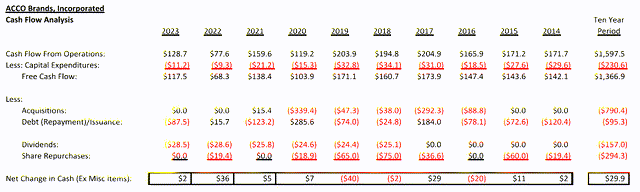
The $790.4 million translates to roughly $7.60 per average share outstanding over that 10-year period – a substantial percentage of the share price in 2014 and far more than the share price at the end of 2023. It’s worth asking what the company received as a result of those cash expenditures, and the answer, as summarized by the following table, is less than stellar.
Winter Harbor Capital, L.L.C.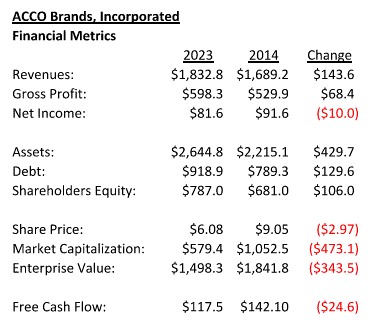
Indeed, over the 10-year period, the company underperformed on virtually every important metric. Revenues and gross profit increased marginally, as did assets and shareholders’ equity, though largely due to accumulated goodwill and intangibles. However, net income (after adjusting for impairment and restructuring costs), free cash flow, share price, market capitalization, and enterprise value all declined significantly over the same period. Importantly, market capitalization and enterprise value both declined more than the value of the company’s share repurchases over the same period, such that the company didn’t simply tread water but actually lost value. We’d argue that shareholders should have expected far more for $790.4 million.
We acknowledge that it would be unfair – at least slightly – to lay full blame on Mr. Elisman for this performance. ACCO’s office oriented business has been in secular decline for some time, although the rate of erosion has been inconsistent. A portion of the overall decline in performance could reasonably be associated with the ongoing challenges in its core markets. However, we do attribute substantial fault to Mr. Elisman as this does not excuse the burning of free cash flows on acquisitions which have consistently turned out to be underperformers.
A Lingering Acquisition Disaster
Arguably, this laying of fault is exemplified by Mr. Elisman’s last material acquisition and, we would argue, most recent disaster. In 2021, we were skeptical about the rationale and timing of the company’s acquisition of gaming accessory maker PowerA. The company did not strike us as complimentary to virtually any of the company’s existing products or within the company’s then existing competencies. The subsequent performance has confirmed our initial perspective.
PowerA has been an unmitigated disaster for the company, despite a promising initial year under the ACCO umbrella. PowerA’s annual revenues were expected to approach $200 million in 2020, the year the company was acquired for approximately $339 million. In 2021, ACCO’s annual report stated that PowerA’s revenue contribution was $249.6 million, representing growth of nearly 25%, representing roughly half of the company’s total tech accessory category revenue of approximately $506.3 million. In contrast, ACCO’s annual reports have been noticeably silent about PowerA’s specific contribution to the top and bottom lines over the last two years, although we can get a sense of performance based on the company’s tech accessory disclosures.
In 2022, ACCO reported that tech accessory revenues – which also include the company’s legacy Kensington brand – were 21% of revenues ($409.0 million) and fell to 17% of revenues in 2023 ($311.6 million). In essence, tech accessory revenue declined approximately 20% in 2022 and another 25% in 2023. Clearly, the acquired business has collapsed (or perhaps held up while the Kensington business collapsed, though we suspect this is not the case) such that category revenues are barely more than PowerA’s total reported revenues in 2021.
Moreover, it’s notable that the revenue loss over the last two years in the tech accessory category exceeds the total decline in ACCO’s revenues over the same period. In other words, ACCO’s other business actually grew (thought barely) over the same time frame as the tech accessory division saw revenues crater nearly 40%.
Winter Harbor Capital, L.L.C.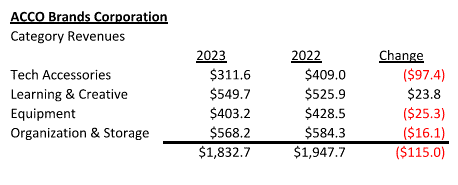
New Management on Probation
It’s for these reasons that we consider the departure of Boris Elisman to be a potentially significant material change for the company – or at least one significant enough to warrant revisiting our earlier assessment. The company’s new management – which still comes from within the company and therefore is not wholly without connection to prior leadership – has so far appeared to emphasize placing the company and a different – and much more viable – trajectory. The indications are primarily an elevated focus on debt reduction and rationalization of the business. Actions speaking louder than words, this includes at least in the first year follow through in terms of the commitment of free cash flows to debt reduction and the closing/consolidation of certain manufacturing and distribution facilities. We’re also encouraged by management’s explicit goal of reducing the company’s leverage ratio, over time, by roughly 50% to a range of 2.0 to 2.5. We’d prefer an even lower leverage ratio given the nature of the business, but we’ll set that aside for the moment.
Moreover, the company’s recently closed manufacturing and warehouse property in Sydney, New York is currently listed for sale through Cushman & Wakefield. The complex consists of approximately 757,000 square feet (300,000 manufacturing, 380,000 distribution/warehousing, and ancillary office space) over 45 acres which makes it difficult to find comparable industrial properties in the region from which to develop a potential sale price for the property. However, our expectation is that the property, if sold in a single transaction, could yield somewhere between $20 million to $40 million. A valuation in this range would result in a rather low price per square foot, which we believe is not unlikely given the size of the facility and its unusual location. Regardless, the potential sale of the property for any significant amount of cash would allow the company to further reduce debt – an expectation on our part and, in our view, a potential test of management’s commitment to debt reduction.
We’re less certain what economic benefit the company may realize from its owned property in Portugal, which is also scheduled to close in 2024 and, presumably, also subject to sale. The property is a single story manufacturing building with approximately 65,000 square feet per our estimates so we don’t expect anything particularly material from the liquidation of this location given the relatively small size of the building. Nonetheless, any potential proceeds could still also contribute to debt reduction.
Still, despite the positive initial signs, we consider the company’s new management to remain on probation as it’s not yet entirely clear that the company as a whole has broken from past experience. In his departure announcement, Thomas Kroeger, the independent lead director, stated that “we would like to thank Boris for his exemplary leadership and dedicated service as CEO. Boris’s innumerable contributions during his 18-year tenure, the last 10 leading the Company as CEO, have successfully expanded the growth opportunities for the Company.”
This is demonstrably false. As noted earlier, over the last 10 years the company has spent nearly $800 million in cash on acquisitions which have yielded essentially no long-term results or, at best, served to offset decline in other parts of the business – not exactly indicative of successfully expanding the growth opportunities for the company. The most recent acquisition of PowerA, also as discussed earlier, has also not yielded significant new growth opportunities.
Clearly, there is an element of politeness in such statements, but at the same time, it is necessary that the company and the company’s leadership, including the board, fully recognizes and understand the disaster which characterized the last 10 years of Boris Elisman’s leadership.
A Sense of Déjà vu?
The recent moves at ACCO mildly remind us of a similar series of events a few years ago at another small manufacturer – LSI Industries (LYTS). In the years prior to new management joining LSI, the company had been making various acquisitions – some quite questionable – in a vain attempt to overcome deterioration in the balance of the business. The trend was not especially different from past events at ACCO. LSI’s new management subsequently refocused the company on improving existing business lines, restructuring legacy businesses by aggressively closing and consolidating facilities, selling excess real estate, and reducing debt, all while supporting a robust and reasonably well-supported dividend. In 2018 and 2019, when we wrote favorable articles on LSI Industries, the company’s shares were trading in the range of $4.00 to $5.00, having come down from the low teens in prior years, and paying a dividend of around 4.5%. The company had been an underperforming industrial manufacturer much like ACCO has been, although in a different industry. The significant changes ultimately led the company to becoming almost debt free and saw the shares rise as high as $16.00 per share for a compound annual return exceeding 20% since the publication of our articles.
The parallels with ACCO are not exact on every measure. LSI primarily operates in a growing industry (lighting and lighting controls) with a large proportion of the company’s revenues driven by large contracts with owners implementing similar systems across many locations. In addition, LSI had a larger portfolio of disparately owned manufacturing and warehouse real estate, which could be consolidated and sold to generate substantial cash for debt repayment. In contrast, ACCO’s real estate holdings are more limited, thus reducing management’s ability to right the business through real estate sales alone. LSI’s debt load was also less than is the case for ACCO making the ability to pay off essentially all the company’s long-term debt in a relatively short period of time (with concerted effort) more achievable. Finally, LSI’s board and management made a more defined and intentional change in fundamental direction and tone with the management change than has so far occurred at ACCO.
Nonetheless, we see the potential for a material change in ACCO’s direction along the lines of that which occurred at LSI Industries. ACCO’s resent moves to close and consolidate a handful of facilities, though more limited, should nonetheless improve the company’s capital structure and operating margins. The stated refocusing on organic growth and dedication of cash flows to debt reduction over acquisitions is also a welcome sign that management intends to be more responsible with shareholder funds going forward. Debt reduction will in turn contribute to higher net income and cash flows, as higher interest rates have pushed net interest expense to 32% of the company’s adjusted operating profit. A halving of interest expense alone would boost earnings per share by around $0.17 – not insignificant for a company with core earnings per share (on a GAAP basis) of around $0.80 and a share price near $5.00. Essentially, a focus on debt reduction alone could over time boost earnings per share by 20% with all else remining equal.
Dividends
A focus on debt reduction – and a high dividend yield – often leads to questions surrounding the sustainability of a company’s dividend. The same question occurred at LSI Industries and for essentially the same reasons we were confident that LSI could sustain its dividend through its transition, so we are similarly confident that ACCO can also sustain its dividend provided the core business does not fall off a cliff.
ACCO’s annual expenditure for dividends is approximately $28.5 million per year, a relatively small fraction of the company’s earnings power and free cash flows. Indeed, the dividend represents only about 25% of the company’s annual free cash flows (including our forward free cash flow projections) leaving significant margin for debt repayment while maintaining the current dividend.
We are thus not concerned about the dividend for the time being, barring a significant drop in annual revenues, i.e., exceeding 10% over the next two years.
Projections
Our confidence in the sustainability of the dividend is based on our forward projections for the company based on our financial models.
On balance, our financial models focus on base valuation and potential downside risk. Our models therefore generally anticipate continuing erosion in revenues, relatively stable gross, and operating margins, which are slightly more pessimistic than suggested by management’s most recent guidance. We anticipate a continued emphasis on debt reduction for at least the next two years (and ideally beyond) consistent with management’s stated long-term target leverage ratio. In addition, we performed projections incorporating more severe revenue erosion than projected by management as well as more pessimistic gross margin and operating margin results to estimate at what point revenue declines would place the company’s emphasis on debt reduction – and potentially the dividend – at significant risk.
Our baseline projection (including amortization expense and excluding any additional goodwill impairments or restructuring charges) for both 2024 and 2025 is between $0.76 and $0.82 per share. We project free cash flow for each year will range between $105 million and $115 million, which is slightly below the company’s stated forward expectations. In addition, based on these values, our baseline projection for net debt reduction over the next two years is approximately $180 million assuming a relatively stable working capital position and without any contribution from real estate sale proceeds. A brief summary of our model projections based on various scenarios (including midpoint values) is reflected in the following table:
Winter Harbor Capital, L.L.C.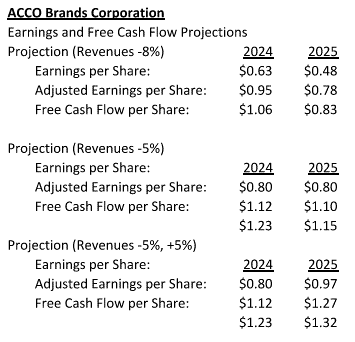
In addition, while earnings per share, free cash flows, and debt repayments are impaired, we don’t see significant risk to the dividend until revenue declines approach approximately 12% per annum. In this case, dividend payments could still be made based on free cash flows although the payout ratio would potentially exceed 100%. In this case, the low end of our projected earnings per share is approximately $0.20 to $0.25 in 2025. This is not outside of the range of possibilities for the company, especially given management’s own admission in the most recent earnings call that revenue trends are trending lower than their expectations at the beginning of the year. However, it would represent a significant additional deterioration in revenues beyond recent experience and would need to persist into 2025.
Unusually, we did not perform extensive assessment of potential positive revenue and operating result outcomes in our sensitivity analysis, as we would typically do to establish a valuation range. The reason in this instance is due to the fact that virtually any operating outcome which exceeds our base case of revenue decline in the range of 5% to 8% and stable gross margins (unless cost reductions fall well short of the company’s objectives) only results in significantly higher earnings and valuation outcomes versus, as we discuss next, is an already compelling potential return.
Valuation
We approach valuation from various perspectives to develop a holistic viewpoint. In the case of ACCO, we consider the twofold challenge of developing a credible valuation for the company. First, the company’s historical performance has been varied, at best, which makes forward projections for the company’s performance highly uncertain and incorporates an inherent discount to the market price which can be difficult to estimate. Indeed, the company’s own management has at times struggled to develop accurate projections for the business, initially anticipating revenue a decline for 2024 of 5% which was revised to a more significant decline of as much as 7% in the most recent earnings call.
Second, ACCO has not historically traded in a manner where the simple application of common valuation multiples provides a convincing forward valuation. The price/earnings ratio has varied widely over the last several years, as have measures such as free cash flow yield, etc. On these measures, the company has often appeared cheap (though not necessarily inexpensive) and actual results have proven the unreliability of simply applying valuation multiples. The reasons are various, including not just the company’s uneven operational performance and high debt load but, we would argue, a discount associated with past management’s failures. Moreover, in the event new management reverses some of these issues, past valuation multiples may not reasonably reflect future valuation multiples.
Still, some benchmark is required and given the above, we have approached developing a valuation based on management’s emphasis on debt reduction. In order to assess the potential forward value of the shares, we have therefore assumed that the company’s enterprise value remains constant and assessed the potential impact on share valuation of debt repayment based on free cash flows developed in our financial models. On this basis, we estimate forward valuations as shown below:
Winter Harbor Capital, L.L.C.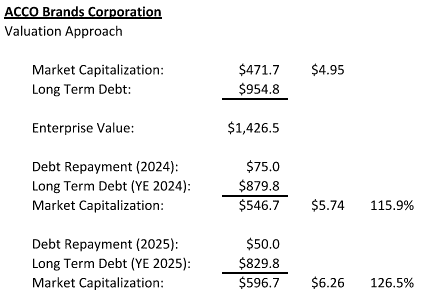
A slightly less pessimistic perspective on revenues, i.e., annual declines of 5% instead of 8% suggests higher valuations as debt repayment is accelerated, as shown in the following table:
Winter Harbor Capital, L.L.C.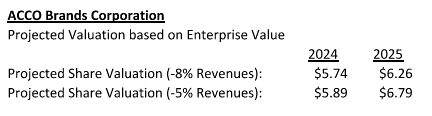
Notably, our valuation expectations don’t rely on a significant increase in many of the company’s enterprise valuation metrics (or any increase for that matter). This approach simply assumes that debt value is essentially converted to equity value on a one-for-one basis as debt is repaid by the company. We should note that while these are point estimates, they are generally the midpoint of valuation ranges developed through our financial models.
In terms of valuation ratios, ACCO already trades well below many peer institutions, its own historical multiples, and the broader sector. The repayment of ~$80 million per year in debt alone should add significantly to the share value, even with a consistently below average EV/EBITDA ratio.
In this analysis, we also ignore for the moment any potential valuation impact from corporate debt tax shields with respect to capital structure for a couple reasons. The first is avoiding overcomplicating an otherwise straightforward analysis. The second is that while the loss of corporate debt tax shields associated with debt payoff may impact enterprise value and thus equity value, the impact is likely immaterial and, moreover, may actually positively impact valuation as there is a strong argument to be made that the company’s debt level relative to operating performance and revenue trajectories is excessive, and thus the company is beyond what the market would consider the optimal debt level.
However, the market will likely take time to recognize the shift of value from debt to equity via repayments until it’s clear that the company’s new management is committed to a different operational approach than has been the case for the last decade. We would not be surprised to see the company’s EV/EBITDA ratio continue to decline in the immediate future as a result of debt reductions in the face of ongoing depressed share valuation. However, barring a significant change in the fundamentals of the underlying businesses or management’s return to questionable acquisitions, the valuation should adjust in time.
In terms of downside risk, while we would argue that the above methodology presents a still rather below average valuation for the company, additional declines cannot be ruled out. In the event that revenue performance came in at the low end of our stress analysis, it’s not inconceivable that shares could trade down in to the range of $3.00 based on our estimates with no offset for limited additional debt reduction. The decline could be worse should the company elect to reduce the dividend. In this instance, the fear of bankruptcy risk, especially while debt remains high, would overtake any benefit of changes to the company’s capital structure.
A Comment on the Brazilian Real
Finally, we’d suggest the company would be well served to consider hedging its potential Brazilian tax liability in local currency. ACCO accrued a significant liability for potential Brazilian income tax claims of $44.5 million in 2012. The Brazilian real has depreciated significantly against the dollar in the interim to the point where the current accrual, including accrued interest and penalties, is now only $21.7 million. We don’t presume to predict the future value of the Brazilian real – this is beyond our expertise – but would suggest an argument could be made to hedge the potential liability and eliminate a part of the potential impact should the real appreciate given the company’s other myriad challenges.
Conclusion
We’ve long followed ACCO due to the notably low (and persistent) valuation over the years, although our skepticism of the company (and in particular its leadership) has always kept us on the sidelines. Our concerns proved well-founded, as the ongoing trend of wasting shareholder funds on acquisitions yielding little long-term value has caused the shares to decline by nearly half since our last article.
However, the long-overdue departure of Boris Elisman and new management’s emphasis on debt reduction has caused us to reevaluate our position. A significant impediment to the company’s appeal has been removed, and the promise of a commitment to debt reduction in coming years adds to the appeal. The company reduced long-term debt by $87.5 million in the last year and appears ready to repay a further $80 million in net debt during the year ahead. If so, this would mark a significant (and welcome) shift from past experience.
Still, the company’s new management team must still demonstrate the strength of their newfound commitment to debt reduction and better stewardship of shareholder assets and cash flows, and our revised perspective relies on the veracity of their intentions. It’s critical to emphasize that our revised assessment is dependent on management remaining committed to debt reduction. A material deviation on the part of management from that focus would represent a material change in the fundamental nature of the company and significantly change our perspective. Ultimately, time will tell whether recent events warrant our present cautious optimism tempered by our years-long observation of the company from the sidelines and an acute awareness of the company’s inherent and ongoing challenges.
Nonetheless, in combination with the rock bottom valuation by virtually any measure, reasonably secure dividend, and (to date) demonstrated commitment to debt reduction, we have positively adjusted our perspective on the company and established a modest position in ACCO. Barring a significant collapse in the underlying business or management’s return to spendthrift ways, it’s difficult to see many plausible outcomes that are not positive for shareholders at this point.
Credit: Source link