
Alistair Berg/DigitalVision via Getty Images
I. PACCAR Has Had A Heck Of A Run
PACCAR (NASDAQ:PCAR) shareholders have done spectacularly well since the turn of the century, both in absolute terms, and when compared to inflation adjusted Real GDP, Nominal GDP, and to the overall stock market as measured by the S&P 500 (SPX).
Chart 1: Growth of $10,000 May 11, 1984 – May 7, 2024
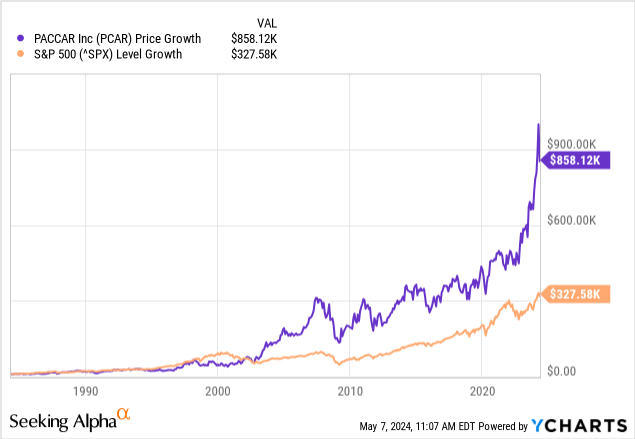
Chart 2: Total Growth US GDP – May 11, 1984 – May 7, 2024
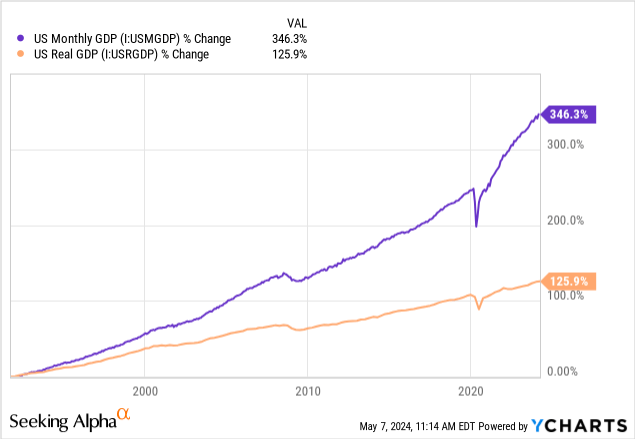
This performance is particularly impressive in light of two secular trends that have been in place over the past 40 years. The first trend is the digitalization of many industries. Snail mail no longer comprises 100% of personal and business correspondence and DVDs and CDs are no longer shipped via trucks to stores – songs and movies are streamed to consumers.
The second trend is the growth of the service sector, especially in low-income countries. The vehicles PACCAR manufactures are used to carry goods such as coal, iron, and televisions. They do not carry services such as haircuts, legal opinions, or articles on Seeking Alpha.
Table 1 shows how the service sector has grown in various countries over time. To put it in perspective, Year Over Year GDP Growth of 10% in China would have resulted a 6.76% increase in the value China’s goods in 1990, but only a 5.58% increase in 2010, and 4.55% in 2020.
Table 1: Growth of the Service Sector*
World Bank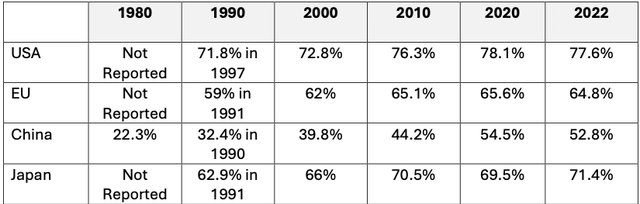
* Source: World Bank
PACCAR’s impressive performance has continued, and over the last ten years its shares have appreciated by approximately 2.5 times the amount that AB Volvo’s (OTCPK:VOLAF) shares have, and nearly double the amount of the S&P Transportation Select Industry Index. The SPTSI is comprised of companies that are customers of PACCAR (i.e. Trucking Companies), or companies in the Rail Passenger & Freight, Air Passenger & Freight, and Marine Passenger & Freight industries that compete with PACCAR’s customers.
Chart 2: Price Return – May 8, 2014 – May 7, 2024
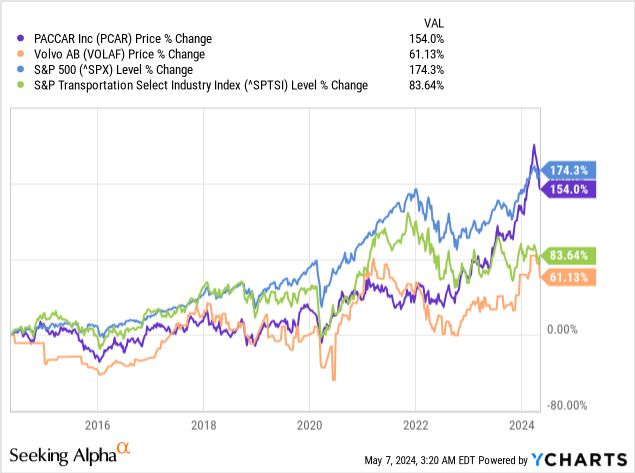
As per Table 2, the bulk of this outperformance has happened in the past five years. In fact, PACCAR’s shares were basically flat for the period 2014 to 2019, and all of its 10-year total price appreciation of 154% has occurred in the past 5 years. Note, December 10, 2021 is the date that Daimler Truck Holding AG (OTCPK:DTRUY) first traded on the Frankfurt Stock Exchange.
Table 2: Price Return – PACCAR vs Select Companies and Indices
Seeking Alpha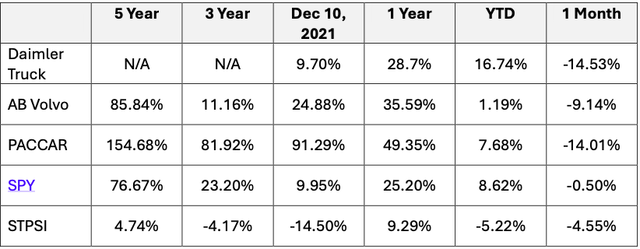
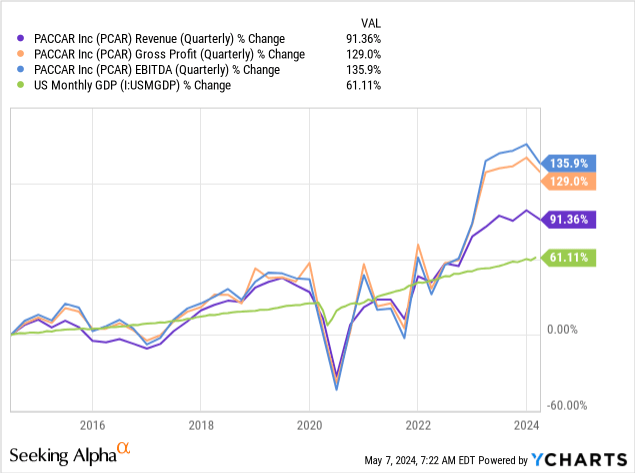
PACCAR has been rewarded by the stock market because it has done a good job of growing its revenues faster than the economy as a whole. As would be expected in an industry with operational leverage (a large proportion of total costs are fixed), this has led to improved margins, with both EBITDA and Gross Profits growing by approximately 130% over the past 10 years, compared to total revenue growth of 90%.
Chart 3: Income Statement Date 2014 – 202 4
II. The Next Ten Years Won’t Be Like The Last Ten Years
1) Exponential Growth Can’t Continue Forever
I learned in a Middle School Science class that animal populations can’t grow exponentially forever. A surplus population of rabbits can lead to an increased number of predators such as wolves in the short term. However, unless that growth decelerates to a constant equilibrium rate, eventually the increased number of wolves will decimate the rabbit population, and the wolf population will crash because there is no longer sufficient food.
PACCAR isn’t a predator, so the comparison isn’t perfect, but there are still parallels. As per Chart 1, from 1984 to 2004, the price of PACCAR’s shares grew at a rate that closely tracked the growth rate of nominal GDP. Over the next 5 years, there was significant outperformance before the Credit Crunch hammered all equities. As per Table 2, PACCAR’s shares were flat from 2014 to 2019, before gaining 154% from 2014 to the present. One third of this growth, or 49%, has taken place in the last year, even after a 14.5% sell off over the last month.
PACCAR’s Revenue has grown much faster than the economy as a whole (90% versus 60%), even factoring in inflation and ignoring the fact that not all of the growth in the economy is in the goods sector. Growth has been driven by PACCAR’s aftermarket parts and financial services businesses, both of which have higher margins than its core truck business. On its 2024 Q1 Earnings Call, PACCAR stated that, “We anticipate second quarter margins to be strong and in a range of 18% to 18.5%. PACCAR Parts had an outstanding first quarter with parts gross margins of 32.5%“.
PACCAR’s growth appears to have come, at least in part, at the expense of its customers because the S&P Transportation Select Industry Index has grown by less than 1% per year over the past 5 years, and it has actually decreased by 4.74% over the past 3 years. At some point, PACCAR’s customers will be unable to pass through their increased costs to their own customers.
On April 30, 2024 PACCAR reported its Q1 Results. Revenue of $8.74 billion and net income of $1.2 billion were comparable to revenue or $8.47 billion and adjusted net income of $1.18 billion in the first quarter of last year. Going forward, the average of 22 Wall Street Analysts’ forecasts for 2024 Q2 and Q3 Revenue are $8.11 billion for Q2 (versus $8.88 billion for Q2 ’23) and $7.61 billion for Q3 (versus $8.7 billion for Q3 ’23).
Nothing goes up in a straight line forever, and the question has to be asked, is this just a blip, or is it the start of a long-lasting trend?
2) The Move To Zero Emissions Is A Threat, Not An Opportunity
Setting aside the possibility of new entrants such as Rivian (RIVN), which I don’t expect will last the course, BEVs threaten PACCAR in the following ways.
a. Significant capital has to be both raised and invested in R&D, Design, Re-tooled and New Factories, and Associated Infrastructure. The industry appears to be responding by forming Joint Ventures in order to preserve capital and reduce risk.
- Greenlane is a $650 million Joint Venture between BlackRock, NextEra Energy, and Daimler Truck North America, that aims to build a nationwide network of battery charging and hydrogen feeling stations.
- Daimler North America, PACCAR, and Accelerate (the clean energy arm of Cummins (CMI)) have formed a Joint venture to manufacture batteries for the North American market. Each company will own 30% of the Joint Venture, and Eve Energy, a leader in the manufacture of lithium iron phosphate (LFP) batteries, will own the remaining 10 percent. In January of this year, it was announced that a 21 GWh factory will be built in Mississippi, with a 2027 target set for the start of production.
- In May of 2023, Daimler Truck Holding AG, which owns 90% of Mitsubishi Fuso, and Toyota (the owner of Hino), announced that they planned to set up a new holding company by the end of 2024 that would be equally owned by both companies. The new entity will initially collaborate on the development of zero emissions technology and global procurement, and it is envisaged that eventually Hino and Fuso will fully merge.
While JVs can spread risk and preserve capital, they can also lead to commoditization and lower margins. At the heart of every vehicle is the engine that powers it. At the heart of a BEV is the battery that powers it. A Class 8 electric Freighter made by Daimler will have the same battery as a Class 8 electric Peterbilt or Kenworth manufactured by PACCAR. Cummins sells its products to third parties like AB Volvo; ultimately, the only things left to compete on will be price and styling.
b. PACCAR’s new truck business typically achieves Gross Margins of circa 10% versus Q1 Gross Margins of 32.5% for its parts business. The drive train in an Internal Combustion Engine, or ICE, typically has 2000+ moving parts, whereas a BEV typically has a few dozen. Fewer parts mean there will be lower sales in this highly profitable segment. A simpler drive train with fewer parts that wear out also means longer lives for vehicles, which means that fleet replacements will occur less frequently.
c. Bulls believe that the move to zero emission commercial vehicles, either BEVs or Hydrogen Fuel Cell powered vehicles, will accelerate the replacement cycle of existing ICE powered trucks. This certainly is possible, but it’s just as likely that the opposite will happen. Imagine that you own a fleet of 50 Class 8 ICE semi-trailer trucks that you plan on replacing at a rate of 10 per year starting in 2025. Perhaps you might decide to delay replacing your 2025, 2026, and 2027 semis with a new ICE-powered vehicle, in order to buy BEVS when there are more charging stations, and when the technology been proven by someone else.
3) Increased Value From Self Driving Vehicles Will Flow To Customers And Software Providers.
A new Class 8 Semi-trailer truck costs between $150,000 to $200,000 on average. The median annual salary for truck drivers is $108,000, with a wide variance depending upon if the driver is employed by a company ($59,000) or if the driver is an owner operator ($324,000). Health and Safety Rules limit the maximum daily and weekly number of hours that a driver can drive, and they mandate a minimum frequency and length of rest stops. Therefore, for long-haul journeys, it is common to have two drivers who can spell each other. Self Driving software has the possibility of cutting a trucking company’s labour costs in half, as the automated vehicle can take over for 12 hours a day or more. However, the lessons of other industries are clear – Intellectual Property providers like Microsoft or Taylor Swift make the big bucks, not hardware companies like Compaq or record companies like RCA, neither of which still exist.
At the present time, the companies that are the farthest along in developing Self Driving software are Alphabet (Google) / Waymo, GM / Cruise, Baidu, and Pony.ai, all of which have Robotaxi fleets. Other automobile manufacturers such as Tesla, BWM, Mercedes, and Geely are also investing in this technology and offer less functional versions to their customers. It doesn’t appear that any Commercial Vehicle manufacturer has invested significant resources in this field. However, on the customer side, Amazon has invested billions of dollars, and it purchased Zoox for $1 billion in 2020. It may be that Amazon has aspirations of building a new Uber, but it may also be that it sees an opportunity to have Self Driving semi-trailer trucks that travel from factories to logistics centres, and Self Driving box trucks that travel from logistic centres to individual stores.
III. Conclusion
PACCAR is extremely well run, and it has been able to grow at a much faster rate than both the economy as a whole, and its customers. This growth has not been at the expense of profitability – indeed, PACCAR enjoys excellent margins due to its expansion into segments such as aftermarket parts. Accordingly, PACCAR has been an excellent investment, both over the long term, and over the past 3 years. However, no company can grow faster than its sector, or the economy as a whole, forever. Eventually, growth must plateau, and possibly even decelerate.
PACCAR, and the transportation industry in general, will need huge amounts of capital to transition to net zero CO2 emissions. This transition will be disruptive. Fewer moving parts in the drive train will adversely affect the sale of aftermarket parts, longer vehicle lives will reduce the frequency of vehicle replacements, and technological change like Self Driving software has the possibility to shift value away from manufacturers.
Despite a 15% selloff over the past month, PACCAR’s shares have risen 50% over the last year. Investors should not treat this as a buying opportunity. Rather, they should look at it as the start of a long period of underperformance and reduce their position.
Editor’s Note: This article discusses one or more securities that do not trade on a major U.S. exchange. Please be aware of the risks associated with these stocks.
Credit: Source link