
Wolterk
Almost two years ago, I wrote a bullish article on Mattel Inc. (NASDAQ:MAT), highlighting the potential of Mattel’s vast trove of intellectual property that was about to be monetized, starting with the Barbie Movie in 2023. I correctly anticipated the success of the Barbie Movie, however, since my article, Mattel’s stock has been disappointing, returning -20% (Figure 1).
Figure 1 – Mattel has fallen 20% since my 2022 article (Seeking Alpha)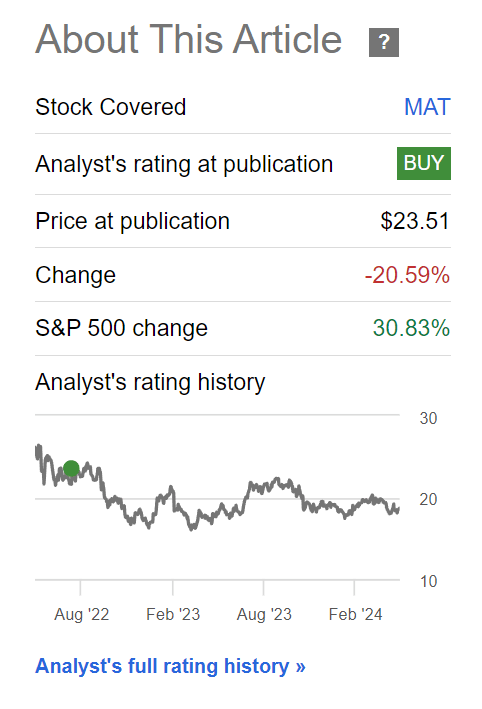
What happened, and is Mattel still a buy in my eyes?
While Barbie was hugely successful, other properties at Mattel shrank more than anticipated, leading to flat revenues and declining earnings. Looking forward, with a dearth of exciting movies until 2025, I fear Mattel will be dead money for the next few quarters. I am downgrading to a hold.
Brief Company Overview
Mattel is a leading global toy company manufacturing iconic toys like Barbie, American Girl, Hot Wheels, and many others. Historically, the toy business had been recession-resistant, with Mattel staying profitable even during recessions in the early 2000s and 2008.
However, with the macro trend towards online shopping and digital entertainment, Mattel’s core toy business has come under pressure in recent years, with the topline stagnating at ~$5.4 billion since 2021 (Figure 2).
Figure 2 – Mattel financial summary (tikr.com)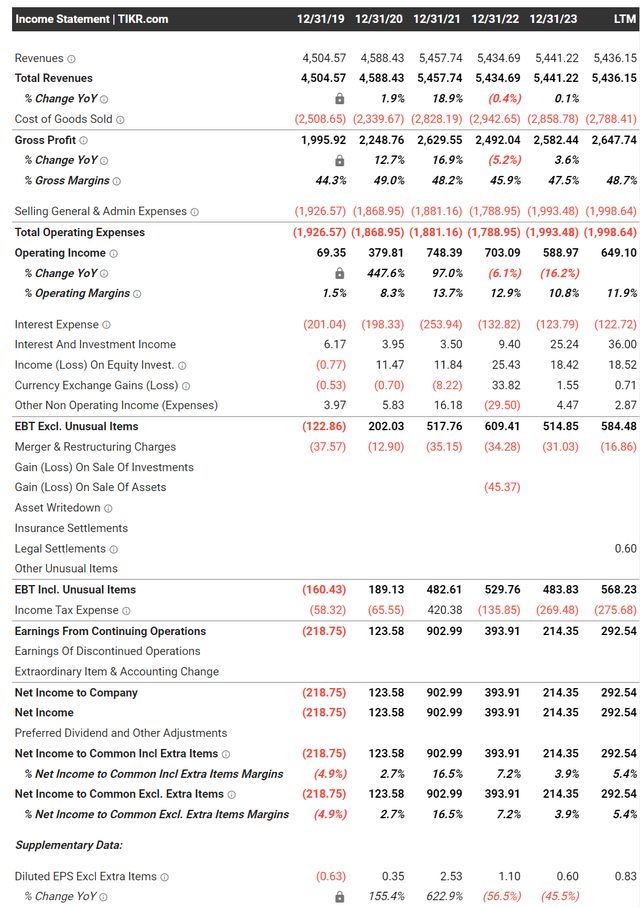
Operating income has also been stagnant, with 2023 operating income of $589 million being 21% lower than 2021’s $748 million, as higher input costs (lower gross margins) and higher SG&A take a bite out of earnings.
Barbie Movie Was A Bet On IP Monetization
As I discussed in my prior article, a key part of CEO Ynon Kreiz’s mandate was to fully monetize Mattel’s treasure trove of intellectual property (“IP”).
Mr. Kreiz was formerly Chairman and CEO of Maker Studios, a leading YouTube short-form video content creator acquired by The Walt Disney Company (DIS) in 2014, so he certainly had extensive experience with content creation.
Properly managed, IP monetization can be a huge business, with lots of tie-ins to Mattel’s existing toy business. For example, when Disney acquired Marvel Studios in 2009 for $4 billion, many analysts were concerned about the high price tag. However, by properly creating and managing a shared ‘multiverse’ for Marvel characters like Iron Man and Thor, Disney was able to turn the $4 billion investment into a movie franchise with $22.6 billion in cumulative box office receipts up to June 2021, plus countless billions in toy sales and theme park revenues.
Coming back to Mattel, a lot was riding on the Barbie Movie, starring Margot Robbie and Ryan Gosling and directed by award-winning director, Greta Gerwig. The trio did not disappoint, as the Barbie Movie was a huge commercial success, becoming the top-grossing movie of 2023 (Figure 3).
Figure 3 – Barbie was the top grossing movie of 2023 (boxofficemojo.com)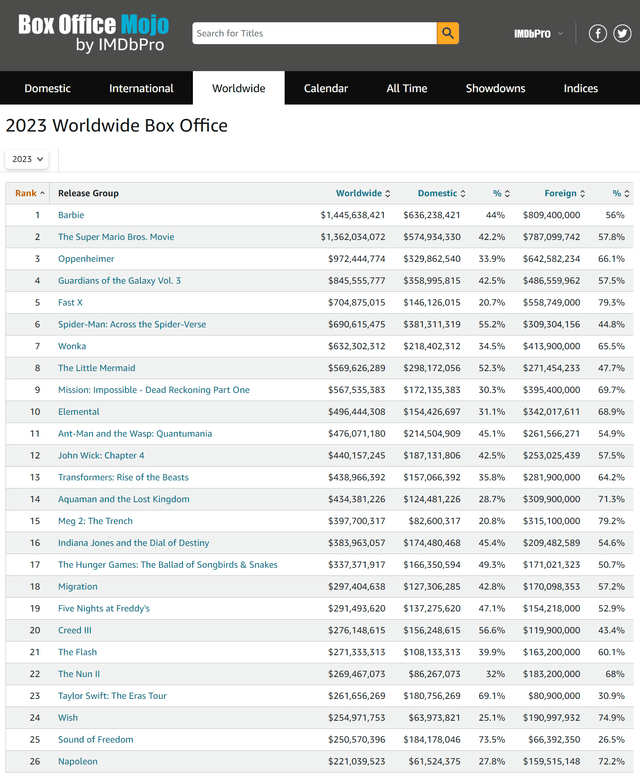
Barbie’s success spurred a resurgence in Mattel’s doll sales, with full-year 2023 doll gross billings increasing 15% YoY to $2.4 billion (Figure 4).
Figure 4 – 2023 gross billings (MAT investor presentation)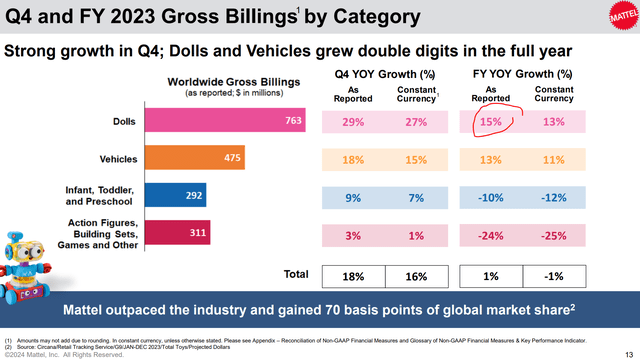
Why Was Stock Weak Despite Barbie?
Given the huge success with Barbie, why did Mattel’s stock not react more positively?
In my opinion, the key reason Mattel’s stock price had not reacted more positively in 2023 was because of the decline in other business segments. For example, while gross billings for dolls grew 15% YoY, toys for infants, toddlers, and preschoolers were down 10% YoY to $1.0 billion. Similarly, action figures, building sets, and games’ gross billings declined 24% YoY to just $1.1 billion.
Overall, despite strong momentum from Barbie, Mattel’s top line remained stagnant at $5.4 billion and operating income declined 15.4% YoY to $589 million.
Put another way, Mattel was lucky the Barbie Movie was such a commercial success, otherwise, 2023 would have been an abysmal year.
2024 Guidance Uninspiring
Looking forward, Mattel’s guidance for 2024 is also uninspiring. The company expects revenues to be flat at ~$5.4 billion with a modest 13.8% YoY increase in adj. EPS on a cost-cutting program and better gross margins (Figure 5).
Figure 5 – MAT 2024 guidance (MAT Q4/23 press release)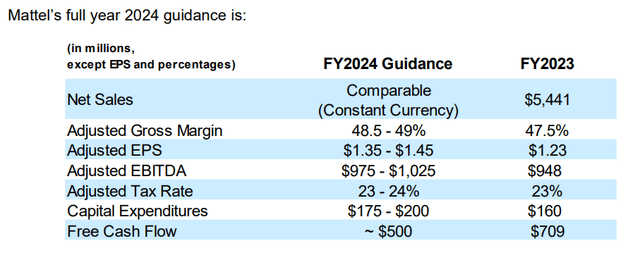
Results so far in Q1/2024 have been in line with guidance, with revenues of $810 million down 1% YoY, and adj. EPS of -$0.05 (Figure 6).
Figure 6 – MAT Q1/24 financials (MAT investor presentation)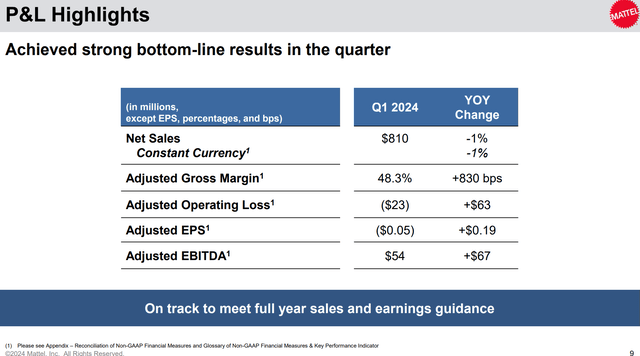
Worryingly, the Barbie halo appears to be fading, as gross billings in the doll segment fell 4% YoY in the first quarter, leading to an overall gross billings decline of 1% YoY (Figure 7).
Figure 7 – Gross billings decline in Q1/24 (MAT investor presentation)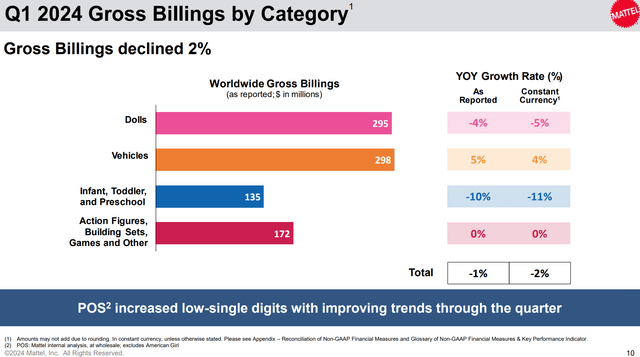
Furthermore, Mattel’s movie slate looks empty, as the vast majority of movies in development based on Mattel’s IP are slated for 2025 or later. Without new movies, there is little to be excited about with Mattel’s portfolio. It is also unknown whether these movies will enjoy a similar kind of nostalgic appeal that Barbie received.
Valuation Appears Fair For Now
With sub-par growth prospects (flat topline growth guidance), I believe Mattel is currently fairly valued, trading at 13.2x Fwd P/E compared to the sector median at 15.6x (Figure 8).
Figure 8 – MAT valuation (Seeking Alpha)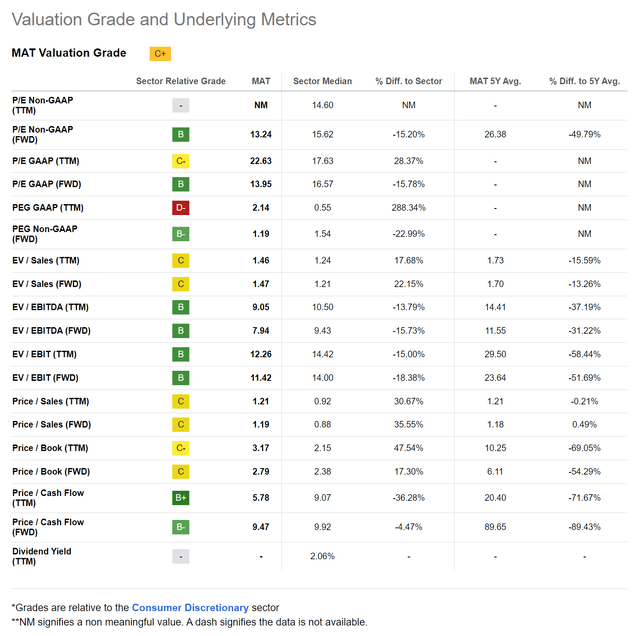
However, Mattel does trade at a valuation discount compared to its nearest rival, Hasbro (HAS) (Figure 9)
Figure 9 – MAT vs. peers (Seeking Alpha)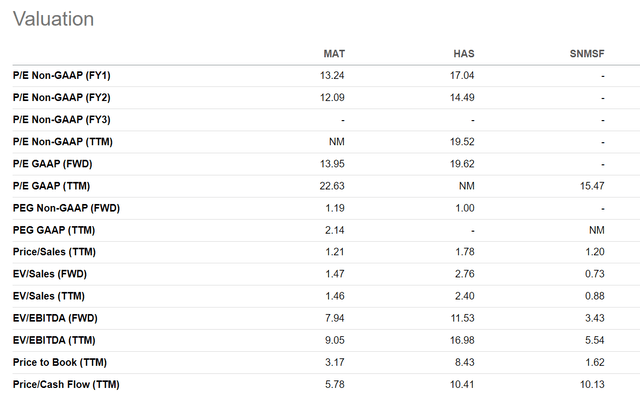
Readers should note that Hasbro faces the same industry headwinds as Mattel and is guiding the street with worse financial performance, so Mattel should arguably be valued at a premium (Figure 10).
Figure 10 – Hasbro is guiding to a revenue decline (HAS investor presentation)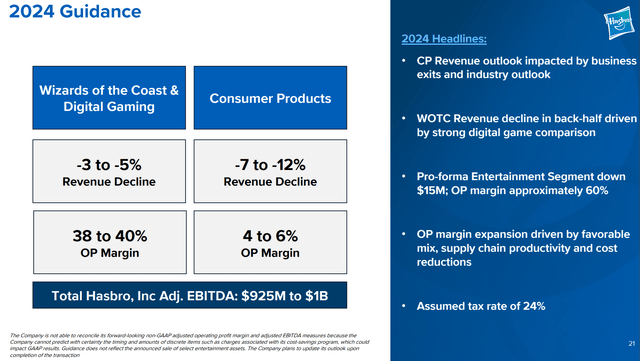
However, Hasbro does have a larger media franchise with a Transformer film releasing in the next few months starring Chris Hemsworth that could garner some near-term excitement.
Risks To Mattel
The biggest headwind to Mattel is the continuation of the macro trend towards digital entertainment. I see it with my children, they are much more interested in playing video games like Minecraft or Roblox than playing with dolls and action figures. While monetizing IP is the right move in the long-run, Mattel’s core toy business risks entering terminal decline as its consumers may no longer find their toy offerings appealing.
On the other hand, a terminally declining business can be run for cash flows and still offer fantastic financial returns, like the tobacco business. The key is whether the company has pricing power and can manage the volume declines effectively.
Conclusion
Although I had correctly predicted the commercial success of the Barbie Movie, I did not anticipate that Mattel’s other toy sales would deteriorate so rapidly as to offset the gains from Barbie.
Looking forward, with no significant movies due until at least 2025, there is not much to be excited about on Mattel. 2024 guidance is looking for a flat revenue year, with modest improvements in earnings from cost cuts. I fear the stock will be dead money for the next few quarters, so I am downgrading it to a hold.
Credit: Source link