
Monty Rakusen
This article was co-produced with Williams Equity Research.
Wall Street has been establishing its foothold in the private credit space for about 15 years now.
Its main focus has been raising capital for private Business Development Companies (‘BDCs’).
After building out the portfolios and a track record, the private BDCs eventually list on a major U.S. exchange.
I’ve written about this many times, including recently regarding Blue Owl’s latest BDC. But it’s not just Blue Owl.
Blackstone (BX) (BXSL), Apollo (APO), KKR & Co. (KKR) (FSK) and Bain Capital (BCSF) are all part of the club.
But not all BDCs are created equal.
While internally managed BDCs like Main Street Capital (MAIN) have structural benefits, there is a place for a well-constructed and run externally managed BDC.
In fact, this and mortgage REITs are the only areas where external management makes sense for publicly traded companies, in my opinion.
As some readers know, I was a due diligence officer for some of the largest broker/dealers. In that role, I got to know most of the private BDCs years before the public markets knew they existed.
Today is yet another example of how we’ll use this knowledge and experience to our benefit.
BDCs’ aggregate market value is now over $274 billion.
When I got started as a due diligence officer shortly after the Great Recession, the total value was about 10% of that figure, by my estimation. The benefit of this growth for investors is multifaceted.
Most quality BDCs are large and established enough to earn investment grade credit ratings, including today’s focus company. Because they have more scale than ever, diversification is significantly improved. Industry and individual company concentrations are carefully constructed and managed.
Of the top 10 publicly traded BDCs by market cap, half began their lives as private BDCs that I worked on in some capacity as a due diligence officer.
In some cases, that went as deep as visiting management at their headquarters and evaluating every aspect of the team, track record, legal documents, and portfolio development over time.
I’ve written articles on all of those BDCs for subscribers except the one I’m discussing today.
This BDC IPO’d recently, and even among my friends who are obsessed with BDCs, not even one knew this BDC existed until I told them about it. For the reasons listed in this article, I think it’s worth keeping on your radar.
Today’s focus company is the Morgan Stanley Direct Lending Fund (NYSE:MSDL).
Originally named Morgan Stanley BDC LLC (you will see that in old SEC filings), the company’s inception date was May 30, 2019.
Most readers on Seeking Alpha haven’t heard of MSDL. Of the tiny portion that have, I’d wager the vast majority would never guess there are five years of 10-Q and 10-K filings available to review. They tell the whole of MSDL’s financials and portfolio development.
These aren’t the easy-to-read style that retail investors are used to. They are a pain to review for professionals, and borderline impossible for regular people.
I’ll give you one example I think you’ll appreciate.
Experienced BDC investors know that the amount of debt a BDC uses relative to its equity is a big deal. Highly levered BDCs are a lot more aggressive and therefore higher risk.
Don’t worry, as the word “leverage” is included 51 times in MDSL’s 10-K filing.
Except it doesn’t actually tell you what the company’s leverage ratio is even once. It requires a good amount of knowledge to determine that.
As I’ve said many times, I don’t know who these reports are supposed to help, but I know it’s not the average taxpayer who pays the SEC’s bills.
Fortunately, I already reviewed the important ones. As of March 31, 2020, the company had $227.3 million in total assets. That was when the capital raise gained momentum, as it stood at just $1.5 million at the end of 2019.
By the end of 2021, MSDL had $2.2 billion in assets. We’ve talked a lot about the different types of loans and investments BDCs make, so I won’t rehash that in detail here.
91.2% of MSDL’s loans were first lien as of that reporting period. Another key metric is earnings. MSDL generated $2.67 in diluted earnings per share (‘EPS’) that year, up from $2.42 in 2020.
That’s good progress for a BDC.
Another important element is realized losses and gains.
In 2021 and 2022, MSDL earned net realized gains. That’s another good sign because most BDCs experienced some losses due to COVID-related issues (minor ones for the best BDCs).
Source: MSDL 2022 10-K Filing
All of the portfolio loans were classified as risk rating 1 (‘BEST’) or 2 (in line with expectations). That’s powerful over any time period, but is exceptional given what was going on in the economy at the time.
In fact, I went through the old 10-Qs and 10-Ks and found zero net realized losses. Owl Rock (now a division of Blue Owl) accomplished this same feat, but otherwise I don’t know of another similarly sized BDC that has.
Portfolio
MSDL released their 10-K filing not long ago, so this information is current.
Source: MDSL Q4 2023 Investor Presentation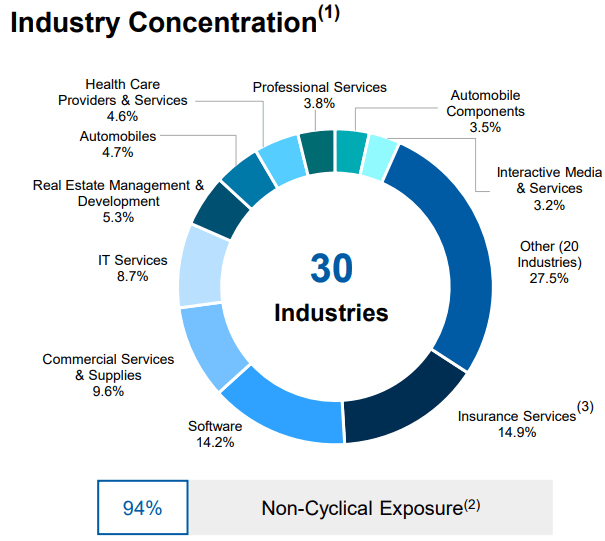
We want minimal exposure to cyclical sectors.
That includes real estate, commodities, oil and gas drilling, and anything else that tends to crash and burn during recessions. I don’t mind exposure to these areas in moderation, but only if the loan economics are stellar.
MSDL has 94% of its industry exposure tied to non-cyclical sectors. Its largest exposures are insurance, software, and commercial services.
The average borrower exposure is 0.60% with the highest at 2.8%. This is in part thanks to MSDL’s already large market capitalization that allows for greater diversification. These metrics are in line with proven heavyweights like Blue Owl (OBDC) and Ares Capital (ARCC).
Source: MDSL Q4 2023 Investor Presentation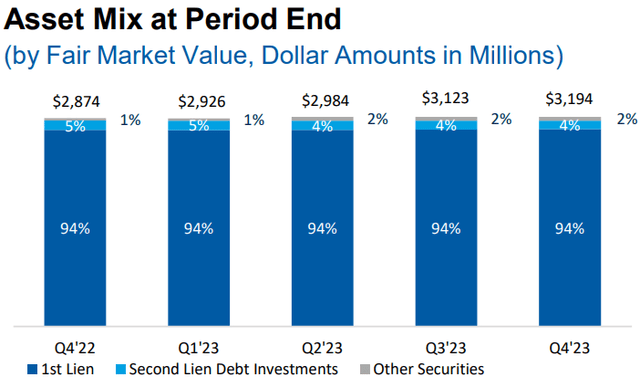
The exposure to safer first lien loans remains at 94-95%, which is what we prefer, all other things equal.
Cash Flow & Dividend
MSDL generated $0.57 per share in net investment income (NII) in Q4 2022. That increased to $0.67 per share in Q4 2023. MSDL easily covered its $0.50 regular quarterly dividend. For long-time BDC investors, you know what’s coming next.
The BDC generated enough extra cash that needed to pay special dividends in all the last three quarters. The $0.27 in recent special distributions is substantial.
Without special dividends, MSDL pays a 9.2% yield. Including them, it rises to 10.5%. In addition, my research indicates there is $0.50 in excess income on MSDL’s balance sheet. In the normal course of business, this will be paid out in the next 4 quarters (or sooner).
Add it all up, and that’s an 11.5% annual yield. It’s also a highly probable one in my view. If management doesn’t elect to pay out the $0.50 as dividends, the BDC must pay taxes on the $42 million. There isn’t any incentive for them to absorb those costs, so I’d expect more special distributions for the foreseeable future.
Credit Rating & Risks
As of the end of 2023, 97.9% of the portfolio was in the top 2 categories, 1.5% was rated 3, and 0.4% fell into the problematic category of 4. That was the first time MSDL had noticeable loan issues, albeit a modest amount.
How do we put the three investments on non-accrual status into context?
One is using the dollar amounts. The three loans are worth $19.3 million against the portfolio value of $3.1 billion. That’s better than peer averages.
MSDL’s leverage ratio was 0.87x at the end of 2023. The BDC industry average is over 1.0x based on my analysis of most companies’ Q4 results, so MSDL is conservatively positioned here too.
In the last conference call, MSDL’s Chief Financial Officer stated that its borrowers have a weighted average loan to value (LTV) of 43%.
MSDL uses lower leverage than its peers’ average, and its portfolio companies appear to be in a similar position. This bodes well for riding out recessions when companies do go under and how much equity you have behind the loan really matters.
MSDL has already earned a BBB-/Baa3 investment grade credit rating. That’s in line with the other top BDCs.
What about the lock-up, won’t that put a lot of pressure on the stock price?
It could and probably will in the short term to some extent. There is a 365-day lock-up for many of the insiders, but I won’t go into detail about that here, as it’s not interesting and not important in my opinion.
I see a lot of people on Seeking Alpha stating that because investors now have liquidity, they will aggressively sell, and the stock will tank.
This doesn’t make any sense, but I empathize with the concern and will touch on it.
First, I’ve tracked the IPOs of numerous companies, including several BDCs. The same pattern occurs over and over again.
If performance is in line with expectations, a modest percentage sell. That could be for reallocation reasons, or it’s a pension-like entity, and they just need to sell to pay expenses.
But if the company is performing well financially, the bulk of investors do not panic sell the instant they have liquidity.
I think this is rooted in the extreme fear of many retail investors of investing in anything illiquid. Ironically, most of these same individuals love investing in real estate and will tell you so.
Real estate is not easy to sell either, and it’s much more costly to do so than any private fund I’ve analyzed (and I’ve analyzed thousands).
Let’s think about the original investors, since they are the ones who have the ability to sell and “crash” the stock. If they were afraid of illiquid investments, why would they invest willingly in the first place? These are sophisticated high-net worth individuals and institutional investors. Most of their assets are in illiquid assets.
If the original investor thought the strategy was attractive enough to risk their money when the company had no track record and no assets, why would they panic sell after it’s performed well for 5 years?
Neither makes any sense. Additionally, if there is selling and the company is doing well (the exception to my thesis), then new investors are happy to step up to the plate. It’s no different than when you and I buy stock when a company becomes unduly cheap.
Existing investors getting liquidity is a factor. But if you are even a medium-term investor (e.g. 2-5 years), I do not think it’s a material risk.
Valuation
Let’s talk net asset value (‘NAV’).
For what I call Tier 1 (highest quality) BDCs, the share price usually represents a 10-25% premium to NAV.
Main Street Capital (MAIN) is an obvious outlier there, but the exception doesn’t make the rule.
This is also very sensitive to market conditions.
As of right now, many BDCs are near 52-week highs and are quite expensive. Yields are still great because higher interest rates have improved cash flows, but valuations are at best “okay” for the better BDCs we are most interested in.
MSDL’s NAV per share has consistently increased (rare among BDCs and unlikely to continue indefinitely besides 1-2% a year) and ended 2023 at $20.57.
The current share price of $21.40 equates to a 4% premium. That’s on the very low end of where MSDL should trade in a non-recessionary environment.
Many of my personal BDC holdings are trading at or above a 20% premium to NAV currently.
Assuming the stock market holds up (BDCs are highly correlated to the stock market in the short term and not at all correlated in the long-term), I believe MSDL could trade at or above $24 in a year or so.
Add in the regular and special dividends, and that ~25% total return is attractive for a conservatively structured and investment grade rated BDC. In my opinion, it is one of the better buys in the BDC sector.
Note: Brad Thomas is a Wall Street writer, which means he’s not always right with his predictions or recommendations. Since that also applies to his grammar, please excuse any typos you may find. Also, this article is free: Written and distributed only to assist in research while providing a forum for second-level thinking.
Credit: Source link